


Comparing the popularity of different words in the latest stories from the the Liberal Democrat, Conservative and Labour Party websites reveals striking differences in the messages being put out by each party online.
Reproduced below are three word clouds, where the bigger a word is the more often it appeared on that party’s latest website stories. The word clouds were generated yesterday (Thursday) based on the then state of each of the three websites.
First, let’s look at the Conservative Party:
 (Click here or on graphic for larger version.)
No doubt about what is central to the Conservative Party’s message – David Cameron. William Hague gets a bit of a look in as does Europe in various forms. The armed forces feature too, but overall the message is pretty much “Vote Cameron”.
Labour by contrast have a very different pattern:
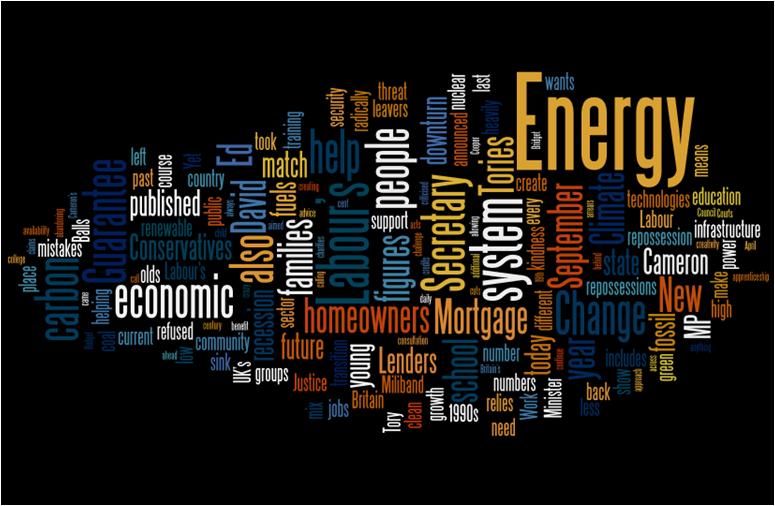 (Click here or on graphic for larger version.)
Whilst you are playing the game of “hunt for the reference to Gordon Brown”, you’ll come across several references to the Conservatives. But references to any Labour figures are distinctly minimal.
As for the Liberal Democrats, it’s a different pattern again:
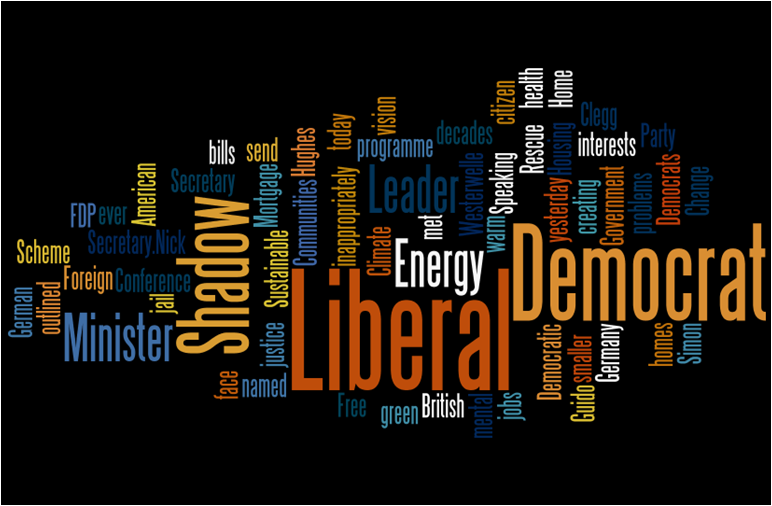 (Click here or on graphic for larger version.)
The emphasis here is much more on the party and the team – hence the popularity of “Shadow” and “Minister” rather than simply Nick Clegg’s name. As with the Conservatives, but unlike Labour, words related to issues don’t feature that prominently.
All three of these are only snapshots of what the respective party websites were pushing as stories at one moment in time. However, in each case the pattern seems to reflect an underlying choice of messages that is also reflected in the wider behaviour of all three parties. In that respect, whatever you think of those choices, all three web teams look on message.
 Follow @libdemvoice.org on Bluesky
 Like us on Facebook
 Subscribe to our feed
 Sign-up for our daily email digest

 Bob Trubshaw revisits the Ironstone quarries of Leicestershire
 Ex-Conservative campaign director sentenced over election bets
 The Burnham government: the shine dims.
 The hopes of the world rest on the shoulders of libtards in the midterm elections in the USA
 Plaid Cymru bottle council tax reform
 Ynys Mon Man
 Tim
Tim Simon Robinson
 Peter Davies
 cim
cim
12 Comments
Fascinating stuff. Has anyone seen the Labour Party’s new X-Factor style homepage? Oh dear!
Very interesting, but shows exactly why the Lib Dems aren’t breaking through into the public consciousness as they should be. Everywhere i look from drugs to economic policy – LDs have better spokespeople with better, more intelligent things to say than the two other parties, but overall – none of this is being punted loudly enough. They don’t look like a viable alternative, because, as the wordle graphic shows, they are far more concerned with being lib dems than shouting about their strong policies. ENERGY/EDUCATION/EVIDENCE BASED POLICY – these are the things I’d like to be shouting out from the page. It might give the public something to think about voting for them for. I looked on the web page to find out who the lib dems stand for – a sound bite to say how their ethos differs from the tories or labour. All there was was waffle about doing it differently. They sound like they’re on the back foot and embarrased about what they are. Shame.
Yes, I agree with OB.
I can see why a comms strategy needs to tie the LibDems’ policies to the LibDems philosophy and people. But giving people reasons to vote for the LibDems means trumpeting the policies in the first place.
That was a weakness of the previous version of the website, and it’s a weakness of this version.
Extremely useful exercise this, Mark, even given the obvious caveats.
This also helps explain why almost no one outside of Westminster knows who Nick Clegg is!
Worrying that we have FDP in our cloud!
How were these generated? Fascinating results and no real surprises. Labour have to highlight positives of their government as well as attack a potential Conservative administration; the Conservatives are running a highly personalised campaign whereas Clegg seems to fail to have name recognition so it has to be the party that is promoted. The interesting aspect is why the websites follow this pattern as this could be the space for a degree of innovation, showcasing the messages that other communication is unable to.
Cheers Mark
Darren
Darren: I used Wordle to generate the graphics, pulling the data off each of the main party websites in turn.
But how can the Liberal Democrat website make references to ‘shadow ministers’ when you don’t have any?
You are not Her Majesty’s Official Opposition, therefore you have ‘spokesmen’ and ‘spokeswomen’ – not ‘shadow ministers’.
You wouldn’t be….misleading people by any chance? Surely not?
Richard H: Would that the Liberal Democrats were more like their German ALDE counterparts, is what I say!
West Midlands Actiis: I wonder how the fact that the official Parliament website lists Liberal Democrat “shadow ministers” fits in your with claims about misleading people? Perhaps you think that Lib Dems have hacked in to Parliament’s website to fake information about non-existent people … or perhaps you’re wrong 🙂
How come ‘lineker’ is one of the biggest words for the Tories? As far as I’m aware, Gary hasn’t joined up – at least not publically – or Wikipedia’s out of date if he has! Surely one mention, attending a launch party for Tickets for the Troops – the only mention I can find on their site – doesn’t make his name this big? If it does, then I question the value of this exercise.
Actually, i’ve just noticed that Johnson Beharry, who also went to the same launch, is also on the Tory word pic – so presumably that one mention WAS enough.
One Trackback
[…] do you least want to be Prime Minister in a year’s time: Gordo or Dave? (43) by Stephen Tall 2. How do the messages on the main political party websites compare? (10) by Mark Pack 3. A Labour gain, but no revival (25) by Iain Roberts 4. Lib Dem Voice publishes […]