


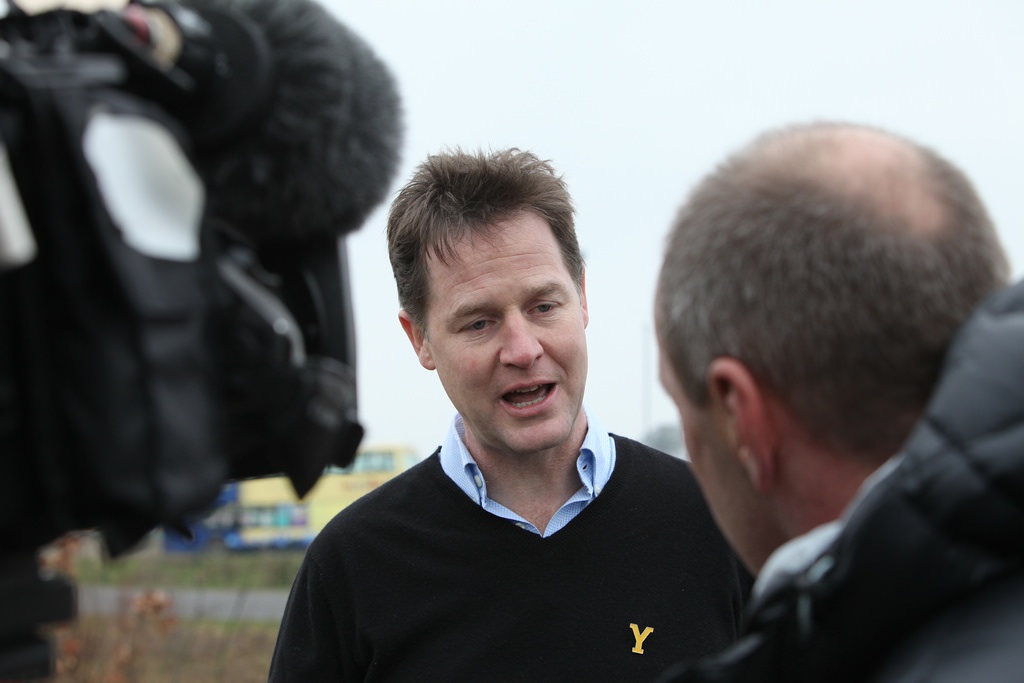
 Nick Clegg takes to the comment pages of the Telegraph today to make the case for Coalition, first taking a swipe at critics on both Left and Right:
For the Left, the very act of coalition is condemned as heinous moral treachery; for the Right, the Lib Dems have far too much clout, thus frustrating the birthright of the Conservative Party to do what it wishes. Unprincipled powerlessness on the one hand, ruthless power-play on the other. Both can’t be right. In my view, both are utterly wrong.
He then make a vigorous defence of the necessity of compromise – ‘Compromise may sometimes be difficult, but in coalition it is a sign of grown-up politics, rather than unforgiveable betrayal’ – before highlighting the ways in which the Coalition has been unafraid to make big decisions, despite the usual accusation that Coalitions are incapable of governing decisively:
Far from now being accused of doing too little, we more often stand accused of doing too much. I am intensely proud of the sheer scale and ambition of what this Coalition has achieved. The biggest transformation of our tax system in a generation – slashing income tax for more than 24 million ordinary people – not only delivering on the Lib Dem signature tune of a £10,000 tax-free allowance, but going further, so that by next April, no one will pay any tax on the first £10,500 they earn. The biggest cash increase in the state pension, following the implementation of the triple-lock guarantee – a promise of decency in retirement made by Lib Dems in opposition and now delivered in government. The biggest expansion of apprenticeships in a generation; ambitious welfare reform to make sure work always pays; the introduction of a Pupil Premium to transform the life chances of the poorest children in our schools; new child-care entitlements to help two-, three-and four-year-olds across the country; the deficit down by a third and falling; radical reform to our broken banking system; the world’s first Green investment bank; and a total overhaul of our energy market. …
no one can say, four years in, that this unprecedented Coalition has not done unprecedented things. That bodes well for future coalition governments, which I believe are an inevitable consequence of the demise of old-style, two-party politics.
You can read Nick Clegg’s article in full here.
* Newshound: bringing you the best Lib Dem commentary in print, on air or online.
 Follow @libdemvoice.org on Bluesky
 Like us on Facebook
 Subscribe to our feed
 Sign-up for our daily email digest

 The Joy of Six 1590
 What is Christian nationalism?
 Latest PollBase is out, with all the British voting intention polls since the 1930s
 cim
cim Roland
 Steve Trevethan
 Suzanne Fletcher
136 Comments
Doing things in power you explicitly said you would not do is perceived as a betrayal. This is why Clegg can’t convince anybody.
@g – The government is there to govern. That takes priority over any and all electoral promises.
Would you prefer a government to fulfil its promises even if it resulted in the UK ended up in a Greek style mess?
@Paul R “Would you prefer a government to fulfil its promises even if it resulted in the UK ended up in a Greek style mess?”
When I voted Lib Dem I did not think that its promises would lead to a Greek style mess; did you?
I agree with his sentiment.
But…
There’s a danger that this argument brings up the worst in Clegg- when he comes across a touch condescending. I’m a grown up and if you disagree with me you’re childish. It’s like (along the lines of) “there’s a thing called the Lisbon Treaty” from the debates. No one likes to be talked down to and sometimes I think Clegg gets too close to doing that.
In short: despite being in a hole, Clegg is still digging. The phrase ‘grown up’ is a particularly interesting choice, since it is overwhelmingly used by adults to children (‘hold a grown-up’s hand while crossing the road’), by children about adults (‘like grown-ups do’) or by adults self-consciously playing at childish things. Into which category is Clegg’s usage intended to fit, I wonder?
Incidentally, the associated comment thread seems to be largely filled with UKIP voters.
Nick Clegg is in denial about just how much havoc he has wreaked on politics in this country. He is the epitome of why voters are right to distrust politicians.
Clegg has forgotten the bad things he has done in government with Tories, sadly those will be things he is remembered for by the public.
Is there no end to this man’s patronising attitude? It speaks to something I’ve always found distasteful about some Lib Dems – The attitude that they’ve transcended a tired old form of politics and exist on a higher plane than the other parties. This myth is easily dispelled with one look at the propaganda sheets they thrust through letterboxes, replete with dodgy bar charts, false claims and manipulated statistics, but all for the Greater Good for the Clegg Party.
I visited the UKIP website but could not enter unless I became a member – which I didn’t do of course; their site seems to be like our members’ forum in that respect. I like to read what their members, and members of other parties, say here on our OPEN website. But we have to remember that anyone commenting on LDVoice is doing so as potential troll, our disaffected members included. I’m still disaffected on some issues as Nick Clegg knows well, but we are still the best party to deliver liberal policies and can only deliver them in government. I accept the compromise we have had to make. We should make sure we vote LD on Thursday if we want LD action as well as LD comment.
@Paul R
If you cannot deliver a promise, the simple solution is to not make it in the first place.
And in a democracy, electoral promises are important. If you are not prepared to take the electorate seriously, then perhaps you should not get involved in politics
I want to agree with this piece by the DPM, but I am concerned that he (once again) is risking people developing the understanding that he believes that this specific coalition is the best of all possible outcomes – which it is hard to persuade oneself of, even if we support it (which I broadly do, allowing for occasional attacks of rage, dismay or frustration).
I think we can say coalition in theory allows for a ‘grown-up politics’ to emerge under the right circumstances; to say it always does, or that this coalition has always demonstrated this, is not really true, even arguably so, and I would hope Nick Clegg would admit this, even if he won’t say it in public.
OK, so the LibDems should have blocked anything that was not explicitly LibDem policy? That seems to be what most people are saying here.
Equally, the Conservatives should block anything that was not explicitly Conservative policy. And Labour should block anything that was not explicitly Labour policy.
Then what?
I’ve been asking this question for four years from the sort of people criticising Clegg here, and I STILL have not had a straight answer. I myself think Clegg has phrased this all wrong, his over-optimistic exaggeration of the contribution of the LibDems to the coalition put me off hugely, to the point that I’ve dropped out of active support for the Liberal Democrats as I don’t want to be associated with it. Yet I have not had a straight answer from ANYONE as to what they think the alternative should be. They still seem to be pushing this line that somehow the Liberal Democrats could have magicked up a government with 100% Liberal Democrat policy out of the Parliament elected in May 2010, so they (all of the party, every single of one of us) are bad people because we did not cause that to happen. I just find this such an incredibly juvenile attitude.
To me, the alternative to the idea that we have to have a compromise government which is somewhere between the ideals of the component parties is that we have a government of just one party, and a system which ensures that always happens. I.e. twist the distortion the electoral system already gives us a bit more, so whichever party has the most votes has over 50% of the MPs and so can govern alone.
g, Phyllis, Peter Watson, Robin Wilde, Voter – is this what you want? Then you can say, the government in power is what people voted for as you seem to be saying that as people vote for a candidate of one party that only a government of one party is valid. As that government has no-one to block it, it can “keep its promises” as you put it. If that’s what you want, ok, be honest and say it. Because to me if you think compromise is all wrong, that’s what you want instead. So, please then go further and take that to its logical conclusion – you are saying what we should have now is a pure Tory government.
so the LibDems should have blocked anything that was not explicitly LibDem policy? That seems to be what most people are saying here.
Actually I think what people are saying is, to quote above, ‘If you cannot deliver a promise, the simple solution is to not make it in the first place.’
Do not make promises you don’t intend to keep. If you don’t intend to do a thing, don’t say that you will do that thing.
It really is that simple. And that ‘grown up’: part of growing up is learning not to make commitments you can’t deliver on (and appartently it is a part Liberal Democrats have not mastered).
Matt (Bristol)
I want to agree with this piece by the DPM, but I am concerned that he (once again) is risking people developing the understanding that he believes that this specific coalition is the best of all possible outcomes
Thanks, yes, well put, what I’m trying to say but much shorter.
Clegg keeps on and on using language which gives the impression he believes the current government is the best possible government there could be, rather than one which being five-sixths Tory is inevitably far more Tory in policy than LibDem. His over-optimism and exaggeration means he hasn’t got across the message that if there were more LibDem MPs it would be doing different things. He is giving the impression that Liberal Democrats believe in and support ALL the current government policies rather than just accept them as a compromise that has to be made because of the realities of the Parliament the people chose to elect.
The boasting about the income tax allowance is an example. It’s a compromise – the Tories left to their own would rather have cut taxes on non-earned wealth, and it’s better than that. However, it is NOT the full Liberal Democrat policy as set out in the manifesto, because that made clear that the increases in tax allowance would be balanced by MORE taxes on other things, not by government cuts in spending. We couldn’t get that because the Tories would NEVER support it, it goes against their core beliefs. Why can’t we have a leader who makes this clear? Or at least a democratic party mechanism so if the DPM can’t say it, someone else with authority in the party but outside government can? Er, don’t we have a “President” who is supposed to have that role? So why isn’t he doing it?
@Matthew Huntbach
I think that if you want to get votes with a tuition fees pledge like the one that was made, then you should be prepared to follow through and make it a red line in negotiations. This might lead to another election.
I see nothing wrong in having two lists, one of absolute requirements and one of things which the Lib Dems would argue for but might not achieve (like Trident). Of course, this would take careful consideration.
@Matthew Huntbach
Whatever one’s views on the coalition — I won’t rehearse mine again here; we already know that we disagree — publishing articles categorising everybody who is upset with one’s party (which appears to be the majority of Lib Dem voters) as children, juvenile or ridiculous most certainly falls into the ‘when in a hole, stop digging’ category.
The gentleman doth protest too much, methinks.
Tim
Actually I think what people are saying is, to quote above, ‘If you cannot deliver a promise, the simple solution is to not make it in the first place.’
So why not have a go at Labour because they have not delivered all the “promises” that were in their manifesto?
Sure, I accept that Clegg going on and on and on about being “in government” makes this a harder line to push, but the Liberal Democrats are NOT “in government” in the conventional sense of that phrase meaning “the sole party that forms the government”.
My questions have not been answered. In four years of my asking them, they have not been answered. In four years of pushing this, all I’ve had back is this juvenile “nah nah nah nah nah, you put the Tories in” attacks which just don’t say anything about how the situation could otherwise be reasonably handled, or refuse to admit the logic of the line which I’ve pointed out above – if the only government you can accept is one of a single party which rigidly pushes its manifesto as a five-year plan, then that government presumably should be of whatever party is the biggest, and that party currently is the Tories. I.e. so far as I am concerned, g, Phyllis, Peter Watson, Robin Wilde, Voter are in effect arguing that what we should have now is a pure Tory government. I cannot interpret their line to its conclusion in any other way however much they refuse to think it through and admit that’s where they are leading to.
So why not have a go at Labour because they have not delivered all the “promises” that were in their manifesto?
It’s not about a manifesto promise, it’s about a specific pledge:
http://www.newstatesman.com/blogs/the-staggers/2010/09/tuition-fees-clegg-vote-mps
That reads: ‘I pledge to vote against any increase in fees in the next parliament and the pressure the government to introduce a fairer alternative.’
That is a specific pledge on how to vote on a specific issue, whether in government or in opposition. It has nothing to do with manifesto plans, which of course can only be implemented if you are actually in power.
And the important thing is that we now know that as that photograph was being taken, Clegg did not intend to honour that pledge, if the Liberal Democrats became part of a coalition government.
In other words, in order to get votes he told the electorate a bare-faced lie.
All that happened after the election was that he got caught out: if the election had returned a majority government (of either party), then the Lib Dems could have held to their pledge, voted against the fees rise, and nobody would have know it was a lie.
But it would still have been a lie and now everybody knows that Nick Clegg tells lies to get votes.
A great many Liberal Democrat MPs voted against tuition fees and honoured their pledges. The remainder could have done the same if they’d wanted to.
daft ha’p’orth
Whatever one’s views on the coalition — I won’t rehearse mine again here; we already know that we disagree — publishing articles categorising everybody who is upset with one’s party (which appears to be the majority of Lib Dem voters) as children, juvenile or ridiculous most certainly falls into the ‘when in a hole, stop digging’ category.
But that’s CLEARLY not what I’m doing. In my message dated 2.04pm I am stating that I am upset with the Liberal Democrat leadership. So does that mean I’m accusing myself of being childish, juvenile or ridiculous? I am probably the member of the Liberal Democrats who is MORE critical of the party than any other in postings to Liberal Democrat Voice.
I am not categorising anyone who is upset with the Liberal Democrats over any issue as childish, juvenile or ridiculous. I am saying that the argument that the Liberal Democrats “broke their promises” because they were not able to manufacture a government which is 100% Liberal Democrat in policy from the May 2010 Parliament is childish, juvenile and ridiculous. I very much regret that because that seems to be just about the ONLY line that comes from anyone who is not a Clegg supporter or a Tory, there has been no serious discussion on coalition governments in the 4 years we have had one. I’m happy to agree that the Cleggite “it’s all wonderful” line about the coalition is also childish, juvenile and ridiculous, if that helps clarify my position.
Matthew
You keep on saying that your “questions haven’t been answered”. But they have, repeatedly. (Just for example, here.) The fact that there are indeed people who keep responding with “nah nah nah nah nah, you put the Tories in” is no excuse for claiming that that is “all you’ve had back” in the last four years.
Tim
That is a specific pledge on how to vote on a specific issue, whether in government or in opposition. It has nothing to do with manifesto plans, which of course can only be implemented if you are actually in power.
I’m not defending Clegg on that pledge. I’m not saying he was right to make it. I never have said that. Why can’t you and others get it out of your head that just because I find the “nah nah nah nah nah, LibDems put in the Tories, belly, poo, bum” line that the Labour Party seems to think is all that needs to be said about the coalition to be childish, juvenile and ridiculous, does not mean I am in 100% agreement with everything Nick Clegg has said and done? Why is it that even though I write loads and loads of stuff deeply critical of Clegg’s leadership, as soon as I refuse to join in with the “nah nah nah nah nah, LibDems put in the Tories, belly, poo, bum” line, I’m attacked as if I am someone who believes Clegg can never do wrong and has never done wrong? Given that I’m so disgusted with Clegg’s incompetent leadership that this is the first election in 30 years where I am not actively involved in campaigning for the liberal Democrats or their predecessors, it is a mark of the childish, juvenile and ridiculous nature of the attacks being made on me that they seem unable to get this point. That is why in four years this debate has just not moved on.
I very much support the policy of full state subsidy for university tuition and I agree it should have been in the Liberal Democrat manifesto, along with the taxes needed to pay for it. However, I also agree that making the “pledge” you write about was very much the wrong thing to do, unless there was an absolute commitment to treating it as a red line issue. That does not, however, change my argument. People here are not attacking the Liberal Democrats on that one issue alone, they are attacking the Liberal Democrats on every issue where there has had to be a compromise between the Liberal Democrat ideal and what a government which is five-sixths Tory is willing to deliver.
@Matthew Huntbach
‘ In four years of pushing this, all I’ve had back is this juvenile “nah nah nah nah nah, you put the Tories in” attacks’
I am upset with the Liberal Democrats because they broke a very specific promise, a pledge to do one thing. Not to create a 100% Lib Dem government, not to fulfil their manifesto (I don’t recall exactly what was on the manifesto but I do recall there were some points on there with which I didn’t even agree anyway), just to do one specific thing. Which was voting against increase in tuition fees. Which they can perfectly well do in opposition, or in Coalition, or in any other circumstance imaginable, because the pledge does not even require the MP to successfully deliver that policy: just to take that action. Feel free to call me childish, juvenile and ridiculous but despite having heard the arguments rehashed for years now I still cannot understand for the life of me why it is preferable to alienate your voting base than to say to your coalition partner, ‘Sorry, Dave, but our word means something to us, so let’s just kick it into the long grass, where it can sit and gently rust right alongside Trident. Or alternatively, you hash out something with Labour on that issue and then we will have been seen to keep our word while you get your way, or some approximation of it.’
I suppose it would be childish, juvenile and ridiculous to complain that the LDs could not create a 100% LD government in May 2010, and if I ever hear anybody complaining about it perhaps I will think that they are childish, juvenile and ridiculous too. However, I’ve never heard anybody make that complaint – but I have heard a lot of people, including g, Phyllis etc, complain about that specific broken pledge.
“People here are not attacking the Liberal Democrats on that one issue alone, they are attacking the Liberal Democrats on every issue where there has had to be a compromise between the Liberal Democrat ideal and what a government which is five-sixths Tory is willing to deliver.”
Sure, there’s anger about other stuff, but it’s the tuition fees issue that, as others have put it, Ratnered the brand.
Tim “And the important thing is that we now know that as that photograph was being taken, Clegg did not intend to honour that pledge, if the Liberal Democrats became part of a coalition government.
In other words, in order to get votes he told the electorate a bare-faced lie.”
Yes that is EXACTLY the point ! In voting for political parties we look at the values they espouse. Nick Clegg made a big thing of the Pledge AND ALSO of the ‘No More Broken Promises’ line. We voted for the Lib Dems because of that. But even as they were making the Pledge, the Lib Dem leadership had decided to break it.
“People here are not attacking the Liberal Democrats on that one issue alone, they are attacking the Liberal Democrats on every issue where there has had to be a compromise between the Liberal Democrat ideal and what a government which is five-sixths Tory is willing to deliver.”
Well, I have never attacked the Lib Dems ‘on every issue’ . I have specifically explained why voters like myself and my family were betrayed by the Lib Dem leadership. How can you possibly defend someone making a promise and standing on a ‘No moreBroken Promises ‘ platform when we now know they had already decided to break that promise BEFORE the election? I am genuinely perplexed how anyone with integrity can defend such actions, I really am.
My criticism of the Lib Dems is not that they compromise. My criticism is that they broke a specific pledge and that they also came up with a simplistic report on council waste. Both of these things affect their credibility and it is hard to imagine my voting for them until they rebuild that credibility. The Tories are not stopping them doing that rebuilding.
I also thought that the coalition agreement would place limits on government but the Lib Dems have done bad things which were not in the coalition agreement.
I like evidence-based policy and it would be nice if the Lib Dems were to say things like “our ideal approach would be this but the Conservatives would only allow that”.
In addition, it is less than a year to the next general election but the Lib Dems have yet to establish any red lines for any future negotiation.
I see all of the above as reasonable comment
I think the tuition fees débacle was less about the merits of the policies themselves (though certainly the fee rise was very unpopular among those affected by it) than its crystallisation of doubts about the Lib Dems and especially Clegg himself — the notion that they had slid too easily and happily into the arms of the Tories, and that Clegg was a smiling, unctuous, slippery operator, quite capable of doing or saying anything to retain the perquisites of power.
Now, personally, I think that is a little unfair. I think Clegg and his allies felt, at the time, that not only were they not being dishonest, but that they were actually being politically brave, heroic even, taking one for the team (the Cameron-Clegg team, that is, not the Lib Dem team) in order to achieve a greater good, idealistically sacrificing their left-wing student supporters in order to achieve other manifesto goals that would be more significant in the long term — say, the Alternative Vote, or maybe Lords Reform. If they gave on this one, tiny, insignificant item, then surely the Tories would pat them on the back and help them out on other issues. Tit for tat. And then, no doubt, the voters would reward the Lib Dems for having been the adults in the conversation, the voice of reason in the room, the centrists who stood up to extremists on both sides, the defenders of common sense.
Now, time has shown that every aspect of that calculation was wrong, wrong, disastrously wrong. The Lib Dems did not get any political biscuits as reward for abandoning the pledge. They were not able to advance further on other manifesto items, but were in fact blocked by the Tories at every turn, even as (with rare exceptions) they continued to enable Tory policies. And, of course, far from being rewarded by the voters for their common sense, the voters perceived this common sense as self-serving expediency, and kicked Lib Dems off councils up and down the country.
The questions that need to be addressed are, therefore: Why was this political calculation so wrong? Why did Nick Clegg get so little in return for a sacrifice that turned out to be an unacceptably large one? And should not those in the Lib Dem leadership be held responsible for this, as it now appears, fatal error?
And, you know, I don’t think people would be half so upset with Clegg if the promise had been made in good faith, and then had to be traded away as part of the coalition negotiations.
It’s the fact that we now know that Clegg knew it was unaffordable; that he tried to get the party to drop it (this is the really damning thing in my opinion, the fact he tried to get the party to drop it means he has no excuse); and then he went out and stood behind it anyway.
All while shouting, ‘No more broken promises.’
David-1 – I think that’s interesting. As I think I have said before, what matters about a policy is sometimes not what the policy says, but where the public perception imagines you are travelling in future as a result of the policy. The leadership seem to have imagined they were taking the country into the centre-ground and no further. The country (abetted by the media and the conservatives for all kins of reasons), having imagined that the lib-dems had the potential to take the nation ‘left’ (in crude terms) imagined the direciton of travel was now to be further to the ‘right’, and felt cheated. In this specific regard of the imaginary consequences of a policy, no promises can ever be made or given, but it is as damaging, if not more so…
The fact that the leadership allowed their own manifesto commitment and the NUS pledge to be confused, is also not a good bit of work, but it is a long time ago now. The issue is now how to be at once more nuanced in the party’s communication, and yet clear enough to be understood, now the public has turned their attention span elsewhere having re-defined for itself what the party stands for (and it’s not generally good).
I think the tuition fees débacle was less about the merits of the policies themselves (though certainly the fee rise was very unpopular among those affected by it) than its crystallisation of doubts about the Lib Dems and especially Clegg himself — the notion that they had slid too easily and happily into the arms of the Tories, and that Clegg was a smiling, unctuous, slippery operator, quite capable of doing or saying anything to retain the perquisites of power
More to the point, the whole of Cleggmania was built on the idea that he was a whole new breed of politician: open, honest, idealistic, not calculating and cynical like the others but a kind of political paladin, untainted by dirty tricks and factionalism and the politics of the past.
And then suddenly almost straight away, he was exposed as having been exactly like the others all along: even while he was presenting himself as whiter-than-white, he was doing exactly the thing he was calling out his opponents for doing, making promises with his fingers crossed behind his back.
It wasn’t the policy, no. It was the sudden crashing down to Earth as the supposed white knight riding to clear out Westminster and bring a whole new era of reformed politics turned out to be just as much of a shady operator as the rest of them, indeed, possibly worse than the rest because everybody knew they said things they don’t mean but Clegg was supposed to be different, he was supposed to be pure, he was supposed to be above all that.
When the others lied, it was expected: ‘politicians do that.’ When Clegg was exposed as having lied, it was a direct slap in the face to everyone who bought into the image he worked so hard to present of ‘a new kind of politics’.
So actually I don’t think it would have made any difference if Clegg had got any concessions from the Tories in return, because nobody would remember them: all they will remember is that the man who stood up and said, ‘I’m not like the rest of them’ turned out to be exactly like the rest of them.
@Tim — You’re probably right, it wouldn’t have made much difference to the voting public at large, but it might have made Clegg’s position within the Party more tenable than I think it currently is — he could have said, “Yes, we did this one regrettable thing, but look at all the other things we achieved.” As it is, the best he can say is “We helped make the Tories somewhat less awful than they might have been.” This is not the most thrilling of rallying cries.
I expect that Clegg will pay the price for his mistakes in due time. I just have no idea precisely when time is due.
I agree absolutely with all the above recent comments – it’s very easy for some people to say ‘ ah well we’re paying the price if being in coalition’ . It’s NOT that at all for most of us. I don’t think I can put it better than the comment
” When the others lied, it was expected: ‘politicians do that.’ When Clegg was exposed as having lied, it was a direct slap in the face to everyone who bought into the image he worked so hard to present of ‘a new kind of politics’.
I and all my extended family and friends would have forgiven the tuition fee debacle if Nick Clegg had stopped the NHS reforms. THAT was precisely what they were in government for, in their own words. To stop the Tories doing awful things. However Clegg signed off the White Paper without even having read it . I mean seriously LibDems, is this man the best of the talent in the Party? Should we not expect more from leaders?
“When the others lied, it was expected: ‘politicians do that.’ When Clegg was exposed as having lied, it was a direct slap in the face to everyone who bought into the image he worked so hard to present of ‘a new kind of politics’.”
AND having done that, he then goes on to tell us we don’t understand ‘grown-up’ politics !!! Great way to win hearts and minds, Nick Clegg !
So Matthew Huntbach, does that make things clear?
I think the reason you think you haven’t ‘had a straight answer’ is that you think the question is, ‘What should Clegg have done in the wake of the 2010 general election result?’
But that’s not the question people are asking. The question they are asking is, ‘Can Clegg be trusted?’ and the answer, based on what we now know about his behaviour prior to the election, is, ‘No.’
When Clegg says “Coalition is grown-up politics” , I suspect he is talking about the view held by Labour and this sentence may have some validity as criticism of Labour. I have not followed what Labour has said too closely.
It remains the case that the article offers no defence of his supporting one policy on tuition fees in public and another in private.
I can definitely say that having the LibDems in coalition has been a real eye opener for me. I used to regard the party as being safe, sensible and reliable. Now the party is in coalition, its views on a whole range of subjects are clear for all to see. What a shock. The LibDem views seem to be the exact opposite of those held by the majority of the public on a whole range of issues including the EU, immigration and knife crime, to name just those that came up this week..
I suspect that the end is near…
@ Matthew Huntbach I think you often express this as a black and white issue, but I don’t think it is. I am sure there are many people who don’t believe we could have enacted all our policies in a coalition government who are very unhappy with the failure of the leadership to use the Liberal Democrat veto. Nick used it on mandatory sentencing for those who carry a knife for the second time, but not against secret courts, the bedroom tax, or top down NHS reform to name just three.
The Liberal Democrat veto works because the programme of the government has to be agreed by both parties the number of MPs each has is irrelevant. The same is true for what made it into the Coalition Agreement.
I think Phyllis position is also not as black and white as it sometimes appears.
@ Matthew Huntbach – “However, I also agree that making the “pledge” you write about was very much the wrong thing to do, unless there was an absolute commitment to treating it as a red line issue. That does not, however, change my argument. People here are not attacking the Liberal Democrats on that one issue alone, they are attacking the Liberal Democrats on every issue where there has had to be a compromise between the Liberal Democrat ideal and what a government which is five-sixths Tory is willing to deliver.”
I understand why you are often attacked on your position on tuition fees and to me it seems that you are saying that the pledge shouldn’t have been made and not the pledge could easily have been met under two circumstances – one we were the majority government, or we were not in government at all. However it is the third circumstance that your position often seems less clear – once our MPs had made the pledge the Coalition agreement should have included a clause whereby all our MPs would vote against all increases to tuition fees. If this is your position you should make it clear.
Matthew you also say that because we only have about one sixth of the MPs is government that the government’s policies should be only one sixth Liberal Democrat and I reject this view completely because without Liberal Democrat support no Conservative party policy could be enacted. It would only be true if a coalition was formed where the largest party already had a majority and the coalition was formed for other reasons than obtaining a majority (National Government and Coalition Government of the Second World War come to mind).
Having read the Telegraph article again, it does seem that Clegg is blurring the distinction between individual decisions and the fact that compromise is required.
“It is ridiculous for either side to criticise the compromises that this Coalition has struck in the national interest. Compromise may sometimes be difficult, but in coalition it is a sign of grown-up politics, rather than unforgiveable betrayal.”
Just because compromise may be necessary, this does not render every criticism of a particular decision ridiculous. Each decision should be judged on its merits.
I would also note that the article is rather too celebratory given the NHS reforms. Cheering just because the government is not a pantomime-horse seems to be setting the bar quite low
Amalric and Tim, thank you for your efforts to shine a light on this. I suspect I know what Matthew’s response will be – a repeat of his previous long posts about Tories holding another election and gaining a majority etc. if the Lib Dems hadn’t capitulated. However I live in hope that having expressed yourselves so clearly Matthew will surprise us all by actually addressing what you are saying rather than what he thinks you are saying.
Sorry typo – first line last paragraph – “about one sixth of the MPs is government” should have been “about one sixth of the MPs IN government”.
@ Peter,
I have ben a critic of the Liberal Democrat leadership on several matters but I don’t think that the end is nigh for the party.
Even if as you say, the party holds views that are the opposite of a majority of the public, does not mean that the views are wrong and that they should not try to use the powers of persuasion to argue for them. I think that is a rather honourable position to take.
@Phyllis
I would be less critical of the Lib Dems if they had stayed true to their principles and not allowed the tuition fee increase, even if a second election had been the result. As the 2010 election broadcast noted, there have been too many broken promises
‘@ Jayne
“Even if as you say, the party holds views that are the opposite of a majority of the public, does not mean that the views are wrong”
Your views on immigration are wrong. You want everyone who wants to come and live here to do so with no let and hindrance.
Your immigration policy is “welcome to Britain everyone, make yourself at home.”
I wonder if you would behave in the same way if it was YOUR personal home you were encouraging the world to come and live in rather than our nation?
We all know the answer to that.
.”
@ simon,
You do know know my views on immigration.
Peter referred to a whole range of views including knife crime.
I am interested in policies that are likely to prove effective and work for the benefit of the nation not scaremongering.
@Jayne: No, the end (of the Liberal Democrats) is not nigh, but we are in a trough — with a lower popularity than we’ve enjoyed for decades, and possibly a worse reputation than ever before — and this seems unlikely to change until the coalition ceases and Nick Clegg and some other figures (Alexander, Laws, perhaps others) are out of the leadership — indeed, until the membership takes back the lead in the party and it no longer matters quite so much what the leadership is.
There’s no evidence that the leadership are causing the low polling figures. Maybe the membership are the problem, not focussing on the actual issues at conferences, not coming across as relevant. Or activists may be the issue, pushing their own policies or own versions rather than what the press get from the leadership. Electorates don’t always vote for inconsistent parties in internal turmoil. Or maybe it’s just the normal fate of minority parties in coalition – has anyone done a historical analysis of other coalitions?
Malcolm Todd
Matthew
You keep on saying that your “questions haven’t been answered”. But they have, repeatedly. (Just for example, here.
No, that doesn’t answer my question at all. My question was “What do people who say the current government is undemocratic think WOULD be the democratic government that should have been formed from the May 2010 Parliament?”. You are writing there just about tuition fees.
daft ha’p’orth
I am upset with the Liberal Democrats because they broke a very specific promise, a pledge to do one thing. Not to create a 100% Lib Dem government, not to fulfil their manifesto (I don’t recall exactly what was on the manifesto but I do recall there were some points on there with which I didn’t even agree anyway), just to do one specific thing.
That doesn’t address the point I was making. Rather it illustrates the point I was making. You seem to be assuming that there are only two positions, one of which is “nah nah nah nah nah, nasty dirty rotten LibDems, you put in the Tories in” and the other is “Clegg is a decent human being who has done a wonderful job of leading the Liberal Democrats and never put a foot out of line. So, since I don’t hold to the first position, you jump to the conclusion I hold to the second, and therefore attack me as if I am defending every aspect of what Clegg did in the 2010 general election and every aspect of how he handled the situation after.
It is impossible to have a sensible argument about these things when that argument constantly hits this brick wall as you and Malcolm Todd have so demonstrated. You are just assuming that the Liberal Democrats are a Leninist party, so every member is an uncritical supporter of The Leader, and so that there is no difference between attacking The Leader and attacking all members of the party, because they a,mount to the same thing.
“ComRes have released what they say is their final poll before the European elections on Thursday. Topline figures are CON 20%, LAB 27%, LDEM 7%, UKIP 33%, GRN 6%.”
It certainly doesn’t look any better. If this poll is correct it would be disaster for the LibDems and their grown-up politics! I have a feeling Paddy Ashdown and his knife will be busy this weekend.
Phyllis
Well, I have never attacked the Lib Dems ‘on every issue’ . I have specifically explained why voters like myself and my family were betrayed by the Lib Dem leadership. How can you possibly defend someone making a promise and standing on a ‘No moreBroken Promises ‘ platform
But I’m not doing that. Here you go, once again, assuming this Leninist model of political party, so that anyone defending any aspect of it, you suppose, must be an uncritical supporter of The Leader and all he has ever done and said, therefore if you attack The Leader for what he did on that issue, you are attacking me, because there is no difference between the two.
Phyllis
I mean seriously LibDems, is this man the best of the talent in the Party?
No. And I’ve said that again and again and again and again and again and again and again and again.
Yet STILL you and all these others are arguing with me as if I am an uncritical supporter of Clegg and all he has ever done. You do that instead of answering the actual questions I posed, instead of engaging in the serious debate about the real dilemma of how to get a government from a Parliament in which there is a range of conflicting opinions. THAT is why I accuse the LOT of you of being childish, juvenile and ridiculous, because NONE of you have had the maturity to be able to see what I am ACTUALLY saying and engage with the points I am ACTUALLY making.
My question was “What do people who say the current government is undemocratic think WOULD be the democratic government that should have been formed from the May 2010 Parliament?”.
But that is the wrong question.
The correct question is, ‘How can democracy function if politicians knowingly lie to the electorate about what their intentions are?’
And the answer is, it can’t.
A manifesto commitment is one thing: it implicitly is a statement about what the party will do if it gets into power. So of course a party which doesn’t get into power can’t be blamed for not delivering its manifesto commitments; how could it?
But the tuition fees pledge was not dependant on getting into power; indeed its wording (‘…and to encourage the government to…’) rather implies that those parading it around expected to be in opposition (if they were the government why would they need to ‘encourage’ themselves to do anything?).
Therefore the fact that pledge was made by senior figures in the party who at the time they were making it had no intention of keeping it, and who at the same time were trying to present themselves as different, more honest, pure and unsullied by the cynical politics of power (‘too many broken promises’ etc) shows utter contempt for the electorate, does it not?
Are you a professional politician, Matthew Huntbach? If not, I think you should become one. Your ability to completely disregard the actual question being asked, substitute the question you wish had been asked instead, and then complain that nobody has answered the question that nobody but you is asking, is masterful.
Pots and kettles, Matthew.
What a lot of people (including myself) are saying above is that there is a huge problem for the Lib Dems in that they are not trusted — even less than politicians generally are — to keep their word. The tuition fees issue was totemic, which is why we keep coming back to it. Saying it’s “just about tuition fees” is rather obviously missing the point. You change the subject to suggest that anyone who brings this up is somehow arguing that there was a realistic alternative to a Tory or Tory/Lib Dem government in 2010 or that the Lib Dems should have got their whole manifesto into effect and accepted no Tory policies that they didn’t agree with. But I don’t see anyone here saying that. Indeed, I’ve said on here before that I believe that a coalition with the Tories was the only realistic option in 2010, if a deal could possibly be made. But simply on principle — a vitally important principle of keeping explicit promises made by MPs when they were seeking election — no deal should have been made that required the party’s MPs to break their word to their electors. That is not a minor issue. And I speak as someone who was not especially convinced of the party’s policy on tuition fees in 2010, by the way.
@Matthew Huntbach
“I very much regret that because that seems to be just about the ONLY line that comes from anyone who is not a Clegg supporter or a Tory”
Then you need to go back and read what I have said in this thread since what I wrote does not match your assessment.
To repeat, I am critical of Clegg on the tuition fee business, since he did not make it a red line.
If you repeat what you have said above, you will simply be setting up a straw man. Why not critique what I actually write rather than a straw man?
Amalric
Matthew you also say that because we only have about one sixth of the MPs is government that the government’s policies should be only one sixth Liberal Democrat and I reject this view completely because without Liberal Democrat support no Conservative party policy could be enacted
No, I am NOT saying that “should” be the case. For a start, I believe we should have proportional representation, which would have led to a coalition which was two-fifths LibDem to three-fifths Conservative, so a very different balance, and also would have given the LibDems a much stronger hand in negotiation, as a Labour-LibDem coalition would have been viable as it wasn’t owing to the distortions of first-past-the-post.
What I AM saying is that your line here is in effect saying that on every issue where there is a difference between the Liberal Democrats and the Conservatives, the Conservatives can be expected just to drop their policies and adopt Liberal Democrat ones. Because that is actually what you mean when you say in effect “Because the LibDems hold the balance of power, they can get anything they want”.
The reality is that ANY bunch of 57 or so MPs in the coalition can play the same game. By exactly the same argument you use, the 57 most right-wing Tory MPs could say “without our support, no government policy can be enacted, so the government must give in to us”.
If you look in Conservative-oriented discussion groups, you find this sort of line being pushed. While here in Liberal Democrat Voice, we get all these people expressing the view that the Liberal Democrats have just rolled over and given in to the Tories, in Tory discussion groups the line usually expressed is that the Liberal Democrats are over-dominant in the Coalition, and that the Tories have rolled over and given in to them on far too much.
If there’s a point I’m really making here, it is that if people think the Liberal Democrats should have more power in the coalition, they ought to support proportional representation which would have given it to them. Yet many people take the opposite line, arguing that from what they have seen of the coalition they like the idea of a distortional representation system, which twists representation of the biggest party upwards and third parties downwards. That was the position of MOST Labour Party people who were actively involved in the 2011 referendum campaigning. So, if that’s what people think, if they think only a single party government is legitimate because a coalition must by definition involve “broken promises”, so a distortion to get that single party government is good, let’s have some honesty on what that means. It means you are arguing that the government we should have in place now should be a pure Tory one. THIS is the point I’ve been making that has had no answer. Replying to that by going on about tuition fees is simply running away from the question I’ve been putting because, I suspect, you lot all know you have no answer to it, or you can see the logic of what I m saying and don’t have the guts to follow it through and accept it’s where your “nah nah nah nah nah, nasty rotten LibDems, put the Tories in ” line leads to.
@Matthew Huntbach
Sorry, perhaps I have not been sufficiently clear. You may believe that it comes down to a dichotomy between a) ‘nasty rotten etc put the Tories in’ and b) ‘Clegg is awesome’. That would be your choice. It’s a free universe and there are an infinity of philosophies, some admittedly more useful than others. Personally, I do not give a monkey’s that the Lib Dems ‘put the Tories in’; between Labour and the Tories there is but a fag paper’s width anyway since they hold very similar views on many of the issues that are most dear to me, which is why I have never been tempted to vote either. A plague, as Phyllis said elsewhere, on both their houses. I hope that answers the question of whether or not I hold position (a). It should be clear that I do not hold position (b), so logically we are forced (I hope) to finally come to the conclusion that I hold position (c).
You keep telling me what I apparently think you think. I don’t jump to any conclusions about what views you hold, since a) I already know roughly what you think since you have told me many times and b) if you will read what I have written, I am only telling you what I think. I would not presume to tell you what you think.
What should I call it when one day my MP vows that he holds Belief X with all his heart and the next day he says that he holds the opposing Belief Y, has always held Belief Y and that on reflection every reasoning person should hold Belief Y, for it is innately superior? I can’t tell you whether that’s Leninism or not, but I certainly can tell you that it is unappealing.
Essentially the thing that bothers me, and you can define this as Position C if you like: I have been lied to by someone I trusted. I am incensed. Hopefully that’s clear.
Voter
Then you need to go back and read what I have said in this thread since what I wrote does not match your assessment.
To repeat, I am critical of Clegg on the tuition fee business, since he did not make it a red line
Yes, and so am I. So why are you and everyone else attacking me on this issue as if I am in support of all Clegg has said and done on the tuition fees issue? Is it because you can’t answer the ACTUAL questions I’ve been putting, so all you do is divert it to that?
daft ha’p’orth
Sorry, perhaps I have not been sufficiently clear. You may believe that it comes down to a dichotomy between a) ‘nasty rotten etc put the Tories in’ and b) ‘Clegg is awesome’. That would be your choice.
Oh, Jeez, how long how we have to go on with this?
No, I’ve been arguing the OPPOSITE to that.
“So why are you and everyone else attacking me on this issue”
I was correcting you on a point of fact. Do not try to read any more into it.
daft ha’p’orth
What should I call it when one day my MP vows that he holds Belief X with all his heart and the next day he says that he holds the opposing Belief Y, has always held Belief Y and that on reflection every reasoning person should hold Belief Y, for it is innately superior?
But that’s NOT the point I’ve been making. There you go AGAIN, assuming this Leninist way of thinking, assuming that I must be an uncritical supporter of everything the Dear Leader of my party does and says, assuming that I must agree with the “it’s all wonderful, the coalition is the fulfillment of our dreams” line coming from Clegg and the party’s national leadership, when actually I’ve bitterly opposed it.
You are attacking me for something which is not just not what I said, you are attacking me under the assumption I hold to a position which I am so against that I have pulled out of all activity in the Liberal Democrats over. Why? Why can’t you just accept what I am ACTUALLY saying rather than jump to these conclusions?
My line THROUGHOUT is that Clegg and the Cleggies are just so wrong to do what you say they do, and I agree with you on that. Throughout I have said that the way they paint the coalition and the compromises coming from it as if it was the ideal and what we always wanted all along is just so damaging. So why do you attack me under the assumption I hold to the opposite point of view?
What I am saying is that if a compromise is reached, it should be acknowledged as a compromise. Because your MP was not in a position to get enough other MPs to agree to position X, and therefore had to settle for position Y, should NOT mean that he says that position X was no good and now position Y is superior. My argument is rather that he should CONTINUE to say that position X was the best, and admit that position Y was a compromise because of all those other MPs who would never accept position X but would accept Y.
@Matthew Huntbach
You say: You seem to be assuming that there are only two positions…
I say: I don’t hold those positions. If you choose to read that into my writing then that is entirely your choice, but it ain’t my philosophy.
You are just assuming that the Liberal Democrats are a Leninist party, so every member is an uncritical supporter of The Leader
As a pragmatic individual, I don’t really view the party as relevant to day-to-day life because I have observed that its decisions have little impact in the short-to-medium term. I certainly don’t view you as a proxy of the leadership, however, nor do I wish to attack you. I have observed that you tend to take criticism of the actions of the party as a personal criticism of yourself, however, for which I am sorry.
So for once and for all, sir, be assured that I am not writing here in an attempt to tell you what to do or what you think, or in an attempt to deconstruct you. I am merely sharing my position. Take it or leave it but understand this: I do not have any interest in taking part in an Anti Matthew Huntbach Hate Party. You are not the Liberal Democrats and what is written about the current party of government using that name is not written about you, or indeed the broader corpus of that organisation. And hopefully now we can leave this ‘why are you attacking me???’ stuff behind us for good, please.
What I am saying is that if a compromise is reached, it should be acknowledged as a compromise. [Your MP] should CONTINUE to say that position X was the best, and admit that position Y was a compromise because of all those other MPs who would never accept position X but would accept Y.
That is indeed one of the key points here. Had my MP done this, it is possible that I would be voting Lib Dem this week. It would’ve made a huge difference, not as much as sticking to his word admittedly (which would’ve impressed the socks off me), but it would’ve been far preferable to what actually happened, and I think I might well have been able to appreciate the fact that at least the guy had not exchanged his values for a more convenient set of beliefs. But it’s not what he did, unfortunately.
“because a coalition must by definition involve broken promises”
I have to say I do not accept this. It is possible to put forward a manifesto and label some items as “red line” items and others not. The promise made to the electorate would simply be to insist on the red line items in negotiations and argue for others as much as this is possible. If negotiations failed, then an election could be held some time later.
This strikes me as a sensible scenario and would have avoided the mess of Clegg now being seen as a promise breaker.
But simply on principle — a vitally important principle of keeping explicit promises made by MPs when they were seeking election — no deal should have been made that required the party’s MPs to break their word to their electors
Or better still, the Liberal Democrats’ leaders should not have made promises before the election that they did not intend to keep in the reasonably-foreseeable (certainly best-they-could-hope-for) scenario where they were the junior partner in a coalition.
That is where all the trouble stems from: the making of a pledge that they knew at the time they were not going to keep if they got into government.
The correct thing to do was to not make that pledge. But they thought it would get them extra votes, so they made it, though they knew at the time it was a lie.
That’s why the Lib Dems have a credibility chasm that will take many, many election cycles to bridge.
It’s got nothing to do with getting a parliament from a range of differing opinions: the Liberal Democrats had shot themselves in the foot long before the nation actually went to the polls in 2010.
You are attacking me for something which is not just not what I said, you are attacking me
Nobody’s attacking you. Why would anyone bother to attack you? You are, as far as I can make out, nobody.
People are attacking Nick Clegg, and by extension the Liberal Democrats, for making promises he (they) never intended to keep.
You seem compelled to leap to the defence of Nick Clegg and the Liberal Democrats, but really, nobody’s attacking you for anything. You didn’t make a promise to the electorate that you had no intention of keeping.
@ Matthew Huntbach I accept that you haven’t used the word “should” it is just the impression that you give when you write, “led to a coalition which was two-fifths LibDem to three-fifths Conservative, so a very different balance, and also would have given the LibDems a much stronger hand in negotiation”. It is a position that is often expressed as the more Liberal Democrats you elect the more Liberal Democrat policies you will get. I still disagree with it as I have set out above.
The point about 57 right-wing Tory MPs is interesting and I would argue that on occasions this seems to have happened. The Tory leadership agreed a position but couldn’t deliver the necessary number of Tory MPs. This is not an argument that states everything the smaller group wants the smaller group gets. It proves that the smaller group has a veto as I stated above.
With regard to the idea that the either the Conservatives or the Liberal Democrats over-dominant the Coalition. I think we agree life would be better if we knew what compromises were actually made. If I knew what we got for supporting the bedroom tax I might be happier. It is the idea that we just went along with it that I find unacceptable.
I didn’t say “Because the LibDems hold the balance of power, they can get anything they want”. What I said was the Conservatives can only get their policies enacted because the Liberal Democrats support them, therefore we have a veto. I don’t understand how you get to “What I AM saying is that your line here is in effect saying that on every issue where there is a difference between the Liberal Democrats and the Conservatives, the Conservatives can be expected just to drop their policies and adopt Liberal Democrat ones.” What I am really saying is where we both agree let’s do it. Where we disagree can we find a compromise or should we do a deal where the Conservatives get something they feel strongly about and the Liberal Democrats get something they feel strongly about. What we don’t agree to do is anything that either party feels strongly shouldn’t happen – i.e. there is a veto.
You are correct there are some people who believe that Coalitions are illegitimate and all governments should consist of one party who can enact their manifesto without having to deal with the views of others. However this is not a liberal position and you seem to suggest that certain people hold this view when they in fact don’t. I supported the forming of the coalition because as a Liberal Democrat I support coalitions. When I was a councillor I supported the joint administration with Labour, I would have happily supported one with the Conservatives instead if we could have got a better deal.
Matthew Huntbach 19th May ’14 – 11:13pm
“”Phyllis
“I mean seriously LibDems, is this man the best of the talent in the Party?”
No. And I’ve said that again and again and again and again and again and again and again and again.””
Matthew, are you now all LibDems?
.
Me: “Well, I have never attacked the Lib Dems ‘on every issue’ . I have specifically explained why voters like myself and my family were betrayed by the Lib Dem leadership. How can you possibly defend someone making a promise and standing on a ‘No moreBroken Promises ‘ platform”
Matthew: “But I’m not doing that. ”
No, nor have you confemned such behaviour without qualifying it. Instead you keep justifying their reneging on Tuition Fees by saying it’s to do with numbers or the realities of Coalition. That doesn’t excuse the lie which was told before the Election. Perhaps you could explicitly condemn that now?
Phyllis
No, nor have you condemned such behaviour without qualifying it. Instead you keep justifying their reneging on Tuition Fees by saying it’s to do with numbers or the realities of Coalition. That doesn’t excuse the lie which was told before the Election. Perhaps you could explicitly condemn that now?
I condemn it now.
Are you satisfied?
I have just repeated what I have already said many times – that I believe it was wrong to make that pledge in the form it was made. When I campaigned for the Liberal Democrats in the 2010 general election I assumed that when we were told the tuition fees policy was costed that it was costed. If those who told us that were lying and didn’t have a clue how it would be paid for, I condemn them for that and call for their resignation from any leadership or campaigning position in the party.
Are you satisfied?
Because I am just repeating what I have always said, that I don’t want Clegg to be leader of the Liberal Democrats, I think he has done an appallingly bad job of it, and I would very much welcome his resignation. I’ve been saying this ever since Clegg emerged as the “obvious next leader of the Liberal Democrats”, pushed so hard by the right-wing press for this position that people who would have done a better job didn’t think it worth standing.
The fact that you put it the way I have quoted above means you simply haven’t given me the courtesy of reading and understanding what I have ACTUALLY written, and have instead assumed the Leninist model of political party i.e. that because I am a Liberal Democrats I must be an uncritical supporter of everything my party’s leader says and does, and that therefore everything I write must have been done on the basis rather than on the basis of what I actually think myself.
Phyllis, you have just proved my point. QED.
Amalric
What I am really saying is where we both agree let’s do it. Where we disagree can we find a compromise or should we do a deal where the Conservatives get something they feel strongly about and the Liberal Democrats get something they feel strongly about. What we don’t agree to do is anything that either party feels strongly shouldn’t happen – i.e. there is a veto.
The problem is politics doesn’t work like that. That’s the point I’ve been trying to make. It’s juvenile to see policies in isolation without the balancing factor that most policies have.
It is just not possible to veto spending cuts in isolation. If a spending cut is not made, it has to be paid for somehow. It is just not possible to veto tax rises in isolation. If a tax rise is vetoed, some spending cut has to be made to take account of the money not coming in.
So, people may say the LibDems should veto every proposed Tory spending cut because that was not in their manifesto. Then the Tories should veto every proposed LibDem tax rise, because that was not in their manifesto. OK, so where do we go from there? That is not a recipe for a working government.
That was the point I was trying to make on tuition fees. Yes, I condemn the leadership of the Liberal Democrats for making a centre point this pledge about them without being absolutely sure in themselves that they would be able to keep that pledge under all possible circumstances. When Phyllis accuses me of having defended the Liberal Democrat leadership on the way it used that policy in the 2010 general election campaign, she is completely wrong. She has just illustrated just the point I have been making – that this debate had been held back by the way all those I have been arguing with have started by making assumptions about me which are wrong, and argued their point on that basis rather than on the basis of what I have actually been saying.
My point is that if we are going to have full state subsidy of university tuition – and I strongly think we should – then we must also be open and clear about the taxes that are needed to pay for it. The two go together, it is not possible to have one without the other. That is why I find it juvenile that people go on about one without the other. The result is bound to be a disappointment with democracy, because the voters somehow think state spending can be magicked up form nowhere – so simultaneously they condemn a broken pledge if a spending pledge is not kept, and they condemn the tax rises that would be necessary to keep that pledge. We are never going to have decent politics until people are willing to accept that if they want the state to pay for something, they have to accept the state collecting taxes to pay for it, and that may mean taxes that they find unpleasant and so at first reject – I mean things like much higher inheritance tax, or tax on property ownership. I know all this because I cut my political teeth campaigning for such things. When I was young and naive and fighting my first council elections, I openly said I thought much higher inheritance tax was good, and that property tax that would encourage people not to hog property beyond their needs would be good – they would raise money needed for good things like subsidy of universities, they would free up property for use by those who need it, they would enable taxes on work and enterprise to be reduced. The reaction was a flood of attacks on me, threats “I’ll never vote Liberal again”, leaflets in the election calling me “Moscow’s candidate”, etc.
Well, OK , if you don’t like the taxes, then you have to have the spending cuts instead. I would prefer a democratic debate in which it is accepted that there is this balance and we try to find the most acceptable point on that balance for most people, rather than one in which each side of the balance is discussed in isolation without considering the other. Had I been in charge of the Liberal Democrat general election campaign in 2010, I would have put it in just that way, rather than making this “pledge” without mentioning in detail any sort of balance.
Whether this contribution will provide the answers that Matthew Huntbach has been seeking for four years, I don’t know. But let me have a go.
1. All coalitions inevitably have to be a compromise between the partners. In that sense, we won’t get everything we want and neither will the Tories in the current example.
2. Personally, I would have gone for an agreement to support a minority government through the confidence and supply arrangement – leaving us free to vote as we wish on other issues and to position ourselves as not directly responsible for all the government’s programmes.
3. I believe that the electorate has the right to know what our red lines will be in advance of an election. Therefore, we should make it plain that a group of red line policies would have to be in any future programme if we were to join a coalition. Voters must know what our inclinations would be prior to voting. Other issues/platforms may well be desirable but would form part of the negotiation process.
I watch this debate with interest. It amazes me that the LibDem leadership did not make the tuition fees issue a red-line in their negotiations. They had made a pledge to vote against any rise. It should have been obvious to them that it should have been a red line during the negotiations. Clearly, some LibDem MPs thought it was important and red-line for them because they stuck to the pledge and voted against the rise.
Matthew “assumed the Leninist model of political party i.e. that because I am a Liberal Democrats I must be an uncritical supporter of everything my party’s leader says and does, and that therefore everything I write must have been done on the basis rather than on the basis of what I actually think myself.”
I don’t think that at all. However you condemn the lib dem leadership lies – which are at the heart of the trust issue – in one short sentence and then spend paragraph after paragraph talking about how spending pledges = tax rises or cuts. There I have put in a nutshell what you spend hours typing out time after time after time ad nauseam. Matthew we all ‘get’ that. But that is not what we are talking about. We are saying that the ‘betrayal’ of the title is NOT to do with the LDs entering into Coalition or about reneging on one or two manifesto commitments. We all understand realpolitik. What we object to is being lied to in a cynical way before the election by being promised ‘no more broken promises’, by the promise of ‘a new kind of politics’ when all the time the leadership was planning to ditch the Pledge even BEFORE the Election. If you are going to make it personal then why don’t YOU do US the courtesy of reading what several of us have said here .
Ed shepherd “I watch this debate with interest. It amazes me that the LibDem leadership did not make the tuition fees issue a red-line in their negotiations. ”
Well they had already decided to abandon it, you see.
http://www.theguardian.com/commentisfree/2012/sep/21/nick-clegg-tuition-fees
In particular,
“What students and potential voters did not know is that months before the general election David Laws, Chris Huhne, Danny Alexander and Clegg had met in secret as part of their preparations and decided that the abolition of tuition fees was not a priority for the party. This senior group had for some time been taking seriously the likelihood of a hung parliament and were meticulous in their preparations. In making their plans, the Lib Dems knew with certainty they would not be in government alone.
Thanks to confidential Liberal Democrat papers passed to me as part of my research for my book Five Days to Power, the evolution on the party’s negotiating position is clear. By March 2010 the party had come to the clear position that the Lib Dems would not waste political capital pushing for the abolition of tuition fees. It was clear and unambiguous. This was a totemic party policy and it was to be ruthlessly sacrificed without any attempt to salvage it. The document said: “On tuition fees we should seek agreement on part-time students and leave the rest. We will have clear yellow water with the other [parties] on raising the tuition fee cap, so let us not cause ourselves more headaches.”
With these words the full extent of the Lib Dem political calculation being made becomes clear. The party would gain its benefit from its public position vis-a-vis the other parties, but privately fighting for their key general election pledge was always a non-starter. Even more than two years later, I still find the level of cynicism involved quite shocking. The party’s MPs and candidates were not told of the strategy”
Phyllis
I’ve just looked at that article you’ve been linking to, and I see it’s a claim by a Tory MP based on unspecified “confidential Liberal Democrat papers passed to me as part of my research for my book”, so I really don’t think we’re under any obligation to accept it as gospel.
Anyway, I think this misunderstands the nature of a promise. If I borrow £5 from you and say “I’ll pay you back next Wednesday” without having any intention of doing so, but my conscience gets the better of me (or my financial situation improves unexpectedly) and I do pay you back when I said I would, then I have kept my promise. My inner mental state at the time I made the promise doesn’t come into it.
Conversely, if I had every intention of paying you back next Wednesday when I borrowed the money, but had a change of heart, or simply had no money, when the time came, then I would have failed to keep my promise. Again, my inner mental state at the time I made the promise is irrelevant.
Now, in the latter case, if I came to you and said “I’m really sorry, I can’t keep my promise, because this and this happened and made it impossible and I really hope you’ll understand”, then you may or may not forgive me, but at least I will be accepting that I made a promise and that I was therefore behaving badly by not taking it. If, on the other hand, I came to you and said “I’m sorry, I should never have promised to pay you back because there was no way I was ever going to be able to”, then you’d be entitled to kick me in the teeth. I don’t know why Nick Clegg (and indeed Matthew Huntbach) finds this distinction so hard to grasp.
“I see nothing wrong in having two lists, one of absolute requirements and one of things which the Lib Dems would argue for but might not achieve (like Trident). Of course, this would take careful consideration.”
This is, essentially, what the Lib Dems did in 2010. When questioned about a hung Parliament (as we were, incessantly, to the detriment of being able to talk about our own policies) we made it clear that we would insist on the front pages of our manifesto being implemented (Green Investment Bank, £10k tax threshold, pension triple-lock, AV referendum) and then get as much of the rest as possible.
If the voters didn’t understand that in 2010, why would they understand it in 2015? If anything politics is even more dumbed-down now than it was 5 years ago.
@ Phyllis,
You could grow old pursuing your argument, stop and smell the flowers.
The most reasonable of people, myself included, welcomed the coalition but on the issue of tuition fees we feel we were lied to, even worse, that young people often making their first votes were lied to. Who can forget the long queues of students trying to get into the voting station in Nick Clegg’s constituency.
The saddest part for me is that Nick Clegg’s currency is now so low, that when he argues for things that I and others believe in, he does not have a voice that the electorate as a whole are prepared to listen to. It will take a long time for the party to regain trust but I hope that it does. In the meantime, it does not really matter whether any of the posters on here understand what you are trying to say, the electorate seems to have made up its mind.
Well said, Jayne. The sun’s come out here — it’s time to smell some flowers!
Phyllis
What we object to is being lied to in a cynical way before the election by being promised ‘no more broken promises’, by the promise of ‘a new kind of politics’ when all the time the leadership was planning to ditch the Pledge even BEFORE the Election.
Yes, so instead of engaging with me in what I am actually saying, you respond to me by attacks on the Liberal Democrat leadership and its electoral strategies as if I am a supporter of them, whereas I have been a vocal opponent of them. Look, can’t you see I’m a vocal opponent of Clegg? So take out your frustrations at Clegg – which I SHARE – at someone else, instead of using me as a punchbag for them.
On tuition fees, I would like to know how much consideration was given to doing nothing. It is evident that reducing or abolishing fees would look like giving the middle classes a bonus at a time when the least well workers were under increasing pressure. So I can see that in coalition when compromise is necessary, that a choice between cutting student fees and raising the tax threshold may have been the reality.
I can understand arguments for raising fees such as increased university autonomy, though I suspect this is more theoretical than real, and that poorer graduates were more heavily penalised by Labour’s scheme. Yet despite this, there should have been a great temptation to decide that in the event of no agreement and that a graduate tax could not be made to work , to leave the system unchanged.
Phyllis
The party’s MPs and candidates were not told of the strategy
Yes, so why do you keep on making attacks on us, even those like me who were just party activists, about it then? Why can’t you give us a bit of support instead and perhaps help us rebuild our party instead of attacking all of us as if we were responsible for what you admit we didn’t even know?
The line YOU are using, Phyllis, is being used by the Cleggies to attack US who hold to the true principles of the Liberal Democrats. The Cleggies are saying that because people like YOU have been lost forever, that we just have to accept the “Clegg coup” and move to a future where we are just an adjunct to the Conservative Party trying to attracts these mythical voters who are free market fanatics but don’t like the Tories because of gay marriage etc.
If instead of attacking me, you were to recognise my position, give some hope to those of us on the left and what was the centre of the Liberal Democrats that we have support out there, and that support will come flooding back when we’ve got rid of Clegg and the Cleggies, we could fight back and re-gain our party. However, if we find, as has happened here, all we get is attacks made on us as if just by being Liberal Democrats we must be mad keen supporters of Clegg and all he has ever said and done, it makes our case look hopeless. They have won and we have lost, thanks to people like YOU, Phyllis.
Martin
On tuition fees, I would like to know how much consideration was given to doing nothing.
There was no such option. That’s what I’ve been saying. If you spend money, that money has to come from somewhere. By “doing nothing” what you actually mean is keeping the state subsidy at the level it was. That is not “doing nothing”, because if it is not paid for by more taxes or cuts elsewhere, it has to be paid for by state borrowing, which STILL places a burden on the next generation.
Malcolm Todd
If, on the other hand, I came to you and said “I’m sorry, I should never have promised to pay you back because there was no way I was ever going to be able to”, then you’d be entitled to kick me in the teeth. I don’t know why Nick Clegg (and indeed Matthew Huntbach) finds this distinction so hard to grasp.
Oh, JEEZ, can’t you give me the courtesy of reading what I’ve written now I must have written it a dozen times?
Why are you STILL writing of me as if I support what Nick Clegg did and agree it was the right thing to do, even though I have explicitly stated I don’t so many times now that I have lost count?
Yes, so why do you keep on making attacks on us, even those like me who were just party activists, about it then?
But nobody’s attacking you!
You must have a massive ego if you think that anybody in this thread cares one jot about attacking you!
It’s Clegg who is being attacked: you know, the deputy Prime Minister, the leader of the party, the one who cynically lied to the electorate.
He’s the one being attacked.
You? You’re nobody. Nobody cares what you think. Why would anybody attack you?
Why can’t you give us a bit of support instead and perhaps help us rebuild our party instead of attacking all of us as if we were responsible for what you admit we didn’t even know?
Because your party is not worth rebuilding, maybe?
@Malcolm Todd
“If, on the other hand, I came to you and said “I’m sorry, I should never have promised to pay you back because there was no way I was ever going to be able to”, then you’d be entitled to kick me in the teeth.”
You have hit the nail on the head, sir, (or since Latin rhetorical flourishes seem to be creeping in to this thread, rem acu tetigisti: same difference).
@Dave Page
“When questioned about a hung Parliament (as we were, incessantly, to the detriment of being able to talk about our own policies) we made it clear that we would insist on the front pages of our manifesto being implemented (Green Investment Bank, £10k tax threshold, pension triple-lock, AV referendum) ”
Funnily enough, that message never got through to me. Just as well, really, as I’m deeply suspicious of the Green Investment Bank. Oh well. 🙂
@Martin
I would have applauded doing nothing. It would not have been more expensive within the lifetime of the coalition or, as it turns out, later. Loans backed by unrealistic IOUs are not exactly high-quality debt anyway – closer to junk than triple-A, thinking back to 2008.
@Matthew Huntbach
Several people here have said it: this is not about ‘using you as a punchbag’. Enough drama.
@ Tim
It’s one thing to attack a professional politician and quite another to post ad hominems towards members of this forum such as yours of 12:23pm. Unnecessarily hostile.
Simon Hebditch
Personally, I would have gone for an agreement to support a minority government through the confidence and supply arrangement – leaving us free to vote as we wish on other issues and to position ourselves as not directly responsible for all the government’s programmes
Think through what this ACTUALLY means. “Supply” means you vote for the government’s budget so it has money to continue. I.e. it means you vote for all the Tory cuts. “Confidence” means you vote for anything else that the government or the opposition has chosen to make a “matter of confidence”, so Labour could have great fun tacking a confidence clause on the nastiest of Tory measures and thereby forcing Liberal Democrats to be obliged to vote for them.
“Supply and confidence” can work for a minority party when that party is in a strong position, and could expect to benefit if there were an early general election. It would have been a good option if the Liberal Democrats had done unexpectedly well in the 2010 general election. The Tories would then need to keep t hem sweet by not proposing anything that would cause them to say “OK, that’s enough, we won’t support that”, for fear that the Liberal Democrats would increase in numbers at their expense in an early general election.
However, the Liberal Democrats did unexpectedly badly in the 2010 general election. There was that early boost, wrongly attributed entirely to Clegg and the first TV debate (much of it was actually down to activists getting out and delivering their pre-election local material), and it seemed to remain steady, but the party got a lower share than expected at the end, there was no real boost, unlike in most general elections, the Liberal Democrats did NOT pick up support as the campaign progressed.
The Liberal Democrats were left in an incredibly weak position after the May 2010 general election. The results showed they were clearly on the decline, would be the main losers if there was another general election shortly after. The main bargaining point which a potential junior coalition partner has “If you don’t give us more, we’ll talk to the other side” was not there, because there were not enough Labour MPs to make a Labour-LibDem coalition viable, and Labour didn’t want it anyway. Plus, the LibDems had spent all their money and had no funds left to fight another general election.
These are the reasons why I accept that the Liberal Democrats couldn’t expect much from the coalition. Accepting it as reality doesn’t mean thinking it to be a good thing. That has been the problem all along, when I’ve tried to talk about reality, others have argued with me as if when I’m describing what IS, I am describing what I would WANT to be the case. So, for example, someone wrote that I had said the Liberal Democrats “should” have only one-sixth of the power in the coalition, which was not AT ALL my point. My point was the brutal reality is about that. Simply because it’s reality doesn’t mean I’m happy with it. Is that really such a difficult point to grasp?
I accept, and have been saying so for four years, that Clegg had made it even harder to put across this point by the exaggerated and over-optimistic was he and fellow Cleggies such as Time Farron has portrayed the Coalition. That is why our party needs to be revived by reversing the Clegg coup and getting rid of those people. So why is it that when I am trying to put this point, all I get is these “nah nah nah nah nah” attacks which assume that I myself am a Cleggie? As I said, maybe because of the way this Leninist model of political party has so sunk into people’s skulls that they are incapable of thinking in a way that isn’t based on an assumption that that’s how parties work, that’s how all party members are.
I just don’t understand why Matthew Huntbach thinks anybody is interested in attacking him, or using him as a punchbag, or anything.
He seems to take all criticism of the Liberal Democrats as personal attacks on him, but they aren’t, because he is, as he keeps reminding everyone, just a party activist, ie, not someone of any consequence. He had no control over the direction of the party, he had no influence, he was and remains irrelevant to the cynical election strategy which is now causing the self-destruction of the Liberal Democrats..
Given he had no say, how could criticisms of the party leadership be possibly construed as criticisms of him, or of ‘using him as a punchbag’ or whatever?
It seems like he wants people to say, ‘We understand, you Liberal Democrats aren’t all like Clegg, we know there are some honest ones of you left, and we hope you oust Clegg and then we will love you again!’
But, frankly, nobody’s interested in doing that and I don’t blame them. The Liberal Democrats are finished, at least for the next couple of electoral cycles. That quixotic dream of the last couple of decades, of gradually building up strength and transforming British politics?
It’s over.
Matthew:
Yes, I do mean that. There has had to be borrowing to finance the new fees system and overall money going to universities has I believe increased. Admittedly this borrowing may appear in a different column in the accountants’ books under the new system. I also admit that poorer graduates (and most at the start are) would be worse off.
Despite, or perhaps because such a response would have been cynically expedient, in political terms it should have been considered (was it?).
@Matthew Huntbach
“Why can’t you give us a bit of support instead and perhaps help us rebuild our party”
The ordinary voter can’t kick the cuckoos out of the Lib Dem nest, no matter how much they might want to. That’s a decision the party would have to make.
Speaking only for myself, I cannot bring myself to reward (what I regard as) cuckoos with my membership dues, so I cannot join (and if I could I doubt my views would be welcome, because regrettably I am very unreconstructed: I’m not an economic liberal) – and I can’t bring myself to reward them with my vote, either, at least not this time. So I will wait and see what happens.
Tim
But nobody’s attacking you!
…
Because your party is not worth rebuilding, maybe?
The second statement directly contradicts the first.
I most certainly AM being attacked here, by the way everything I write is being ignored and instead of being followed up on is met by another attack on Nick Clegg, as if somehow I myself am a supporter of the man.
I have given thousands of pounds of my own money and thousands of hours of my own time to help build up the Liberal Democrats, so I most certainly DO take your last sentence, Tim, as a personal attack on me, because it ignores all my motivations and all I have wanted to do in what has been my lifetime’s endeavour.
I most certainly DO think the Liberal Democrats are worth building as the party I joined and helped build up before Clegg and the Cleggies took it over. You insult me very deeply and personally when you attack me in that way in uyour last sentence.
daft ha’p’orth
Speaking only for myself, I cannot bring myself to reward (what I regard as) cuckoos with my membership dues, so I cannot join (and if I could I doubt my views would be welcome, because regrettably I am very unreconstructed: I’m not an economic liberal)
Sure, and I’m not much different from you, as right now ALL that I am doing in support of the party is paying the minimum membership fees in the hope Clegg and his mouthpieces such as Tim Farron will be got rid of soon, and we can get together and pull the party back to where it should be when that happens.
I hope you and others are getting my point about Farron.
Martin
Despite, or perhaps because such a response would have been cynically expedient, in political terms it should have been considered (was it?).
I’ve no idea, but the reality is that the current system amounts to much the same thing. I.e. the whole loan system is just disguised state borrowing, with the write-off terms so generous it now seems it will provide MORE state subsidy than what we had before.
Tim
But, frankly, nobody’s interested in doing that and I don’t blame them. The Liberal Democrats are finished, at least for the next couple of electoral cycles.
Yup, so we are back to it being Labour-Tory-Labour-Tory-Labour-Tory-Labour-Tory forever. Next time pendulum swings to Labour, time after to the Tories, no change ever from that. Unless something else breaks through, and given that the only something else on the horizon that might do so is UKIP, well.
This is so depressing – a boot stamping on a human face forever, as Orwell put it.
everything I write is being ignored and instead of being followed up on is met by another attack on Nick Clegg
Yes…
as if somehow I myself am a supporter of the man
… no. What you write is not being ignored ‘as if you were a supporter of Clegg’, what you write is being ignored because nobody has any interest in finding silver linings, or wishing for a glorious new dawn where Clegg is deposed.
It’s not because you are a supporter of Clegg that people aren’t interested in engaging with you, it’s precisely because you’re not.
People were cynically lied to and betrayed. They aren’t just going to turn around and help rebuild a party that did that to them, even if most of the activists (and some of the MPs) didn’t realise what was going on (and especially because it’s not like this was entirely out-of-character for the Lib Dems: they have had their ‘different policies in different places’ reputation for slippery dishonesty for years, not without foundation, and this lie was just a slightly bigger version of it).
I have given thousands of pounds of my own money and thousands of hours of my own time to help build up the Liberal Democrats
It must be hard for you to realise that all that money and effort was wasted. you may not believe me but I do sympathise.
Matthew, you are absolutely right about the “supply and confidence” option. The real choice was between a coalition and a second election. If we had gone for a second election, Lib Dems would have been censured for refusing the very kind of governments that we advocate. Proportional representation does imply coalition government – we say coalitions are no bad thing and in fact a virtue in terms of preventing a minority supported government from abusing its position.
There was every likelihood that in a second election Lib Dems would have lost further seats. It is possible that support would have recovered well by the following election. However this would be after the Conservatives had reduced Lib Dem representation by reducing the number of constituencies: this would have hit Lib Dems the harder than Labour.
@ Tim: I can’t really see what you are doing on this forum if you are going to do is post criticism after criticism of Lib Dem members like Matthew and then trumpet ‘it’s over’ as if it makes any difference. We will see.
People outside the party, which I take it you are, have been writing the party off for decades, because the old two party system suits them just fine.
However, the party will recover from this low and it will come back – so watch out.
Correction: ‘ if all you are going to do is post criticism’
Jayne Mansfield “@ Phyllis,
“You could grow old pursuing your argument, stop and smell the flowers.”
Believe it or not, I am capable of smelling the flowers AND holding a discussion. I am in my garden now enjoying the fragrance of the Syringa, thanks to the wonders of wi-fi 😉
I don’t intend to give up the flowers or the discussion, but thanks for the thought :/
@Matthew Huntbach
I do indeed get your point about Farron.
Yes, this situation is in all seriousness very depressing. Everybody has lost something from this episode, including a good number of people who are probably currently feeling rather smug about it. There is nothing to celebrate about another group of the public losing faith in politics…
@Matthew Huntbatch
I do not see that you are being attacked! You should go back to 2010 comments on here to see attacks. On pleading with LibDem members on here I was called Labour Troll and even accused of being an undeserving benefit claimant along with others who were bullied off commentating. That after voting LibDem because of Clegg. It was more than a slap in the face it was devastating. Therefore I assure you the attacks you feel you are getting are nothing to what was meted out to us. We also get moderated while the attackers are not.
“We have another final European poll, this time from TNS. Their topline figures for European voting intention are CON 21%, LAB 28%, LDEM 7%, UKIP 31%, OTHER 13% – much closer than their previous poll which had a nine point lead for UKIP. It’s based on only those certain to vote, but from a four-point verbal scale rather than a 0-10 scale, so it’s not as strict a filter.”
Out of the two final Euro polls out so far the LibDems have had 7% in both. That if I remember is around the lowest they have recorded over the last couple of months. They really have had a dreadful campaign.
@Dave Page
“This is, essentially, what the Lib Dems did in 2010”
Not in my view I fear. They did not take my “two list” approach.
The Lib Dems signed a pledge on tuition fees and then decided not to make it a red line issue.
If there were failures in communication, then the party should note this and perhaps install a leader who makes it a priority to do better in communication.
It looks as if those of us who are certain to vote will have to vote tactically to keep Ukip out..
@ Anne,
I think that things must have changed since then there has certainly not been any of that nastiness whilst I have been coming on here, and I now read all the threads every day. In fact, other contributors show considerable forbearance given that I am trying to understand the importance of different political policies, and are quite tactful when I make crass comments.
Tim
People were cynically lied to and betrayed. They aren’t just going to turn around and help rebuild a party that did that to them, even if most of the activists (and some of the MPs) didn’t realise what was going on
Yes, because people like you are going to make sure of that by the way you go on about it. You and Phyllis and the like seem very happy to see people like me suffer, see our dreams destroyed, even though you agree we are entirely innocent of any charges. Because you hate Clegg and what he did but you don’t have Clegg to kick, you are kicking me here and enjoying it. You are just loving winding me up by ignoring what I am saying and just instead using it as a reason to post another attack on Clegg. You know that when I attempt to talk reason and sense, you get a real kick out of ignoring it and seeing how that winds me up more. Well, maybe that amuses you. But what good do you think you are achieving?
So, you probably will get your way, the Liberal Democrats probably will be destroyed as a significant force for the foreseeable future. I’ve already stopped bothering with them anyway, I’m not going to be throwing any personal effort into re-building the party post-Clegg, well, not unless there’s a real big force of other people doing it and I can assist them. I’m not going to do again what I did in LB Lewisham, when I with a few others pushed out the Tory party, and made what was once a Tory-Labour marginal place into a Tory-free zone.
What will the result be? Well, Tim, you will probably manage to revive the Tory Party. And, once Labour gets in and makes a mess (and they will, because they have NO answers, nothing in the way of the political guts needed to solve this country’s deep problems, and they hope to win only by “nah nah nah nah nah, nasty dirty LibDems, never vote for them again”) and the pendulum swings back to the Tories, you’ll see what a 100% Tory government can do. It won’t be nice, but you and Phyllis and co can take the credit for giving it to us by the way you have so gleefully helped re-establish the two-party system.
@ Matthew Huntbach “It’s juvenile to see policies in isolation without the balancing factor that most policies have. It is just not possible to veto spending cuts in isolation. If a spending cut is not made, it has to be paid for somehow. It is just not possible to veto tax rises in isolation. If a tax rise is vetoed, some spending cut has to be made to take account of the money not coming in.” I did write “find a compromise”. Once we had accepted that spending cuts had to be made then the discussion has to focus on which ones. I expect the Conservatives have vetoed any cuts to the universal benefits that the retired receive, therefore it would have been possible to veto the bedroom tax and look for something that would save about the same amount of money that didn’t cause such hardship and need special funding to help with the hardship. There is always the option of doing nothing. I know politicians would rather do something that doesn’t work to doing nothing, but doing nothing is an option which gives people time to come up with new alternatives.
There were spending cuts set out in our manifesto and I assume the Conservatives vetoed them therefore any alternative spending cuts need to be acceptable to both parties or you take one Conservative cut and balance it with a Liberal Democrat one.
Your position on tuition fees always seems to be focused on what was in the manifesto and this can be understandable when some people say that the manifesto plans were unaffordable. However the tuition fee issue is not just about getting the Liberal Democrat policy as set out in the manifesto it is about our MPs not voting to increase tuition fees under any circumstances.
@ Matthew Huntbach – There was no such option. That’s what I’ve been saying. If you spend money, that money has to come from somewhere. By “doing nothing” what you actually mean is keeping the state subsidy at the level it was. That is not “doing nothing”, because if it is not paid for by more taxes or cuts elsewhere, it has to be paid for by state borrowing, which STILL places a burden on the next generation.” I think you are incorrect here. If our MPs had kept their pledges (i.e. their word) then nothing would have changed from the pre 2010 general election position. Also it appears that in the short term there was no savings and doing nothing would not have had to be financed by a cut elsewhere. Please let me know what savings Vince said there would be over the life of this Parliament if he did say such a thing.
@ Phyllis – I wonder if the betrayal isn’t quite as bad as we think it was. The article you quote has, “By March 2010 the party had come to the clear position that the Lib Dems would not waste political capital pushing for the abolition of tuition fees.” This is not quite the same as saying that during any coalition negotiations the Lib Dems would not bother to get included a right for them to vote against all rises in tuition fees and maybe the phrase “We will have clear yellow water with the other [parties] on raising the tuition fee cap” means there was still a commitment to honour the tuition fee pledge. It would be interesting to know if the negotiation team did argue for our MPs to be able to vote against a tuition fee rise or if they went into negotiations only asking for the right to abstain.
@ Matthew Huntbach – “I most certainly DO think the Liberal Democrats are worth building as the party I joined and helped build up before Clegg and the Cleggies took it over” – on this I agree with Matthew. I believe there are lots of other members who feel the same and our time will come, we just have to be patient. When I dream about the future I hope that the Conservatives will become pro the EU and so those who would have been happy in the Conservative party of 1980 can return to it and leave our party to those who still believe in the whole vision of Liberalism.
Matthew: there has to be a party for people who are strongly in favour of cooperation with and removal of barriers between our European neighbours, who are anti authoritarian government and believe the state is subservient to people, who want to see representative and democratic voting systems and who have socially liberal attitudes.
We do have to face the fact that such a position does not get a great deal of traction in the UK. Baseline Lib Dem support is disconcertingly low. Much of the previous Lib Dem support was borrowed: those wanting to cock a snook at Labour, those whose votes are habitually anti, come what may. This has been lost. The tuition fee issue has been a convenient hook to rationalise rejection of Lib Dems. Certainly it cannot have been a good idea to make it so easy for the opposition, but we delude ourselves if we believe that without this issue polls would be greatly different.
In fact, so far as I can see, students accept the new system and are not vociferously campaigning against it. For the moment they have the money and are getting on with there lives. Whether we shall see a backlash as the new generation start to earn higher wages and notice the tax difference is an open question.
The Liberal Democratic Party represents a spectrum, as does any party. Nick Clegg’s attachment to centralism worries me. It lacks definition. His performance in office has, I feel been variable and he has been at the centre of a very tricky position for the Party. I regret how Ming Campbell succumbed to media attack as I feel he had stature that only Vince Cable could equal. I hope other coming through will develop an authoritative voice. From a distance, I see little and it will be harder to have an impact when the Party is out of office.
I am not sure Matthew why you respond so much to Tim, I do not think he has liberal sympathies and he is having fun. Perhaps he fancies himself as the “boot stamping on a human face”. When and if Labour get back in office, you too might indulge in similar fun should you have an idle moment. However , should that happen, I reckon that your capacity for analysis will incorporate a keener awareness of the difficulties of governance.
The Five Days to Power quotes mean nothing to me, as the original documents they are purportedly quoted from have never been produced, and there’s no telling what their original context was, or if (for instance) they were in definitive policy documents or just part of a list of options. There’s enough with which to task the Lib Dem leadership without referring to decontextualised snippets cherry-picked by a hostile source.
David-1 20th May ’14 – 4:34pm
“The Five Days to Power quotes mean nothing to me, as the original documents they are purportedly quoted from have never been produced, and there’s no telling what their original context was, or if (for instance) they were in definitive policy documents or just part of a list of options. There’s enough with which to task the Lib Dem leadership without referring to decontextualised snippets cherry-picked by a hostile source.”
I agree with you that the source is not great. What stops me dismissing it out if hand is that I remember the news covering the Sorry video and when Cable, Alexander etc were asked about what had happened they all said we knew it was unaffordable. Ithink people were asked about this claim and they did not reject it out of hand or seek to explain it. Nor have any if those mentioned ever explained what exactly happened and why they did not make it a red line issue. Common sense tells me that when people are being attacked for doing something, they would explain why they acted as they did. Clegg et al have never done that. Were they pressurised by the Tories ? Dud they fight tooth and nail but had to compromise to get other policies through? This would be a position that many could sympathise with. However Clegg et al, even though they are lambasted continually for the tuition fees debacle, they have never Once explained it that way. That leads me to believe there is some credence to the allegations, especially as I discovered after the Election, that the lib dem leadership did not believe in the tuition fee policy at all and wanted to drop it but the membership voted to keep it in. Now, others who were there at the time will now more about this thanI do, but I can only go on what I have learnt and the article I quoted is merely the one I could put my finger on very quickly. However, I did not arrive at my view solely based on this one article but also what lib dem leaders have said in news interviews, their prior views, and by what my instinct tells me about how people behave. I do feel that if there were an alternative explanation, someone would have refuted ‘Five days….’ not least here on LDVwhere this issue has been discussed more than probably any other.
Apologies for typos etc as writing on a mobile device with fat fingers :/
Amalric “@ Phyllis – I wonder if the betrayal isn’t quite as bad as we think it was……”
Well that may well be the case but I have to wonder why Clegg has never actually explained what happened and why they broke the Pledge. The Sorry video just says they ‘weren’t absolutely sure we could afford it’ . But in the Manifesto it talked at length about ‘fully costed ‘ plans, even taking into account the Recession. . In the Sorry video, Clegg doesn’t say ‘we had to compromise’ or ‘ the Tories wouldn’t agree to the Mansion Tax’. This leads me to think those discussions never took place and that the lib dem negotiating team never put a case forward for keeping the Pledge. Otherwise why wouldn’t they come out and say so? It’s not as though this has been a leak-free government .
However I am open to being persuaded otherwise if evidence to the contrary is available.
Matthew Huntbach ”
“Yes, because people like you are going to make sure of that by the way you go on about it. You and Phyllis and the like seem very happy to see people like me suffer, see our dreams destroyed, even though you agree we are entirely innocent of any charges”
Goodness me! We are having a reasoned debate where we express an opinion and I have found the recent comments very thought-provoking. However, I am finding your dramatics quite difficult to deal with and you are making this very personal in a way that most if us have not done. No-one is setting out to wind you up but you obviously ARE wound up. I can only repeat what others have said – we are criticising the DPM not Matthew Huntbach and urge you to not take this so personally. It really is NOT about you. Some of us still have an open mind on this and are willing to be persuaded on this if the right evidence comes along. However, accusing us of seeking to ‘destroy’ you is not helpful.
As for ignoring what you are saying, you post what I consider to be long ‘essays’ which would take me hours to respond to point by point. If you were more succinct, that would be beneficial to all parties and might elicit the responses you are seeking.
Martin “The tuition fee issue has been a convenient hook to rationalise rejection of Lib Dems. Certainly it cannot have been a good idea to make it so easy for the opposition, but we delude ourselves if we believe that without this issue polls would be greatly different.”
I can only speak for myself and my close family and friends. When the Election results came out, we felt a pang if sympathy for poor Nick Clegg and the LibDems. We felt he had been handed ‘a poisoned chalice’ our exact words. The tuition fee issue was terrible but Clegg had the chance to redeem himself and the Party in our eyes when the NHS Reforms White Paper came out. I remember saying to husband when the ‘pause’ was announced “thank god for the Lib Dems, THIS is what they are in government for” . Imagine our dismay at what transpired next. And then our anger at two things – first that Clegg signed the Foreword to the White Paper without even reading or understanding it, and then secondly the jubilation at Cabinet when the reforms were finally signed off . Lib Dems celebrating. It was then the Party lost our trust completely.
Matthew: “Oh, JEEZ, can’t you give me the courtesy of reading what I’ve written now I must have written it a dozen times?
Why are you STILL writing of me as if I support what Nick Clegg did and agree it was the right thing to do, even though I have explicitly stated I don’t so many times now that I have lost count?”
Seriously? I’m sorry if you can’t see past your name being coupled with Clegg’s in the same sentence. I didn’t say what you accuse me of saying whilst accusing me (with delicious self-awareness) of not reading what you’ve written. (I admit I haven’t read everything you write — I haven’t read War and Peace either, and for much the same reasons. ) I’m no fan of Clegg either, and yet at times I will find myself using similar arguments; he’s not the devil, after all.
In this issue, Clegg has apologised for making the promise but not for breaking it. You have also said — in support of your point that you don’t support Clegg on this — that you believe he and the party were wrong to make the promise. My post was (yet another) attempt to explain the difference between saying “it was wrong to make the promise” and “it was wrong to break the promise”. The fact that neither Clegg nor you show any sign of understanding it does not constitute evidence that you and he are two peas in a pod, and I’ve never suggested that it did. Nor am I interested in “attacking” you; I am only trying to explain what makes me and others like me so outraged about this. I am sorry that we have the temerity to disapprove of Clegg for what you consider to be the wrong reasons.
Malcolm Todd
I am sorry that we have the temerity to disapprove of Clegg for what you consider to be the wrong reasons.
Well there you go again, making an assumption about me that is untrue. What are these “wrong reasons”? I agree it was wrong to break the promise once made, I have never said I didn’t. I understand what you have said, and I did from the start.
So, let me make it clear – I believe it was wrong to make the promise, but I believe once it was made it was wrong to break it. I have always believed that. I did not need you to convince me of it. The point I’ve been making all along was not the point you seem to be accusing me of making here and it never was.
Phyllis
The tuition fee issue was terrible but Clegg had the chance to redeem himself and the Party in our eyes when the NHS Reforms White Paper came out. I remember saying to husband when the ‘pause’ was announced “thank god for the Lib Dems, THIS is what they are in government for” . Imagine our dismay at what transpired next. And then our anger at two things – first that Clegg signed the Foreword to the White Paper without even reading or understanding it, and then secondly the jubilation at Cabinet when the reforms were finally signed off . Lib Dems celebrating.
Yes, and I agree with you on that. So why I being attacked and accused of supporting Clegg by disapproving of some supposed “wrong reasons” for being angry with him? The only thing I disagree with you in what you write above is that phrase “Lib Dems celebrating” as if all Lib Dems were celebrating. This is what I cal the Leninist mentality, the assumption that all members of the party unthinkingly follow the party line as laid down by the Dear Leader, so if he celebrates in this, so do we all. We don’t.
I have CONSTANTLY been criticising Clegg for the way he has come across as “celebrating” the miserable little compromises that have to be made in coalition, making it seem they are just what we wanted in the first place. I very much do understand why this makes you and others angry and not wanting to support the party. So why do you and others keep assuming I don’t so have to be lectured about it?
The point I have ACTUALLY been making is that I don’t think the Liberal Democrats were in a position to have much influence in the coalition. Simply because I make that point doesn’t mean I’m happy with it being the way things are. I do in fact feel that an escape route from the coalition should have been made available, and the NHS “reforms” which were against the coalition agreement should have been sued as the reason to pursue that escape route. I went at my own expense, which I couldn’t really afford, as a delegate to the Newcastle/Gateshead Liberal Democrat conference to vote against the LibDems giving any support to those “reforms”. When Clegg and the Cleggies ignored what the party’s democratic mechanisms said they wanted, that was the point I dropped out of all campaigning activity for the party, reducing my involvement to paying yearly the minimum membership fee.
So why do you and other think you have to argue with me about this, think that I am still some sort of Clegg supporter who feels contempt for you about “disapproving of Clegg for the wrong reasons”? Why can’t you take what I am actually saying instead of jumping to some wrong conclusion and attacking me on that basis?
Phyllis
Goodness me! We are having a reasoned debate where we express an opinion and I have found the recent comments very thought-provoking
Well, I am glad of that, because all you’ve come across as is someone who’s ignored what I’ve said and just used it as a reason to launch into an anti-Clegg diatribe on the assumptions that as I am still just about a Liberal Democrat members I must underneath be an uncritical supporter of Clegg and all he says and does, and that anything I say to the contrary is just trying to fool you whole hiding my real Clegg-fan motivation.
Phyllis
If you were more succinct, that would be beneficial to all parties and might elicit the responses you are seeking.
I have made my points succintly. All follow-ups are due to you and others ignoring them and responding with anti-Clegg diatribes, so I have had to go on and explain my points in more detail, and explain why your diatribes have got me wrong.
It wouldn’t have got like this if you had the courtesy to accept what I wrote in the first place at face value, instead of attacking me for holding views I never had in the first place while ignoring what my actual views as succintly expressed really are.
“There is also a new Opinium poll out in this morning’s Daily Mail, with full details here on the Opinium website. Topline figures are CON 20%, LAB 29%, LDEM 5%, UKIP 31%, GRN 5%, BNP 3%. Labour and UKIP very close for first place, the Lib Dems equal with the Greens but on only 5%, which would probably lose them all their MEPs.
It’s unclear if this is Opinium’s final poll before the European election – the fieldwork was actually conducted at the tail end of last week.”
It just gets worse and worse.
It’s not absolutely clear from that Opinium poll that the Lib Dems can be sure of ending in the top five. For one thing there will be the “An Independence from Europe” candidates at the top of most ballot papers. It’s not unbelievable that they could attract one in six of those intending to vote for UKIP. Then there’s the BNP, whose support will – I would guess – be concentrated in the metropolitan areas with local elections on Thursday, where turnout is likely to be higher.
And a comment on UK Polling Report from someone who has delved into the tables says the SNP is on 4%., which would also place their Scottish vote very close to the Lib Dem vote for the whole UK.
Phyllis
In the Sorry video, Clegg doesn’t say ‘we had to compromise’ or ‘ the Tories wouldn’t agree to the Mansion Tax’. This leads me to think those discussions never took place and that the lib dem negotiating team never put a case forward for keeping the Pledge. Otherwise why wouldn’t they come out and say so?
I am facing the problem that there are so many issues here, yet if I try to explain them I am accused of going on for too long. Also the problem that if one tries to defend and explain ANY aspect of what the Liberal Democrats are doing in the coalition, one is written off as if one supports EVERY aspect of what the Liberal Democrats are doing in the coalition, and that is interpreted as every aspect as Clegg and those surrounding him choose to portray it.
Anyone who has been involved in serious discussion which involves negotiations to reach a compromise will know that if your immediate reaction to the compromise being agreed is to rush out and go into details of what the other side would or would not accept, and how you don’t really like what was ended up with, but those rotten people you were arguing with wouldn’t budge any further etc etc will know that next time you face those rotten people they are not going to be nearly so willing to talk frankly with you and do what is necessary to reach a compromise. So I think the line you are using here in expecting precise details of the negotiations to be revealed is naive.
However, from the very start of the coalition I’ve been saying that the way Clegg and the ad-men surrounding him and making the party’s national image is all wrong and very damaging. By exaggerating what the Liberal Democrats are able to achieve in the coalition, and by painting every compromise that comes out as if it is the ideal, what the Liberal Democrats wanted in the first place, they have given the impression that all along the Liberal Democrats were much closer to the Tories in their way of thinking than they made out in the general election. Unfortunately, ad-men seem to have this mentality that you always have to sell things in this way. Have you ever seen a product sold with the line “Ok, it’s not very good, but it is cheap, so it’s probably all you can afford, so buy it”?
Also, yes, Clegg is way to the right in the party, and very naive and incompetent, so, yes, I can quite accept that he hasn’t pushed as hard as I would like a Liberal Democrat leader to have done, and has been too willing to accept the Tory lines. This does not however change the fact that to expect the Tories to drop their core beliefs in order to accommodate the Liberal Democrats is unrealistic. There are five times as many Tory MPs as LibDem MPs, and given that no-one outside the LibDems seems to know or care about the argument that this does not reflect the share of the vote, the Tories can say “Why should 300 of us drop our core beliefs and take up those of 50 LibDems instead?”. The core belief of the Tories is that tax should be reduced, especially tax on rich people and on unearned income. This really is at the heart of what the Conservative Party is all about, perhaps you need to talk to a few Tories to find out that. Asking a Tory to support higher taxation on property or inheritance is like asking a Liberal to support racism or anti-homosexual legislation. They just aren’t going to budge, because it strikes at their core. So I can see the point that the LibDem team may not have pushed because they knew the level of taxation required was just way beyond what the Tories would be willing to concede. If the pledge was kept without raising taxation, that could only be done by quite savage cuts elsewhere – ok we have already had savage cuts, so consider what much more deeper cuts would be like. As I have said, reducing the cost of university subsidy by reducing the number of university places was an obvious option.
Clegg should of course have thought through all possible scenarios and therefore before making the pledge considered how achievable it would be if the Liberal Democrats ended up in coalition with the Conservatives. This doesn’t mean that the tuition fees policy shouldn’t have been there in the manifesto, but it shouldn’t have been highlighted with this “pledge” worded in a way that actually only made sense if it was in the context of being part of a coalition.
However, I very much dislike the way politics is covered in this country, with this Paxman aggressiveness which insists on simplistic black and white answers, and refuses to acknowledge that most political issues are about finding a balance. I’ve been there myself when I was Leader of the Opposition of a London Borough council, having to deal with journalists who would put some simplistic proposition to me, expected a “yes” or “no” answer, and wouldn’t listen when I tried to explain that it doesn’t work like that.
I dislike the way that we have had a bloat in party manifestoes, so that they are now put forward as rigid five-year plans, as “promises” like some sort of legal agreement. The real world doesn’t work like that. In the real world you have to adapt to circumstances, you have to deal with changing requirements. Party manifestoes used to be brief statements of aims and objectives, and I think that is better. Rigid up-front planning of details is just setting up things for failure, even disregarding the additional issue of what happens when no party has a majority. In my day job I teach software engineering, the real world has gone from waterfall to agile software development techniques for just these reasons. I’m not sure if anyone reading this knows what I mean here, but go and look it up. It’s yet another case where being a computer scientist gives one just so much useful insight and ways of thinking that can be applied more widely.
@ MH – “As I have said, reducing the cost of university subsidy by reducing the number of university places was an obvious option.”
The 50% of school leavers wheeze was another political target acting as a timebomb for a future government just like the 50p tax rate, even if it wasn’t created explicitly as such.
Matthew,
A word to the wise. Don’t waste ever more time debating with Phylis. Go out and deliver some leaflets!
David
David
A word to the wise. Don’t waste ever more time debating with Phylis. Go out and deliver some leaflets!
As I have already said, I have stopped doing any active work for the Liberal Democrats. I will not be delivering any leaflets in this election campaign. That is because though I accept the sad compromises that the reality of the situation forces the Liberal Democrats to agree with in national government, I feel the way Clegg and he Cleggies portray them as a triumph is hugely damaging and is undermining the defence I’ve been trying to give. Clegg is a disaster, I won’t do any work for the party while he remains as leader.
I also am really worried about the way Clegg and the Cleggies, aided have been shifting our party to the right, using the line “We’ve lost all those old voters we had, and will never get them back, we just have to accept that and look for new voters on the ‘liberal’ right”. If that’s the future for the party, it’s not a party I want any part in. My point is that people like Phyllis by denying the existence of those on the left of the Liberal Democrats, assuming that every member of the Liberal Democrats must be a Clegg fan, and giving no support for those of us who are trying to pull the Liberal Democrats away from that. are aiding and abetting the Cleggies in that plan. We on the left of the party need to be able to point to a big pool of potential voters who will come back to us if we move their way. But we can’t do this if we turn to look for them and all we get is Phyllis and co yelling “Nah nah nah nah, nasty dirty LibDems, you rolled over and gave in to the Tories, we’ll never vote for you again”. The Cleggies point to people like Phyllis and say “There, that’s what we mean, those voters are lost forever, our only future is to become a party of the economic right”. That’s not made up, Liberal Democrat MP Jeremy Browne wrote a whole book recently making that case.
Matthew Huntbach “we get is Phyllis and co yelling “Nah nah nah nah, nasty dirty LibDems, you rolled over and gave in to the Tories, we’ll never vote for you again”
Not true.
I have already said we were sympathetic to the Lib Dems plight and that it was evidence of opportunism (Ashdown’s word) conducted in bad-faith and also the issues around the NHS which made us lose trust in the Clegg team. We agree that there was nothing that Clegg or the Lib Dems could have done but enter into Coalition with the Tories. That’s why I called it ‘a poisoned chalice’ at the time.
There are obviously enough right-thinking LDs in the Party as they have collectively voted against Secret Courts etc. but the MPs ignore the membership and vote with the Tories. This seems to me to be the really fundamental problem here as it undermines the D in LD.
Matthew Huntbach “The Cleggies point to people like Phyllis and say “There, that’s what we mean, those voters are lost forever, our only future is to become a party of the economic right”. That’s not made up, Liberal Democrat MP Jeremy Browne wrote a whole book recently making that case.”
Well that’s not my position but yes clearly there are many many people who are lost to the Party. But the Party has also lost itself because the remaining membership is powerless to persuade their MPs to honour the decisions made at Conference. So, what will be the Party’s response?
“David Evans 21st May ’14 – 9:11am
Matthew,
A word to the wise. Don’t waste ever more time debating with Phylis. Go out and deliver some leaflets!”
You’d have had more success telling Matthew to “go smell the flowers” as Matthew no longer delivers leaflets.
I wonder if years outside of government has allowed the party to adopt a whole load of policies that may appeal to the activists but don’t work with the voter, who tends to have both feet firmly on the ground. The energy policy, for example is an appalling, immature collection of insanely stupid initiatives.
The party needs a mature leader from an industrial engineering background to knock some sense into it. I cannot think of one senior LibDem politician that I would trust to run a whelk stall.
Peter
I wonder if years outside of government has allowed the party to adopt a whole load of policies that may appeal to the activists but don’t work with the voter, who tends to have both feet firmly on the ground.
I think you will find that Liberal Democrat activists, many of whom have been active in local government, very much DO have their feet on the grounds. You don’t win and retain council seats by not having your feet on the ground. Your feet very certainly do get attached to the ground if you’ve been involved in running your local council. The Liberal Democrats have devleoped in a crude Darwinian way, survival of the fittest. As we’ve had to fight to win every vote, unlike Labour and the Tories we don’t have a big bunch of voters who will always vote for us, the party has prospered in those places where the activists have their feet on the ground and so have managed to win over the vote and take control of council seats and councils. The black holes in Liberal Democrat support are those places where the local activists were a bit airy-fairy, so got nowhere.
Peter, you are repeating the right-wing slurs against Liberal Democrat activists – we are hearing these sort of slurs from the Cleggies, telling us we must throw away all the old vote we have worked for and go for this new economic right-wing vote they say is out there waiting for us. I think it’s people like Clegg and the spads and ad-men who surround him who don’t have their feet on the ground. They love to abuse the activists who built the party up so they could take it over and wreck it. But few of them have ever had the sort of experience most Liberal Democrat activists have had of actually going out the and knocking on doors and winning votes.
Personally, I do not feel betrayed by Nick Clegg. I think a lot of the angst over the issue comes down to not understanding the changes he and his supporters were engineering within the lib dems.. This is unfortunately why I’m a floating voter these days..
I don’t recall Nick Clegg setting out how he wished to change the Liberal Democrats from a party that believed in all aspects of liberalism to one that just believes in personal freedoms and neo-liberal economic policies when he stood for the party leadership. Maybe the angst among members is because of his failure to be open and honest about this and then setting about changing the party.
Amalric
I think you are incorrect here. If our MPs had kept their pledges (i.e. their word) then nothing would have changed from the pre 2010 general election position. Also it appears that in the short term there was no savings and doing nothing would not have had to be financed by a cut elsewhere.
No, I am not incorrect. The tuition fees do not bring more money into universities, they simply replace the direct state subsidy. So if tuition fees had not been raised, the money for subsidising universities WOULD have had to come from somewhere. Either more taxes, or cuts in other state spending (or perhaps cuts in university places), or straight government borrowing. When you say “Nothing would have changed” you are ignoring the fact that the reduction in direct state subsidy of universities was used to balance the books elsewhere. That’s the point I’ve been making – state spending cannot be treated as a policy on its own as if doing it or not doing it has no implications elsewhere.
You say there are no actual savings, and yes, there’s been analysis which has shown that. The reality is that the system of automatic loans and generous write-offs amounts in the long run to state borrowing to subsidise universities. That’s the point, in the end, the net effect isn’t so different from what was on before as the arguments about it might suggest. The borrowing is done in a disguised way so it doesn’t appear on the balance sheets as actual state borrowing, but the state guarantee to pay it off if the ex-students can’t means it is really. It’s a bit like PFI in that respect, all a bit silly numbers fiddling.
So, the Liberal Democrats (or some of them – the majority of back-bench Liberal Democrats MPs voted against the tuition fee rise), by pushing the system to make sure it has these generous conditions made sure it ended up with much the same effect as if they had kept their pledge. Whereas if they had actually kept to the letter of the pledge, with the Tories absolutely refusing the direct state borrowing or tax rises that would have been required, it would have to have been done at the cost of a huge reduction in the spending on universities i.e. big slashes in the number of places. See Jedibeeftrix at 8.37am on Monday 21st May. There really has been a lot of talk in Tory circles on the lines he’s suggesting here, that the university system is bloated and needs cutting back. Phyllis may think I’m talking rot here, but I really do urge people who accuse me of that when defending the Liberal Democrats in the coalition to hold their noses and try looking at a few Conservative discussion sites to see what we are up against.
@Matthew Huntbach
With the greatest respect, I disagree that the statement ‘if tuition fees had not been raised, the money for subsidising universities WOULD have had to come from somewhere’ is meaningful – just as you do, in your later remarks. Whether or not the tuition fee were raised, the overall funding continues to originate at the same source.
The previous formula went:
Govt provides state subsidy of £whateveritwas+ govt provides student loan of £3kish = £{previous sum}
Now the formula goes:
Govt provides much reduced state subsidy of £whateveritis+ govt provides student loan of £9kish=£{new sum}
As you have just stated above, ‘tuition fees do not bring more money into universities, they simply replace the direct state subsidy’. £{new sum} pretty much equals £{previous sum}, that is, universities haven’t gained from all this. And student loans come from the Student Loan Company, which is a ‘non-profit making Government-owned organisation’. Ultimately, the money the SLC gives out comes from the same place(s) that the subsidy did. The only difference between the previous formula and the new formula is that more of the money that the government is giving out is now backed by an IOU, which would arguably sound good if it were not dodgy debt written in crayon on a loose scrap of toilet paper.
The only way in which this new system could have saved money within the lifetime of the Coalition is if student loans magically cost governments less upfront than state subsidies. But since the new system only came along in 2012/13, nobody will be repaying until at least April 2016. Factually, the new system does not begin to repay within the lifetime of this Coalition. So really, there’s no argument to be had; massively increased loans made no contribution to the austerity effort, full stop. The only meaningful contributions to the austerity effort within that timescale were the essentially unrelated HEFCE cuts which, among many other things, cost my job and those of many other people in similar roles. Within the timescale of the recession, this govt could’ve stuck with those HEFCE cuts and done nothing whatsoever to alter student loans and it would’ve made no difference at all.
If the powers that be had really needed to make savings upfront then they would have simply cut funding further and let the sector shrink faster. What they did with loans is silly numbers-fiddling and was ultimately pointless from the austerity perspective – but it will have done a lot to achieve what the Tories actually wanted, which I suspect included carving out a large segment of the pie for private/commercial degree awarding institutions whilst ensuring that the rich got away with paying as little as possible. Consequentially, the sector as you and I know it will shrink anyway as the private sector muscles in: it will just be a long, nasty and protracted process.
You aptly compare it to PFI. I agree with you that it has all the features of PFI; that is, both will become a ruinously expensive millstone that will be terribly difficult to get off from round our collective necks for a very long time, long after any benefits cease to be felt. And, like American student loans, it will no doubt contribute to future debt bubbles. But what it has not done, and what I strongly suspect that it will not do even after 2016, is save money.
Daft “The only way in which this new system could have saved money within the lifetime of the Coalition is if student loans magically cost governments less upfront than state subsidies. But since the new system only came along in 2012/13, nobody will be repaying until at least April 2016. Factually, the new system does not begin to repay within the lifetime of this Coalition. So really, there’s no argument to be had; massively increased loans made no contribution to the austerity effort, full stop”
And therein lies the tragedy. The Lib Dem leadership has brought all this opprobrium on the Party and lost so many voters -all for nothing! If there had been any positive impact on the nation’s finances, Clegg et al might have had a leg to stand on but….
Matthew Huntbach ‘Phyllis may think I’m talking rot here, but I really do urge people who accuse me of that when defending the Liberal Democrats in the coalition to hold their noses and try looking at a few Conservative discussion sites to see what we are up against.”
I never said you were talking rot. I asked, on another thread, if you knew for a fact that that is actually what had happened in the Coalition talks. I know you have experience if working in coalition at local government level and perhaps this is colouring your view of what might have happened in May 2010 when the Lib Dem and Tory negotiating teams sat down to discuss what they would agree on. The truth is, none of us know how the discussion went, though we can infer from things said and done before and after the event. I, and many others, have inferred that the Lib Dem leadership had never believed in the Party’s Tuition Fee policy and gave it up without any regret. You have a different view. But neither of us knows that last part for sure.