


Welcome to the latest in our occasional series highlighting interesting findings from academic research. Today – bar charts. Or, more precisely: why bar charts? Not, why push tactical voting and ‘we can win here’ messages, but why bar charts rather than pie charts, line graphs, scatter graphs or any of the myriad of other graphical devices available?
Pie charts make an occasional appearance in political leaflets but bar charts are so much the dominant form that the idea of switching to pie charts was the concept behind one of Liberal Democrat Voice’s April 1st spoof postings a few years back. However, the reasoning behind this is talked about only very rarely, despite their being some hard-nosed scientific research behind it.
A good example is William S. Cleveland and Robert McGill’s academic paper Graphical Perception: Theory, Experimentation, and Application to the Development of Graphical Methods (September 1984, Journal of the American Statistical Association) (hat-tip: FlowingData).
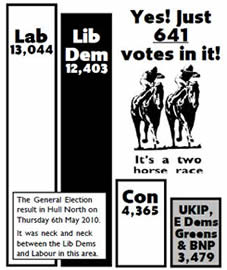 What they found was that when it comes to the sorts of comparisons required for a tactical voting / we can win here message, scatter plots and bar charts generally are better understood than pie charts and graphical devices that rely on volume (rather than length) or intensity and shades of colours.
Where bar charts edge it over scatter plots in leaflet design is, in my view, that scatter plots need clear axises and space to be easy to follow. Bar charts work better in the more crowded environment of leaflets as they retain more of their clarity as other elements intrude around them than scatter plots do.
The 2011 World Infographics Summit also saw discussion over the relative merits of bar charts, pie charts and other graphical devices with, as Scientific American reported, the case for pie charts being harder to understand again being made. Most importantly, “the human brain is more adept at comparing lengths than areas”.
That’s all not to say that the choice of bar chart over other devices was based on careful psychological and graphical design research. But the advantages of bar charts do help explain why they seemed to be the right choice and why they prospered.
As for the first bar chart, I’ve so far traced the idea back to Chris Rennard’s Association of Liberal Councillors booklet in 1984, when he called them “block graphs” and included some examples from recent elections. Anyone got any earlier spots?
 Follow @libdemvoice.org on Bluesky
 Like us on Facebook
 Subscribe to our feed
 Sign-up for our daily email digest

 Jane Dodds stands down as Welsh Lib Dem leader
 The straight and narrow path to Marzipan Tunnel
 A U-turn too far
 Rob Heale
 Chris Moore
 Adam
Adam Paul
Paul
8 Comments
Bar charts are trivially easy to distort, as well.
http://www6.politicalbetting.com/index.php/archives/2011/01/14/and-so-onto-barnsley-central/ is perhaps a slightly exaggerated version of the trend, but not every bar chart that has ever appeared in a political leaflet is as accurately-scaled as the Hull one shown in this article…
So much easier for Libdems to play the old game of supressing the zero I’m afraid.
This one from the Tories compairng their result in a General Election year to Lab and Lib Dem from previous years has got to be the worst distortion of the bar chart.
http://peterblack.blogspot.com/2011/04/really-dodgy-tory-bar-chart.html
@Colin Green – Astonishing! They used different elections to get the numbers for different parties!
@toryboysnevergrowup
“So much easier for Libdems to play the old game of supressing the zero I’m afraid.”
You mean like the graph on a Tory leaflet here showing increase in council tax during the then minority Labour administration when all the council tax charged in the previous Tory-led administration was suppressed but which started from a marked zero!
Commenting reminder: Please remember to respect our moderation policy which basically asks people to be polite, be on topic and be honest (ie don’t pretend to be more than one person or to be someone you are not).
As you can see from other comments published on the site, wide-ranging and robust debate is fine (including comments critical of the party or the site). However, we do ask for little bit of civility – and the chances are you’ll find that makes your points a little more effective at persuading others anyway!
We have the policy about off-topic comments so that people can choose to take part in the discussions which interest them, rather than finding the same discussions shoe-horned into threads on posts on a wide range of other topics.
If there’s a topic that is relevant to our site and hasn’t been covered in a post then raising it in a thread is fine. However, what goes too far – for example – is raising the same topic in several threads in quick succession.
More details are at https://www.libdemvoice.org/comment-policy which you can also get to via the reminder link which always appears next to the box for posting a new comment.
Lies, Damned Lies and Bar Charts.
The best Bar Charts are those comparing the Red Lion with the Dog & Duck.
@MBoy
Astonishing! Their PPC last year in Swansea was the Lib Dem PPC in 2005, so I can guess where they’ve got that idea from.