


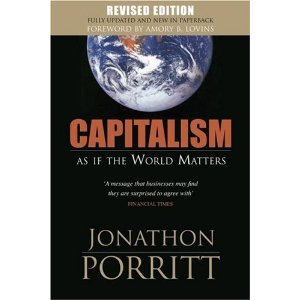
First published in 2005 and issued in a revised edition in 2007, Jonathan Porritt’s Capitalism as if the world matters has played an important part in arguing the case that not only can capitalism and sustainability go together, but that a reformed version of capitalism is essential to achieving sustainability.
This view sets Porritt apart from many of his former colleagues of his from his six years as chair of the UK Ecology Party (now the Green Party) and another six heading up Friends of the Earth. It made – and makes – his book controversial in many green circles but also makes the book appeal to business people who Porritt wishes to persuade to change their ways. “Like it or not (and the vast majority of people do), capitalism is now the only economic show in town,” argues Porritt.
It is also an optimistic book for, as Jonathan Porritt writes, “There’s so much to be hugely hopeful about – technologically, politically, spiritually … Capitalism has always been a self-correcting system, capable of startling and seemingly ‘unthinkable’ shifts at precisely the moments when those shifts are most needed”. Optimism does not just reflect Porritt’s outlook; he also argues that it is necessary for success: “changes have also to be seen as desirable changes: good for people, their health and their quality of life – and not just good for the prospects of future generations … This means working with the grain of markets and free choice, not against it.”
 “Market-based, properly regulated capitalism is still capable of meeting today’s daunting challenges … [but] we will need to engineer tomorrow’s world, step by step with great determination. It won’t just happen by chance,” says Porritt.
Tomorrow’s world needs to be different in two main respects, according to this book: it needs to be sustainable and it needs to prioritise well being over financial wealth and economic growth.
On this point, Porritt cites JM Keynes’s distinction between relative and absolute wants: “Keynes pointed out that our absolute wants (those which we feel regardless of our relative position in society) are limited and finite; it is our relative wants (those which we feel in comparison to what others have in society) that are apparently insatiable”.
In this respect, therefore, the book is very much in line with arguments made by others such as The Spirit Level that, in developed first world economies, the link between well being and economic growth is extremely weak. As Porritt puts it, “What gives this analysis extra bite is the linkage between declining levels of contentment and inequality: the greater the inequality of income distribution within a developed country, the higher the levels of dissatisfaction and alienation – with the interesting exception of Singapore”.
The book has some radical prescriptions, particularly on social justice’s role in ensuring sustainability: “No serious definition of the word ‘sustainable’ could possibly allow for a continuation of the grotesque disparities in wealth that we see today, both within countries and between countries”. But, more generally Porritt, “demands a reform agenda, however radical it may appear to some, [but] not a revolutionary agenda”.
That is what the book details, often more in textbook than polemic style, providing a comprehensive sweep of policies and supporting evidence which makes the book a useful reference source.
You can buy Jonathan Porritt’s Capitalism as if the world matters from Amazon here.
 Follow @libdemvoice.org on Bluesky
 Like us on Facebook
 Subscribe to our feed
 Sign-up for our daily email digest

 The Joy of Six 1590
 What is Christian nationalism?
 Latest PollBase is out, with all the British voting intention polls since the 1930s
 Peter Davies
 cim
cim Roland
7 Comments
It’s good to see that some Liberal Democrats are still interested in ‘green’ issues and protecting the environment despite being part of a coalition government that seems intent on trashing our countryside and its wildlife – selling off the country’s forests, constructing a major railway line through an area of outstanding natural beauty (instead of going round it!), building never ending housing on greenbelt land, planning to slaughter large numbers of badgers (contrary to expert scientific advice), back-tracking on animal welfare laws and so on.
A couple of links, if I may:
http://www.guardian.co.uk/environment/blog/2011/jan/18/uk-environment-health-government-spin
http://www.independent.co.uk/opinion/commentators/johann-hari/johann-hari-for-sale–camerons-green-credentials-2177929.html
Interesting piece but the Spirit Level is not a serious piece of work. They have used hand picked statistics and countries to reach the conclusion they wanted, that more equal societies are happier.
Using a different set of statistics a completely opposite conclusion could be drawn.
There have been a number of critques but one of the best is that by Prof Saunders for Policy Exchange.
http://www.policyexchange.org.uk/publications/publication.cgi?id=195
Well done Mark for introducing the environment into the LDV debates. There seems to be a general lack of interest in Green issues, but they are more important then ever.
Jonathan Porritt once wrote a pamphlet for the John Stuart Mill Institute and it would be interesting to read your views about that as well.
I think Porritt is right that capitalism is the only game in town, even though there are many good reasons not to like it. I think it is unfair to characterise the Green party as being a neo-Marxist party, Caroline Lucas comes across as a perfectly reasonable politician in comparison to George Galloway. But I would like to see them enter in the debate on capitalism, they are not making much impression from their current position.
Simon: I’m less impressed with the Policy Exchange publication than you by the sounds of it; don’t know if you say my review at https://www.libdemvoice.org/beware-false-prophets-22222.html ?
Geoffrey: I’ve not come across the pamphlet. If you can point me at a copy, I’ll certainly take a look.
Democratic capitalism will have a better chance of survival if the widely but often subconsciously accepted Conservative political ideology of unrestrained Dynastic Capitalism is replaced by a Liberal political ideology of Popular Capitalism in each new generation.
In a capitalist democracy it ought to be a human right to have national Universal Inheritance – capital for all – to spread more widely the private ownership of capital in each new generation, as well as national Universal Suffrage – votes for all. In the UK we finally got Universal Suffrage in 1928. Now for Universal Inheritance!
All UK-born UK citizens at 25 should receive £2,000 in 2011 up to £10,000 in 2015 and hopefully more thereafter, financed by radical reform of Inheritance Tax to bear more on recipients than on donors and with the abolition of scandalously unlimited lifetime gift and agricultural, business and shareholding asset-linked exemptions.
Dane – I’m not sure you could necessarily call that liberal. Rather than giving people money by taking it all away from the rich, I would prefer government to better educate people so they could run more mutuals and cooperatives. The kind of state intervention you call for is in my view dangerous. There has to be a limit to what governments can and should do, and the onus should be on the people to take more responsibility to make the changes that improve people’s lives. It is obviously harder and takes longer to make a better society, if you don’t have a police and army to force people to your will, but I would suggest that in the long term people would become better at taking responsibility for their actions and we could as a society progress without the need for coercion by the state. There are unintended consequences to high levels of state intervention, and in my view one of them is that people become less able solve problems by themselves and become increasingly dependent on governments. Not only is that dangerous in the sense that people could scrutinize governments less, but it also goes against the liberal belief of encouraging people to fulfill their potential and be the best that they can be.
OT: I agree that capitalism is compatible with sustainability. The best hope for the planet lies in technological advances that can replace fossil fuels or make products use fossil fuels much more efficiently. I think it’s unlikely that the Americans, Chinese, Indians, Brazilians etc will cease using fossil fuels without a replacement so there’s little point in wasting time on trying to make that happen.
“Sam”
The Liberal Party constitution, as I mentioned above, calls for Liberty, PROPERTY and security for all. How else will you achieve that, when some start off with billions and others with nowt?
Universal Inheritance does not take away from the rich. It takes away some part of what people receive for doing nothing, before they receive it. Of course better education is good if it leads to more mutuals and cooperatives. But what is dangerous about redistributing the inheritance of wealth? It is more dangerous for the stability of our capitalist democracy NOT to redistribute the inheritance of wealth, with inequality ever rising between the super-rich and the rest.
Yes, there must be a limit to what governments can and should do. But starting people off less unequally should not be off limit. The Universal Inheritance proposal is exactly a way of taking responsibility to make a change that improves people’s lives.
All I am suggesting doing is giving a bit of capital to all 25 year olds, itself subject to a progressive cumulative Lifetime Unearned Capital Receipts Tax, so that it will be clawed back from those who subsequently inherit large amounts. Having a bit of capital, small though it may initially be, is helpful to people to solve problems for themselves. This goes WITH the liberal belief in encouraging people to fulfil their potential and be the best that they can be in each new generation.
You are aiming at the wrong target. I would agree with you if you were arguing against a wealth tax.
However, what I am proposing is a redistribution of the RECEIPT of gifted and inherited unearned wealth FROM people in each new generation who have done absolutely nothing themselves to create, earn, save or make that wealth – a significant part of which they will still receive – TO those who would otherwise inherit nothing during their lifetime. That will really improve people’s lives ,by reducing alienation, financial and social exclusion and poverty, and increasing education (helping to pay for tuition fees), entrepreneurial activity and opportunity for all.