


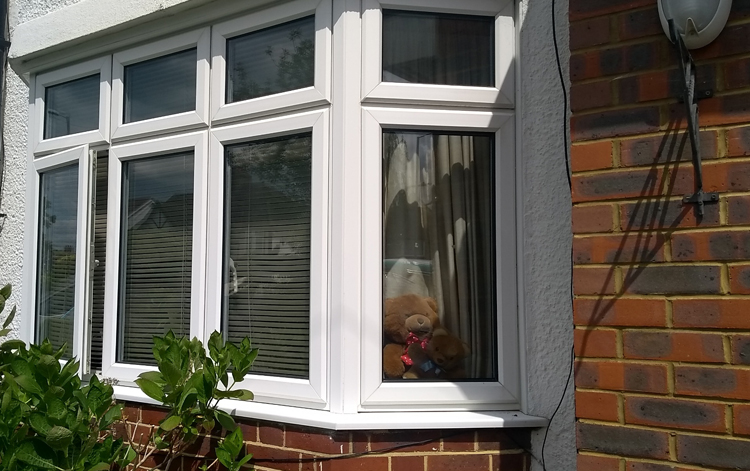
My home was built in the 1930s, along with thousands, if not millions, of others. The standard three bed semi has become an icon of suburban life, and can be found outside the town centres of most UK cities.
When new, the homes offered comfortable living within easy reach of countryside and town, and indeed nearly a century later they are still much loved. They were built to high standards and often survived much better than the skimpily built post war housing. Most of them have two double bedrooms and a small room, often referred to as a box room, though commonly used as a single bedroom.
In my case, my house is still just 200 metres inside the Greater London boundary, and beyond that is protected Green Belt, which in my case means farmland, riding stables, travellers sites and a golf course. And yet we can get into London in just 15 minutes from Surbiton Station, which is a couple of miles away.
Did I mention Surbiton? Before we go any further I need to make it clear that although The Good Life was set in Surbiton it wasn’t actually filmed here. But it has cemented the idea that Surbiton – once known as the Queen of the Suburbs – is very upmarket. In fact, Surbiton, and its poorer relation Chessington (where I live), are fairly typical of the outer London commuter belt. These areas are socio-economically and ethnically mixed, with some parts that score quite highly in deprivation indexes.
It is common to sneer at suburban life. In popular culture the suburbs represent shallow middle class values, in comparison with a gritty urban lifestyle; but, of course, all of life is here – and the air is clean as well.
I have always thought that the suburbs, and especially those developed during the inter-war years, deserve more respect than they are usually given. Kingston University thought the same and set up a Centre for Suburban Studies, some years ago, although it doesn’t seem to be functioning at present.
Some years ago there was a TV programme titled How Buildings Learn, based on a book by Stewart Brand, which referred to the way that homes are altered and extended to adapt to the changing needs of the owners. And most of the 1930s houses near me have been changed substantially over the years. Garages were the first to appear, effectively turning semis into terraced houses, followed by porches, conservatories and back extensions. Then came the downstairs loos and the extra bedroom in the loft. And finally, garages were replaced with extra living or study space plus larger kitchens. Our house has gone through most of those transformations in its lifetime (it never had a conservatory, as far as we know).
We have lived in this house for nearly 40 years, bringing up our family and seeing them off to homes of their own. We haven’t downsized, partly because I can’t bear the thought of packing up and moving, but also because we can accommodate visitors here. Neither of our sons lives near by, so it is a real blessing to be able to fit them all in with their families for family events.
Sadly we can’t have people to stay for the foreseeable future, so the box room has reverted to type. It is steadily filling up with bags of shredded paper, bags full of clothes and toys for the charity shop, bags of unwanted electrical goods destined for the tip, bags of school reports and mementos to be finally reunited with my sons – in fact, it should be renamed the bag room.
Please note
We have been in full self-isolation since 16th March to protect my husband whose immune system is compromised.
If you are in self-isolation then join the Lib Dems in self-isolation Facebook group.
You can find my previous Isolation diaries here.
* Mary Reid is a contributing editor on Lib Dem Voice. She was a councillor in Kingston upon Thames, where she is still very active with the local party, and is the Hon President of Kingston Lib Dems.
 Follow @libdemvoice.org on Bluesky
 Like us on Facebook
 Subscribe to our feed
 Sign-up for our daily email digest

 Photos from the official reopening of Whickham Voluntary Library
 Bodhana Sivanandan is youngest ever female international master
 Yes, I'm still in favour of making the House of Lords democratic
 British music only!
 Tony Vickers
 David Blake
 Richard Dickson
 Richard Cripps
 Steve Trevethan
11 Comments
Chessington. There is a zoo there.
Sitting here in my box room – renamed the study 🙂 Though as the youngest of 3 girls my bedroom was always the ‘box room’. Dad built me a desk to go over the bottom of the bed – luckily I have always been short!
@Manfarang – yes, indeed, it was rather wonderful living close to a zoo when the children were small. But many years ago it morphed into Chessington World of Adventures, and having a major theme park on your doorstep is very different, especially when trying to drive anywhere in the summer.
As councillors we had to determine planning applications so I know the exact point at which people start screaming on rollercoaster as well as the breeding habits of mountain gorillas.
We also ensured that local residents get a free family ticket each year.
Mary
I actually once went to the zoo but that more than sixty years ago so I have little memory of it. The name always stuck in my mind.
I had a brief, disturbing, vision of mountain gorillas breeding on the rollercoaster… do agree about building quality, had a couple of 1946-ish houses that were a bit like that game where if you take the wrong bit out the whole lot collapses! Having grown up in a ten room Victorian edifice, I don’t really find a four or five room house that large, even if rattling around solo.
Reading this I was struck how much of it applied to our own house, diametrically across
Greater London at the north-east edge. We don’t have a nearby zoo or theme park – the threat of a theme park was averted about 20 years and the land now form Rainham Marshes RSPB reserve. I couldn’t say my house (1928) was ‘built to high standards’ as the builder clearly cut costs by reducing the size and used some materials that didn’t cost him a lot; added to that the war-time remodelling by the Luftwaffe, followed by repairs (from the public purse) clearly to the lowest contract. But it is definitely in the right place, and its situation has got better while we have lived there.
Garages were the first to appear, effectively turning semis into terraced houses, followed by porches, conservatories and back extensions. Then came the downstairs loos and the extra bedroom in the loft. And finally, garages were replaced with extra living or study space plus larger kitchens. Our house has gone through most of those transformations in its lifetime (it never had a conservatory, as far as we know).
The one change not mentioned is the through lounge. 1930s houses in the north-west fringes of London where i live were built with two downstairs rooms as well as the kitchen and in the 1960s the wall across the middle of the house was often removed and replaced with an RSJ. Also early garages were built for cars that were narrower than modern cars. I can remember the difficulty of getting my 1970s Mini Metro into my 1930s garage in such a way that I could open the driver’s door wide enough to get out. The avoidance of ‘terracing’ from two-storey side extensions led to a requirement for a ‘set-back’ on the front wall at first floor level in our Council’s planning rules.
@Laurence Cox – ah yes, the through lounge. When we bought our house in the early 80s unusually the wall between the front and back rooms was still intact, but the previous owners had built a back extension making that room much bigger. Huge patio doors, which were really cold in winter, especially when combined with a concrete floor. It still had a small galley kitchen, though, which hardly functioned as the hub of the home.
And pine ceilings – remember those?
Laurence Cox; “1930s houses in the north-west fringes of London where i live were built with two downstairs rooms as well as the kitchen and in the 1960s the wall across the middle of the house was often removed and replaced with an RSJ.”
Yep, live in one big noise space. No front room or back room, nowhere to listen to The Archers whilst others read.
“Also early garages were built for cars that were narrower than modern cars. I can remember the difficulty of getting my 1970s Mini Metro into my 1930s garage in such a way that I could open the driver’s door wide enough to get out.”
It’s the way that you do it, of course.
The track of a 1930s Austin Seven is 40 inches. The track of a Metro is 50 inches. Ouch.
Almost every car today is bigger than a Metro, and the width of traffic lanes and the dimensions of parking have had to change to accommodate the area of parked cars.
Every car today is a space hog.
Jenny Barnes: “Every car today is a space hog.”
Since you didn’t ask, Jenny, I’d create a vehicle tax on area and mass. So area (width by length), how much space occupied by a parked car, is the first factor.
The second factor is mass or weight, and you have to measure in tons. Then you square it. Heavy vehicles makes our lives unpleasant, rip up out roads expensively, so cough up.
And the great thing about a square factor for weight is that when a family saloon weighs about a ton or tonne, you’ll build them lighter.