


Political Communication in Britain, edited by Dominic Wring, Roger Mortimore and Simon Atkinson, joins a long list of books already published on the 2010 general election. As with others it also faces the tough task of finding a niche between the burgeoning coverage of politics in the media, especially online, and the revitalised Nuffield general election series.
In its favour, Political Communication in Britain brings together a strong cast of journalists and politicians who were active participants in the election, with six of the nineteen chapters coming from insiders such as Sky’s Adam Boulton, the Labour Party’s Greg Cook and the Liberal Democrat peer Chris Rennard. Even so, much of the content is familiar to anyone who has read even only a small sample of the post-election analysis, whether in book form or not.
Compared to the books which appeared last year, the contributors to this volume have had extra time to collate and analyse evidence, as is shown by the blizzard of statistics about the TV debates. Not all questions, however, have been helped by extra time for, as the book says on the question of why the final polls got the level of Liberal Democrat support so wrong, “the [polling] companies’ own investigations and those of the academics has been, so far, inconclusive and to some extent contradictory”.
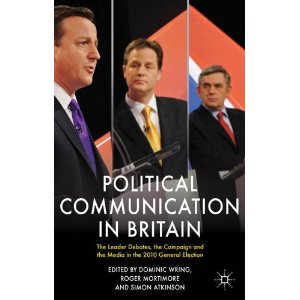 More illuminating are the chapters from Ivor Gaber on the media (which captures how much the old structure of daily press conferences and regular press releases has disappeared) and one on constituency campaigning, which presents the results of MORI polling in Labour/Conservative marginal seats.
In the final week of the election, 56% of people said they got most of their news about the election from the TV, unsurprisingly. But closely grouped way behind TV were newspapers (16%), the internet (13%) and radio (10%). Nearly everyone (95%) had received at least one leaflet in the last week, with 62% receiving direct mail. Just under one in five had been personally canvassed (18%) – the same figure as had visited a website looking for political information. Fractionally less (17%) had seen a political party mentioned on a social network, ahead of the 10% who were phoned by a party.
In other words, whilst TV and leaflets still dominate, the internet is firmly established as one of the most important of the second tier methods of communication. Party’s own official online channels were less popular than other sources of online information however, with 10% visiting official party websites and 8% having received an email from the party.
It is these sorts of detailed results that, alongside the insider perspectives, make the book a good read. Even if you have already read all the others published about the general election this one offers some new material, and if you have not yet read any this is a good one to put on your short-list alongside the best of the rest.
 Follow @libdemvoice.org on Bluesky
 Like us on Facebook
 Subscribe to our feed
 Sign-up for our daily email digest

 There's no good news on the restoration of Ludlow's town walls
 Latest voting intention and leadership ratings opinion polls
 United Nations Day, 24th October
 The church and the lifeboat memorial
 Peter Davies
 PM
PM Mick Taylor
 colin murfin