


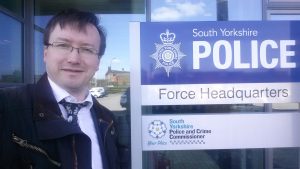
 The election for a Police Commissioner for South Yorkshire was subjected to perhaps the most powerful and least effective scrutiny of any of them.
Following hundreds of children going unprotected from sexual exploitation in Rotherham, with significant and gross police failures to believe, investigate and prosecute, we finally have a large team of detectives working these cases, under the direction of the National Crime Agency.
The first Police Commissioner, Shaun Wright, had resigned (after much resistance) having been responsible for childrens’ services in Rotherham that had also failed these children. His replacement, Alan Billings off Thought for the Day was now seeking re-election.
Already the central issue of the campaign was whether the force had learned the lessons from this time, whether it was now putting victims first or whether some of the attitudes that led to the problem still prevailed. I spoke, as did other candidates, about changing the leadership and culture of the force and Billings, as the incumbent emphasised the progress that had been made.
Then mid-campaign the Hillsborough Inquest verdict came in: the 96 were unlawfully killed and the fans were fully exonerated. Criticism poured in of police conduct at the inquest: that they had reneged on an earlier apology and gone back to the cover up and smear position of the 80s.
Questions were raised, and never adequately answered, about Billings’ role in this, and it undermined, to put it mildly, the message of progress and the problems being in the past. Thematically, Orgreave, Hillsborough and Rotherham, had all seen victims being failed and smeared, and the police covering up.
And then we saw the suspension of the Chief Constable David Crompton (on full pay for the remainder of his contract) and within 24 hours the withdrawal of the deputy now acting chief constable due to outstanding unrelated allegations. Why suspension? Was it to avoid any due process? Shouldn’t suspension be for a particular purpose – for a case to be made and answered?
I would have had a particular interest, had Crompton been dismissed, as an elected member of the South Yorkshire Police and Crime Panel (PCP) which has a role in the dismissal process. The final PCP meeting had been cancelled following “advice” that members might use it to make political points before an election and this would breach “purdah” rules. Preposterous advice – purdah is there to restrict council officers not elected members, and scrutiny of the commissioner was more pertinent at this time than ever. We did finally get an acting chief constable, who managed to make a (reasonable) statement on the extremely sensitive subject of Orgreave, the day before the election. Purdah! Who needs it?
I said “most powerful and least effective scrutiny” because none of this seems to have affected the result very much. South Yorkshire is as close to traditional Labour one-party-state territory as they come, and the most grievous failure of a public service has resulted in elections for police commissioner and for Rotherham Council (which had been taken over by commissioners) that left them both pretty much the same as before. I polled just over 10% across the region, 3% up on 2012.
Putting party politics to one side, we are entitled to expect that the team that messes up, whichever team that is, gets voted out, and when it doesn’t democracy is a little bit broken. The weakness of the police commissioner concept is right here: meaningful accountability can only exist in marginal force areas.
* Joe Otten was the candidate for Sheffield Heeley in June 2017 and Doncaster North in December 2019 and is a councillor in Sheffield.
 Follow @libdemvoice.org on Bluesky
 Like us on Facebook
 Subscribe to our feed
 Sign-up for our daily email digest

 Myth and mystery on the Stiperstones ridge
 Perhaps the most pointless question PMs are asked (LDN#215)
 Wes Streeting is a twerp
 Ianto's shrine to be saved
 Roland
 Alex Macfie
 Nonconformistradical
 Mick Taylor
 Richard Spate
7 Comments
Very good Joe and perhaps you have some kind of future in Home Office or local police force policy areas.
The point about marginal constituencies being required for accountability is important. There is talk about extending the Mayor of Liverpool role into Greater Liverpool – including Southport. One for Greater Manchester too. Ambitious Labour politicians are already queuing up to stand for them but I doubt Southport would be happy getting dragged into a Labour fiefdom. Central Liverpool is probably quite happy being dominated by Labour.
Constituencies shouldn’t just be become one Party fiefdoms unless that is what the vast majority want. Perhas there shouldn’t be one party fiefdoms at all.
We should remember that the US versions of Police Commissioners and Mayors that the Tories and Labour tried to copy are associated with public primary systems, so if a Democratic Police Commissioner is poor, they can be challenged in a primary by another Democrat, even in an area where the Republicans have little or no chance of winning.
Selection challenges to incumbents in our political system are much rarer and much less likely to succeed than primary challenges to incumbents in the US.
When electing a group, as with the parliamentary parties, they can be held accountable to some degree through the whip; but when electing an individual , there’s no real way to hold them accountable. This is why Police Commissioners and Mayors are such a bad idea in the British context.
A more proportional voting system would help to prevent such monopolies of power in the hands of a single party. We must keep pressing for voting reform at all levels, not just Westminster. And a return to Police Authorities rather than this nonsense of PCCs who are mostly placemen of the dominant party in each area.
I am glad that the issue of Police and Crime Commissioners in general, and the issue of South Yorkshire’s experience in particular, are getting a good airing. The South Yorkshire experience, which is very close to us in Chesterfield (which recently opted into a closer relationship with the Sheffield City Region) is incredible. Where else has agenda items like Orgreave, Hillsborough and Rotherham? Possible the Met. It is my hope that central government and the South Yorkshire boroughs and all their people are putting their heads together with Joe Otten to think carefully through the issues.
We who live next door are watching carefully.
My area (Dyfed Powys) was one of the few where an incumbent PCC was voted out. A Tory was replaced by Plaid Cymru. The pattern of voting though was similar to that of the Welsh Assembly list election on the same day. The turnout was higher too, with assembly elections on the same day, but very little literature or media coverage for the PCC election the democratic accountability is as weak as in a one party state.
I agree with what you say about meaningful accountability and marginality to an extent, although if there were all-party pacts to not stand party-backed candidates, that might achieve something (I know, this is fantasyland, but it’s not an unreasonable idea per se).
Just as important is all-region turnout.
In the Avon and Somerset area, Bristol’s unusually high turnout (we had mayoral and all-council elections at the same time, whereas further West, I suspect many people were barely aware the election was on) clearly skewed things in favour of Labour – although effectively what this meant was that it was Labour who were beaten by the incumbent independent, rather than the Tories.
Without an equalised electoral cycle across all the council areas involved in the PCC election (any takers? no?) the PCC elections are not credible.
Thanks for all the comments.
I should add that the dismissal procedure for the chief constable has now begun. I will get to examine the grounds and the response in detail as a member of the Police and Crime Panel, but this will be in closed session.
On the turnout point, we had much the same. Doncaster, with no council elections had a turnout of 20%. Sheffield and Rotherham with all-up elections (for different reasons) were in the mid 30s, and Barnsley, with the usual foregone conclusion election by thirds, was in between.