


Here’s the proportion of local election candidates of the three main parties who were female over the last twenty-five years. As you can see, proportions for all three parties grew in the late ’80s and since then have stalled (Lib Dems, Conservatives) or only crept up (Labour), all remaining under 40%.
The dips every four years are due to county council elections having a much lower proportion of female candidates than other local elections.
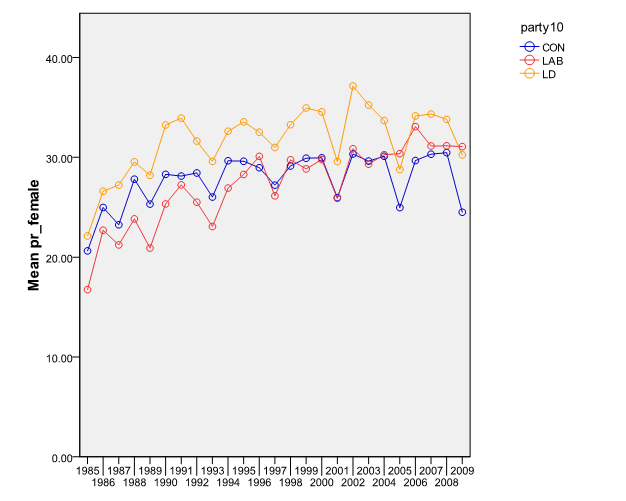
So, what do you make of this? Does it matter? Should the flat trend for the Liberal Democrats be a cause for concern? And why has no party seen its proportion get close to the proportion in the adult population?
Thanks to Michael Thrasher of the University of Plymouth for supplying the data and graph.
 Follow @libdemvoice.org on Bluesky
 Like us on Facebook
 Subscribe to our feed
 Sign-up for our daily email digest

 Ellesmere Yard: A living relic of the canal age
 Latest PollBase is out, with all the British voting intention polls since the 1930s
 Can Davey survive as leader?
 Hywel
Hywel Sarah
Sarah David Raw
 Chloe
Chloe PM
PM
32 Comments
I wish I had easy answers for this. It’s interesting though, that even with Labour’s all-women shortlists policy, we’re still doing better (mostly)
the problem with counties in my view over districts, is the size of divisions results in too many safe seats, where the incumbent, usually grey haired and male, keeps getting re-elected and nobody within their own party ever challenges them for the nomination to be candidate.
The other problem is counties tend to meet in the daytime so holding down a job and being a Cllr is difficult. Districts tend to meet in evenings which allows a better work-Cllr life balance.
I have never yet seen a group of activists with a gender a split as even as 40/60 – suggests to me that female candidates are actually doing rather well.
The pinch-point is at a stage in the process well before we start picking candidates from the activist base. One possibility is that the environment of campaigning is unattractive to women – perhaps a group of bearded men sweating over a Riso talking about opinion polling in the run up to October 1974 is not their idea of a fun Saturday?
Another thing that strikes me anecdotally (though I dare say figures would back me up) is that those women who are active in the party TEND to be either pre-children or retired. This suggests to me the startling insight that politics isn’t terribly family-friendly and if we want female activists who become female candidates and female councillors/MPs then we need to have a system that is much more flexible around people who have families (or even jobs!)
I agree with the comment that L/D`s have done better over the last 23 years, since 1988, in attracting more women candidates to stand in the Council Elections probably as they feel more welcome and their contributions are more valued and respected.
However,it has been a mighty struggle for women to raise their numbers in being candidates in Local Elections, since the female councillors were first granted the legal right to be elected in 1907, in the post 1906 Liberal `Landslide’ General Election ferment.However,there was no `Quick Win’ for the Suffragettes, until their massive munitions factories WW1 Service and Land Army community work won them the vote.
Understandably, during this period,especially when women were living under so much social and economic restraint and most women encouraged to marry and be dependent on a man`s income, there was no floodgates opening for them to stand in Local Elections.
The bar for women to stand in Local Elections must continue to be raised but Prof.Michael Thrasher`s graph demonstrates that the L/D` s have done better over the last 25 years then the rest but there is a lot more to do.
Except even that’s not quite right, because as you note, it is women activists who “tend to be either pre-children or retired”. The same bias isn’t so true for men (though in my local party I can only think of one man with school-age children too – and I don’t think what I’m about to say can fairly be applied to him).
The problem appears to be the greater willingness of men to (crudely) abandon childcare responsibilities to their partners, or alternatively, the greater willingness of women to support their partners by taking those responsibilities. It’s not, in other words, “the system” that’s at fault so much as it’s the nature of relationships between men and women even in modern families. Perhaps the greatest blow for equality would be struck by refusing to select anybody as a candidate who has a child under 16. (The fact that my youngest child is now 17 should in no way be seen as implying self-interest in this entirely serious proposal…)
First para was meant to be a quote from Benjamin’s comment above, by the way. Still cr*p at HMTL.
Benjamon: “One possibility is that the environment of campaigning is unattractive to women – perhaps a group of bearded men sweating over a Riso talking about opinion polling in the run up to October 1974 is not their idea of a fun Saturday?”
I think it’s unavoidable that female candidates for political office will need to be interested in politics. And I cant see us eradicating the disgustingness that is the male sex from the situation either, sadly.
@ Malcolm Todd: Perhaps the greatest blow for equality would be struck by refusing to select anybody as a candidate who has a child under 16.
An interesting comment, and I think you’ve hit the big problem when you point out that it’s “the nature of relationships” that is the problem in that women always seem to end up holding the baby (more or less literally). But surely your suggestion to refuse to select anyone with children younger than 16 years old is cutting off one’s nose to spite one’s face? This might reduce the disparity in gender but it would make it even more difficult for small local parties to find candidates and would be bound to exclude some very capable people (for example, I believe a certain Nick Clegg MP has three children under the age of 16…). And, as it happens, the only councillor I know with a young child is actually a woman. And surely the voters may question how representative we are of them if no county council candidates have school age children even though they will be running the local schools….
Um… I hoped it was obvious that my “entirely serious proposal” was anything but.
My intention was to dig out the underlying cause – or at least, one highly significant underlying cause – and to indicate the deep-rooted difficulty of tackling it. (Which may sound a bit obvious, but these threads can produce some astoundingly naive comments at time.)
Also, I think that just as “it’s unavoidable that female candidates for political office will need to be interested in politics” (well said, commenter!), it’s pretty unavoidable that those who want to pursue a political career to any height will have to be prepared to put in some seriously antisocial hours and activities, so I don’t think being “flexible around people who have families” [Benjamin] is necessarily the answer; at least it’s not the answer to underrepresentation of women, unless you accept as a given that women will be more restricted by having families than men.
@Malcolm Todd: Sorry :-S Comment threads are not good for irony…
I’ll go and stand in the dunce’s corner for the rest of the day…
Part of the issue is that I suspect many of our potential candidates come from a demographic where if they are of “child-rearing age” there’s a strong likelihood that both partners will be working, at least part time.
Then you have to couple this with the fact that “Lib Dems work hard for you all year round – not just at election time”.
That makes it a very difficult sell to any partner. “Sorry darling, you’re not going to see me for the next four years because every spare minute will be spent on council business or local party campaigning.”
And then there’s the fact that regardles of partner’s views, many men will make the same decision themselves – after working a 50 hour week (and part of the weekend), you tend to want to spend what little leisure time you have left interacting with your family. You’d have to be particularly singleminded to still want to go for this.
When will you political types EVER learn. The voting public couldn’t give a flying one what race, gender, sexuality, age your candidates are. What we ACTUALLY want is ANYONE with even a modicum of talent and ability to set some policies to get us out of the ugly mess we have been dropped in. Here’s a clue. Massive cut in public sector profligate waste, quango cull, end to ludicrous non jobs, saving of £120 billion (20%) year. Incentives ( that’s tax cuts to you) to encourage the private sector to reinvest and vastly increase job and wealth creation.
If the LibDems went back to being a “classic liberal” party instead of a mildly socialist / 3rd way party, they would win by a landslide
Thank you, libertarian. Here’s the thing: there are lots of issues discussed on this site, in different threads. We political types are occasionally capable of thinking about more than one thing, which means that we don’t have to drop everything (including principles and long-term vision) whenever a crisis comes along.
As to your second point: the Lib Dems have never been a classical liberal party, so there’s nothing to go “back” to there; and I think you’re making the classic ideologue’s mistake of assuming that if only someone would espouse the theories that you personally are convinced hold the answer, then the logic of your position would be so overwhelming that almost everyone would be sure to vote for it. I believe there’s a Libertarian Party. If you’re right, they should sweep the board at the next election, and you needn’t worry about what Lib Dem policies are.
Malcolm: good points, and there’s also the small matter that when people are asked, they do frequently say that the demographic and social make-up of elected bodies do matter to them.
We have similar debates around the number of women PPCs. I gave evidence to the Speaker’s Conference on my experience as a woman in politics. The issue of caring responsibilities is crucial, affecting all carers/parents of young children, but women disproportionally. Politics will take all the time and energy (emotional and physical) you can give it. The more you give the more successful you are likely to be. The more caring responsibilities you have, the less spare time & energy (of all kinds) you have to give. I think that is the nub of the issue now, rather than overt sexism. Do the demands of politics make it ‘institutionally sexist’?
I have no children, healthy parents, a compact urban seat, a flexible employer, a large activist team and an incredibly supportive and housesavvy partner. I am very lucky (and the harder I work, the luckier I get) but would never claim to be typical!
BTW I would *love* to see Tabman fighting on a libertarian platform in a local election where the issues are cycling on the pavement, dog dirt, vandals in local playground, street drinkers, people spitting or smoking in stairwells, planning apps in conservation areas, small shops, parking controls, and all the other stuff that councillors have to deal with.
My apologies to Tabman, I meant Libertarian of course!
@Malcolm Todd
Typical, stereotyping and making judgements based on no evidence.
All of these “ideas” have been tried for the last 12 years and failed. If you seriously think that the number of female candidates has anything useful to contribute to the running of the country then you are deluded. We are £1.4 trillion in debt, paying interest payments of £1 billion per week and now have 5.9 million not working.
Your “principles” are very interesting but this entirely bares out the point I made, the voting public aren’t interested in your “principles” they want solutions to problems. I know you don’t do government but at least you ought to understand purpose. It is also interesting how selective your “principles” are, and it obviously doesn’t include sticking to manifesto promises.
Fair point the LibDems have never been Liberal, I agree. However allegedly they were a merger of the Liberal Party with the SDP. That is my point, adopting fully the principals and policies of the Social Democrats has failed big time, my suggestion is that you try a different route.
I ask `Libertarian’ if he has read Vince Cable`s excellent and acclaimed critique of the `Credit Crunch’ in `The Storm’-The World Economic Crisis and what it means’?
I believe that there is growing evidence of rising food prices in 2010 of a kind that suggests that we require the urgent implementation of proposed Liberal Democrat `Fairer Taxes’ to remove from taxation, 4 million, on the first £10K income.
When energy and housing costs are factored in we can see that Britain not only is vastly more unequal over the recent 10 years but there are underlying disproportionate taxation and bank charges creating fundamental social and economic unfairness, borne by the least off and poorest people.
In finding out how to open the door to more women candidates in Local Elections, more evidence is required from women about their experience, as to what they would like to see happen to involve further in reaching their potential goals in their invaluable contribution to community and national politics.
We need a debate that continues to raise the hackles of women and cause them to argue what they require from their male counterparts in putting themselves forward for Local Elections.
Sal Brinton and Bridget Fox and many women PPC`s this time,from the 150 women standing, would make excellent L/D MPs and deserve to be asked the question again as Parliamentarians.
I also
How did they carry out the research?
How did they allocate the Vals and Kims and … er … Gwyns?
@crewegwynn
I thought they sent a survey to all candidates. But thinking about it I never got one when I was a candidate in 1991 and 2004 so it’s a fair question. I suppose they could make a good guess at my gender but I wouldn’t say I have an obvious name.
The figures are based on analysis of actual candidates rather than survey data. There may be a handful of problems with people called Sam and so on, but bear in mind that we’re talking about thousands of candidates for each of the main parties in a May round of election, so that’s not the sort of issue which will cause a problem with the overall picture.
Interesting we only have one female contributor (I think) to this discussion.
I have found all of the comments on here really interesting. I am a female councillor and like Bridget have no children, healthy parents, an urban seat and a fantastic husband who doesn’t expect me to iron his shirts. The Lib Dem council group on Hull is 34 in total of which 16 are women of varying ages, with different levels of responsibilities both inside and outside the council and with varying caring responsibilities.
This certainly happened more by accident than design, but the key to the Group being cohesive and successful is providing a supportive atmosphere for anyone to thrive in. I saw Prof. Thrasher speak at an event about barriers for young councillors and some similar issues to those raised here came up.
For me it has to be about constituencies and Council groups working hard to enable the best candidates to be successful, regardless of their demographic. My experience of the Lib Dems is that we do that rather well.
I think the ‘child bearing/rearing’ point is well made. It does work for both parents, but women do still bear a disproportionate amount of caring responsibilities.
Both my husband and I have been councillors for more than 14 years. For the past decade, we have (and still do)both held positions of responsibility in a LibDem run council, whilst having a school aged child.
Taking up the point of the timings of council meetings, the worst time for anyone with school aged children is mid/late afternoon – the schools are out, after-school activities need equipment and transport and those who might look after children are at work.
As chair of my local party, I am proposing a gender balance task force to see why our female members are less likely to get involved in the local party, attend meetings, undergo candidate training etc. We’ve only had a couple of female candidates put their names forward for selection this time.
Sounds interesting Dave; would be good to hear what you find/conclude.
We have more regular female campaigners in our team than men. Would things be any different if we had more men and less women? – Of course not.
Candidates need to be selected on the basis of their links to the area, campaigning history, enthusiasm for the job and political knowledge, as well as having the right personal qualities to be an MP. Labour’s parachuting in of female candidates goes down badly (Blanau Gwent) and imposing a target from central office on a gender ratio affects local party decision makers’ ability to choose who they deem to be the best candidate.
To attract more women with children (and dads too) campaign teams need to offer as many opportunities to get involved as possible, mornings, afternoons and evenings. Candidates are often drawn from local campaign teams, so making it easier for people to get involves in a campaign seems the most sensible option. Although I’d argue the Liberal Democrats do this already and are a party with a healthy range of backgrounds – Men, women, Minimum wage earners, millionaires, Students, Elderly people, Mums and dads, people from a whole range of jobs and even an Old Etonian!
To attract more women with children (and dads too) campaign teams need to offer as many opportunities to get involved as possible, mornings, afternoons and evenings. Candidates are often drawn from local campaign teams, so making it easier for people to get involves in a campaign seems the most sensible option.
Excellent point. Clearly some local parties (e.g. Hull, as Abi Bell points out above) have been able to find ways to bring in and support all kinds of candidates, so what’s needed is for good ideas to be spread around.
Maybe we should do some recruiting at the school gates….
Sorry, I’m puzzled why children always seem to be the be all and end all of this argument.
The average age of councillors is 57 (interestingly in my constituency in last May’s local elections, I’ve calculated the average age of electors is 58!) but we seem to be no better in recruiting female candidates over the age of 50 than we are recruiting those below.
Incidentally, 38% of our members are female but only 30% of our Councillors; I’m puzzled why. It’s not through lack of effort.
Hi Martin,
It’s good to know you are making efforts to recruit more women candidates, and disappointing that this has not been more successful. Maybe worth ‘headhunting’ women who are activists in other fields (school governors, church, WI, etc) who clearly care about their community and may be ready to take it to the next stage – as Lib Dems, of course! Is there any pattern in the reasons the women you have targetted have said no? Caring responsibilities can include partners & parents as well as children!
I think there are 2 points here that spring to my mind. Firstly, the Campaign for Gender Balance has done a huge amount to support female talent at PPC level. We have so many excellent female candidates, like Bridget Fox, and more are emerging all the time. The CGB programme gives support and encouragement, which (and I speak for myself here) some women need, perhaps more than men. When Parliament and politics has been seen by many as somewhat of a male birth-right, it makes sense that to just open the doors to woman and expect us to come rolling in probably isn’t going to happen.
This support, to my mind, is not available at a lower level. Hopefully in time the PPC-level stuff will be able to filter down, but again it’s how do we reach women who may well be active in their community but not conference-going Lib Dems aware of the support networks? I have said before that a mentoring scheme should be available for women who want to stand for local and County council seats, the same as PPC selection, and have volunteered to do this, as a Councillor myself.
I wanted to stand for County Council after I was elected as a local Councillor some years ago, but was discouraged from doing so. My constituency ended up with an all-male slate for the Counties, unsurprisingly, and I was the only female who had shown interest in being a candidate. Perhaps it was felt I lacked the experience and gravitas to cope with roads and schools? All of our candidates were retired, white men who were already elected at local level. Perhaps it wasn’t just my gender than procluded me from standing, but the fact that I am a third of their age and have a job. If we want to look at how to encourage female candidates we still need to break the mould of the idea that standing for Council is something that white men do after a fulfilling career to keep them occupied in their retirement?
One Trackback
[…] So, what do you make of this graph about gender and politics? (24) by Mark Pack. 2. Opinion: UK Border Agency plunges colleges into crisis (20) by the Head of a […]