


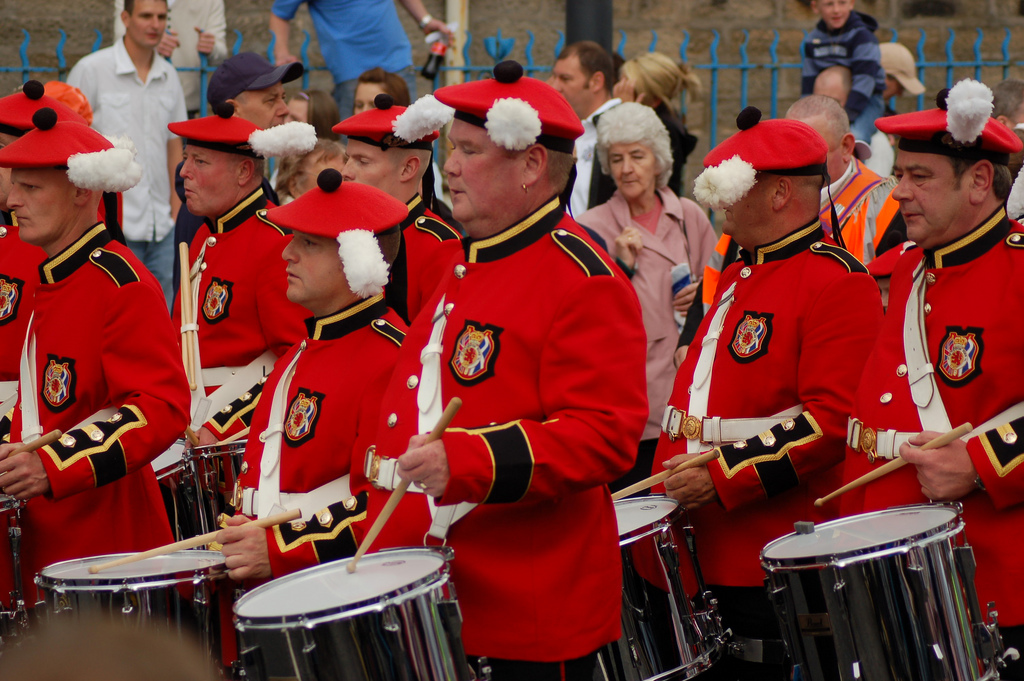
 I was on the new Scotland 2014 show on Monday night. It was my first live studio based interview. I travelled to the beautiful BBC headquarters at Pacific Quay in Glasgow for 9pm. I am not a great user of cosmetic products, usually because I end up looking like a clown if I try to apply them myself, but the very lovely experts soon had me looking 10 years younger. They even straightened my hair!
I was there, along with Richard Dixon, the Director of Friends of the Earth Scotland, to do the “Top Trending” slot where they have two people discussing the various stories of the day. Our first topic was the Orange Order. Over the weekend, an Orange Order march in Glasgow had ended in violence. The organisation has also become a registered participant in the referendum campaign on the “No” side, although they won’t and never will have anything to do with the Better Together campaign. There was also an online petition calling for these marches to be banned. I don’t think they should be, but care needs to be taken to make sure that they don’t seem intimidatory and, particularly, any behaviour which incites religious hatred should be tackled.
The Order had said that sectarianism was now a “myth” in Scotland. I pointed to the 2000 people who had been convicted of religious hatred (an aggravated crime thanks to the persistence of then Liberal Democrat MSP for Central Scotland Donald Gorrie) in the past 10 years. Donald always used to get us to ask ourselves what these Orange marches, based on the worst kind of religious prejudice, would look like to people from abroad. Actually, to me as a highlander, this central and west of Scotland tradition seems bizarre, completely out of place in a modern, vibrant, inclusive democracy. It’s to be hoped that the next generation, which instinctively feels more liberal, accepting and tolerant, will distance itself from this sort of old fashioned thinking.
The second issue we discussed was the much mocked Scotland team outfits for the opening ceremony of the Commonwealth Games. My view was that the women’s outfits particularly, with their cumbersome shawl, were just horrendously outdated. However, I did recall how we were all whinging ahead of London 2012 and the minute that flame was lit, we were in raptures of positivity.
We ran out of time to discuss the third topic we had prepared, legal highs, in response to the news that they were being banned from the T in the Park music festival. Had we got there, I suspect you might have heard the words “need for evidence based policy”, “as a liberal, I think you need to be very careful about banning things” and “we need to educate people about these things” come from my lips.
It was a good experience on a relatively new show that is trying to make the referendum debate a bit more enjoyable and less combative, with a bit more illumination than roastiness.
You can watch it here on the BBC iPlayer from about 15 minutes in.
Photo of an Orange Order march in Larkhall, Scotland by Ross Goodman
* Caron Lindsay is Editor of Liberal Democrat Voice and blogs at Caron's Musings. You can find her on Bluesky at caronmlindsay.bsky.social
 Follow @libdemvoice.org on Bluesky
 Like us on Facebook
 Subscribe to our feed
 Sign-up for our daily email digest

 The Joy of Six 1593
 Do shouty politicians gain long term votes?
 Farage let off Reform staffer accused of racist slur
 Latest voting intention and leadership ratings opinion polls
 Rose Runswick
 Tristan Ward
 Katharine Pindar
 tom arms
 Andy Daer
One Comment
Well certainly in my experience (growing up in The Bogside of Derry in the 1970’s) the Orange Order was essentially about preserving a cultural identity whose socio-economic characteristic was that the protestant working class was fractionally less poor than the catholic working class. The industries that were off-limits to Catholics (eg shipbuilding in Belfast) have vanished and their replacements in Derry such as Du Pont in the 60’s and Seagate in the 90’s are strictly non-sectarian.
The Orange Order is a dying thing. It’s raison d’etre has vanished. Frankly I can’t even be bothered to be annoyed about it any more, despite the triumphal cry of “croppies lie down” that I remember vividly from childhood.