


There’s a fear emerging in the so-called realignment of British politics. All the talk is of Reform UK and the Greens being the insurgent parties that are taking over from the traditional main forces of the Conservatives and Labour. If that’s the current media and social media narrative, where do the Lib Dems fit in?
The harsh truth is that, unless we have a message that gives us an identity among those who don’t take a massive interest in politics but do at least vote, we are heading for irrelevance. That’s not true in terms of our electoral performance in places where we have a foothold via MPs and councillors. They are doing a great job and are natural recipients of votes from those who want to keep the Tories down and Reform at bay. But in the national conversation, too many people are saying ‘the Liberal who?’
Three years ago a few dozen party activists met in York, frustrated at the way the party’s ‘seats over votes’ strategy was starving the party of an identity in the minds of voters, and even of party activists. The emerging ginger group, known as the Yorkists, has been fighting for a better definition of what the Lib Dems stand for, if only so that most voters have an idea of what a vote for the Lib Dems means, or can summarise what we’re about in three or four seconds.
Approaching the two-year mark in this parliament, the Yorkists have asked the question: how should the party go into the next general election, expected in 2029? Not exactly ‘What specific policies are essential?’ but ‘What are the criteria for a Lib Dem offering that will motivate people to campaign for us in places where we can win, and will perhaps attract votes in other areas that could deprive Reform or the Conservatives of vital votes that keep their total number of MPs down?’
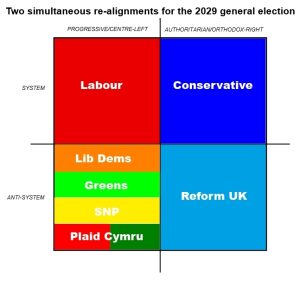 The result is a paper called ‘The New Deal’. It’s worked on the basis that the party has to be clearly seen to be in a particular square in a two-way realignment of British politics.
In the vertical alignment (similar to the old left/right or progressive/authoritarian division), the Lib Dems must be part of the progressive centre-left bloc, because that is where most of our votes came from that saw us rise from 15 MPs before the 2024 election to 72 after it. It also fits with a revival of British Liberalism. In the horizontal alignment, we have to be on the insurgent side, an ‘anti-system’ party that distinguishes itself from the more-of-the-same ‘system’ offerings from Labour and Conservatives that voters are increasingly turning away from (the paper makes clear that ‘anti-system’ doesn’t mean revolutionary, but an acknowledgement that the current system isn’t working for too many people so significant change is needed).
The Lib Dems are well placed to be the most sensible and grounded of the anti-system parties, but there’s a problem. The more socially Liberal we are, the more any commensurate policy platform would involve measures that would cause some people who voted Lib Dem in 2024 to pay a bit more in taxes. It’s all very well being authentically Liberal, as long as we don’t frighten too many of our horses.
That’s where the idea of a ‘new deal’ comes in. We need to sell the idea that affluence doesn’t help people if society and public services are breaking down. ‘The New Deal’ quotes Keynes and Beveridge as saying you don’t have a prosperous economy if there is too wide a gap between the richest and the poorest. It calls for a new economic model to redress the balance of 45 years of Treasury orthodoxy set when Thatcher and Reagan were at their peak. And it calls for a handful of imaginative policies so voters and supporters can feel inspired to vote and campaign for the Liberal Democrats.
It is not a manifesto – that’s the job of the party’s manifesto group – though it hints at what could be in the 2029 Lib Dem offering. It is also agnostic on the party leadership – it sets out what leadership is needed, not who that leader should be. It has an introduction by William Wallace, and has the tacit support of many people who want to see its ideas discussed, if only so the party tackles the clear danger that current political trends threaten us with irrelevance.
‘The New Deal’ can be downloaded here.
* Chris Bowers is a two-term district councillor and four-time parliamentary candidate. He writes on cross-party cooperation, was the lead author of the New Liberal Manifesto, and is unofficial coordinator of the Yorkists.
 Follow @libdemvoice.org on Bluesky
 Like us on Facebook
 Subscribe to our feed
 Sign-up for our daily email digest

 "A chap on his own gets a bit cracked sometimes": Michael Powell on Mr Colpeper
 The oldest pub in Swansea and the secret tunnel
 Why I'm fighting these plans
 Latest voting intention and leadership ratings opinion polls
 Liverpool near bottom of the league for recycling
 Alex Macfie
 Brigid Gardner
 PM
PM John Studholme
 Jeff
Jeff
24 Comments
Why are we on the other side to the Tories. In areas we are probably nearer to them than certainly the damn Greens, they are the ones we should be having a go at, we need to put them firmly back in their box.
All okay looking for a new strategy, image whatever we wish to call it, but who will front it to the public. Seems we are saying in a roundabout way that we need different leadership. Nothing wrong in that.
One thought. What is the greatest short term problem the country has? Not the usual culprits of social and economic policy. surely it is Defence and we are saying nothing about that, I for one do not want my grandchildren being forced to speak Russian!!!!!
Perhapos we should restore National service, at the end of the period I suspect quite a few would stay on and that alone would boost the numbers of military personnel.
Heavens this is radical stuff for this party. Different image though.
“ and will perhaps attract votes in other areas that could deprive Reform or the Conservatives of vital votes that keep their total number of MPs down?’”
So how do we go about attracting the votes of people inclined to vote for Reform? Do we toughen up our rhetoric about those who are crossing the Channel in small boats? Do we take a harder line regarding the use of prison for violent offenders?
I’m not sure that seeking to appeal to Reform-inclined voters should our priority.
I think your left/centre-left ‘anti-system’ bloc still breaks down into activists who are ‘recognise the spirit of the system, just want it to work better and be held up to scrutiny against its original principles’ and ‘want to rip it up and set it down on a new basis, and tell those who hanker for the old system and some aspects of comfort they got from it that they are wrong’. And you will find some Labour activists and voters in both those groups and the wider pro-system group.
As a voter, I do not want to be yoked in tandem with the Greens’ particular vision of a new system, although I am desperately conscious of Labour’s failings in and out of government, and the way the system is creaking, and I am wary of those in the Lib Dems who are full of wonderful ideas about how to change the system but maybe naieve about testing and scrutinising them and engaging with people who might disagree, as a democratic governmental process once elections are won.
I guess I’ll have to vote Labour and give up hoping the Lib Dems will listen to my concern about the Greens’ policy tendencies, or adopt a policy platform that sees the whole country as democratic citizen-stakeholders who have a right to be heard, whoever they vote for, then. (None of which is to say I’m about to throw in my lot with the centre-right.)
Chris says
“he harsh truth is that, unless we have a message that gives us an identity among those who don’t take a massive interest in politics but do at least vote, we are heading for irrelevance.”
I was not in York 3 years ago. I am a refugee from the Labour since the last venetal election – a member over many decades in my old party- as the Lib Dems have the members with ideas. Somehow this must be funnelled up to HQ.
I joined the Social Liberal Forum, and also the Yorkists at my first LD annual conference in Autumn 2024.
I give my full support to the Yorkist ‘The New Deal.’
I believe there are lots of people out there in the electorate who just want a sensible government, with a firm view of how it can make life better in the tradition of Beveridge.
I recommend ‘The New Deal’ as a good read with an inspiring ambition.
Given the fixed term Parliament Act was repealed by Johnson, I would be aiming at 2028. There is little benefit to the sitting government to go for the full five years, particularly if you want to limit the opposition’s access to Whitehall etc.
Also having a complete offering early in 2028, means you have the resources needed to communicate what a LibDem government would be about, prior to the formal pre-GE period…
@kira Colin’s – “ So how do we go about attracting the votes of people inclined to vote for Reform?”
An interesting question, as the answer is probably slightly different to what you may expect. Reform to gain the votes it will need to form a Parliament has to appeal to a wider audience, which means doing what it is currently doing and moving towards the centre – not so much by dropping its more contentious policies but by adding policies/messages that are more appealing to right leaning voters. Hence part of the challenge will be for LibDems to get these more moderate voters to vote for the LibDems instead of either the Conservatives or Reform. We can expect the more extreme Reform voters to assist in reducing the Reform vote, by transferring their allegiance to Reclaim et al. .
Just a quick response to Kira Collins’ comment. An article on LDV is limited to around 750 words, so there’s a lot more in the 20-page ‘New Deal’ paper. And that includes why, in some cases, it is Lib Dems v Reform in voters’ minds. We saw that at the 2024 general election, when Lib Dem canvassers were astonished to hear voters saying “I’ve narrowed it down to you or Reform.” The first reaction is: how can people narrow down their choice to two diametrically opposed parties? The answer lies in the fact that these voters are sick of the two main parties, so want to use their vote to protest. So for them it becomes a choice between those nice people whose councillors fix potholes, or those brash people who say it how it is even if they’re a bit racist. How many of these voters there are is hard to say, but this emphasises why we have to be on the ‘anti-system’ side of the horizontal divide.
Splendid stuff, well done Yorkists! ‘The New Deal’ seems a great idea in itself. Your graphic shows, however, how much work will need to be done to assert ourselves above the other parties of the progressive Centre-Left, especially the Greens in England. As you write on page 13, “The Greens cannot simply be ignored … they are threatening to take over the UK-wide ‘progressive anti-system’ role unless the Lib Dems dig into the Liberal tradition and start producing some eye-catching radical policies.”
Quite so, and one I am proposing is a national effort, as after World War 2, to treat the lack of sufficient social and affordable homes that we (and Labour) are committed to build but aren’t building nearly enough of as a national Emergency. There’s a draft motion which my Cumberland party is backing, as will I trust Social Liberal Forum Council, and it is going for drafting advice to FCC this week.
The New Deal graphic is very helpful but of course not perfect. As to preventing Reform from winning, we need to be an anti-establishment party as Chris Bowers says. It is not about compromising with Reform’s basic divisive authoritarian approach. In a Guardian webinar early this year, the leader of Hope not Hate said research shows at least one third of Reform voters are about dissatisfaction with Labour and Conservatives, not immigration; one third are completely fed up with the way we are governed and want radical change; only the remaining third are focussed strongly on immigration.
When the Liberals were at our most successful in the 1970s and 1980s, it was because we were then the insurgent party, taking on both Conservatives and Labour and challenging the Establishment. Now the Liberal Democrats are often seen as complacent – making criticisms but also being ultra-polite and “reasonable”. Sadly the merger in the 1980s brought in people who wanted middle-of-the-road, moderate politics which wouldn’t annoy the Establishment and sought only to make ‘moderate’ changes. So it is hardly surprising that the insurgent role has moved to the new parties like Reform and the Greens. Many of these middle-of-the-roaders then learnt how to be more radical, while others moved on to the pro-Establishment parties. If Liberals are to succeed, they must resonate with the public demand for real changes in our institutions, and again become more challenging, more radical (which doesn’t mean moving towards the extremes of left or right!), and making clear that we are against the status quo where the present structures are not those we need for ordinary people. Moderation does not win elections!
This is where Coalition comes in. Sure, you didn’t make a lot of centre-left voters very happy by backing the Conservatives, but more importantly you went into government and did Establishment things while in government. Then you came out of it and again backed the Establishment line that Britain should stay in the EU.
Now … you may have been right or wrong on those decisions, it doesn’t matter. I voted to Remain. I do not like the Conservatives at all but I can see why a Con-LD coalition made sense to try at that point. But they were very much the actions of a party trying to position itself as a Sensible Party Of Government – and post-referendum, you followed that up by picking the Sensible Ed Davey to contrast with the Johnson vs Corbyn dynamic of the time.
If you want to switch away from that to being an anti-system party then … well, that’s not impossible with the right approach. Both Johnson and Corbyn did – at least semi-successfully! – portray their traditionally Establishment parties as being anti-establishment ones under their leadership. But you probably need that level of disruption to the current Lib Dem setup and brand.
Or you could note that there are three parties already in the “left of centre anti-establishment” quadrant and try to fight for superiority in one – or both! – of the less crowded pro-establishment boxes. That’s perhaps easier.
@ cim “This is where Coalition comes in. Sure, you didn’t make a lot of centre-left voters very happy by backing the Conservative”.
Interesting comments cim, and just out of curiosity has anybody got the party membership figures to show how many members the party lost between 2010 and 2015 ?
As Liberal Democrats we need to stand for the Liberal democrat world order, the international institutions and efficient trading systems. We have to analyse where the system mat have gone wrong and make suggestions as to how improvements can be made.
@ cim, To answer my own question, according to Mark Pack’s website, party membership dropped by a third over the course of the Con – Lib Dem Coalition.
Rif – “..taking on both Conservatives and Labour and challenging the Establishment.” Yes I identify with those sentiments, which is why I joined the SDP in 1983 precisely because they were doing that. At that point I had barely registered the presence of a Liberal Party other than as footnotes in my A Level politics textbooks in the 1970’s. I had never had a Liberal leaflet through my door and I had only once (knowingly at least) met a Liberal Party member.
Fourty three years later, I am still campaigning for the Liberal Democrats and have, so far, served a combined total of 28 years in elected public office as a Cllr and as an MP. My happiest years politically were when I served as an MP under the leadership of former SDP member, Charles Kennedy. My unhappiest years were after the Economic Liberals took control in December 2007 and on into the disastrous Coalition Government.
So, we all have different views about the past and future of our Party. I do agree with you though that we need a much sharper presentation of what we are about. Recent years have seen some some good policies emerge, such as todays on energy costs. But they all tend to be separate, clever, little fixes with no clear overall image of what we are about.
I disagree with Roland. Reform have no more need to broaden their appeal by softening than Trump did. They only need to get as many of their supporters out as possible and be propped up formally or informally by those Tory’s and DUP who don’t defy the whip. It’s even possible Reform will need to concentrate on not being outflanked Restore. The next GE will be a pivot, with I hope a great deal of tactical voting. Seats over votes makes sense to me. I also believe the Green gloss is fading, a combination of their own missteps and right wing msm backlash. Lib Dems must be ready to play vital role. But it feels a short hop from being ‘anti establishment’ to ‘who needs experts’
An interesting looking diagram. Different from the Political Compass. But a similar lower-left quadrant.
My first thought was that Reform and the Conservatives were obviously billionaire owned parties – so that is the Authoritarians. Labour has a lot of progressive members, but the governing Blue Labour faction has been revealed as run by the Mandelson Class. Complicit in a US Vassal State / Big Tech agenda.
The actual political action is in the progressive-insurgent quadrant. Dealing with issues that 80+% of the voters want addressed – and 80+% of billionaires want contained. Also the P-word.
Did the Greens steal our playbook and park their tanks on our lawn? Is the SNP after our seats in Scotland? Does everything look up for grabs? Better get a strategy. See you at Conference!
The one thing that this article shows is that it is impossible to establish a strategy that makes us clearly different from the other parties if we stick to our personal favourites of left or right wing, authoritarian or liberal, insurgent or traditionalist, nationalist or not.
In each of these alternatives we come at best a poor second and never a way favourite choice.
However, there is one scale where the Liberal Democrats outscore every other party with most voters
Being competent.
Whether from local government experience (except where we get over enthusiastic and tell people we can fix our underfunded council with no money whatsoever) or our involvement in coalition (which, despite its total failure as a mechanism to promote liberalism, was by far the most stable and considered government of the 21st Century) there is one we score highly with all demographics except died in the wool extremists of all parties.
and that is competence.
Yes it’s dull to progressives who have cut their teeth on protesting about the rights and wrongs of gender politics. It’s equally dull to those who love debating the pros and cons of different forms of PR – the answer is STV even though most of us couldn’t conduct a STV count for a council group cabinet without using a computer – think Horizon, or even US 2028 in Republican states where the voting machines have been suborned! But we are good at it when we work hard
… and people know it.
@David Evans
In London we ran on Competence & Hard Work, we made gains in places where we already ran The Council, everywhere else we went backward or went nowhere while The Green made huge advances from a standing start. They went with the clear expression of Values ( often Values we share ) & won.
We can try to “keep The Politics out of Politics” all we like but The Voters will ignore us.
Competence and hard work do certainly win us council seats, I suppose, David Evans, and I would suggest ‘stability’ and ‘reliability’ as partner virtues we can proclaim, which I don’t think the voters want change from, having had the opposite in the time of Boris being PM. But Paul Barker seems right to suggest we need to keep asserting our values, which remain even when we begin to suggest radical new policies as we need to do.
A clear, credible, principled strategy from the Yorkists! Makes a welcome change.
Sadly, followed by twenty below-the-line posts, providing nearly twenty very different “recipes” for the elixir of success. Well, sorry Lib Dems, you’ll never find “sharpness” if you try to tell the voters about all those disparate trains of thought.
So yes, competence matters. But don’t kid yourselves that anybody (except LD activists!) recognises the LDs as especially “competent”. And if you go on and on about competence, while trying to position the LDs as “anti-system” – Well, all you will manage to convey to the voters is that you are in a muddle.
One of the more important issues that the electorate care about is how much political parties understand what matters to them. This varies from person to person and place to place. There are some things however that override these concerns and are of a more national nature. These are what we should focus on during a GE campaign. We should include in our manifesto a commitment to Universal Basic Income, ensuring full transparency in all public matters and making our electoral systems fairer.
“according to Mark Pack’s website, party membership dropped by a third over the course of the Con – Lib Dem Coalition. “
Did anyone ask those lost members, why they dropped their membership? Could it be that those strong, radical, bold, liberal policies became collateral damage in the rush to put on a blue dress to court David Cameron? As Clegg said on a hot-mic moment to Cameron “I cant think of anything we disagree on”. I suspect that the greatest threat to bold Liberal values, are Liberal MPs who get a sniff of (£)Cabinet jobs.
Why are we on the other side from the Tories? Because they stand for every kind of inequality, the gutting of local government and a narrow nationalism. We stand for Liberty, Equality and Community (or say we do), we’re keen for devolution and we’re internationalists.
The question about Reform voters is an important one. I think the Reform vote consists of three main blocs: the intolerant Hard Right, always around but powerless alone (formerly Tory or BNP); people who feel ignored, who regard the political system as alien and who know little about it (mainly previous non-voters, especially in local elections); and people who just say “all the others have let us down, so why not try something different?”. The first group are simply enemies. The third can be quite easily attracted to us if we appear different, relevant and hardworking. The second group is dangerously large and more easily engaged by people with super-simple answers, but it is important for democracy that we try.