


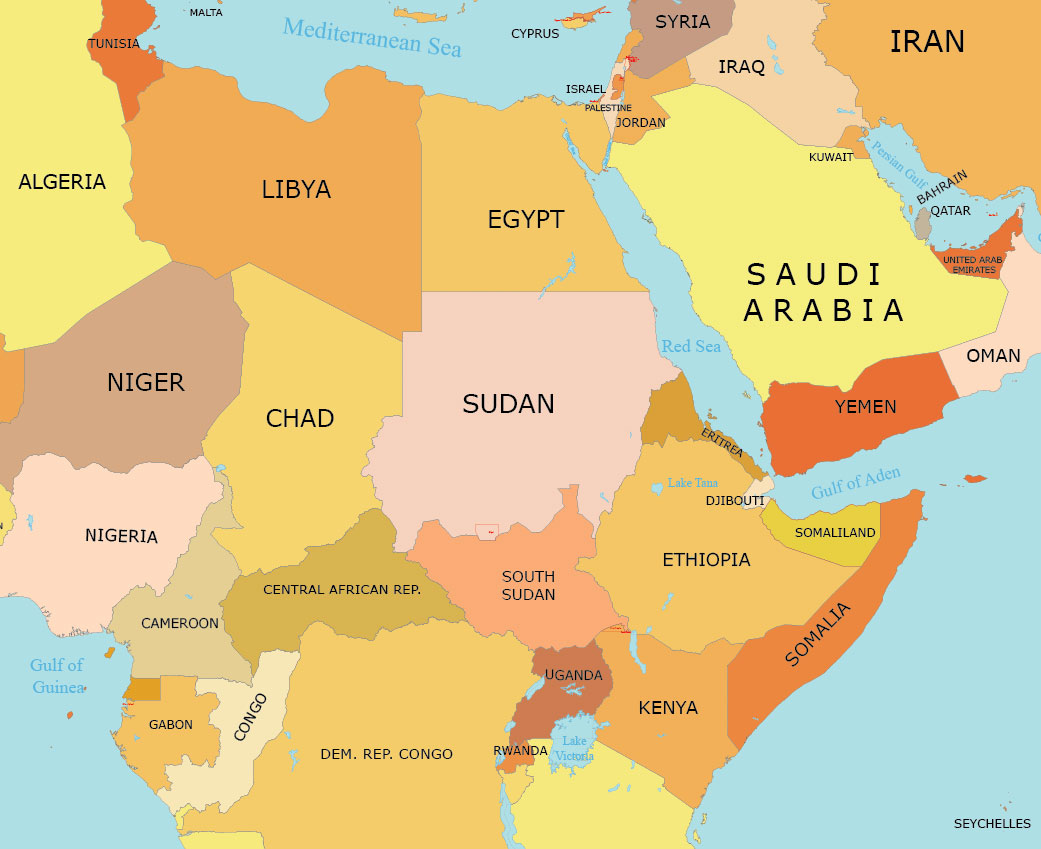
Source: Horn of Africa Simple Map
Part 1 was published yesterday.
DJIBOUTI
This small but strategic former French colony sits at the Red Sea gateway to the Suez Canal, overlooking the narrow Straights of Mandeb. It is famously home to a port serving Ethiopia and hosting the huge multi-agency Camp Lemonnier base for the US and in part the UK, with 4000 staff. However over the last 15 years Chinese companies have dominated and they also have a large Red Sea military base there, a short drive from Lemonnier, allegedly staffing up to 10,000 personnel.
Proposals for a bridge between Djibouti and Yemen, enriching this poverty-stricken area, have been many times scuppered by conflict. The Chinese take over of port facilities prompted DP World (Dubai, UAE) to develop the Berbera port in Somaliland, and potentially the small Bosaso Port in Puntland.
SOMALIA
After achieving independence in 1960 from Britain (Somaliland) and Italy (Puntland, South-Central Somalia), Somalia has been riven with conflict, especially since the collapse of the ‘unified’ government in 1991. There has been no stable government since, although Somaliland has been somewhat less in turmoil. A local movement emerged to settle local disputes, the Islamic Courts Union, but after 9/11 in the US this was seen as problematic.
With Western encouragement Ethiopia invaded in 2006, but were repelled in 2009 by a nationalist tribal movement, Al Shabab, which still controls much of ‘South-Central’ today, despite monthly US bombing. Right wing factions in the US have lobbied for recognition of Somaliland after 2009, but this came to nothing until December 2025 when Israel recognised Somaliland as a separate country, gaining a series of beneficial concessions. This had added to tensions between the UAE and Saudi Arabia, with the latter ‘less enthusiastic’ about such recognition, notably concerned about the possibility of Israeli bases both at the north and south ends of the Red Sea, inter alia.
ETHIOPIA
Apart from the Afar and Somalia regions in the East, Ethiopia is a landlocked, fertile, mountainous country, reliant on Djibouti for external trade. The country is divided into regions based on different ethnicities and their languages, which has led to ethnic-based internal conflict in the post-Italian-colonial-era, hindering development. Nearly two thirds are either Omoro or Amhara. One in eight Ethiopians is either Tigrayan or Somalian with affiliations to Eritrea and Somalia respectively.
Contrary to Western perceptions Ethiopia has 20 relatively modern cities with a population exceeding 100,000, and a modern capital of 3.5m people. Generally perceived as close to the West (eg in relation to Somalia), Ethiopia has close economic and military relations with China. Whilst Ethiopia and Somalia have been at war in the recent past, Ethiopia has been seeking alternative routes to the Indian Ocean, bypassing Djibouti, in discussions with the authorities in Mogadishu and Somaliland, hence the port development in Berbera.
LIBYA
Like most of the Maghreb, oil-rich Libya was a largely Berber region until the Arab migrations under Ottoman rule and before. When Italy occupied Libya before WW1 they divided it into eastern Cyrenaica and western Tripolitania; a division reflected in the post-Gaddafi conflicts after 2011, and the rivalry between western Tripoli and eastern Benghazi/Tobruk. Italian settlers were concentrated in eastern Cyrenaica and this is where most of the infrastructural investment was focused, further fuelling the rivalry.
The West hosts the officially recognised Western-backed government. The Eastern forces, who claim they are are the legitimate government, are allegedly supported by Turkey, UAE, Egypt and Saudi Arabia. However, reflecting new divisions elsewhere, the Saudis have developed closer relations with the government in Tripoli, signalling the scope for an intensification of the conflict.
CONCLUSIONS
There are many scenarios where escalation could occur, focused around the Red Sea, notably linked to oil production and transportation. A Western campaign against Iran could result in a blockade of the Straights of Hormuz, the Bab El Mandeb and the Suez Canal. Western forces could restrict the Chinese base in Obock, Djibouti and pre-empt a Russian base in Sudan. If UAE-Saudi relations deteriorate further, a high intensity conflict could re-ignite in Libya.
In Yemen, the STC could try and regain its territory from Saudi-backed forces. Ansar Ullah in NW Yemen could regard such a conflict as an opportunity to regain territory further south and even ‘re-take’ Taiz. Following Ansar Ullah attacks on shipping, and on Israeli territory, the US has been looking at new ways to ‘clip the wings’ of the Ansar Ullah leadership, recent bombing seemingly having had little effect.
If RSF forces escalate attacks against Port Sudan in Sudan, South Sudan, losing 90% of state revenue, is likely to want leverage over the RSF, with attacks across the border in RSF-held territory, including Darfur, despite the fact that locally the two sides are cooperating.
The recognition of Somaliland as a separate state, may bring it into conflict with currently-recognised Somalia, and potentially involve Ansar Ullah in Yemen, especially if it results in US and Israeli military assets on the ground. If steps towards a Russian base in Sudan near Port Sudan accelerate, Western intervention could result, if a wider war is anticipated.
The act of describing possible conflicts and escalations makes both the fragility and complexity very clear. UK parliamentarians need to keep a watchful eye on the detail, and act as ‘adults in the room’ rather than cheer on never-ending conflict, which could too easily spiral out of control.
* Paul Reynolds works with multilateral organisations as an independent adviser on international relations, economics, and senior governance.
 Follow @libdemvoice.org on Bluesky
 Like us on Facebook
 Subscribe to our feed
 Sign-up for our daily email digest

 Ianto's shrine to be saved
 Walkabout
 Talbot Street and Church Street, Ellesmere
 Neil Fawcett
 Simon Robinson
 Chloe
Chloe Peter Davies
 PM
PM
3 Comments
UPDATE. There are a number of symptoms indicative of an escalation of tensions between UAE and Saudi Arabia in the last few days, providing some challenges for the FCDO in London. Saudi Arabia has been wirhdrawing forces from Bahrain. Informal briefings from Saudi officials suggest they suspect UAE of preparing assets in Bahrain for a conflict with Saudi Arabia. The STC in Yemen has disbanded under pressure from the Saudis, and the Saudis have orchestrated emergency arms supplies from Pakistan for the SAF in Sudan to help in the war against the RSF. However these reports all carry a ‘monitor and verify’ warning, and are subject to statements from the UAE. The FCDO may be turning to Oman and its pivotal role in the GCC, for calming actions, while the US is focused elsewhere.
Thanks, Paul. This is very helpful and informative for those of us who are a bit bewildered by the politics and history of those regions. I suspect there are many of us who are grateful but have nothing to add in the way of a comment.
Libya
“The West hosts the officially recognised Western-backed government. The Eastern forces, who claim they are are the legitimate government, are allegedly supported by Turkey, UAE, Egypt and Saudi Arabia.”
Actually Turkey strongly backs the government in Tripoli (the west) and has provided military support against the Haftar government in the east.