


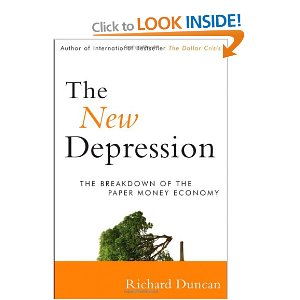
A slight change from the usual in my day job at MHP Communications has come courtesy of our client Richard Duncan and his new book, The New Depression, which is primarily about the US but with lessons that are very applicable to the UK.
In a nutshell, his case is half-Austrian. Or indeed half-Keynesian. That is because whilst Duncan’s diagnosis of the current economic ills is very much in the Austrian school of economics, with its emphasis on the role of credit, his prescription for fixing the economy is large-scale borrowing to fund infrastructure work, all of which sounds rather Keynesian.
 It is a more fiscally responsible version of Keynesianism than some, for Duncan argues that, “The U.S. government can now borrow money for ten years at a cost of 2 percent interest a year. If it borrows at that rate and invests in projects that yield even 3 percent … on a grand scale in grand projects … [our economy] could be transformed”. In other words, borrow massively to boost economic growth, but spend those funds on projects that will generate future returns which make the borrowing affordable.
Duncan has a particular set of target for his investment plans for the American economy – developing new industries to reduce the trade deficit and generate new tax revenues. In particular, he talks about renewable energy, arguing that massive investment will cut energy bills whilst also providing the sort of financial return that makes the massive spending of money on it a prudent rather than profligate move.
All that means there are three main bones of contention in the book: is Richard Duncan right in blaming the crash on credit conditions; is he right that massive infrastructure investment on projects which pay returns the answer; and if money is to be invested in infrastructure that pays returns, does renewable energy fit the bill? Although a book principally about the US economy and the policy choices faced by Americans, those three questions are very applicable to other countries too, even if his evidence tends to be centred on the USA.
As he mulls over these three questions, most readers will find at least one eye-catching piece of evidence to savour, such as when he describes how heavily the financial system became dependent on credit not going sour:
In 1945 [American] commercial banks held reserves and vault cash of … the equivalent of 12 percent of their total assets … By 2007, the banks’ reserves and vault cash [was] 0.6 percent.
He goes on to argue that
Economic progress was no longer achieved the old-fashioned way through savings and investments, but, rather, by borrowing and consumption … The new reality is that credit has displaced money as the key economic variable.
Hence the book’s subtitle, “The Breakdown of the Paper Money Economy”.
Each of the three main questions in themselves could sustain not merely one whole book but a mini-book publishing flurry of titles. To condense credible arguments over all three into one relatively slim and easy to follow volume is tribute to the Duncan, even if some readers may choose to agree with less than all three of the main points of his case.
30% discount: you can buy The New Depression by Richard Duncan from Amazon at 30% off the cover price.
* Mark Pack is Party President and is the editor of Liberal Democrat Newswire.
 Follow @libdemvoice.org on Bluesky
 Like us on Facebook
 Subscribe to our feed
 Sign-up for our daily email digest

 The Joy of Six 1590
 What is Christian nationalism?
 Latest PollBase is out, with all the British voting intention polls since the 1930s
 Peter Hirst
 David Allen
 David Warren
 Tim Rogers
 David Raw
17 Comments
Mark – can you axpand a little on why you connect his views on the role of credit in causing the crisis with the Austrian school?
The popular understanding – which may be wrong! – is that it was advocates of the Austrian school who wanted the deregulation of the supply of credit.
Tim: By de-regulating the supply of credit, you open up the market to huge experimentation as well as huge risk. The idea is that by making banks culpable for their own failures, they will internalise the risk and become more fiscally prudent. Basically, self regulating. Austrian Scholars believe the implicit guarentee of a bailout which is signaled by the state’s regulation of the banking sector (which becomes the means for the state’s economic ends) encourages greater risk taking.
What interests me is this idea of the breakdown of paper money: paper money itself was invented as a token of the state’s promise to supply the barer with precious metals as a representation of all the labour which went into its aquisition. Money is itself a representation of debt: if credit has become the driving force of consumer purchasing power, then the idea is that consumers are good for it because everyone is doing well. They will continue to do well so long as the economy continues to do well, which it will if everyone can keep spending. So when amount loaned exceeds the means for the debtor to pay it back, then the economy stops doing so well, and all the debtors find themselves with reduced incomes, less secure jobs, higher prices, and a ball-and-chain of debt. Spells out how intricate the relationship between creditors, debtors, and the state really is.
Some good questions.
By all accounts infrastructure in the USA is in a very bad state so spending on that looks like a good bet. On this side of the pond it is probably rather better on average but I worry that the general clamour for more will lead to projects like the HS2 which (and I haven’t followed it closely) appears to NOT meet rate of return criteria – or only after the numbers have been fiddled. Ditto PFI projects of which have a stupidly high cost of capital and the central purpose (although it would never be admitted) is that its a way of getting spending off the govt’s balance sheet. (It doesn’t of course).
Renewables seem to be everyone’s favourite investment and that worries me. When a wave of uncritical support builds like this it’s too easy NOT to ask the proper questions but rather to blow a bubble so Mark is right to question whether this will fit the bill. I think renewables are high risk.
A better approach would be to note that some countries are doing perfectly fine as it is without needing to clasp at renewable straws. Perhaps we should ask what it is that makes them successful and which of these factors we could/should replicate. And as it turns out the countries that are doing well already at other things tend to be the countries that are doing well at renewables – Germany for instance.
Tim: Austrian in that he sees credit as so central to the economy’s performance. He in fact presents his own theory of credit, but the central importance given to credit is very much in tune with the Austrian school. Where he departs from it is his views on how to tackle the problems that arise from changes in the levels of credit – talking of infrastructure investment and the like rather than of financial market deregulation.
Thanks Toby.
Do you accept their argument? My own view would be that state regulation or self-regulation probably makes no difference at the end of the day. If you are ‘too big to fail’ then the state is going to bail you out anyway.
Tim: I am in no position to say. I think there’s a huge psychological element to how investment bankers treat their work, and any recommendation ought to be backed up with a rigourous emperical study on their behaviour when exposed to particular incentives. This split between highly protected retail and totally unprotected investment banking sounds like Vince Cable might buy into it, though, but I don’t want to misrepresent his view.
As for “too big to fail”, it seemed to me that the course of nationalisation, re-capitalisation and re-floation was exactly the right move. It stopped people from losing their deposits, and when managed correctly even generates a profit for the taxpayer. The last thing we need in a crisis of credit is a whole load of money disappearing. I suppose the negative implications are contained within the problems of the national deficit.
The challenge is of course to get the US government to borrow money and spend it on infrastructure, rather than letting it get stolen by companies with impressively complicated proposals that turn out to be ineffective at anything other than receiving funds from the government.
I think the point is that after WWII there was a drive to improve and expand. In terms of Britain we need to make our energy more selfsufficient. British power stations need to be updated, We are sitting on abundant coal that for ideological reasons,, both environmentally and politically sensitive, we’ve talked ourselves out of utilising. Our gas storage could be expanded and improved. .Water is wasted because we have companies that will not pay to replace the pipes that carry it.. So we do have infrastructure problems that need addressing.
On the subject of renewable. Sure they are high risk. But doing nothing beyond expanding monstrously inefficient wind farms and subsidising them at great expense without looking at ways of making the technology better is pointless. We’re an Island in a stormy sea, so hydra power of some sort could be looked at more seriously.
On a relatively less major note our broadband could be a lot faster. These are major infrastructure projects that would have long term benefits.
Precisely. If money was actually being borrowed by governments to spend on economically productive projects then I’m sure a lot more people would support it. The reality though is that deficits are being run to support everyday transfer aand public services spending. That’s why it’s a disaster in the making.
I suppose one test of the importance of credit would be the value of the ratio of debt to paper money. In https://www.libdemvoice.org/greece-a-victory-for-all-europe-29028.html, John Dunn claims that “UK indebtedness as a whole (government, banks, households, etc.), is somewhere in the region of 492% of GDP”. If this is true, it would seem likely that the ratio is at leat 5 and probably more like 20. That seems to make credit the primary measure of economic wealth, not paper money, and the necessary focus of attention if things are to improve.
I suggest that RISK is a major factor in economies running in credit, so we need to develop much better methods of risk assessment, risk mitigation, and damage control.
Like the US, it seems we can borrow at low interest, so the investment argument seems to be sound. Renewable energy is just one of the many optons – everyone seems to be doing it so will it necessarily allow us to pay back that debt? The Institution of Civil Engineers prduces regular “State of te Nation” reports and briefings which describe the generally catastrophic nature of some of our infrastructure, and makes recommendeations on what to do. (http://www.ice.org.uk/Search/Advanced-search.aspx?searchindexes=1&searchtext=State%20of%20the%20Nation)
I don’t thnk it was too many years ago that people were saying that our pipelined infrastructure – water, sewage, gas – was made in Victoria’s time and now in dire need of repair. And of course North Sea oil production is slowing and we need new energy sources. These kinds of things need to be done now, because if we leave them till later the problems they create will prevent us from taking full advantage of conditions when a global recovery starts.
Good points from Richard Dean.
I’ve heard somewhere that a water provider in the south (where there’s regular hosepipe bans) loses up to 20% of its water through leaks in its distribution system.
The more I read about the economic problems in Europe, the more it seems to me they are about foolish lending rather than about the single currency. The single currency may have led to a false sense of security over lending to countries with weak economies, but I don’t think this entirely absolves the bankers.
The UK political/media establishment has been very happy to over-emphasise the role of the single currency in this and under-emphasise the role of property speculation. There are very obvious reasons for this. First much of the media is owned by people who wish to have a weak EU and to align the UK with the USA and right-wing extreme free-market economics. While they may fly the patriot flag, what they really hate about the EU is the way its international co-operation can fight back against the interests of global big business. They prefer divide-and-rule in which big business plays off nation state against nation state. See how the EU “interference” they hate most is that aimed at the “finance industry” even though to get the support of the plebs they run all those “straight banana” stories. Secondly, if it gets out that the real problem is the idea that we can all make money by selling houses to each other, that undermines much of what has been said by them about the UK economy ever since Mrs Thatcher set it off on its disastrous path to being about making money from owning things rather than making money from work.
I know something about Ireland where there was just so much throwing money into property “no questions asked” as if it were a perpetual money generating machine. Yet how many of t hose now blaming the Euro for Ireland’s problems had anything critical to say about the notion of the “Celtic Tiger” when this nonsense was happening?
Underneath, the “property ladder” is a conveyor belt of money from the middle classes to the rich. People are encouraged to borrow more than they can really afford and convinced this is somehow a worthy “investment”. It is forgotten that every pound used to buy housing comes out somewhere else at the other end. The more that is made available at the bottom end to buy it, the more prices go up, the more is churned out for the super-rich at the other end. So the super-rich end up with the real wealth, and the rest of us end up with the personalised debt. The word for a form of investment which pays out only because of what is paid into it is “Ponzi scheme”.
However, to question the extent to which UK property ownership is wrecking our country due to its Ponzi elements is to question what is regarded as most fundamental to UK politics since 1979. I know from bitter experience how difficult it is in this country to question the idea that property ownership should be a money-making machine. Even the tiniest interference with that, such as Vince Cable’s proposed “mansion tax”, gets shouted down. I’m afraid, however, that so long as we live in a system where it is just supposed those who own property can make money without having to work for it, we will never build a truly strong economy. Furthermore, given the necessity of good homes for a stable society, we shall just build up human misery and a rotten unhappy and unstable society which is not a basis for a prosperity.
Mark,
It is good to see publications moving away from dogmatic positions like Hayek v Keynes and developing their economic argument around the proven insights of the great economic thinkers. We need more of this impartial thinking and analysis if we are to develop a rational and reliable base of economic theory, grounded in real world evidence, that can be consistently applied in a policy framework.
Matthew,
agree with your comments on the problems in the Eurozone. However, I don’t think property speculation and the desire to extract economic rents is anything new. Land reform has been an integral part of mamy a revolution and social upheaval, as I expect access to affordable housing will be in the 21st century.
Further to Matthew’s comments the best background analysis of how this works is that of Minsky explained by Steve Keen in his good but wonkish Debtwatch blog.
Following a great depression bankers are cautious and lend only to projects that a soundly based. As time passes and with it a generation of cautious bankers a cohort who have never experienced bad times takes over and takes more and more risk. This matters because banks can create credit with just a few mouse clicks and are incentivised to do so since the more they lend the more interest they get. The only real constraint is the leverage of their capital base they feel safe with or are regulated to. With securitisation of loans this constraint disappears so credit can expand explosively.
Genuinely quality projects are relatively scarce but once debt becomes readily available and cheap customers will naturally take advantage. This is exacerbated when high pressure selling of inappropriate financial products, (especially to less sophisticated customers – eg sub-prime) happens and, absent toothy regulation, it happens a lot. Since the credit supply is large in relation to the property prices these start to rise creating a one way bet of prices floating ever higher on a tidal wave of cheap money.
At this stage most investment is no longer in productive assets but speculative although individuals are all behaving perfectly rationally and the economy is booming. But the big picture is that this is a Ponzi scheme. When the Ponzi eventually and inevitably breaks the losses are immense because a generation’s savings have in effect been poured down the drain leaving nothing to show for their hard work. Thatcher and her followers enabled this by deregulation – when the establishment believed that markets can do no wrong there was little incentive to ask searching questions.
The Euro made it worse. Before the Euro if a German bank lent to a Greek or Spanish borrower there was an exchange rate risk – if it went against them they could loose – and so they were properly cautious. After the Euro the exchange rate risk was eliminated so the surplus country banks lent freely to the deficit countries – a trend that was encouraged because the ECB set interest rates low to help Germany recover from reunification.
What the banks forgot of course is that you cannot abolish risk. What was formerly exchange rate risk merely morphed into solvency risk. If a retailer or manufacturer made an equivalently basic error they would deserve to go bust and so do the banks. Governments have been trying to paper over this inconvenient truth and restore the status quo ante by bailing them out with taxpayers’ money (under the table as it were so that voters don’t notice) but the banks’ losses are too big.
We need to work out a completely new concept of how the economy should be run. Other countries have done this and so can we, the most difficult part of this is escaping from the blinkered thinking we get from a political establishment that wants no change because it is doing very nicely thank you.
Liberal Eye,
I would endorse your comments on Minsky’s financial instability hypothesis. It is by far and away the most prescient and lucid real world explanation, I have seen, of how we got, over a period of several decades, to the ‘Minsky Moment’ of a banking collapse in 2008.
Minsky did take a run at working out how the economy could be run better [i]Stabilizing an Unstable Economy (1986)[/i],and advocated government control of excessive speculative lending through regulation, central bank action and other tools as well as a job guarantee program to stabilise wages, inflation and employment.
Link to a good analysis of the present UK economy. (Warning – not for the squeamish)
http://media.hindecapital.com/attachments/reports/full/129/original/Eyes_Wide_Shut_Part_I.pdf
(It’s pretty much along the lines that Liberal Eye said 19th June 4:45pm, but with graphs).
John Dunn
Thanks for linking that Hinde Capital report which I hadn’t come across before. Their analysis is sobering indeed but very much along the lines of my own. There is an escape route but it’s closing fast.
As an aside, they admit that their financial model is very limited – I should say! A model of a complex system (ie the economy) that cannot handle feedback loops, the defining characteristic of complex systems!!! In defence of Hinde that is fairly standard or so I understand. No wonder economists have played a large part in driving us into a hole.