


The Labour Party has two attack lines on the economic recovery these days. One is that it is the slowest recovery ever, and the other is that it is happening particularly unfairly. Both are wholly without merit, and show that Labour are living in a fictional dreamworld.
The charge that this is a particularly slow recovery seems to be based on the length of time it is taking to return to trend, looking at graphs such as this:
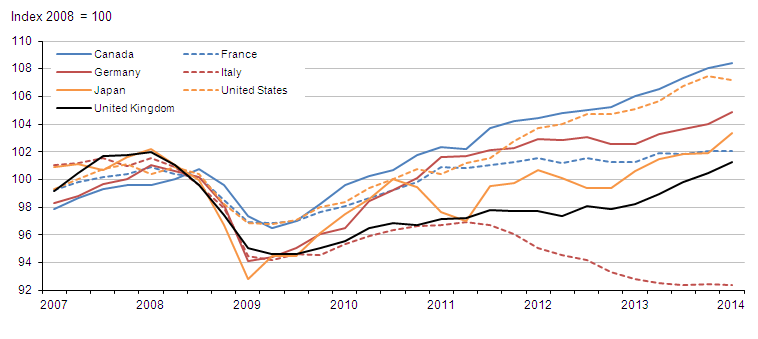
But of course this length of time depends not only on the speed of recovery, but on the distance, that is the amount of GDP lost in 2008 and 2009 that has to be made up. To damn the coalition’s recovery as slow because the recession under Labour was big, is hypocrisy of the highest order.
I’ve also heard Labour blame the coalition for the “longest recession since the second world war” which lasted from Q2 of 2008 until Q3 of 2009 before the coalition was formed.
So let’s look at the recovery, since 2010, bumpy start and all. Taking Q2 2010 = 100 shows G7 performance since the coalition was formed. (Disclaimer: there is also a change to GDP calculation between these two graphs.)
And here's UK GDP growth since Coalition was formed in 2010 relative to rest of G7 after @ONS revisions: pic.twitter.com/Wz0ITzniWI
— Ben Chu (@BenChu_) September 30, 2014
Could it have been even faster? Possibly. But does this show the coalition’s economic policy doing damage, or performing weakly? It’s pretty hard to make that case any more.
Second: the unfairness of it all. I have touched on this before. What we are seeing is that growth in the economy is being reflected not in wage growth, but in growth in the numbers of people who are employed. This is fairer. It brings more people closer to the average income than increases in in-work wages would, as that would leave the unemployed further behind.
Broadly speaking economic growth must be reflected in some combination of increased profits, increased wage rates, or more people in work. Each of these three possibilities is fairer than the one before, so this is the fairest kind of recovery there is. That’s not to say it will last – as unemployment falls there will be upward pressure on wages, and that too should be welcomed.
With fairer taxes, and with welfare rising faster than wages, a falling gini index should be no surprise.
Over longer period recent inequality changes insignificant. Big rise in 1980s. Flat-ish ever since: pic.twitter.com/xdrFFpL3hk
— Ben Chu (@BenChu_) October 1, 2014
Now it is true that many people, in or out of work, are struggling to make ends meet. Inflation, particularly for food and energy, has been high over the last decade or so. The growth of food banks represents good anecdotal confirmation of this. So there remains a great deal of hardship in the country, and we should keep our focus on creating jobs, on fairer taxes, and on maintaining an adequate safety net in the welfare state. But hardship is not evidence of an unfair recovery because there is a squeezed middle and a squeezed top as well. The crash made the whole country a lot poorer, remember. Our fair and, now, fast recovery is the quickest route out of this.
* Joe Otten was the candidate for Sheffield Heeley in June 2017 and Doncaster North in December 2019 and is a councillor in Sheffield.
 Follow @libdemvoice.org on Bluesky
 Like us on Facebook
 Subscribe to our feed
 Sign-up for our daily email digest

 "Private affluece and public squalor" rule OK
 Jago Hazzard on the planned West London Orbital rail service
 A brilliant maiden speech from Dave McCobb
 Labour to shun pacts with Greens
 Steve Trevethan
 Kevin Hawkins
 Ellyott
 Nonconformistradical
 David Raw
88 Comments
This *is* the slowest recovery in at least a hundred years though. The recession of 1920-1924 was deeper but we still saw a quicker recovery. I’m really confused as to why you’re trying to pretend otherwise.
I’d make four observations, in no particular order.
1) Once again we see a LDV article on this that does not mention ringfences – something that this coalition has been rather fond of. It is well and good to look at fairness in terms of (lack of) wage growth, but what about the fiscal consolidation per se? Why exactly is it A-OK to borrow £2bn+ for a, ‘fuel,’ payment in, supposedly, austerity? Defence, local government and HE have all taken considerably deeper cuts due to ringfences. It is not clear to me at all why there are sacred cows. At least not in economic terms.
2) All of this is with QE – started under Labour, carried on under Coalition. Take that out of the economy and the numbers probably don’t look so good. We are nowhere near unwinding QE, or indeed selling bank shares. That’s not to say that the Coalition has done much different to what Labour would have done – I simply observe here that it’s a factor. We have turned our currency into toilet paper.
3) Fairer taxes? 20% VAT was and remains ugly. CGT is good stuff though.
4) Is deficit reduction still the be-all-and-end-all? It wasn’t totally clear when Cameron was planning to introduce his tax cuts yesterday, but even so it still looks like opening a fiscal gap. I await Clegg’s views on surplus/deficit with interest.
Surely VAT is a fairer tax in that the rich have to pay it and most basic goods which the poor need are VAT exempt.
@Little Jackie Paper
“Fairer taxes? 20% VAT was and remains ugly.”
What a strange comment. There’s nothing in the least bit “ugly” about 20% VAT.
Those more essential items subject to 0% or 5% VAT saw no increase in the VAT rate at all. No wonder the independent IFS concluded that the increase in the standard rate of VAT was “mildly progressive”.
People should look at the facts before making assertions.
Joe Otten has done that and we should draw the conclusions.
Simon
You may recall that we were against a rise in VAT at the last election – all the way until we put VAT up.
As the wise man is quoted as saying here http://blogs.channel4.com/factcheck/so-is-vat-regressive-day-2-and-the-debate-continues/5455
‘If you look at the effect (of VAT) as compared with people’s income then, yes, it is regressive’
@LJP – ” We are nowhere near unwinding QE”
You think that we will ever unwind QE?
@Little Jackie Paper
Unfortunately you are clearly not a wise man.
Because VAT (at 5%) is charged on certain items (principally domestic gas and electricity), and because any tax on domestic fuel is regressive, overall VAT is regressive not progressive.
However what I said is that the increase in the standard rate of VAT was “mildly progressive”.
If you don’t appreciate the difference between the standard rate of VAT and all VAT perhaps you would be better not commenting on the subject.
@A Social Liberal
“You may recall that we were against a rise in VAT at the last election – all the way until we put VAT up.”
I don’t generally don’t recall things that didn’t happen. You’ve clearly got a strange memory.
BEFORE the 2010 General Election, Vince made it clear on BBC TV that he couldn’t rule out an increase in VAT. Had you forgotten that?
Paul in Wokingham – ‘You think that we will ever unwind QE?’
It looks remote.
Simon Shaw – ‘If you don’t appreciate the difference between the standard rate of VAT and all VAT perhaps you would be better not commenting on the subject.’
I am mindful that, judging from previous threads, you seem to think that passive aggression and sneery insults are some sort of a substitute for debate. To my mind you are twisting and turning like a twisty turny thing. You think that VAT is the good stuff, and that’s your value judgment to which you are entitled – perhaps you could elaborate in some way that extends beyond calling me thick.
I disagree with you, and I can remember a time when that didn’t result in a spit of vitriol. There are, of course, entirely valid reasons to raise VAT, not least the large sums it raises. I however feel that they are outweighed, I’m terribly sorry if my expressing a view affronts you.
Simon Shaw – Perhaps the picture here might jog your memory?
http://www.theguardian.com/uk/blog/2010/jun/22/nick-clegg-vat-poster
Slow and unfair. The fact is that Osborn inherited higher growth then crashed and it’s just about recovering again. Food banks, wage freezes or benefit freezes and sanctions for the poor. Tax cuts, no strings bail outs for bankers and knock down sell of for share holders. Nothing fair or quick about.
I vote Lib Dem, but flat out refuse to support the coalition or argue for its continuation.
Wouldn’t a fairer assessment of “recovery” be something like “GDP minus deficit”. It’s fine to have growth in GDP, but if that is achieved at the price of a deficit that increases more than GDP does, then we are making ourselves poorer in the longer term.
Calculations, based on data from Google, suggest that “GDP minus deficit” is increasing at about 1% per year. Which is ok, though small. A problem is that people perhaps don’t feel it that way.
@Little Jackie Paper
Your difficulty is that you clearly just don’t understand how VAT works.
I know that Blog sites are full of people talking about things that they know little or nothing about, so what you are doing is nothing unusual. However you shouldn’t really complain when I point out that comparing the effect of ALL VAT (including the 5% rate) with just the Standard Rate (previously 17.5%, now 20%) is highly misleading.
Richard Dean – Yes. But then there is the other aspect which is household deleveraging. There are some good graphs here:
http://moneymovesmarkets.com/journal/2013/1/2/will-uk-consumer-deleveraging-slow.html
For me this has been one of the more significant triumphs of the Coalition (albeit helped by low interest rates, started under Labour and carried on post election) and I am somewhat surprised that they don’t make more of it.
Little Jackie Paper
“Simon Shaw – Perhaps the picture here might jog your memory?”
Once again the snide comments. Why don’t you do two things:
1. Find out what that advert ACTUALLY says at the bottom (which the Guardian photo doesn’t make clear).
2. Find out what Vince said BEFORE the Election about increasing or not increasing the VAT rate.
As you are obviously so interested in this topic, you could then come back and tell the rest of us.
Actually my previous calculations now seem erroneous. Since 2010, the deficit seems to have increased more than GDP, so we seem to be poorer now than previously. This would agree better with what people feel.
@Simon Shaw “overall VAT is regressive not progressive. However what I said is that the increase in the standard rate of VAT was “mildly progressive”.”
So is the Lib Dem position that VAT is bad (regressive) but increasing it is good (progressive)?
@Little Jackie Paper
As Simon Shaw points out, before the 2010 election Cable said he could not rule out an increase in VAT. Also, the Conservatives said they had no plans to increase it, e.g. William Hague: “‘Vince Cable said no chancellor rules out any tax increases but we don’t have any plans to increase VAT. I think the Liberal Democrats can pipe down about this now,’ the shadow foreign secretary said.” (http://www.dailymail.co.uk/news/election/article-1264531/General-Election-2010-Tories-planning-secret-389-year-VAT-bombshell-warns-Clegg.html). This, and Simon’s enthusiasm for the increase, suggests that perhaps the rise in VAT from 17.5% to 20% was a Lib Dem policy, not one of Osborne’s. Food for thought, and sadly another reason for me not to return to the Lib Dems any time soon.
Nobody should take the comments on this site, whether above or below the line, as the gospel Lib Dem position, unless I suppose written by an official spokesperson.
But VAT is clearly somewhere in the middle of the tax range, being less progressive than income tax, but more progressive than Labour’s favourite place to hike taxes: Council Tax. It’s mildly progressive if you judge by expenditure deciles and mildly regressive if judged by income deciles – largely because there are significant numbers of people with temporarily low or zero income but who maintain high levels of spending. This is not a “lib dem” position, it is an observation that does not depend on any political motivation.
I support Clegg and Danny, so I have nothing to gain by criticising the Lib Dems economic policy, but I am concerned. I don’t have much unique to say about the Conservatives policy.
What I want to see from the Lib Dems is a tacit recognition that the recovery is fragile. They don’t have to announce it and start advertising Britain’s weaknesses to the world, but they can start by governing and promoting policies as if there is hardly any money left.
I want higher taxes and more cuts. I would also love some u-turns on previous policies. I am not against Keynesian investment, but I think we’ve taken it too far.
Pressure needs to be put on the Bank of England to hurry up with a slight interest rate increase. It is encouraging a culture of household debt and gambling on the stock market.
Lastly, the business vote is up for grabs with businesses concerned about the Conservatives clamping down on free movement. This also has social implications, so the Lib Dems should present themselves as the real party of sustainable business and a fair society.
@ Little Jackie Piper
“3) Fairer taxes? 20% VAT was and remains ugly. CGT is good stuff though”.
Tax systems have to do lots of things besides redistribute income. For example they need to raise enough money to fund government, discourage undesirable activities [hence landfill duty etc] and so on. Surely we should look at the overall impact of the total tax system when we judge whether or not it is progressive and not just the impact of individual taxes? Most of the basic necessities of life: housing; heating; water; food; public transport are not subject to the 20% VAT rate.
@ Eddie – “I want higher taxes and more cuts.”
This is exactly what we’ll get, regardless of whether the tories, labour, or martians get into power in May15.
With a £80b/year deficit this is already priced-in to the system, as they say.
What matters is where you stand on the balance of spending-cuts / tax-rises….
We tax right now about 42% of GDP, which is already greater over and above the long-term historic trend of ~38% of GDP.
This is partly due to the low growth at a time of static tax revenues, and will naturally lower to about 38% of GDP as the economy recovers. likewise spending as a proportion of gdp will decline back to 38% as growth replaces deficit spending and debt interest repayments with tax.
The question is do you seek to keep the tax-rate at current levels, and above the historic long-term trend rate, and are you going to seek a mandate to do so in 2015?
@ Richard – “Surely we should look at the overall impact of the total tax system when we judge whether or not it is progressive and not just the impact of individual taxes?”
Absolutely, we should!
And the ONS is quite certain that all household income quintiles lose roughly one third of income to the exchequer when the effects of [both] taxation [and] benefits are considered:
http://www.ons.gov.uk/ons/dcp171778_367431.pdf
I find myself extremely relaxed with this result.
@Little Jackie Paper:
” Perhaps the picture here might jog your memory?ing on fule e”
It certainly jogs mine since I must thank you for proving yourself wrong and Simon Shaw right.
The advert clearly points to the likely intention of the Tories, pre-election, to raise the rate of ALL VAT (including fuel) to pay for their uncosted handouts to the rich which would be highly-regressive in both elements. ie adding to Labour’s 13 year record of increasing inequality more than Mrs Thatcher did.
Raising only standard rate VAT, of which I am no massive fan for other reasons, is mildly regressive. If you had the slightest clue what it is like to live on state benefits alone or even on part time minimum wage, you would understand this as you tend to buy very little that is standard rated. But it would appear that you do not.
@Peter Watson
“Simon Shaw – “overall VAT is regressive not progressive. However what I said is that the increase in the standard rate of VAT was “mildly progressive”.”
So is the Lib Dem position that VAT is bad (regressive) but increasing it is good (progressive)?
Is regressive the same as bad? For example, food prices are regressive, but they are just a fact of life. Taxes on tobacco are regressive, Are you implying they should be reduced, as that would be “good”?
I was merely stating some facts about VAT that clearly some people either haven’t thought about or don’t understand:
1. 5% VAT on domestic gas and electricity is regressive, as green taxes can often be.
2. Because many essentials (most food, childrens’ clothes, public transport, rent etc) are zero-rated or exempt, standard rate VAT (20%, previously 17.5%) is mildly progressive.
3. Taking 1. and 2. together, VAT as a whole is regressive.
4. Because of 2. the increase from 17.5% to 20% VAT was “mildly progressive”, according to the IFS.
5, The IFS have never said that VAT overall is progressive.
@Joe Otten
“The Labour Party has two attack lines on the economic recovery these days. One is that it is the slowest recovery ever, and the other is that it is happening particularly unfairly. Both are wholly without merit, and show that Labour are living in a fictional dreamworld.”
“With fairer taxes, and with welfare rising faster than wages, a falling gini index should be no surprise.
Joe I understand you are a parliamentary candidate for the next election. And your views shows me why I would never be able to vote Liberal Democrats again when so many like you on the right of the party seems entirely at ease with the direction that the coalition has dragged the party and indeed would be happy for it to become further dragged to the right.
For a party that is supposed to believe in “plural politics” which to my understanding means a party that is willing and capable of working with any party of any hue, However, this does not appear to be the case with you.
All I have seen from you is your constant attacks on Labour and their economic policies, in fact Labour hardly even gets to take a breathe after releasing a statement and you pounce with your expert analysis on how terrible they are and yet when it comes to your bedfellow Tories….. complete silence.
It makes me question just how much negotiation is going on between the coalition on economic policies and cuts when there are so many people like yourselves ready to defend the Tory Position.
You say welfare is rising faster than wages. How about some honesty please. Why is Welfare currently rising faster that wages? It is not out of work benefits, sickness benefits, Tax credits that are rising faster, these have all been capped at 1% for the last couple of years and are set to be frozen for the next couple of years after that.
The reason that the welfare bill continues to rise is because Pensioners have been totally shielded from the welfare cuts, not only have they been shielded but they have been increased by RPI adding billions of pounds to the welfare bill.
People like yourself and your Tory counterparts like to constantly bang on about how much the welfare bill is rising and needs to be brought under control, you freeze welfare for those on low income, unemployed and sick. And then you chase the Silver vote by ever increasing state pensions, serps, Attendance Allowance.
You Increase the welfare budget at the expense of cuts to the working age poor.
Whilst the party is being ever dominated by those on the right, the Clegg’s, Laws, Alexanders and Browne’s and the up and coming Otten’s. I will never give my vote to Liberal Democrats again
@Peter Watson
“This, and Simon’s enthusiasm for the increase, suggests that perhaps the rise in VAT from 17.5% to 20% was a Lib Dem policy, not one of Osborne’s. Food for thought, and sadly another reason for me not to return to the Lib Dems any time soon.”
I think the increase in (standard rated) VAT was a very good idea. As you appear to think it wasn’t, perhaps you could explain why?
Also, could you also explain where you would have preferred to raise tax instead, bearing in mind what the Coalition Government has already done, including:
1. Top rate of income tax 10% (now 5%) higher than Labour’s 40% rate
2. Tightening up on tax avoidance, particularly in the area of Tax Relief on Pension Contributions.
Or would you simply have preferred an even bigger budget deficit?
@matt
“Why is Welfare currently rising faster that wages? It is not out of work benefits, sickness benefits, Tax credits that are rising faster, these have all been capped at 1% for the last couple of years and are set to be frozen for the next couple of years after that.”
I notice that you missed out Housing Benefit. Was that deliberate?
You call for honesty. Could you tell me whether the (non-pensioner) welfare bill is rising faster or slower than wages?
Finally, as you are clearly such a fan of the Labour Party and its economic policies (sic), why don’t you just vote for them rather than coming on here and attacking people like Joe who make totally valid criticisms of them?
@ Matt – “The reason that the welfare bill continues to rise is because Pensioners have been totally shielded from the welfare cuts, not only have they been shielded but they have been increased by RPI adding billions of pounds to the welfare bill.”
I don’t know if you remember, but a consistent theme throughout the noughties was how pensioners were being utterly shafted.
This might then be seen as a natural correction, perhaps?
*this from a person as much as three decades away from retirement*
@Simon Shaw
“I notice that you missed out Housing Benefit. Was that deliberate?”
I did not mention housing benefit because housing benefit goes straight into the pockets of the landlords and not the welfare claimant. And in my opinion it is the fault of successive governments that Housing Benefit has risen so far, down to selling off all the council homes and not replacing them. Also because of the lack of proper rent controls
The other reason I did not mention Housing Benefit was because some pensioners do in fact claim housing benefit as well, adding to the welfare costs
“You call for honesty. Could you tell me whether the (non-pensioner) welfare bill is rising faster or slower than wages?”
Out of work benefits and sickness benefits are not rising faster than wages, it is true to say they saw a significant increase in the few years from 2004, but then that was only catching up from the years when they were held back.
From 2011 the coalition has capped increases at 1% below the rates of inflation and they are set to freeze them for another 2 years 2016/17
So no (non- pensioner) benefits is not raising faster than wages (excluding House Benefits as already explained)
“Finally, as you are clearly such a fan of the Labour Party and its economic policies (sic), why don’t you just vote for them rather than coming on here and attacking people like Joe who make totally valid criticisms of them?”
That tired old chestnut again Simon. I will post where I damn well like on a open forum as long as I stick to the rules.
If you do not like it, do not read it and stick to your members only section.
I have a voice and I have a right to express it and express it I will. funny enough it’s called Free Speech
And I have a right to lobby any party with my opinions.
I would have thought an intelligent, open minded person such as yourself representing the Liberal Democrats would understand and welcome that with open arms
@Jedi
“I don’t know if you remember, but a consistent theme throughout the noughties was how pensioners were being utterly shafted.
This might then be seen as a natural correction, perhaps?”
And you think the same was not true for people on out of work benefits? They were also shafted for years and many living in horrendous poverty. The Increases they got where also seen as a “natural correction”
However since the coalition came to power those attitudes seem to change.
The coalition raised welfare spending on the silver votes at the expense of cutting welfare for the working age, sick and unemployed.
Thats the honesty that the Tories and Liberal Democrats seem to not want to admit to
It was an unnecessarily slow recovery for a country that issues it’s own currency.
At the time the Coalition introduced an accelerated programme of deficit reduction the then Governor of the Bank of England promised to offset the fiscal tightening with substantial monetary easing. But failed to deliver. Nor did the Coalition leaders take him to task on this. They feared accusations that in doing so they were casing inflation.
Britain led the way out of the Great Depression by being the first country to leave the Gold Standard. The list of countries recovering from the Great Depression exactly match the the list of those leaving the Gold Standard. The last to leave were the last to recover. QE is similar to leaving the Gold Standard. It could have been conducted in a number of ways. The way the Bank of England did it was more unfair and more distorting that it could have been. Again, politicians were negligent as much as central bankers. Politicians gave the central bank independence over operational matters, not total independence, but they never used the power that they had retained over the central bank. Alas!
QE, like all forms of monetary loosening is influenced by the expectation of whether it will be permanent. The more it is felt that it is temporary, the less effective it is. The theory is that if you think a policy will be reversed in a short while, you are not influenced by it. Why make a relatively illiquid investment decision based on an ‘incentive’ that is going to be reversed in the relatively near term?
If the recovery falters or if another global supply shock strikes, we, as a currency issuer, need to be ready to adopt sufficient monetary easing very quickly. If talk of near term interest rate increases continues there is a great danger of the recovering faltering. Next time we should ensure that unconventional monetary easing is done in a way that produces lasting assets for the public not for the already asset rich.
Keep watching the rate of growth of. NGDP .
@ matt – “And in my opinion it is the fault of successive governments that Housing Benefit has risen so far, down to selling off all the council homes and not replacing them. Also because of the lack of proper rent controls”
Or, perhaps we should have made a planning regime permissive enough to accomodate the swiftly rising population we were encouraging….
Rent. Controls. Don’t. Work.
@ BleB – “Britain led the way out of the Great Depression by being the first country to leave the Gold Standard. The list of countries recovering from the Great Depression exactly match the the list of those leaving the Gold Standard. The last to leave were the last to recover. QE is similar to leaving the Gold Standard.”
Hmmm, surely the eurozone is a much better analogy for the gold standard and the crisis it exacerbated?
First to leave = first to recover – and then maybe Britain will find the pace of its own recovery accelerating…
@jedi
“Rent. Controls. Don’t. Work.” Why don’t they work?
You did not reply to my point on my previous comment, So maybe you agreed with it?
“And you think the same was not true for people on out of work benefits? They were also shafted for years and many living in horrendous poverty. The Increases they got where also seen as a “natural correction””
“You did not reply to my point on my previous comment, So maybe you agreed with it?”
No. I do not.
New labour tried throwing cash at the welfare state with a toxic nest of in work and out of work benefits and if they could not achieve that on the back of what the public will consent to in taxation then money is not the solution to the problem.
Want more money to spend, ask for the electorate for more tax.
““Rent. Controls. Don’t. Work.” Why don’t they work?”
http://www.thelocal.se/20130723/49206
Jedi.
Home ownership is going down in Britain. It depends on how you view the market. Fair rent agreements, a form of rent control, were the norm until 1989. They worked fine.
@Jedi
You have a very peculiar perception of history.
It was a well known fact that benefits where kept well below inflation for years under Tory Governments and in the first years of Labour Governments, those on working age benefits and out of work benefits where as you put it utterly shafted for years.
The Increases in benefits where seen as a natural correction and essential to lift millions of families and especially children out of poverty,
Then the global financial crisis hit and all of sudden all of the compassion in the world disintegrates,
Parties ashamedly try to redefine what and who are classed as living in poverty.
The working and non working poor, sick and disabled are all thrown to the wayside in order to limit the impact on the rich and the very rich.
There was no were all in this together, The recession did not affect those at the very top on the income scale, in fact many of them saw their wealth increase during the recession
But that’s ok, you carry on and try to rewrite history, distort the truths.
Hopefully come election day most people will be sensible enough to see through all this guff
Perhaps not as off-topic as it might seem: I notice that Tesco has sold (at a loss) the brand-new, unused corporate jet that it recently purchased so that it’s brilliant management team (who as we all now know have been cooking the books overstating half-year guidance) could fly around just like He-Man, Skeletor and the other Masters Of The Universe. Meanwhile on the shop floor you’ll get a short-hour contract on minimum wage.
I agree with Jedibeeftrix that the on-going crisis in the Eurozone is an example of what happens when nations do not have control of their own monetary policy: note Italy on the GDP graph above. With its extremely high debt-to-GDP ratio (current 133%), Italy is at particular risk from the slide into secular deflation that is now taking root across the EZ.
And I agree with Bill (indeed it is the single comment I have made most often on this forum) that we made a profound error in introducing QE as a strategy whose primary effect was to boost the nominal value of the assets of the rich. Why did the treasury limit itself to purchasing gilts when it could – for example – have bought AA-rated bonds from builders of social housing?
@ Glen – “Home ownership is going down in Britain. It depends on how you view the market. Fair rent agreements, a form of rent control, were the norm until 1989. They worked fine.”
We were also building a greater number of houses each year at a lower level of population growth.
Building more homes is the answer, via a more permissive planning environment, not trying to buck the market from correcting price against (limited) supply with (growing) demand.
@ matt – “Then the global financial crisis hit and all of sudden all of the compassion in the world disintegrates,
Parties ashamedly try to redefine what and who are classed as living in poverty. The working and non working poor, sick and disabled are all thrown to the wayside in order to limit the impact on the rich and the very rich.”
Matt, the historic long term trend in this country for taxation as a proportion of GDP is roughly 38% percent.
Labour managed to push this up to ~40% and had a deficit of several percent on top of this (at the height of the economic cycle which is downright irresponsible), and even then you say this is not enough money.
Your problem is with the electorate of this country; go and ask for more taxes!
Every now and then I consider going back to voting for the LD
Then, thankfully, Joe Otten and Simon Shaw poke their heads up and remind me why there is no way that I could vote for a party where two such people are elected representatives and consider themselves the mainstream
Fortunately I see no chance of Otten ever making it to Parliament – I have some friends who live in his prospective constituency and are thankfully of the same opinion of him as I, although I would be amused to see him squirming whilst doing a volte-face under a new leadership in 2015
Thanks guys for helping me out in this way
@Jedi
“Your problem is with the electorate of this country; go and ask for more taxes”
Actually you are wrong there, I do not want to ask the whole electorate to pay more taxes.
Where I differ to you, I want to see changes to different priorities on area’s where we spend money and make cuts.
You want the Defense Budget to be kept at 2% or higher of GDP, I would rather see it cut and too cancel the replacement of trident. I don’t see the point in having a nuke which will only be used in retaliation to a nuke attack. If I am going to be nuked and Killed, I am not going to take much satisfaction in knowing that we had the time to hit the send button and nuke them back, seems pretty pointless waste of money to me and I rather see them invest in tech that can shoot a nuke down rather than firing one back.
You believe in Pensioners being protected from welfare cuts and support their triple lock which means pensions go up by a minimum of 2.5% each year depending on whats higher, inflation, wages or 2.5%. This adds Billions of pounds a year to the welfare bill that everyone then criticizes and try to portray the money going to the low paid, unemployed and disabled. I believe there should be a sense of fairness across the board and ALL benefits should be increased by CPI.
I would like to see the department of work and Pensions broken up. I would like to see separate department for Social Security and Tax Credits
And an entirely separate department for Pensions.
With that transparency so the county can actually see where a majority of their taxes go on welfare departments, maybe we will get a little less of this poor bashing and vilification.
Jedi
Two Ns in Glenn.
Sure we don’t build enough houses. But it is not the only factor in high prices or high rents. It’s about asset acquisition, investment and borrowing. If the market had corrected things in 2008 house prices would have collapsed faster than they id in the early 90s. No one could afford to let that kind of thing happen because the financial sector and home owners can’t afford to take the hit. Fair rent agreements and more social housing would cut the welfare bill more effectively than benefit caps as well as providing more people with more disposable income to spend which would be better for the economy than an over reliance on the financial sector. It’s as plain as the nose on an elephant that we’re still reliant on bubble economics and all bubbles burst.
However, I respect your opinion enough to realise I’m not going to change it.
the problem with hitting defence is that it is tiny in comparison.
less than one twentieth of total government spending.
cutting it in half would destroy the country’s foriegn policy, but make only an utterly trivial and temporary contribution to welfare spending
A big cut in the defence budget is a red line for me. We need to support those we send into battle. It’s not out of proportion, what’s out of proportion is the pet project budget – free school meals, discounted bus fare, tax cuts for manufacturing – all these need to go first.
I wasn’t suggesting that the savings should go on Welfare.
I was talking about priorities in general.
You often talk about how government spending should be capped at 38% of GDP.
I was setting out what would be my priorities on sticking to that cap.
I would also rather see the 50% Tax rate restored on earnings over £150k
I would like to see tax relief on Life time Pension pots reduced to £1 million pounds and £26’000 a year (the UK median wage)
Why should people get tax relief over and beyond on pensions than most people earn in this country. It is disgraceful
It’s about installing “fairness”
I want to see pensioner benefits like winter fuel allowance and free bus passes removed from wealthy pensioners who do not need them or who live abroad in warmer climates.
I would like to see an end to the ridiculous amount of Tax relief private landlords get, Why should hard working families struggling to pay extortionate rents in the private sector, only to see there landlords claim expenses on their tax returns for :
maintenance and repairs to the property (but not improvements)
contents insurance
interest on a mortgage to buy the property
costs of services, including the wages of gardeners and cleaners
letting agents fees
legal fees for lets of a year or less, or for renewing a lease of less than 50 years
accountant’s fees
rents, ground rents and service charges
direct costs such as phone calls, stationery and advertising for new tenants
Its about fairness and doing what is right.
making those with broader shoulders pay more and cutting out the unaffordable perks that are denied to the rest of the country
@stuart moran
You don’t explain why you sometimes “consider” voting Lib Dem. Has it ever occured to you that the answer is almost certainly very straightforward – you just aren’t liberal or particularly democratic.
In contrast both Joe and I, and all (or nearly all) the Lib Dems I know are as well.
Get over it! I’m sure there are plenty of other parties you can choose from.
@ matt – “You often talk about how government spending should be capped at 38% of GDP. I was setting out what would be my priorities on sticking to that cap.”
Fair enough, Matt. I profoundly disagree, but that is fair enough.
@matt
“I would also rather see the 50% Tax rate restored on earnings over £150k
I would like to see tax relief on Life time Pension pots reduced to £1 million pounds and £26’000 a year (the UK median wage)”
If that is what you think, are you happy to acknowledge that the Coalition Government’s record on both those points is far, far better than that of the last Labour Government?
@matt
“I would like to see an end to the ridiculous amount of Tax relief private landlords get, Why should hard working families struggling to pay extortionate rents in the private sector, only to see there landlords claim expenses on their tax returns for :
maintenance and repairs to the property (but not improvements)
contents insurance
interest on a mortgage to buy the property
costs of services, including the wages of gardeners and cleaners
letting agents fees
legal fees for lets of a year or less, or for renewing a lease of less than 50 years
accountant’s fees
rents, ground rents and service charges
direct costs such as phone calls, stationery and advertising for new tenants
Its about fairness and doing what is right.”
Are you serious?
You ask why should landlords be able claim tax relief on expenses. Maybe because they are running a business and all the things you mention are legitimate business expenses?
Rent controls didn’t work. That is why they were abolished. Rents could be more affordable if two key things were to happen. Both of them require political change and determination . Firstly, more homes need to be available in the areas where there is high demand. This will only happen if the housing market is liberalised from planning and other control. If there were reasonable returns available from building homes for rent, everybody would be doing it. Land prices are too high and that is a result of planning policies. The second thing that needs to be changed is social housing policy. Allocation of the best council and housing association homes is, effectively, a lottery in which only the economically inactive are permitted to hold tickets. Much public money is spent on housing benefit which ends up in the hands of b&b and other private landlords at rates which are artificially high due to excess demand and the willingness (obligation?) of local authorities to pay. The requirement to include affordable housing in new developments further hampers the provision of housing and inadvertently has the opposite net effect of what was intended.
There is no coherent strategy offered by any party to address these problems, as far as I am aware.
@Simon Shaw:
“Get over it! I’m sure there are plenty of other parties you can choose from.”
You truly are one of the rudest and least friendly people I’ve ever come across on “civilised” debate forums. And you consistently act in a manner that is neither liberal nor democratic (by your constant nitpicking, spin and telling people you don’t agree with to go away). It doesn’t take much to be polite and accommodating, but there you go.
People such as yourself and the way you hold members of the public who disagree with you in contempt is one of the reasons I’m proud to no longer vote for your hollow shell of a party.
@Simon Shaw
“If that is what you think, are you happy to acknowledge that the Coalition Government’s record on both those points is far, far better than that of the last Labour Government?”
No, I wouldn’t. Please do not come back with the line that the Labor Government only introduced a 50p rate in the last 30 days of government or whatever it was, there would be no additional tax rate if it were not for the Labour Party in the first place who believed those with the broadest shoulders should pay more
And as far as tax relief on pensions, yes the coalition has gone further than what the Labour government did, BUT I want to see it go even further.
I do not want to see a government allowing people with extremely large pension pots who have enjoyed enormous tax relief, then being able to pass these pension pots tax free onto children and Grandchildren.
“Are you serious?
You ask why should landlords be able claim tax relief on expenses. Maybe because they are running a business and all the things you mention are legitimate business expenses?”
Yes I am serious Simon. You are one of the many who harp on about the size of the welfare budget and housing benefit. And yet the people with their hands deeply in the pot are those property landlords that are charging extortionate rents and inflating costs. Then on top of that they are getting huge tax deductions on top of that.
In fairness something has to give,
Simon Shaw
I have voted LD every election since 1987 – so I am what I would have called a loyal LD voter. Unfortunately, you seem to treat us voters with complete contempt and have no interest in what we say
I must say I find very little liberal about you and Joe Otten – unpleasant as well in your case
I am glad there are other party’s to choose from, it seems like a lot of your ex-voters think the same – remind me how you did in the European elections again…..? Looking at how all the indicators (polls, elections etc) I am not quite sure how you think that your attitude will encourage people to vote for your party? Do you want to leave the party as a narrow ideological rump then fine….just don’t expect us to take you seriously
It may surprise you to know that the Liberal Democrats have no monopoly or right to necessarily assume they are, liberal. I find your definition of ‘liberalism’ similar to how I would define – vindictive and feudal perhaps
We shall see post the next election how you and your party’s approach towards their voters brings…
@matt
On the issue of landlords running a business, you clearly just don’t understand.
As an analogy, consider Tesco. Here is a company that (still. apparently) makes a profit of around £1 billion a year. Do you know that they actually get tax relief on the wages (sometimes not a lot above the National Minimum Wage) they pay to their checkout staff and shelf-stackers? They also get tax relief on building maintenance and repairs, insurance, interest they pay on mortgages to buy and develop stores, accountant’s fees, rent and the cost of phone calls and stationery.
Would you argue that it is also disgraceful that billion pound companies like Tesco are given all that tax relief? If not, why not?
I do not agree with getting tax relief on Mortgage Interest payments. Quite Simple really
I do not see why buy to let landlords should be able to take out buy to let mortgages at ridiculously high rates sometimes, then claim that as a tax deduction.
Then they charge extortionate rents, pushing up the cost of housing and property prices.
The issue of tax relief for landlords needs to be defended because some economists who know little about tax think mortgage interest isn’t a legitimate business expense. They say “but dividends aren’t deductible”, but dividends are profit, the doughnuts. Even some in the Lib Dems think this.
And please do not tell me what I do and do not understand.
Just because I disagree with you on something does not give you the right to tell me I do not understand something, It’s called having a right to an opinion
I probably should not have listed all the things that a landlord can claim as tax relief, but I just copy and pasted the entire lot from HMRC.
What I should have done was to point out that i just disagree with the Tax deductions for
Mortgage Interest paymnets and insurance
@ matt
“I do not see why buy to let landlords should be able to take out buy to let mortgages at ridiculously high rates sometimes, then claim that as a tax deduction. Then they charge extortionate rents, pushing up the cost of housing and property prices”.
Then is not the answer for the Co-op or some other social business to borrow money at the much lower rates of interest that the evil landlords have wickedly chosen not to borrow at and charge reasonable rents (which still cover all of their costs) and thus drive the vile landlords out of business.
matt
Don’t bother trying to explain to this lot….you may have more luck on ConservativeHome – they are less right-wing and apologists of the rich and privileged over there….
Matt, Stuart, honest disagreement is very welcome here. It is the grandstanders that annoy people. I sometimes annoy people too, but the essence of what I’m saying is honest debate, which you two engage in, is very welcome. Continuous improvement for us all.
Thanks Eddie
@Stuart Moran: “Don’t bother trying to explain to this lot….you may have more luck on ConservativeHome – they are less right-wing and apologists of the rich and privileged over there….”
That is true. I regularly post here on Lib Dem Voice, ConservativeHome and LabourList. Of the three, this page is the one which is most restrictive in what is allowed to be posted and contains, again of the three, the most defensive and intolerant attitudes (by a few certain posters) towards those who have a differing opinion. Not to mention the fact that, of all places, ConervativeHome actually seems less right-wing, more welcoming and more friendly than Lib Dem Voice these days. The irony being the Tories are a party I would never, ever vote for and whose policies are and have always been beyond the pale for me. The thinking on this thread is very telling of how low this party has sunk: extortionate rent-seeking buy-to-let landlords and their tax breaks are defended while cuts to the disabled, which have left people destitute and hungry are seen as necessary.
It’s simple: telling people to go post elsewhere and “get over it” because they have a differing viewpoint is neither liberal nor democratic. A liberal and democratic person would welcome differing views and debate in a manner which is polite yet robust. It’s amazing how, on this site, people with reasonable but unpopular viewpoints, or people from other parties get shouted down and told to go elsewhere by the likes of Simon Shaw. It’s telling how Joe Otten hardly ever has a bad word to say about the Tories but attacks Labour every time Miliband sneezes. This recovery is anything but “fair” for those of us on the breadline. If this site is representative of modern Lib Dem thought, then the party is no longer Liberal nor Democratic.
@matt
“I do not agree with getting tax relief on Mortgage Interest payments. Quite Simple really
I do not see why buy to let landlords should be able to take out buy to let mortgages at ridiculously high rates sometimes, then claim that as a tax deduction.
Then they charge extortionate rents, pushing up the cost of housing and property prices.”
I really don’t think you understand how this works. Why don’t you agree with interest payments being deductible as a business expense? And does the same apply to Tesco or any other company? What about the other Tesco business expenses on which they get tax relief, and which I asked you about. Specifically I asked: Would you argue that it is also disgraceful that billion pound companies like Tesco are given all that tax relief? If not, why not?
Also you talk about landlords “taking out buy to let mortgages at ridiculously high rates sometimes.”
Have you really thought that through? If landlords are stupid enough to pay over the odds on mortgage loan interest, then they suffer the most, i.e. bearing 60% or 80% depending on their marginal rate of tax, so why would they do it? You talk as if the fact that it is allowable as a legitimate business expense means they pay no heed to the interest rate they are charged. Do you actually have any experience of the world of business?
@Stephen Campbell
I regularly post here on Lib Dem Voice, ConservativeHome and LabourList. Of the three, this page is the one which is most restrictive in what is allowed to be posted and contains, again of the three, the most defensive and intolerant attitudes (by a few certain posters) towards those who have a differing opinion. Not to mention the fact that, of all places, ConervativeHome actually seems less right-wing, more welcoming and more friendly than Lib Dem Voice these days.”
What tosh! For those who don’t look at ConservativeHome (as I do, from time to time), its posting columns are full of UKIP supporters doing their best to undermine the Conservatives. In fact, it is almost a mirror image of Lib Dem Voice, where those on the Left and Far Left try to do the same to the Lib Dems.
On balance, its rather more of an problem on ConservativeHome than it is on LDV.
Eddie Sammon – ‘The issue of tax relief for landlords needs to be defended because some economists who know little about tax think mortgage interest isn’t a legitimate business expense. They say “but dividends aren’t deductible”, but dividends are profit, the doughnuts. Even some in the Lib Dems think this.’
Well, yes I’d agree that mortgage interest probably is a business expense (what you think about the privatisation of housing we can leave aside here). And there is a difference between economic rent and profit. But then I do believe that the levels and type of rent extraction are a problem, particularly for the young. There is a problem in this picture, even if the relief isn’t the best way to tackle it.
I would hope that although you are correct in the narrow sense you could at least understand why tax relief for landlords, many of whom are on the sweet end of the house price hyperinflation deal (and possibly BTL) grates with the priced-out.
Simon Shaw – ‘ If landlords are stupid enough to pay over the odds on mortgage loan interest, then they suffer the most.’
Unless they just pass it on in higher rents. Do you actually have any experience of the world of renting?
It’s one of the great oddities of the last 30 years – the right has tended to see inflation as the great economic problem of our time, yet house price inflation all seems to be fine.
@Stephen Campbell
“It’s simple: telling people to go post elsewhere and “get over it” because they have a differing viewpoint is neither liberal nor democratic. A liberal and democratic person would welcome differing views and debate in a manner which is polite yet robust. It’s amazing how, on this site, people with reasonable but unpopular viewpoints, or people from other parties get shouted down and told to go elsewhere by the likes of Simon Shaw. It’s telling how Joe Otten hardly ever has a bad word to say about the Tories but attacks Labour every time Miliband sneezes. This recovery is anything but “fair” for those of us on the breadline. If this site is representative of modern Lib Dem thought, then the party is no longer Liberal nor Democratic.”
You really need to read the heading at the top of this site. It doesn’t say “Let’s not be beastly about Labour – Voice”, it says Lib Dem Voice. What that means is that if Joe or anybody wants to write an article dealing with (incorrect) claims made by Labour (or by the Conservatives, or by UKIP, for that matter) it isn’t really for you to complain that he hasn’t attacked all three equally.
It’s very telling that you don’t attempt to deal with the substance of Joe’s article merely complaining that he “hardly ever has a bad word to say about the Tories”. Well I don’t recall you ever having a bad word to say about Labour – so what?
Simon Shaw – ‘It’s very telling that you don’t attempt to deal with the substance of Joe’s article merely complaining that he “hardly ever has a bad word to say about the Tories”. ‘
Your many comments on here don’t seem to deal with the substance of the article.
Apologies – my earlier post
‘(and possibly BTL)’
should read
‘(and possibly Right to Buy)’
re: Little Jackie Paper
“Simon Shaw – Perhaps the picture here might jog your memory?”
For those interested in what the tag line on the poster being referred to says:
“The Conservatives would have to raise the average family’s VAT by £389 to pay for their tax promises.”
[Source: https://www.libdemvoice.org/nick-clegg-reveals-tories-13bn-vat-bombshell-18755.html
Click on the picture of the poster for a readable image.]
Re: Richard Dean (3rd Oct ’14 – 11:20pm)
“Actually my previous calculations now seem erroneous. Since 2010, the deficit seems to have increased more than GDP, so we seem to be poorer now than previously. This would agree better with what people feel.”
It would also agree with the fact that the next administration will have even less room to manoeuvre and have to mae even harder spending decisions than the current one.
@Little Jackie Paper
“Simon Shaw – ‘ If landlords are stupid enough to pay over the odds on mortgage loan interest, then they suffer the most.’
Unless they just pass it on in higher rents. Do you actually have any experience of the world of renting?”
What makes you think they would be able to pass it on? That’s not how it works, is it.
A landlord doesn’t say “My all-in costs on this property are £500 a month, so I will rent it out at £540 a month, which will give me a modest profit”. What they say is “The going rate for that sort of property is £625 a month, so that is what I will rent it out for.”
I appreciate that you probably don’t want to think about market economics, but that’s how it works.
“It’s one of the great oddities of the last 30 years – the right has tended to see inflation as the great economic problem of our time, yet house price inflation all seems to be fine.”
I’m not sure even the Right see house price inflation that way. Like a lot of Lib Dems I know, I see house price inflation as being a major concern. That’s why I have repeatedly argued on LDV for the straightforward solution, which is to build more houses.
Roland – ‘It would also agree with the fact that the next administration will have even less room to manoeuvre and have to mae even harder spending decisions than the current one.’
Agreed. But going back to my earlier point the Coalition’s ringfences reduced the room for manoeuvre even more than necessary. The Conservatives and Labour have both promised ringfences for large budgets – I will watch the LD conference with interest. Ringfences are a fundamental point for all parties because the necessary implication of them is deeper cuts elsewhere – assuming the overall aim is a surplus.
74 comments & not one from a Woman, as far as I can see. The original discussion degenerating into a series of personal squabbles. Are they by any chance related ?
Why should landlords (or big business) get tax breaks on their interest during this time of austerity? Why do free marketeers often get protection from risk at the expense of others? The very nature of the free market means if people want to succeed they need to take risk, yet they’re always seeking ways to limit their risk, especially when the taxpayers are subsidising it.Isn’t it enough for them to be making money off other people simply because they own something? A place to live is not a luxury item like champagne. We’re supposedly in a time of austerity, so why are we continuing to give tax breaks to landlords and big businesses while council tenants are hit by the Bedroom Tax even if there’s nowhere suitable for them to move to? I thought we were “all in this together”? What’s moral about giving them relief on choices they make while disabled people, who never chose to be in the situation they find themselves in are forced to choose between heating and food in the winter? I’m sure it is, to some people, a “legitimate business expense” but it doesn’t seem very moral to me during these times, nor does it fit in with the fact that those of us on lower incomes are expected to tighten our belts and face cuts. Politics is all about priorities. And the priorities of the coalition (and Labour before them) towards those who are already comfortable and those who are struggling has been very striking indeed.
And, @Simon Shaw, I have plenty of bad things to say about Labour. In fact, I stopped voting for them in 2001 and voted Liberal Democrat (proudly, I might add) at every local, national and European election since then, but no more. I was not surprised in the slightest when they went into Iraq under dodgy circumstances. They are an illiberal, sometimes nasty and authoritarian party whose leadership ignores their members and no longer truly represents the very people it was set up to do. New Labour became too beholden to big business and the already powerful. The Tories, Labour, UKIP and now the Lib Dems are now too economically right-wing for me to vote for. And I’m not some frothing Trot: I consider myself a social democrat. A position that used to be welcomed and was once mainstream in this party.
Shaw – ‘ What they say is “The going rate for that sort of property is £625 a month, so that is what I will rent it out for.”’
Which doesn’t stop them passing on any costs does it? I perhaps should admit a certain vested interest here in that experience has given me a loathing of the BTL class such that I’d best not say what I think of landlords as LDV would almost certainly ban me for life.
‘I appreciate that you probably don’t want to think about market economics, but that’s how it works.’
I appreciate that you’ve not answered my question about whether or not you’ve rented. But then going off your chippy attitude here and on the previous thread I realise that YES/NO is beyond you.
‘I’m not sure even the Right see house price inflation that way.’
I know – telling isn’t it?
‘Like a lot of Lib Dems I know, I see house price inflation as being a major concern. That’s why I have repeatedly argued on LDV for the straightforward solution, which is to build more houses.’
I’d certainly agree that more building is absolutely necessary. It’s not the only thing, but it is essential.
@Little Jackie Paper
Simon Shaw – ‘It’s very telling that you don’t attempt to deal with the substance of Joe’s article merely complaining that he “hardly ever has a bad word to say about the Tories”. ‘
Your many comments on here don’t seem to deal with the substance of the article.
Yes, but I’m not the one complaining about Joe being thoroughly beastly about Labour. That was Stephen Campbell’s gripe.
As to dealing with the substance of the article, you will recall that my first posting was in response to what I thought was your strange claim that “20% VAT was and remains ugly” – for which I have still not seen any evidence.
The main reason why landlords should be allowed to deduct interest from rents is because otherwise tax will end up being levied on amounts that aren’t income.
Indexation should be restored to the computation of capital gains for the same reason.
@Little Jackie Paper
“Shaw – ‘ What they say is “The going rate for that sort of property is £625 a month, so that is what I will rent it out for.”’
Which doesn’t stop them passing on any costs does it? “
Well it does, actually. The going rate is the going rate. The irony is that the quickest way to put upward pressure on the going rate is to stop allowing mortgage interest to be treated as a deductible business expense for tax purposes.
“I appreciate that you’ve not answered my question about whether or not you’ve rented. But then going off your chippy attitude here and on the previous thread I realise that YES/NO is beyond you.”
Well, I have rented in the past – in the early 1980s – but as it was a while ago I didn’t feel it added a lot. Even if I had rented in the last 5 years it wouldn’t affect the simple economic facts of life.
“I’d certainly agree that more building is absolutely necessary. It’s not the only thing, but it is essential.”
I think it is the only thing (or virtually so), to be honest.
“Much public money is spent on housing benefit which ends up in the hands of b&b and other private landlords at rates which are artificially high due to excess demand and the willingness (obligation?) of local authorities to pay.”
“obligation” there is the key word.
while we complain about the excessive amount we give to short term lets in housing benefit, did we not make this a statutory obligation for local authorities whilst failing to build enough houses,
a rod for ones own back we might say…
@Joe Otten
Did I just see you at conference during the welfare debate and you were the only person to vote against the motion and the amendments?
matt 5th Oct ’14 – 10:44am
@Joe Otten —- Did I just see you at conference during the welfare debate and you were the only person to vote against the motion and the amendments?
I did not see it matt, bot Joe Otten in a minority of one seems highly likely.
@John
There was only one person who voted against the motion this morning. The man reading the results said it out loud.
I was disappointed that the conference hall seemed pretty empty considering the importance of the subject matter and especially considering the language we have heard of late from the Tories.
I am sure I noticed Joe in the hall and I could be wrong, I am just being nosy
Only just seen these comments. I think I missed the welfare debate, and I certainly wasn’t the person to vote against. I do occasionally find myself in a small minority in the conference hall. The football debate most recently.