


 Three weekends ago, I had the privilege of leading the Liberal Democrat delegation to the Alliance of Liberals and Democrats for Europe (ALDE) Congress in Brussels — one of the most important international gatherings for liberal parties from across Europe. It was the culmination of months of preparation and a clear demonstration that the Liberal Democrats are once again stepping up as leaders within our wider liberal family.
The response to our call for delegates was exceptional. We took 35 members to Brussels — one of our largest, most diverse delegations in recent memory. We were proud to include a wide mix of ages, genders and sexualities, with representation from a range of ethnic backgrounds and lived experiences. Importantly, members with disabilities and those requiring carers were fully supported to participate. Many were first-time delegates.
The feedback was inspiring. Delegates repeatedly described the weekend as energising — one told me it reaffirmed their political home in the Liberal Democrats at a moment when they had been uncertain whether to stay in the party. The improvements we have made over the past three years — pre-Congress webinars, structured support, clear communications and social activities that build team spirit — have turned our delegation into one of the most effective in ALDE.
We should celebrate that success. We are not just showing up — we are shaping the international liberal agenda.
Ahead of Congress, we co-hosted a strategy meeting for non-EU liberal parties alongside our Norwegian sister party. The goal: to ensure voices outside the EU are heard, respected and integrated into ALDE’s work. We proposed strengthening the pan-European focus of Congress resolutions — particularly on defence, energy security, digital rights, the environment and the fight against populism.
This matters because there is a growing concern that ALDE risks becoming “Renew-lite” — overly tied to the internal politics of the European Parliament and the Renew Europe Group. While that relationship is important, liberalism does not stop at the EU’s borders. ALDE must champion liberal values across the whole continent — including through the Council of Europe, PACE and NATO — where we and many of our sister parties are active and influential.
Following significant accessibility failings at the ALDE Council meeting in Helsinki last year, the Liberal Democrats took a lead in securing commitments for reform. Working with more than twenty like-minded parties, we prepared a motion requiring stronger accessibility standards at all ALDE events.
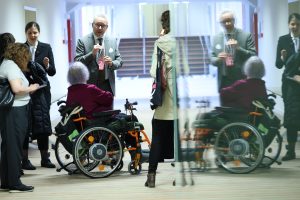 Because ALDE acted before Congress – introducing important improvements — and issued a pledge – making a public commitment to full accessibility, we agreed to withdraw the motion. Instead, we hosted a powerful fringe debate led by Julie Adnams Hatch and Baroness Brinton, focused on disability rights and equality for political participation.
The packed room of delegates showed there is real momentum for change. Plans are now underway for a European-wide Declaration on Disability Rights to be brought forward at the ALDE Congress in Vienna in 2026 — delivered with Liberal Democrat leadership.
One of the most difficult issues before Congress was our attempt to secure a united liberal response to the ongoing Israel–Gaza conflict. Earlier this year at the ALDE Council in Helsinki we failed to agree a resolution — a failure of our values and credibility. We could not experience a repeat of that situation, so I led the drafting of a compromise urgency motion that affirmed two core liberal principles: a two-state solution with recognition of Palestine, and Israel’s legitimate right to exist in safety and peace.
Negotiations were intense and at times deeply emotional. Despite broad agreement from nearly all parties, FDP Germany — whose members currently lead ALDE, Liberal International and ELF — tabled a late amendment, which risked unravelling the delicate compromise. Ultimately, Liberal Democrats and others stood firm that passing a resolution was of the utmost importance, and the motion was approved with overwhelming support.
It was not easy. But it was necessary. Liberalism must be a credible voice for peace, human rights and international law — not a bystander.
We also secured a unanimous vote on our resolution on Sudan – literally at the last minute, which just proves never to give up – largely based on the motion overwhelmingly passed at our Autumn Conference. With the humanitarian situation worsening rapidly, based on our resolution ALDE was able to publish a strong, timely statement calling for a ceasefire and protection of civilians.
During Congress, we met had private meetings with several of our sister parties including Momentum in Hungary — who face an increasingly authoritarian government and have taken the high-risk decision to boycott next year’s national elections. These conversations were a sobering reminder of how fragile democracy remains in parts of Europe — and how vital international liberal solidarity is for parties on the frontline. This message was bright home by the video of messages from the leaders of our sister parties in Georgia, who have been arrested and imprisoned on trumped up charges. Their courage and bravery is a lesson for all us liberals, to stand up against authoritarianism and laws that aim to crush our liberal values.
I have been hugely proud leading our delegations to ALDE and Liberal International these past three years. This recent ALDE Congress was no exception, proving what Liberal Democrats can achieve when we are organised, strategic and confident. It also showed that there is a growing energy behind progressive, pro-European liberalism. The recent electoral victory of D66 in the Netherlands reinforced that there is real appetite for that vision.
The Liberal Democrats must remain at the forefront of that movement. Our leadership is being noticed — and it is making a difference.
* David Chalmers is Chair of Federal International Relations Committee and leads the Lib Dems ALDE Delegation
 Follow @libdemvoice.org on Bluesky
 Like us on Facebook
 Subscribe to our feed
 Sign-up for our daily email digest

 The Stone Roses: Waterfall
 More ministerial dissent over Labour's immigration policies
 Jane Dodds stands down as Welsh Lib Dem leader
 Christopher Burden
 David Allen
 Peter Davies
 expats
 Jenny Barnes
5 Comments
I have concerns about the tactics of Momentum in Hungary. Earlier this year 6 parliamentarians thought it appropriate to disrupt a session of parliament by letting off smoke bombs in the chamber in protest at an amendment that had just been passed. Whatever the issue, there is line that should not be crossed by political parties who argue in favour of democracy – and letting off smoke bombs in parliament crosses that line.
I have considerable sympathy for David’s sterling efforts over the Middle East.
At the 2005 Liberal International congress – I was asked by the late Robert Woodthorpe-Browne – for reasons I can’t now recall – to chair a meeting that sought a compromise motion between the Israeli Liberal party (then called Shinui) and the strongly pro-Palestinian Danish party Radikale Venstre.
LI tries to proceed by consensus rather than contested votes but positions were so entrenched that the only compromise that could be reached was a largely meaningless one that simply listed topics to be resolved. Sadly, little appears to have changed in 20 years.
Well done David, Sal and other delegates for helping keep the Lib Dems and liberalism at the heart of Europe! I hope to re-engage with ALDE next year as my 4 year book project draws to a close!
Why do lib dems love the EU so much?
@ David,
“Why do lib dems love the EU so much?”
Good question.
However, I’m not sure that most Lib Dems, and also most Remainers/Rejoiners, whatever their party inclination, do. There isn’t much said or written about the intrinsic merits of the EU as such.
The ‘love’ is for the UK’s membership of the EU, which isn’t the same thing.