


Alistair Carmichael was on the Daily Politics today, quizzed by Jo Coburn over the party’s position on the Article 50 debate, the Single Market/soft Brexit and a referendum on the final deal.
The segment starts at 21 minutes below, and Alistair is on from 24 minutes.
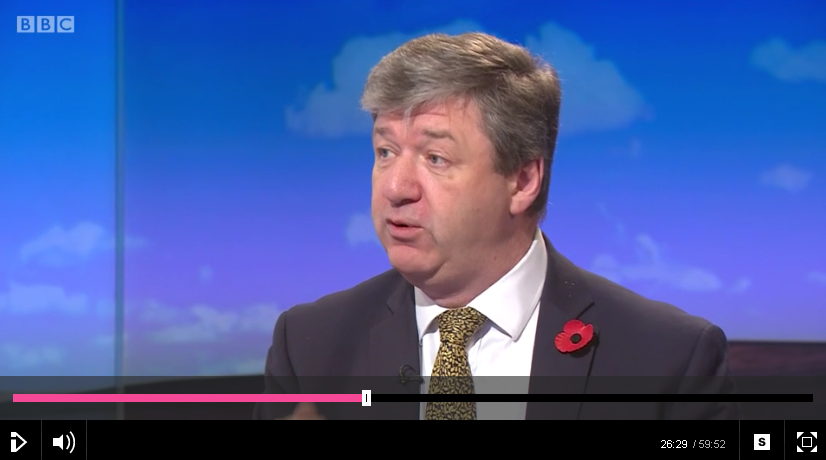
It was put to him that making the A50 vote conditional on single market membership and a “second” referendum was seeking to thwart the will of the people:
It is impossible for everybody who voted to leave for a whole range of reasons to get what they wanted. So we cannot go ahead with negotiations without being quite clear that at the end of it they will be given the chance to say, whatever I voted for on the 23rd June, I got it or I didn’t.
…
Stephen Phillips resigned his seat in Parliament last week because he was very clear that when he voted to leave he was voting for a soft Brexit. He now hears what Theresa May is planning and it is not what he signed up for.
Jo Coburn challenges Alistair on the point that he must have known that Brexit meant leaving the Single Market. This is a little mischeivous. It was a warning from Remain that Single Market memnbership was at stake, but that warning was rejected by voters in favour of handwaving reassurances from Leavers that must now be tested.
In case this is not clear let me offer a hypothetical scenario:
Suppose Party A warns that Party B would, say, trash the health service, and Party B denies this and wins the election, and then trashes the health service. Party B does not have the defence that Party A had given this warning and therefore given them a mandate to trash the health service. And it is not reasonable to accuse Party A of defying democracy if they wish to keep defending the health service.
Except that there was a range of views from Leavers rather than a united denial, this seems to be more or less exactly the situation we are in now with the Single Market.
Later Jo asks if setting out the position won’t weaken the government’s negotiating position:
It is a matter of national importance that we know what the government wants to achieve here… the first time they sit down to negotiate this the other side say “so tell us, what do you want” – that what TM should be telling parliament. The reason they wont is that as soon as they go beyond Brexit means Brexit her own party splits in different directions.
To be clear then, the ask is that the government sets out what it wants, not what it would settle for. The latter would weaken the negotiation, but the former is essential for negotiations to be possible. What do we actually want out of this? If we’re not willing to tell the EU what we want, you can guarantee we won’t get it!
* Joe Otten was the candidate for Sheffield Heeley in June 2017 and Doncaster North in December 2019 and is a councillor in Sheffield.
 Follow @libdemvoice.org on Bluesky
 Like us on Facebook
 Subscribe to our feed
 Sign-up for our daily email digest

 "A chap on his own gets a bit cracked sometimes": Michael Powell on Mr Colpeper
 The oldest pub in Swansea and the secret tunnel
 Why I'm fighting these plans
 Latest voting intention and leadership ratings opinion polls
 Liverpool near bottom of the league for recycling
 Alex Macfie
 Brigid Gardner
 PM
PM John Studholme
 Jeff
Jeff
38 Comments
I love this:
” If we’re not willing to tell the EU what we want, you can guarantee we won’t get it!”
Pure, undeniable and simple.
It would be wrong for parliament to thwart the will of the people by failing to give them a Brexit. It would also be wrong for the government to thwart the will of the people by giving them a harder Brexit than could have commanded majority support in the referendum.
It’s hypocritical of the government to present the first wrong as an affront to democracy and the second as listening to the electorate. They should either be seeking a soft, centrist Brexit to reunite the country after the marginal referendum result, or a second mandate for a more specific Brexit, secured either before or after the negotiations.
If they aren’t willing to do either of those things, then they’re in no position to criticise MPs for voting against triggering A50 on the grounds that they’re ‘thwarting the will of the people’.
Joe, or his colleagues in Sheffield might be interested to know that First Minister, Nicola Sturgeon gave a speech at the University of Sheffield’s Political Economy Research Institute last night, where she talked about the economic causes and consequences of Brexit and her government’s position. In particular she made clear that membership of the single market is key for the whole UK and that the Westminster government should prioritise that over restricting movement. In questions afterwards she spoke strongly in favour of immigration and said that she found it hard to imagine SNP MPs deciding to vote for invoking Article 50.
With the Scottish government announcing today that it will intervene to oppose the UK government in the Supreme court appeal, the views of the First Minister are certainly relevant to those in other parts of the UK and can be read here…
http://news.gov.scot/speeches-and-briefings/fm-speech-to-speri-1
In a response to the Financial Times Future of Britain Project the French MEP Sylvie Goulard (ALDE Group member) wrote “Membership of the single market….simply does not exist”.
Jo Coburn challenges Alistair on the point that he must have known that Brexit meant leaving the Single Market. This is a little mischeivous. It was a warning from Remain that Single Market memnbership was at stake, but that warning was rejected by voters in favour of handwaving reassurances from Leavers that must now be tested
Johnson, Gove and Leadsom are all on camera, pre-referendum, as saying that a Leave vote meant leaving the Single Market:
https://t.co/VnTaCP1sPD
As well as Cameron and Osbourne.
How can anyone seriously claim that anyone voting ‘Leave’ wasn’t voting for leaving the single market?
Every single person who voted ‘Leave’ must either have actively wanted to leave the single market, or have known that it might mean leaving the single market and accepted that that would be a reasonable price to pay for leaving the EU.
Indeed Dav, they voted that it might happen, and it is up to our sovereign parliament to express a view on whether it should happen – i.e. on whether it is in our national interest or not. Particularly if the government is unwilling to express its view.
Dav,
I think your rewriting history, most people didn’t know what the single market was and prominent leavers even after the vote said
Boris Johnson: UK will ‘still have access to single market’ despite Brexit
Conservative Party leadership frontrunner says cooperation with Europe will ‘intensify’
http://www.independent.co.uk/news/uk/politics/boris-johnson-eu-referendum-single-market-brexit-a7104846.html
I think many leavers have a view of what Brexit means, unfortunately few have the same view hence the mess we are in.
Dav, why do you assume that everyone who wanted to leave the EU but didn’t accept that leaving the single market would be a reasonable price for that voted Remain? Leaving could involve getting exactly what they wanted, whereas Remaining couldn’t, so why wouldn’t at least some such voters vote Leave?
Dav: Jo Coburn got a little angry when she should have listened more carefully. She quotes MPs from Remain and Leave while interviewing two MPs, but this is a broadcasting journalist with fulltime politicians. She did not appear to understand and certainly did not accept that 17 million voters are diverse in where they live, what they do for a living, how old they are, what gender they are, etcetera. All these factors, and others, create diversity of opinion. At street level the referendum debate was a dialogue of the deaf, quite different from the debates in parliament or the debates and interviews in the TV and radio studios.
Without getting a bit morbid here, given there have been 175,000+ deaths since June 23rd (many of whom were Leave voters) and there are a number of voters who have turned 18 (many of whom are Remain voters)….. numbers that will increase by the time Article 50 bill appears, it may be the case that invoking it will be going against the will of the people.
@ Joe Otten ……….. “Suppose Party A warns that Party B would, say, trash the health service, and Party B denies this and wins the election, and then trashes the health service”.
Tread carefully there, Joe. Some of this sounds suspiciously familiar from the events leading up to the 2012 NHS legislation.
As for Alistair, Jo Coburn got miffed because he constantly talked over and interrupted the more polite Teresa Villiers…………… a hangover from the ‘combativeness’ spin when Nick appointed him as Secretary of State over the more experienced and skillful Michael Moore ?
@ Glen Andrews “Without getting a bit morbid”.
Cut out the ageist stuff young Glen. It doesn’t play well with those of us who were radical Young Liberals in the 1960’s and are now radical old Liberals in 2016.
@David Raw – it’s nice to be called young; it doesn’t always feel that way when my daughter gets irritated with my efforts at operating the laptop using my analogue logic. I was only referring to well recorded statistical reality, sorry if the phraseology got your back up – that doesn’t change the fact that the demagraphic churn between the referendum and the A50 bill might be such that parliament is going against what the people of the country actually wants… I’m not saying there is any way of telling whether that’s true of course – apart from another referendum which obviously won’t be happening at that time.
Good to hear Alistair persisting in stating what seems to me the only fair line. Ultimately, if the intended vote cognizant of negotiated possibilities is to have any meaning, Remain has to be an option still on the table at the point; re-entry does not look like a practical possibility and WTO are for many of us the ‘nuclear option’. So we have to prepare the ground for and argue the case for that necessary end-game; the only end game which can achieve the LibDems stated aims on Europe and be, unarguably, democratic.
All we seem to be missing in the arguments is what Tony Blair said in the New European (and Nick Clegg later said on air he agreed with, every word) – that the electorate is entitled to change its opinion as new information emerges (and I would say, the truth starts to be understood). Anyone who now says ‘Brexit we must’ or ‘The Government has a mandate to take us out of the EU’ – or worse ‘We all agree that.. [Brexit is inevitable]’ is undermining that line, and without the line, party policy is palpably weak and ineffective and cannot achieve our aims.
“The government’s appeal against the High Court ruling that MPs must vote on triggering Brexit will be heard in the Supreme Court from 5 December. It will last four days, with the decision expected in the new year.” BBC.
Live TV is expected. I wonder whether bookmakers will be quoting odds on the viewing figures.
@ Glen Andrews,
Perhaps the Liberal Democrats should consider ways to hasten our demise.
I am very much happier now that Alistair has publicly stated that there needs to be more
transparency in the Governments position before we would contemplate voting blind on Article 50. Nick Cleggs article says the same thing perhaps as a party we have begun to challenge the proclaimed view that the electorate have spoken, of course they did, but in so many varied voices.
‘bob sayer
“perhaps as a party we have begun to challenge the proclaimed view that the electorate have spoken, of course they did, but in so many varied voices.”
What is all this myth about those voting brexit having varied voices?
It is nonsense
The question on the ballot paper was to remain a member of the EU or leave the EU.
Leaving the EU clearly meant leaving the single market. Everyone understood that and the majority voted for it.
It is now up to the government to pursue negotiations to remove us from the EU and strike up a uk bespoke free trade agreement. Not a Norway model, Not Switzerland model, A UK version. If they’re not able to negotiate a free trade agreement, then its WTO.
All this soft brexit, hard brexit, access to the single market, its all bull.
The Vote was to leave the EU and all the ties that come with that, Immigration, CFP, CAP, EU Law, unable to make our own trade agreements, border controls etc. etc.
People knew what they were voting for and for remainers to keep claiming that they were ill-informed or uneducated and therefore should be ignored is the most disgraceful undemocratic behaviour I have ever seen / heard
Brilliant.
Carmichael ,the people have spoken,we don’t like it and will do our best to block it by hook or crook.
And people wonder why people don’t bother to vote and politicians are held in lower regard than estate agents.
@matt – Like it or not, the largest reason for voting Leave cited by Leave voters was that they were anti-immigration. In very many cases, Leave voters then cited immigrants from named non-EU countries as examples for those they didn’t want while usually failing to mention EU countries. There was a reason that the Leave campaign played upon fears of possible future Turkish immigrantion in the last week or two and it wasn’t due to them deciding to have a balanced and honest debate about the EU.
Paul – ‘Like it or not, the largest reason for voting Leave cited by Leave voters was that they were anti-immigration. In very many cases, Leave voters then cited immigrants from named non-EU countries as examples for those they didn’t want while usually failing to mention EU countries.’
Do you have a source for that?
@Paul
That is so disingenuous, where is your evidence for that?
Point to some solid evidence where people who were voting leave where citing immigrants from non EU countries.
What people did raise concerns about in regards to non EU, economic Migrants, was the open boarder policy of Germany that encouraged hundreds of thousands to trek through Europe. Those where perfectly valid concerns for people to raise.
It is not racist or xenophobic to voice concerns about this, especially since the chaos it caused across the whole of Europe.
Most peoples concerns was about the uncontrolled EU immigration of Unskilled workers which drives down wages and puts huge strain on limited resources, namely housing. That is a perfectly legitimate concern for people to have.
Even if Immigration was the sole reason for voting for Brexit, which it wasn’t, the people were still entitled to vote the way that they did for whatever reasons.
The government chose to hand the power on this issue back to the people and put this out to plebiscite. The people chose.
That’s democracy.
@Paul
http://lordashcroftpolls.com/2016/06/how-the-united-kingdom-voted-and-why/
“Nearly half (49%) of leave voters said the biggest single reason for wanting to leave the EU was “the principle that decisions about the UK should be taken in the UK
(33%) said the main reason was that leaving “offered the best chance for the UK to regain control over immigration and its own borders”
Therefore according to this poll, the biggest reason people voted for leave was due to sovereignty and democracy and not immigration as you suggest
Mr Otten – on your Party A/B Health Service example. There is a difference though isn’t there? What has troubled me most in the past couple of months is that the EU does appear to be the Hotel California: you can checkout any time you want but you can never leave.
Your A/B example would be more relevant if in trashing the Health Service the Party involved then signed up to an agreement, binding on future governments, that health service reform was now a competence of someone else, irrespective of what the voters wanted from their health service.
I just don’t understand what some remainers and the EU institutions think that A50 is in that treaty for – surely it is specifically envisaging a state leaving and having the explicit right to do so. I certainly don’t understand why Tusk/Juncker seem to think that they have some sort of obligation of non-cooperation with an EU member state exercising a treaty right.
The EU surely was never intended to be some sort of prison?
No indeed, Little Jackie Paper, it is not a prison. The EU is a club that many countries want to join, for good reasons. It is one that we would want to remain in if we knew what was good for us.
We have decided to leave, and this whole debate is about a negotiation to keep some of the benefits of membership. Losing all the benefits would not be in our interests. That doesn’t sound at all like a prison.
Nor is Article 50 the only way out. Greenland left prior to A50. A new treaty signed by all members could enact a withdrawal. A member could simply dishonour its treaty obligations and pull out. And – as we are seeing suggestions by some in the case of Hungary – any member abandoning democracy and human rights would be thrown out; though the mechanism is yet to be established, democratic leaders would not tolerate sitting down with a dictator to discuss policy.
And indeed if it had ever been in the national interest for us to leave the EU, the government would have done it. Nobody could have stopped them, we are a sovereign nation after all.
Or, suppose Party A warns that Party B (and Party C) would, say, increase tuition fees, and Party B denies this and wins the election with Party A, and then increases tuition fees. Party B does not have the defence that Party A had given this warning and therefore given them a mandate to increase tuition fees. And it is not reasonable to accuse Party A of defying democracy if they wish to not increase tuition fees.
So Lib Dems should have stuck to their guns and opposed increasing tuition fees? And VAT?
I watched the programme. What Mr Carmichael appears not to understand (or perhaps not to want to understand ) is that the British people voted to leave the European Union. That means Leave. Leave totally. Leave everything. Out. O – U – T. Out. As in LEAVE. Like it? Do not like out? Leave means Leave. (Must I say Brexit means Brexit?). The British people have spoken just as in the USA the American people have spoken. Perhaps not everyone’s cup of tea – but I think its called democracy. Which bit of that is not to understand?
@ Grahame Lamb
As far as I remember lots of the leading Leave campaigners stated that we could leave the EU and this would have no effect on our trading relations with the rest of the EU. If when a deal is negotiated this is not true, would you not agree that that was promised was not being delivered? In these circumstances why would it be wrong to ask the British people if they really wanted this worse trading relationship with the rest of the EU?
Michael GB
I take your point.
Going back to the Referendum of 1975 (the only other UK referendum in British history so far as I am aware) the question was (in terms) whether or not to accept the new terms of our membership as re-negotiated by Harold Wilson and George Brown. In other words it was an In/In referendum. The vote was Yes for the new terms. But if it had been No we would have still been in on the original terms.
23 June was In or Out (as David Cameron said it would be) Many prominent politicians made it abundantly clear that leaving the EU would mean leaving the “single market”.
This means that from “outside” we can negotiate a trading arrangement with the EU. This could be advantageous to both the UK and the EU. I am sure that all reasonable people would wish for a peaceful and protected Europe. We will leave the EU but we will not leave Europe. And I hope that the next American Administration will be of the same mind.
@ Grahame Lamb
Thank you for acknowledging my point.
(There was a referendum in 2011 across the whole UK.) The 1975 Referendum Act set the question as “Do you think that the United Kingdom should stay in the European Community (the Common Market)?” (https://en.wikipedia.org/wiki/United_Kingdom_European_Communities_membership_referendum,_1975) This was an in/out advisory referendum.
Have I understood the Lib Dem position correcntly – basically if the negotiating postition is strong enough on key points they would support an Art 50 notice? Why not just take the same stance as the SNP who say they can’t forsee a situation where they would would support an Article 50 vote?
In response to previous posters question, I refer people to Table 30 in the final IPSOS-MORI opinion poll taken on June 21-22.
https://www.ipsos-mori.com/Assets/Docs/Polls/jun2_2016webV4.pdf
The single largest factor cited by 54% of Leave voters was as can be seen Immigration. The clear majority of our immigration in every single year of our ECs/EU membership is from non-EU countries, not EU ones. So it is clear that Leave voters were “punishing” the minority for the “sins” of the majority, even though control of the majority is entirely a UK matter (bar a few minor special cases). It was also to my mind notable in that Leave voters (when asked to in radio interviews) cited immigration as the reason for their vote even though in many/some cases the “immigrants” in their local areas were non-EU ones (or even first or second generation British) and those areas had very low rates of EU immigrants (circa 3-4% of the population). By way of contrast the two Regions of the UK with the highest rates of EU immigration, had high Remain votes.
@Paul “I refer people to Table 30 in the final IPSOS-MORI opinion poll taken on June 21-22.”
Interestingly, that table states that the cost of EU membership fees was considered “very important” by only 7% of those intending to vote for Exit (and 2% of don’t-knows), so perhaps the significance of the “£350 million per week” claim has been overstated by anti-Brexit campaigners.
Unfortunately, before the referendum the response of the Remain campaign to concerns about immigration (as indicated in this and many other polls, as well as in countless workplace and bar room discussions up and down the country, etc.) was simply to dismiss Brexiters as racists and xenophobes rather than engage with them on the issue. My gut-feeling was that this demonisation meant that polling did not account for shy Brexiters and I made money betting on Brexit while voting for Remain, but ultimately I believe it was an attitude that contributed significantly to losing the referendum and I do not believe that this is appreciated by many Lib Dems who seem to be campaigning as if it were still 22 June.
With regards to your point about non-EU vs EU immigration, I don’t think that you are accounting for the significant rise in net and total immigration from the EU since 2003 (with a step increase after 2012). People’s opinions before the referendum will have been informed by their experiences of this rapid and recent change, and I don’t think that enough was done to reassure them or address areas where there might be genuine problems (e.g. local infrastructure, etc.).
Michael GB
I seem to have missed something. Please remind me what the 2011 Referendum was about?
If you say that the 1975 referendum was a In/Out (which indeed you do) this contradicts my memory: which might not be perfect, of course. So I must revisit !
For the future, there is some uncertainty (who would disagree with that ? A Russian fleet in the Mediterranean just for an example – and not unrelated to Brexit I would suggest) . “Cave” as public schoolboys used to say ( reportedly). Things may be moving faster than we know. This might sound old-fashioned, but I think we need to “be careful out there”.
PS What did I miss exactly ?
Grahame
Just noticed properly your “link”.
Very helpful. Thank you again.
The position is now the Lib Dems will only vote for Art 50 if there is a commitment to a second referendum. Tim again seems to be changing things as he goes along
Hywel, when was this position announced? I had the impression that Tim Farron and other Lib Dem MPs were avoiding saying one way or the other how they would vote.