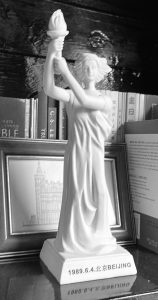
 As I write this, I am looking at my small model of the Goddess of Democracy (民主女神像) on the shelf. It takes me back to my student activist years in Hong Kong, when democracy was something my generation argued about, organised around and fought for.
The original Goddess stood in Tiananmen Square for only a few days before it was destroyed in June 1989. Its image survived. In Hong Kong, one organisation kept that memory alive for more than three decades: the Hong Kong Alliance in Support of Patriotic Democratic Movements of China (支聯會).
On 21 August 2026, the Hong Kong Alliance and its former leaders Lee Cheuk-yan and Chow Hang-tung were convicted of inciting subversion under the National Security Law. Albert Ho, another former leader, had previously pleaded guilty. Central to the case was the Alliance’s longstanding call to “end one-party dictatorship”. The court held that this sought to undermine the constitutional leadership of the Communist Party of China.
The Alliance organised the annual candlelight vigils in Victoria Park commemorating the victims of 4 June 1989. Its politics were always contested. The pro-Beijing camp opposed its objectives. As a member of the pan-democratic camp, I defended the tradition of June Fourth remembrance. Some right-wing localists opposed the vigil for very different reasons, questioning its focus on democratisation in China and arguing for a future centred more exclusively on Hong Kong.
Those arguments could be fierce. Looking back, what stays with me is that we were able to have them.
That was part of the Hong Kong I grew up in. Pro-Beijing politicians, pan-democrats and localists had radically different ideas about democracy, identity, China and Hong Kong’s future. Even the meaning of June Fourth was openly contested.
Much of that political space has disappeared. Political participation now operates under the principle of “patriots administering Hong Kong”, with national-security requirements shaping who can stand for public office. Pan-democrats and localists no longer participate in formal politics in anything resembling their previous form.
The Alliance case captures this change. Hong Kong once argued openly over competing political futures. Today, advocacy directly challenging the Communist Party’s monopoly on political power can fall within national-security law. It raises a basic liberal question: how much room remains for peaceful political disagreement?
Pluralism requires space for people with fundamentally different ideas to argue, organise and persuade. We can profoundly disagree with a political movement while defending its right to take part peacefully in public life. That freedom once allowed pro-Beijing politicians, pan-democrats and localists to argue over Hong Kong’s future. Its loss should concern liberals everywhere.
The Alliance also carried something beyond politics. For decades, candles in Victoria Park allowed Hongkongers to remember publicly what could not be openly commemorated in mainland China. A replica of the Goddess of Democracy stood at the Chinese University of Hong Kong (CUHK) from 2010 until it was removed in December 2021. As political space narrowed, so did the space for public remembrance.



 Follow @libdemvoice.org on Bluesky
 Like us on Facebook
 Subscribe to our feed
 Sign-up for our daily email digest

 There's no good news on the restoration of Ludlow's town walls
 Latest voting intention and leadership ratings opinion polls
 United Nations Day, 24th October
 The church and the lifeboat memorial
 Ernest
  Tim
Tim  PM
PM  Pawel Urbanski
  cim
cim 