


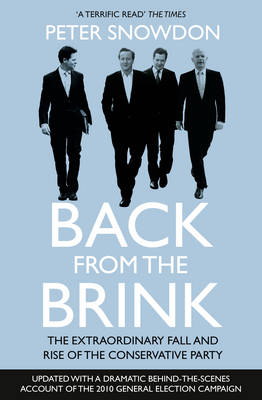
Peter Snowdon’s history of the Conservative Party in opposition, quickly updated last year to include the final stage in their recovery, has four white men on its cover striding towards the reader – Cameron, Osborne, Hague and Clegg. It tells you immediately the sort of book that Back from the Brink: The extraordinary fall and rise of the Conservative Party is: tightly focused in on politics as seen from and carried out in Westminster.
This is an account of senior political figures and their political, policy and media manoeuvrings. The public feature very rarely (unlike in Deborah Mattinson’s memoirs from the Labour side), except in aggregate in voting figures or polling results and even then only occasionally. Despite the majority of voters in the election which put David Cameron into first place in May 2010 being female, women only rarely feature save in the form of Mrs Thatcher or changing party candidate selection rules.
If you take as given that very narrow focus, the book is extremely well executed with a clear narrative style packed full of detailed interview accounts from the main participants. Generally both sides of the argument are put when it comes to assessing personalities, with David Davis and Chris Grayling being the only two senior Conservatives whose reputations come out worse at the end of the book than at the start.
 Overall the book’s message is that the Conservative modernisers got it right, and where they didn’t it was for not pushing on effectively enough with modernisation. As that is not a message someone such as ConservativeHome’s Tim Mongtomerie would agree with the absence of a serious consideration of the different strategies available to the party is a shame.
Missing too is any real sense of quite who David Cameron is, deep down. The book quotes him saying, “I think you’re right that it took me quite a long time to get here [to the moderniser viewpoint], but let’s hope that, like slow cooking, the result in the eating will be much better, stronger and more convincing” yet subsequently there much cooling, warming, cooling and yet more rewarming of Cameron’s approach to modernisation.
The book thins out too as we get to 2009 and then 2010, though both of these drawbacks are to a degree inevitable given the lack of perspective that seeing Cameron in power for several years will give future authors. Those future authors, and students of the period, will I am sure however be grateful for the detailed, readable account from one perspective of the Conservative fall and rise packed as it is with so many interviews with the key figures.
If you are the sort of person interested in why William Hague gave up on modernisation midway through the 1997 Parliament or how Iain Duncan Smith went from rebel to leader to outcast to Cabinet Minister, then this is the book for you. Along the way there are the delights of quotes such as the one from ex. Australian Prime Minister John Howard to William Hague: “You know, William, there’s only one thing harder than the first year in opposition … It’s the second.”
 Follow @libdemvoice.org on Bluesky
 Like us on Facebook
 Subscribe to our feed
 Sign-up for our daily email digest

 Woman 'posed as substitute teacher to insult students because she hates kids'
 Tories to reward the better off
 Spread it around
 David Allen
 Mary Reid
 expats
 Chloe
Chloe Chris Bowers
18 Comments
According to a customer review on Amazon, the book starts from Margaret Thatcher’s demise. But the roots of the Conservative Party’s fall surely date from Thatcherism itself.
The Tories once held a respectable minority of seats in the industrial north of England and shed-loads of seats in Scotland (where they currently have one!). An unelectable Labour Party, bone-headed trade unions, the SDP split and the Falklands all lulled the south of England Tories into thinking they could forget about pretending to govern in the interests of the whole country. Slowly and painfully, Labour made themselves electable again and the rest is history.
Which poses a question for the Lib Dems, now that we’ve signed up to the new Thatcherism………..
But the fundamental point about the Conservative party is that amazingly, despite massive amounts of cash from the likes of Lord Ashcroft, a desperately poor outgoing Labour government that had presided over an economic car crash and wall to wall fawning coverage from most newspapers, it did not “rise”. The last election should have been an open goal for the Conservatives, yet they failed to win a majority. Had it not been for the Ashcroft cash targeting key seats, they probably would have had even fewer MPs than they did.
At the heart of this was the unattractiveness to the general populace of their underlying philosophy: that the state is always a “bad thing” and that markets and competition are the solution to any problem you can care to mention. Voters are sick to the back teeth of this approach, having seen through this ideology as simply being a cover for the rape of our economy by the rich and powerful. My worry is that we Lib Dems are letting too many policies through the net that still coincide with this agenda e.g. privatising our woodlands and the Post Office, opening up the NHS for more private sector involvement and reducing employees’ rights in the workplace.
This does not mean that voting Labour is the solution. It is far too corrupt, anti democratic and beholden to special interests like public sector unions and in government has shown just as much of a weakness towards free market indoctrination.
We need to use the forthcoming Spring Conference to put a bit of backbone into our MPs in fighting against the neo-liberal measures that the Conservatives keep on trying to slip into the Coalition government’s programme. Tough measures to sort out the budget deficit are one thing, but sitting idly by while our government permits further advancement of nasty, vindictive, far right policies under the guise of so-called “growth promotion” is quite another.
Chris is right. From the latter years of the 80’s the Conservatives got complacent. Having won time and time again when no-one said they could they started to believe they would always win, and that’s when they started to fall apart from Mrs Thatcher on down. From the late 80’s when they thought up the Poll Tax through to David Cameron’s election, they basically refused to face up the fact that deep and serious change was needed, with only brief and half hearted moments of open awareness. For example in Major and Hague’s first days. But this wasn’t nearly deep enough until Cameron came along.
@Robert C
I wouldn’t wax too lyrical about the “unattractiveness to the general populace of their underlying philosophy”. They got 10.7 million votes, to 8.6 million for Labour and 6.8 million of the Lib Dems. If their philosophy is underlying unattractive, what does that say for Labour and the Lib Dems. They must be downright disgusting to the general public.
The Conservatives didn’t get a majority because there support was badly distributed. It was far too concentrated. Cameron won a much more decisive popular victory than Blair in 2005 but failed to get nearly as many seats because his support wasn’t spread out enough and the electoral system was stacked against him. This is the Conservatives’ problem. They can get the number of votes, but unless they can manage to increase the geographic range of their appeal and over-turn the polarisation that is the legacy of Thatcher they’ll never get another majority.
I don’t see what’s liberal about a nationalised timber company, a fully state owned postal company or ideological opposition to private involvement in public healthcare. Sounds more like socialism to me. Nor why opposition to these ideas is “nasty, vindictive or far-right”? Sounds like a proper liberal mix of government and private action to me, to harness the advantages of both.
@ Stephen W
“I don’t see what’s liberal about a nationalised timber company, a fully state owned postal company or ideological opposition to private involvement in public healthcare.”
Because involving private companies in running public services has been proven in virtually every single instance to involve private companies rooking the public mercilessly and shirking their wider responsibilities in favour of maximising short term profit. All but the most blinkered free market ideologues can see that.
“The Conservatives didn’t get a majority because there support was badly distributed. It was far too concentrated. Cameron won a much more decisive popular victory than Blair in 2005 but failed to get nearly as many seats because his support wasn’t spread out enough and the electoral system was stacked against him.”
You are joking, right? The Conservatives got 47% of MPs for 36% of the vote and you are moaning about “badly distributed support” as if it would have been OK for them to fix things so that they could gain outright power with 36% support.
This only goes to show how arrogant supporters of both big parties are and what a disaster it will be if we go back to having one party government again.
Calm down there, you’ll give yourself a heart attack.
“Because involving private companies in running public services has been proven . . .”
Uhhhh. No it hasn’t. Private companies are already involved in public services in so many, many ways. And I don’t even regard state commcerical forestry as a public service. More like a nationalised industry that has no place in the 21st Century. If that was true the most efficient public services would only be seen under Communism, as that’s the only way you can remove private involvement from the public sector. And as I said, the assumption that pure public, state owned good, private always bad, certainly ain’t liberalism social or otherwise. Socialism pure and simple.
“and you are moaning about “badly distributed support””
I’m not moaning about anything. I’m noting a simple fact. Blair in 2005 got 9.5 million votes equalling 54% of seats on 35% of the vote. Cameron got 10.7 million votes giving 48% of seats on 36% of the vote. That means his support wasn’t as efficiently spread as Labour’s was for the previous 13 years. I’m not suggesting they should have got more, I’m merely pointing out why they didn’t. It wasn’t only or even majorly a problem with the lack of votes. I suggest you think about the difference between someone noting a fact and supporting a point of view.
“Because involving private companies in running public services has been proven in virtually every single instance to involve private companies rooking the public mercilessly and shirking their wider responsibilities in favour of maximising short term profit. All but the most blinkered free market ideologues can see that.”
Even were that true hitherto (and I’m not sure it is), it does not necessarilly follow that all private companies always fleece the public in delivery of all public service in perpetuity.
And we haven’t even considered other types of provision that aren’t private, public or monopoly.
Aside, for one moment, from the rights and wrongs of privatisations, the worst aspect of Thatcherism is the implementation of cuts which save relatively small sums of public money (we can all agree that cuts are inevitable – some of them quite big) at the cost of real damage to the fabric of Society (“Big Society” or not).
That’s what we’re seeing from this government.
Stephen W is right that the Conservatives are surprisingly popular – thanks to the voting system a mere 36% is often enough for a tidy majority in the Commons, as the 2005 election proved. By reducing the number of seats to 600 and equalising voter rolls, the Tories hope to restore themselves to parity with Labour in terms of the votes-to-seats ratio.
What exactly will the Lib Dem message be in 2015? Civil Liberties? Decentralisation equating to cuts? It’s the Economy and Public Services stupid! Labour will say they have learnt lessons and that Banks were more to blame than Government. The anti-Labour vote will simply revert to the Conservatives (at least in England). If we get AV Tory voters may give their Lib Dem buddies second preference, but Lib Dem MPs will be as emasculated as the “National” Liberals of the 1930s.
It could be a return to two-party dominance in England (Scotland and Wales are obviously different). That’s assuming UKIP don’t overtake the Lib Dems.
@ Stephen W
I wouldn’t wax too lyrical about the “unattractiveness to the general populace of their underlying philosophy”. They got 10.7 million votes, to 8.6 million for Labour and 6.8 million of the Lib Dems. If their philosophy is underlying unattractive, what does that say for Labour and the Lib Dems. They must be downright disgusting to the general public.
This was indeed an election where the parties struggled to be the “least awful” but it was a tough fight – all could fairly claim to be dreadful in multiple ways. The Tories’ advantage was that at least they had a philosophy if a fairly repellent one to the majority who reject the inequality that is one of its toxic by-products. I think this explains much of the geographic concentration of the Tory vote. After all, with rising inequality some are winners in the short term and will look no further than that.
The Lib Dems’ difficulty is that we really didn’t have a plan based on a clearly articulated philosophy. “Liberal” is one of those Humpty Dumpty words than means whatever people want it to mean. We have therefore by default tended towards being a coalition of campaigners for this and that (mostly perfectly good causes in themselves). Come election time and the need to have a manifesto the result is an energetic papering over the cracks with “fairness” (another Humpty Dumpty word) pressed into service as a unifying principle – which it ain’t.
Possibly that last paragraph reads as a bit depressive but there’s hope if we want to seize it. To date (the last 20+ years) Lib Dems have been remarkably content to contemplate their own collective navel while hoping for a hung Parliament as if that would be the answer to everything. As we’ve seen, it isn’t. We get a few baubles while the Tories get their philosophy.
If we are to find a coherent philosopy we must understand how money flows around the economy and how those flows can break down (leading for instance to an growing underclass with little stake in society). The Tories follow the neoclassical school of economics as their guide although it is self-serving intellectual drivel, riddled with inconsistencies and a proven failure in practice. It’s great merit (to them) is that it justifies greed.
There is an alternative economics but sadly, Lib Dems by and large don’t “do” economics so it lies neglected. Until we discover it we are left to argue over symptoms, not casuses.
@Stephen W
I have no intention of either “calming down” or “giving myself a heart attack”, so stop being so patronising.
“And as I said, the assumption that pure public, state owned good, private always bad, certainly ain’t liberalism social or otherwise. Socialism pure and simple.”
And your apparent blinkered assumption that the private sector is good and the public sector is always bad is a similar form of ideological contortion.
My point, which you have conspicuously and patronisingly failed to address, is that where wider public interests (e.g. facilitating access to woodland, actually keeping hospital wards clean, providing acceptable levels of transport service, building and maintaining schools in a cost effective manner to high standards) are at stake, not just revenue and profit maximisation, the private sector has been an utter failure, time and time again.
@ Chris
The Labour party won’t have a message next time, having an appalling track record in office, and having opposed every single measure aimed at sorting out the public finances and incorrectly predicted a double dip. With the very unpopular Ed Miliband and Ed Balls at the helm, it will also have a highly unelectable leadership as well.
For a supporter of a party that was booted out of office on 29% of the vote just eight months ago, having ruined the public finances and presided over the collapse of our educational standards (according to authoritative OECD studies, not inflated GCSE grades), your arrogance is truly astonishing. I actually wish we could have an election now and Labour were put back into office. Their support would collapse so fast it would be a pleasure to watch, were it not for the economic disaster it would cause.
It’s interesting to see how ready Labour party supporters are to go back to the old two party duopoly, even if it means increasing support for their rivals. What a bunch of anti-democratic demagogues you are.
“And your apparent blinkered assumption that the private sector is good and the public sector is always bad is a similar form of ideological contortion.”
I have nowhere claimed such a thing. The private sector gets many things wrong. Which is why we have substantial public services in the first place. However, I frankly disagree with your universal statement that private involvement in public services has always and everywhere been a failure. There are many situations where it has been a disaster, such as PFI, but that is usually down to incompetence on the behalf of the government negotiating the contracts. There is good and bad in both public and private sectors. And I do not think these modest involvements of private sector actors in public provision are either extremist or “nasty, vindictive or far right”.
@Robert C
If I gave the impression of being a Labour supporter I apologise. I once voted Labour in a Parliamentary election – it was 1970, the first time I was old enough to vote, and there was no Liberal candidate in the constituency where I was living at the time. As with every Parliamentary election since then, my vote failed to elect a candidate – a marginal constituency swung back from Labour to Conservative.
I was a life-long Liberal until recently resigning when it became apparent that policies which would have appalled the party in opposition had become policy. (I admit that I would have voted Labour for tactical reasons in 1997 and 2001 if the Lib Dems had been a poor third locally).
Anyway – the point I was trying to make about Labour was that they will undoubtedly adopt a dual approach in 2015 – yes we’ve learned fom our mistakes but it was all the Bankers’ fault anyway. In fact they are saying this already.
I don’t know whether Labour’s strategy will succeed. But I do fear a return to 1970 style two-party duopoly. Am I being over pessimistic?
Robert C
If you are going to quote sources you should try reading them first. OECD said nothing of the sort about educational standards, They said very clearly that they had no evidence one way or the other about a rise or decline in standards.
“Trend comparisons, which are a feature of the PISA 2009 reporting are not reported here because for the United Kingdom it is only possible to compare 2006 and 2009 data. As the PISA 2000 and PISA 2003 samples for the United Kingdom did not meet the PISA response-rate standards, no trend comparisons are possible with these years.”
The only authoritative source which claims to have measured standards over time is TIMSS and they argue that England is one of the most improved countries in the world.
OECD also found that standards in the UK are around the OECD average:
“In the 2009 PISA assessment of 15-year-olds, the United Kingdom performs around the average in reading and mathematics and above the average in science among the 34 OECD countries.”
Repeating Gove’s misleading comments does not make an argument! Oh and by the way, even Gove admits that standards have risen. He just argues that they have not risen as fast as other countries and that the UK has been left behind. Hardly a collapse in educational standards!
@Liberal Eye
“……hoping for a hung Parliament as if that would be the answer to everything”. Spot-on – in fact we used to call it a Balanced Parliament.
Of course it was always going to be UNbalanced in favour of Tory or Labour, since the Lib Dems were certain to be the less weighty partner. The Great and Good of the Party obviously dreamt of forcing a referendum on Proportional Representation, which they were sure the Party would win, thus opening the way for better, more equal, coalitions. And we’d all live happily ever after.
They forgot that the dominant party would never concede PR, and if the Lib Dems tried making PR the price for coalition they would be seen to put party advantage over the national interest, thus proving the argument of the anti-PR brigade that fair votes give too much power to small parties.
In fairness, the Party always had a weak hand and did what it had to do after the 2010 election. “A plan based on a clearly articulated philosophy” would, as Liberal Eye says, have strengthened their hand.
“Because involving private companies in running public services has been proven in virtually every single instance to involve private companies rooking the public mercilessly ”
Robert C, I think you mean rooking the government. And if the government really does always overpay as badly as you suggest, that would mean that it is as extravagant and wasteful in spending taxpayers money as the Taxpayers Alliance claims.
“history of the Conservative Party … has four white men on its cover striding towards the reader – Cameron, Osborne, Hague and Clegg.”
Spot on Mr Snowdon.
in 1974 I twice came within a hair’s breadth of being elected Liberal MP for Newbury on a platform of greater equality of opportunity in education, health AND INHERITED WEALTH, together with the privatisation of all actrivities other than those which either cannot or ought not to be rationed by price.
The best aspect of Margaret Thatcher was her privatisation. The worst aspect of Margaret Thatcher was her vigorous reinforcement of the Conservative political ideology of unrestrained Dynastic Capitalism cascading down the generations.
It is time to challenge that political ideology and replace it with a true Liberal political ideology of Popular Capitalism with the redistribution of inheritance in each new generation in order to spread more widely the private ownership of wealth. How else will that liberal Conservative Oliver Letwin, now the Minister for Policy, fulfill his promise some years ago in a Daily Telgraph front page headline that “We will redistribute wealth and empower people”?
David Allen. If Clegg is a Tory, you are a fully payed up Scargillite.
Let’s move on … nothing to see here …
“Tabman”
The blind leading the blind?