


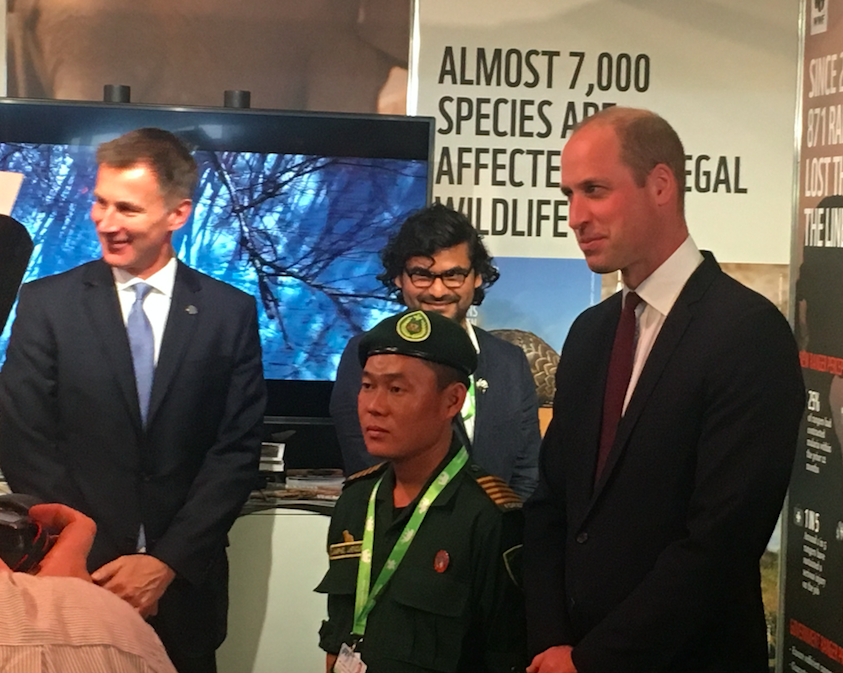
 Last week I attend the Illegal Wildlife Trade Conference (IWT) in London. The optics were every bit as impressive as you would imagine for such an occasion. In attendance, there was a star-studded line-up of celebrities such as Ben Fogle and Nicky Campbell, UK cabinet ministers Jeremy Hunt and Michael Gove, African presidents and even the Duke of Cambridge himself. It felt like the grand opening for the international fight back against wildlife crime and was a great marker for real action on this criminal activity.
The flagship policy launched at the conference was the ‘Ivory Alliance 2024’, which will link the UK with international partners to introduce domestic ivory bans globally by the end of 2020. Again, the list of partners is really quite impressive: The Prime Minister of New Zealand, MPs from Hong Kong and the Philippines, and a Tourism Minister from Uganda. The UK is absolutely right to work with a range of different international actors, but there was something lacking, something so obvious: the European Union.
Where was the French Government who just introduced one of the toughest ivory bans on the planet? Where was Europol who have been providing cutting-edge police intelligence to help national police forces catch wildlife traffickers? Where was the European Commission to explain how Member States are progressing with the 2015 EU Action Plan against Wildlife Trafficking? This plan not only addresses the crimes in Europe, but also works with countries across the world to take real action in the fight to protect biodiversity. This deliberate sidelining of the EU’s work on wildlife trafficking is very counterproductive. Surely, if we are to win this fight, we need to work collaboratively with partners, a point that was made in numerous sessions at the conference.
 As Chair of MEPs For Wildlife, a cross-party group of MEPs, I have been championing action to tackle wildlife trafficking for the past five years at the European level. The EU is one of the world’s major transit points and markets for illegal wildlife goods, so it is essential that Europeans are coordinated in their efforts. Last year I convinced EU governments to make environmental crime a security priority for Europol 2018-21; this literally means more cash and police officers to tackle this scourge, not just in Europe, but with the long reach of the EU, across our planet. MEPs For Wildlife are incredibly proud of this extra funding which, with the help of wildlife charities, we all helped secure.
So, you can imagine my surprise at the IWT conference last week where it seems the UK Government had practically whitewashed out any mention of the EU. Even the interactive question app used to ask the panel questions (Glisser) seemed to deny any questions of the EU from reaching chairs of the sessions (both my assistant and I tried asking questions on multiple devices). It is as if the UK is trying to re-invent the wheel. It felt like the message was: Brits are back in the control – just like old times. However, the world just does not work like that anymore.
It is bizarre, because in the past the UK has been a powerful voice at raising wildlife trafficking at an EU level – I know several Conservative MEPs who take this issue very seriously. But the tunnel vision the UK government currently has with its policy to leave the EU at any cost means we are missing, or deliberately blocking, opportunities for collaboration with our neighbours.
I feel very strongly about protecting wildlife. I am married to a primatologist and spent my 20s studying wild animals with him in Africa. After my tenure as an MEP I will continue to fight for this cause and I will try to ensure the new European parliament and new MEPs continue to champion tackling wildlife trafficking at an EU level. So it shocks and saddens me to see the UK government’s mindset is missing this when it comes to tackling global challenges. The UK government’s ‘Ivory Alliance 2024’ is very important, but it is not enough. Gove should be using his Government’s desire to tackle this abhorrent trade to encourage other EU countries, as well as other source countries to follow suit and introduce their own ivory bans. This is about protecting the magnificent creatures on this planet, not running short-term political games in the name of Brexit.
* Catherine Bearder was Lib Dem MEP for the South East region from 2009-2020.
 Follow @libdemvoice.org on Bluesky
 Like us on Facebook
 Subscribe to our feed
 Sign-up for our daily email digest

 "A chap on his own gets a bit cracked sometimes": Michael Powell on Mr Colpeper
 The oldest pub in Swansea and the secret tunnel
 Why I'm fighting these plans
 Latest voting intention and leadership ratings opinion polls
 Liverpool near bottom of the league for recycling
 Alex Macfie
 Brigid Gardner
 PM
PM John Studholme
 Jeff
Jeff
One Comment
Primatology is the scientific study of primates. It is a diverse discipline and researchers can be found in academic departments of anatomy, anthropology, biology, medicine, psychology, veterinary sciences and zoology, as well as in animal sanctuaries, biomedical research facilities, museums and zoos.
https://www.bing.com/search?q=Primatology&filters=ufn%3a%22Primatology%22+sid%3a%22aa2c0c02-d18f-0517-81be-831de50970e4%22&FORM=SNAPST