


Dear Ian,
I’m a bit confused by your article about hung Parliaments in the Telegraph, where you wrote:
The last time a British election failed to produce a decisive result, in February, 1974, the FTSE All Share Index – a broad measure of the stock market – fell nearly 15pc in a month and ended the year more than 50pc below where it began.
The piece even has a graph starting in January 1974 and going through to late 1974.
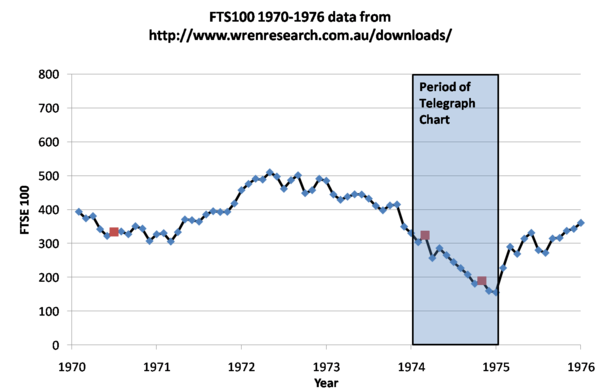
Why does this leave me confused? Well, I’m sure on most financial matters you know far more than me. But even I know that British share prices had been steadily dropping since early 1972.
Although your graph starts in February 1974, if it had been extended back to early 1972 it would have seem a long-term, consistent fall in British share prices before any hung Parliament.
Don’t you think starting the graph just in February 1974 therefore makes it a bit misleading? And to understand what happened in 1974 wouldn’t it have been better to give the context, i.e. that share prices were already steadily falling?
Yours,
Mark
UPDATE: SmallCasserole has produced this excellent graph illustrating the point:
 Follow @libdemvoice.org on Bluesky
 Like us on Facebook
 Subscribe to our feed
 Sign-up for our daily email digest

 Why I'm fighting these plans
 Latest voting intention and leadership ratings opinion polls
 Reform councillor breaches rules by being leader of his own political party
 Liverpool near bottom of the league for recycling
 Vote Tory, get Reform?
 Jeff
Jeff Nick Baird
 David Wright
 Sarah
Sarah David Raw

13 Comments
Ha! It had nothing to do with the hung parliament and much to do with the recent collapse of the post-war Bretton Woods global financial system plus the massive secondary banking crisis that was going on in Britain at the time…
I made a graph that conveys the point more clearly: http://imagebin.ca/view/9b9Zkee.html
Well, isn’t it a bit like putting an “only X can win here” bar chart on using the results from a different type of previous election.
Yes Jock, and both are stupid reprehensible practices.
Don’t you see Mark? Investors were so concerned about a hung parliament happening they stopped investing two whole years before the election even happened! In fact, Investors are such skittish creatures it would probably be better for everyone if we didn’t have elections at all; we could just have the Queen pick people to form the government. Can’t we all agree that would be for the best?
This is pretty fun: http://blogs.telegraph.co.uk/news/cristinaodone/100036269/why-the-french-want-nick-clegg-to-win/
‘Don’t vote for Clegg! It’s what the French want you to do!’ Torygraph up to its usual standard.
I made a graph of the FTSE 100 for the period 1970-1976, elections marked with big squares:
http://twitpic.com/1i2z55
Thanks SmallCasserole – fab graph which will add to post
@ Duncan
Oh it’s her again – Ms. Ordone also had a go at Dr. Evan Harris, calling him Dr. Death and more of the same.
Anything written by Ms. Odone is a waste of server-space.
Oh what a shame – we were having a spoof Daily Mail Anti-Lib Dem story competition and Christina Odone has won. The mind boggles that this woman is presented as some sort of “faith” correspondent.
There seems a general trend among Conservative commentators to be very flexible about the 1970s time-line.
Another one I’ve seen in a couple place recently is “the Lib-Lab pact was a time when the inflation rate rose to over 25%”. Well, no, the inflation rate peaked well before the Lib-Lab pact. It had already fallen when the Lib-Lab pact was agreed, it fell further during the time the Lib-Lab pact was in operation. It rose again after the 1979 general election.
Well done Mark. They’re not going to stop this rubbish of course. The Telegraph is clearly so desperate that they’ll throw what they have of their reputation to the dogs to try and win this election for the Tories.
Have they not even grasped that because one event happens a bit after another that does not mean the first event caused the second. Nick Clegg does well in debate, weather gets better ergo support for Nick Clegg produces better weather.
City boys are not paid to calculate the national interest. They are barely able to work out their own interest. They are clearly unable to act in their employers’ interests. We have to have the confidence to listen to them – as much as all others – and then make our own decision.
Any reform – even the modest reforms put forward by the Lib Dems – challenges established interests and the cry of fear is the established language of resistance. Without change those established interests will act to maintain their relative position – regardless of the state of everyone else.