


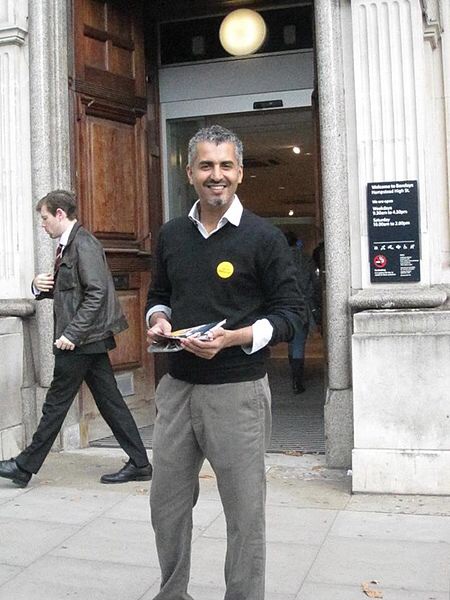
 Hampstead and Kilburn PPC Maajid Nawaz has been writing for the Daily Mail in his day job role as Chair of the Quilliam Foundation. He looks at the rise of ISIS, the potential dangers for the UK and how we should respond.
The greatest challenge is how to tackle the growing crisis.
First of all, direct Western military intervention would be extremely unwise in the current climate. That would be the greatest possible clarion call to unite jihadists under the ISIS banner.
Britain has up to 500 citizens fighting in Syria. Such high numbers do not emerge from a vacuum. There is a residual atmosphere of sympathy in which aspiring jihadists incubate.
Any Western attack would almost certainly resurrect domestic sympathies for extremism.
Instead, we must adopt a regional and pragmatic strategy, exercising what influence we can over our allies in the Middle East. We must persuade neighbouring Sunni Muslims from Turkey, Saudi Arabia and the Gulf to fight.
Were Sunni Muslims to take the lead in defeating ISIS, they would help undermine the myth of a noble jihad against infidels.
And we must support the Iraqi forces. But our support for Mr Maliki must be conditional on his reaching a settlement with Iraqi Sunnis, while the secular Kurdish Peshmerga must be encouraged to reconsider adding pressure on ISIS. Training and logistical support could be provided, but at the moment this is a regional fight. It is imperative that it remains so.
You can read the whole article here.
Photo of Maajid Nawaz by Ross Frenett
* Newshound: bringing you the best Lib Dem commentary in print, on air or online.
 Follow @libdemvoice.org on Bluesky
 Like us on Facebook
 Subscribe to our feed
 Sign-up for our daily email digest

 Senedd bans poem by Wales National Poet
 "A little heaven here on earth": Launde Abbey in Leicestershire
 Steve Trevethan
 Ruth Bright
 Peter Davies
 Tristan ward
 expats

27 Comments
A classic example of how inter-connected the world these days is and how the “pull up the drawbridge and keep England to itself” tendency among a number of angry old blokes is laughable as a future direction for this country to take. This is an incredibly complicated issue and I have found the inputs I have seen from Maajid (“Newsnight”, “Daily Politics”) very enlightening. (One thing I can never understand, though (with reference to one of the countries mentioned in the article, Saudi Arabia), is that, given the billions the Saudis spend on weaponry from the UK alone (http://www.theguardian.com/world/2013/may/20/uk-approved-arms-exports-saudi-arabia), what do they actually DO with the heavy items among this (fighters, missiles etc)? The nearest the Kingdom has come to being invaded in my lifetime was in 1991 when Saddam overran Kuwait (bad decision!) and the Saudis immediately had to call on the USA, UK, France, the UNO…. Still, good news for BAe etc workers).
The idea that a Western attack would “resurrect domestic sympathies for extremism” seems to call for comment. The word “resurrect” suggests that sympathies are latent, which need not be the case. One thing that such an attack would do would be to make it absolutely clear where Western governments stand on the issue of an extremely savage group.
The word “sympathy” seems inaccurate to me. The title of the latest video “There is No Life Without Jihad” gives a clue: people are seeking a meaning to the lives and finding it in jihad, and that’s basically what the apparently nice, gentrified, misguided young people in the video are saying. They speak of a “noble” cause, and the emphasis is on the word “noble”: they’re looking for respect and certainty which they’re not getting in their UK lives.
Young people make many mistakes – jobs go wrong, marriages can seem like prisons, freedom can be puzzling if all your choices till now have been guided by others. ISIS appears to offer a way to escape these kind of human, personal issues. Finding other ways to resolve them here in the UK would perhaps do a lot more to reduce the numbers of “sympathizers” who leave.
I suggest that it’s the people on the ground who must take the lead in fighting ISIS – it doesn’t matter what religion they are. The reason that it’s their role is that the people on the ground need the learning experience that will hopefully change their society and allow them to develop institutions and habits that mitigate against these things repeating in future.
It’s good to see that Maajid is continuing to engage with this problem.
I would certainly support his comments and look to Sunni Muslims (Turks, Kurds and Arabs) to take the lead in defeating ISIS – especially (following a political settlement) the Dulaim Tribe and other Sunni Militia’s of Anbar province in Western Iraq who were armed and supported by General Petraeus in 2006-08 to expel Al Qaeda in Iraq.
With respect to British Jihadi’s returning from military service with extremist groups , I think the time has come for enhancing domestic security measures. When control orders were abolished, the Government retained the right to reintroduce more stringent measures in situations it deems an emergency. As a result of this position, and in response to the Counter-Terrorism Review’s conclusion that, “there may be exceptional circumstances where it could be necessary for the Government to seek parliamentary approval for additional restrictive measures”, the Government has prepared the ETPIMs Bill. This Bill would introduce an additional security measure which could be placed on individuals: the Enhanced TPIM (ETPIM).
ETPIMs are distinct from TPIMs. An individual cannot be subject to both a standard and an Enhanced TPIM simultaneously and the conditions that must be met before the Government can impose an Enhanced TPIM are more stringent than under the current regime. There is much correlation between the operation and policing of TPIMs and ETPIMs (as there is between TPIMs and the former control orders), but ETPIMs are generally tougher, both in terms of the restrictions to liberty an individual under an ETPIM would face, and in the threshold the Government must meet before an ETPIM can be imposed on an individual. ETPIMs differ from standard TPIMs in the following ways:
– A strengthening of the legal test to be met before imposition from “reasonable belief” under a TPIM to “balance of probabilities” under an ETPIM;
– Under an ETPIM, the Secretary of State could impose a curfew for up to 16 hours on an individual. Under the existing TPIM Act an individual can only be compelled to reside overnight at a specified residence;
– ETPIMs allow a complete—as opposed to partial—ban on electronic communication devices;
– Individuals under an ETPIM can be prohibited from entering a defined area and from associating with any individual without the Secretary of State’s prior permission; and
– The Bill would allow the Secretary of State to require an individual to reside at any residence specified by the Government (i.e. relocation), unlike the existing TPIMs Act, which makes no such allowance.
The compulsory relocation measures in the ETPIMs should allow for holding returnees in UK aided humanitarian camps in Turkey, Jordan, Lebanon or the Kurdish region of Iraq for a cooling off period of rehabilitation and reintegration by providing aid and assistance to Syrian and Iraqi refugees, pending their return to the UK.
The parliamentary committee on ETIMS has identified a number of problems with the current draft proposals.
http://www.publications.parliament.uk/pa/jt201213/jtselect/jtdraftterror/70/7002.htm
One of the obvious problems is that ETIMS themselves would be expected to radicalize. In Section 68 (Chapter 5) a witness states “the advantage of TPIMs and controlling measures means that people are taken away from the radicalising environment that was causing the major problem”. The witness does not appear to recognize that having an ETIMS served against you is not exactly welcome ! In the video I mentioned earlier, one of the misguided young people says that “the cure for depression is jihad”. This suggests to me that the way to combat radicalization is to address a problem of depression, something that the threat of ETIMS will not do.
Section 80 implies that ETIMS will resolve the problem that evidence to convict can be inadmissible in a normal court!Another witness called ETPIMs “a stopper on gathering evidence for prosecution”. Is this what we want?
Charles Rothwell is right to ask questions about Saudi involvement in the region.
When he asks about Saudi weaponry he might ask how much of it has actually found its way to Syria, Iraq and other places in the last few years. Who exactly are the Saudis arming? What is the Saudi objective in so doing?
The role of the appalling extreme tyranny that is Saudi Arabia is usually glossed over by the BBC and western media.
Could that be because the money of the tyrants speaks louder than any calls for women’s basic human rights or anything even approaching democracy?
Could it be that the cosy back door arrangement that keeps the Saudis sweet when it comes to Israel has suited the pro-Zionist extreme right in The USA ?
The BBC and ITN and the press in the UK are suddenly in a panic about ISIS. But they look the other way when the Saudis engage in barbaric, extremist, inhuman practices.
Prince Charles has made more state visits to Saudi than he has to many Commonwealth democracies. Why is that?
Before worrying about a few hundred UK citizens in Syria is it not time to worry about the feudal dictators in Saudi?
Richard,
the conclusions of the Parliamentary Committee on ETIMS are as follows:
“In an ideal world there would be no need for a controlling measure such as ETPIMs, the Government would face a simple binary choice to prosecute a dangerous individual or leave him at liberty. Sadly this situation does not exist and the Government must devise a system to tackle the ongoing terrorist threat from those individuals who cannot—for whatever reason—be deported or safely prosecuted. Almost by default such a system is sub-optimal solution, but sub-optimal does not mean inadequate. We accept that these measures are a suitable response to the challenge they seek to tackle.”
“While we give cautious approval to these measures we cannot approve of them in their entirety nor the process by which they will be placed before both Houses for approval. We have concerns about both the lack of certainty over the circumstances in which these measures will be introduced and the ability of Parliament to scrutinise adequately whether these powers are necessary to meet the particular threat identified. We expect the Government to address our concerns before the Bill is introduced formally.”
The questions then to be answered would then seem to be:
– Is this heightened threat from returning Jihadi’s a circumstance that warrants the introduction of enhanced security measures; and will Parliament have the ability to scrutinise adequately whether these powers are necessary to meet this particular threat?
If the answer is yes, them the committee has already confirmed its acceptance that these measures are a suitable response to the challenge they seek to tackle.
@Joe Bourke.
Parliamentary democracy doesn’t seem that simple to me. If and when this gets debated in parliament, the questions raised during the committee and the conclusions of the committee will all be subject to further questioning and scrutiny. Some of the further questions are likely to include whether the proposed measures will actually be effective, whether they might make the problem worse by further radicalizing people who are not yet radicalized, and whether they are open to misuse by authorities, resulting in a major loss of freedoms for many innocent people.
@ John Tilley.
Spot on.
Julian Lindley-French’s thoughts on what to do about iraq (from the foreign policy perspective):
http://lindleyfrench.blogspot.co.uk/2014/06/iraq-what-to-do.html
“Britain has up to 500 citizens fighting in Syria. Such high numbers do not emerge from a vacuum.”
Perhaps not, but let us hope that they find conditions in iraq so ‘congenial’ that we have no cause to worry that they might come back come.
I’ve read the article and have three main points:
1. Maajid is against direct attacks from the west in Iraq, but was in favour of them in Syria?
2. I favour Maajid’s approach towards Iraq, but direct military involvement cannot be taken off the table when it comes to violent extremists.
3. There’s no future for a party cheering on immigration and civil liberties in the days of ISIS. We need to do a speech on this and not just let David Cameron look like the statesman.
Max Hastings has a good historical piece alongside Maajid’s today Islam must accept much of the blame for today’s bloody chaos writing:
“The unpalatable truth is that most of the Middle East’s troubles derive from adherence to a medieval culture that recoils from innovation, promotes religion far beyond its proper place in mankind’s affairs, and institutionalises the oppression of women…The lessons of history are that we Westerners can do little to change the course of events in the Middle East, and are ill-advised to try. Meanwhile, here at home we must fight with every weapon in our hands — legal, cultural and educational — to prevent the curse of Islamist militancy from spreading its wholly pernicious influence within our own societies. What they do within their own regions of the world, it must be their affair to resolve, with such modest support as we can give. But there can be no compromise with such warped doctrines here, in the sorry name of multiculturalism.”
The anguished mother of a 20 year old student from Cardiff was on the news today in despair at the ‘brainwashing’ of her only son. Her description of the process that led this boy to join-up with ISIS is reminiscent of how suicidal religious cults attract followers. It is also an apt reminder of just what has to be dealt with ISIS – there is no ‘casus belli’ just indoctrination, mindless violence and banditry. We must recognise it for what it is – anarchy and criminality of the most depraved kind. It has to be combatted with resolution and determination, without agonising about inspiring domestic sympathies for extremism – just as this mother would given the chance.
The guys in the video look like lost boys, not hardened extremists, yet anyway. They decided to do something radical about their unsatisfying lives in the UK, and are now perhaps realising that their new situation is even worse. Could they come home if they wanted to? I don’t think their colleagues in ISIS wold let them! None of them look happy. The video might even by interpreted as a cry for help or rescue.
Our response to the 500 should be based on reality rather than panic, and on the recognition that they remain UK citizens and are therefore entitled to the state’s protection. Even if ETPIMs are part of a response, they should be regarded as far from being either the largest part or the most important part.
thank you Joe, Max is always worth a read.
the finishing line is correct.
Some people felt the same against folk that went to fight in the Spanish civil war.
It seems that the cabinet is split on military action in Iraq, according to the Sunday Times, with Sajid Javid taking the side of the Hawks and Baroness Warsi together with Libdem ministers taking the side of the doves:
“Senior ministers are at odds over whether to back US airstrikes against the militant group Isis amid disagreements about the extent to which British national interests are under threat. Hawks say Britain will have to allow American warplanes to use bases in Britain to launch attacks and believe the UK has vital interests at stake. But doves, led by the minister without portfolio Ken Clarke, are warning that it would be folly to get involved in military support… Cabinet sources say the defence secretary Philip Hammond told the cabinet Britain should keep open the option of backing US airstrikes… The chancellor George Osborne warned the cabinet that Britain’s interests are at stake because the conflict could wreck the economic recovery by driving up oil prices… Their position is supported by Michael Gove, the education secretary, and Sajid Javid, the culture secretary. Clarke told both meetings that the UK should not get involved and warned that Iraq risks ‘Balkanisation’. He is backed, in Tory ranks, by the Foreign Office minister Baroness Warsi and Andrew Lansley, the leader of the Commons, as well as by Liberal Democrat ministers.”
Well said – and spot-on – both Charles Rothwell and John Tilley.
All liberal democracies should shun the vile and murdering ‘Kingdom’ – as should every Liberal Democrat.
The Sunni v Shia conflict has much in common with the catholic v protestant conflicts in 16th century Europe. Eventually it more or less worked itself out (except for residual bits like northern island) when people realised that living together was better than fighting. It may be that the majority of Sunni and Shia muslims want to live in peace. (There is no indication that that are attacking each other in the UK). Our diplomacy should be aimed at encouraging the two forms of Islam to work together, at which point we can help against the extremists.
PS don’t forget, Syria and Iraq are British and French constructs, just like the national boundaries in most of Africa. The sins of the fathers upon the children unto the third and fourth generation!
David,
” It may be that the majority of Sunni and Shia muslims want to live in peace.” I expect that this right.
The trouble in Iraq seems as much political as it is sectarian. The Maliki government has , in trying to rebalance political power and the economy in favour of the majority Shia’s, alienated the Baathists and former Military Council officers in Saddam Hussein’s regime that were primarily from Sunni Tribes.
Similarly in Syria the top government, military and business posts were concentrated in the hands of Assad’s relations and close circle of Alawite supporters. The initial demonstrations against Assad included Alawites and not just Sunni’s.
@David White
“All liberal democracies should shun the vile and murdering ‘Kingdom’ ”
Wrong on two counts, I think. First, if by “shunning” you mean “Not buying oil from” then you are asking for a global energy disaster. Not a very liberal thing to impose on the good people of the Western World, and they’ll still have the oil ready to sell us at even higher prices when our populations hurt so much they force a change of policy. Second, if by “shunning” you mean “not speaking to”, then how do you expect things to change? You are abandoning the good people of the Kingdom to the fate that you so vividly imagine. Again, not a very liberal thing to do.
As liberal democrats, we have to take the world as it is and seek to persuade those we disagree with to change their ways. We also have to be ready to change our own ways if someone else shows us we are wrong. “Shunning” just ain’t the way a liberal democrat does things.
@JoeBourke
“The trouble in Iraq seems as much political as it is sectarian.”
This is certainly true, though the people currently exploiting the chaos (ISIS) are really interested only in their particular warped view of religion. At least that’s what they tell us. See the “18 core ISIS tenets” after the third video on this page :-
http://www.longwarjournal.org/threat-matrix/archives/2014/06/_this_video_begins_with.php#
@Richard Dean
I very much hope you are right and that these young men going out to fight are basically decent lads led astray by misguided youthful idealism. But reading ISIS’ proclamations about what they stand for, and seeing some of the things they have done, this seems hard to believe.
@Stuart Mitchell
Those young lads in the “There is No Life Without Jihad” video haven’t done any fighting yet. They’d surely be different if they had. Unfortunately they’re probably going to end up having to do the fighting that will traumatize them, and which will turn some of them into extremists.
Right now they’re all nervous, like this is the first time they’ve ever felt free to say what they mean and they don’t really know how to do that so they’re trying to remember to not make mistakes about what they’ve been told by their recent ISIS acquaintances. They may have gone there willingly, but now they are probably no freer to come home than hostages would be.
Good comments from John Tilley.
I am puzzled however by the apparent schizoid policy of the British government in all this, which condemns ISIS east of the Syria/Iraq border, yet gives aid to jihadists to overthrow Assad on the western side of that divide.
Time for a control order on William Hague?
Eddie Sammon, you say that there is no future for a party of civil liberties in the age of ISIS.
Rubbish.
The ‘age of ISIS’ is precisely when a party of civil liberties is most needed. It is now that this country needs a party willing to defend its people from paranoid state security policies and to work with our fellow democracies in Europe to keep the frontier secure against spillover.
If we crack down, we would sacrifice the very thing we’re supposed to be protecting and would end up creating a reality that resembles the fiction that the extremist imams preach.
Stuart Mitchell
I very much hope you are right and that these young men going out to fight are basically decent lads led astray by misguided youthful idealism. But reading ISIS’ proclamations about what they stand for, and seeing some of the things they have done, this seems hard to believe.
It doesn’t seem that much different to times past when there were idealistic kids who would express support for the most appalling illiberal regimes who were some sort of “Socialist” under the supposition that anything sadistic they did was just necessary for The Revolution.
It seems most of these kids really don’t have much of a clue about what is happening out there, so are easily misled into seeing it as some sort of brave fight of Islam against its enemies as opposed to a squalid scrabble led by people in love with violence and brutality which involves Muslims killing Muslims. It is for this reason that I always come down VERY hard on those amongst us here who still love to get their Blair-kicking boots out and write up what happened in Iraq as some sort of “West against Islam” thing. That is just the sort of thing that encourages the kids to go out there. It is also why the west should no get involved, because that just bolsters that idea.
The solution has to come from within Islam. There seems to be too much of Muslims writing this off as “nothing to do with us” and expecting everyone else just to agree with that “Oh yes, those people doing those horrible things aren’t what Islam is all about, it’s really a peace-loving religion”. I appreciate what Quilliam is doing, but even there I see too much of this “Nothing to do with us” stuff and a defensive “If you disagree, you’re just a nasty Islamophobe” attitude, and not enough about developing a more decent form of Islam which attracts the idealistic young.
I don’t see anything in what these “Islamists” produce which suggests any real feeling for God and His creation, just selective quotes from scripture used to push a political line, and a real deep sadistic attitude. Is it really so difficult for Muslims elsewhere to develop something a bit more appealing than that? To what extent have Muslims elsewhere let this thing develop by having a mechanical unthinking attitude to their religion which is easily twisted in the way the “Islamists” do it?
It sounds a bit colonialist Maajid as a British man telling people from Muslim Countries to fight in a war.
Either A> Maajid believes there should be a war, in which case should he not offer to commit British Troops or B> He should not ‘persuade’ other countries to do anything as it will be THEIR children that will doing the fighting.
The Irony are that ISIS were funded by the West, so we support them in syria but not Iraq? What is the motive for this?
The age old motive. Oil.
Just saw Kilburn PPC Maajid Nawaz on BBC Question Time – can’t wait for him to be elected – he’s a credit to the party. Shame he can’t stand for the leadership against Clegg – he could take the party beyond the current debate and win against UKIP
Thought I would bump this article given the grave situation in Iraq. I don’t particularly agree with the article’s specifics, but things have changed since then.
My gut instinct is that if we aren’t going to intervene militarily against ISIS then we may as well pack in the Armed Forces. They look as bad as the Nazi Party.
It is good that Kurdish Sunni’s are fighting them, but we need to provide them more support. It’s not fair to leave them to do all the fighting.
Best wishes