


These are not normal political times. These are not easy times. And they are certainly not times when large swathes of the electorate is crying out for gimmicks, distractions, or anything that looks remotely unserious. They are times of international instability, economic uncertainty, pressure on public services, and a deep distrust in politics. In moments like these, what voters are looking for above all else is seriousness, serious ideas. Serious tone, serious leadership.
Which is why, for many of us watching Ed Davey’s speech at Spring Conference in York yesterday, there was such deep frustration. Because there were good things in what he said. There were important themes about Britain’s place in the world, about security, and about the values we champion as Liberal Democrats.
But all of that was immediately overshadowed by what came next. The dancing.
At best it looked tone-deaf. At worst it looked profoundly inappropriate given the gravity of the times we are living through. To say it was inappropriate is an understatement.
Politics is about judgement. And leadership is about understanding the mood of the country. Voters who are worried about paying their bills, worried about the NHS, worried about global instability, are not asking whether politicians can dance (in Portcullis House or, indeed, the floor of Conference). They are asking whether they can lead.
And we have to be honest with ourselves as a party. To pretend there are no serious rumblings about the leadership is to deny reality. Quiet (and not so quiet) conversations, with that as their focus, were happening wherever a group of people gathered in York – from grassroots activists to members of Parliament (indeed I had one such conversation with an MP). That is not disloyalty. That is what healthy political parties do when they are concerned about their direction (as, to be fair, most political parties currently are).
Because the uncomfortable truth is this: we are too often being lost in the shuffle.
Despite our historic parliamentary breakthrough in 2024, we too often still feel like an afterthought in the national conversation. We are far too easy for the media to ignore. Too easy for our opponents to sideline, and too rarely setting the political weather rather than reacting to it.
Most worrying of all, we risk losing what has always made the Liberal Democrats distinctive: our radical edge.
We were once the party that unapologetically made the case for constitutional reform, civil liberties, internationalism, and a fair economic settlement (much of which I heard lots of talk about at Conference, but how often are they raised by the leadership in any meaningful way?). The party that was prepared to challenge failed orthodoxies and present bold alternatives.
We should be the natural political home for people who believe Britain needs deep reform, not just managerial competence. Yet too often recently we have sounded cautious when we should be bold, managerial when we should be radical, and reactive when we should be setting the agenda. As was said at a fringe meeting I attended in York, we appear to have become the party of the status quo.
This is not about personalities. It is about direction.
If we want to matter, we have to be impossible to ignore. That means sharper messaging. Being true to our values. And yes-a more serious presentation of who we are and, crucially, what we stand for. Because here is the political reality: voters rarely reward parties they do not quite understand. And they never reward parties they do not take seriously (even if we may feel those parties are far from serious).
The Liberal Democrats and our predecessor parties have an extraordinary history. We have talented MPs, committed activists, and values the country desperately needs. But potential alone is not enough. We have to look, sound, and act like a party that believes it is ready for the responsibilities of power.
Because these are serious times. And serious times demand serious leadership.
When did we change our nuclear policy?
One of the more surprising moments in Ed Davey’s conference speech was his apparent shift in emphasis towards Britain maintaining its own fully independent nuclear deterrent – with only passing reference, it seemed, to our long-standing belief in multilateral nuclear disarmament.
Yes, the world is dangerous. Yes, the international situation has deteriorated. But when did this become the party’s defining message on defence?
Ed Davey’s conference speech argues this reflects growing uncertainty about reliance on the United States and the strategic realities posed by Russia and global instability. But within a democratic Party, questions of this scale should surely not simply appear in a leader’s speech without meaningful debate among members. Unless I somehow missed it, where was the consultation? Where was the policy paper? Where was the member engagement?
We Liberal Democrats rightly pride ourselves on being a democratic party. That means big shifts in tone or emphasis should be discussed openly, not unveiled unexpectedly. Because if we want to be taken seriously externally, we must first respect our own democracy internally.
Conference Reminds Me Why Our Party Still Matters
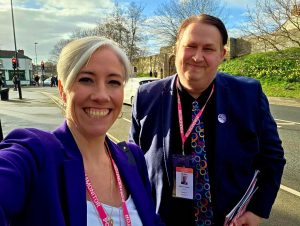 Despite my frustrations, Lib Dem Spring Conference in York was, at its heart, a reminder of what makes this party special. It was wonderful to connect with friends and colleagues old and new-people United by a genuine desire to build a fairer, more liberal Britain.
There is real energy in our movement. We should make progress in May’s elections. The question is whether it’ll be the next breakthrough moment we need.
Time will tell…
* Mathew Hulbert is a former Councillor, is a regular commentator on TV and Radio, and is Co-Host of the Political Frenemies podcast.
 Follow @libdemvoice.org on Bluesky
 Like us on Facebook
 Subscribe to our feed
 Sign-up for our daily email digest

 How John Prescott blocked the full redevelopment of Ellesmere canal basin
 LGS establishes new link with US National Winston Churchill Museum in Fulton Missouri
 Labour need to step up on abolition of leaseholds
 Show Racism the Red Card
 Richard Church
 Tim Rogers
 BigTallTim
 Geoff Reid
 Ruth Bright
48 Comments
Has Ed changed our nuclear policy?
All Ed said was that we should make our nuclear capabilities independent from America. This piece is doing a lot of shameful reaching to conclude we somehow abandoned our long term goal of mulilatieral disarmament. That is not the case.
Devil’s advocate here.
Politics is about hope versus hate, about improving the quality of life for all versus selfishly looking after Number One. When times are good, there is scope for hope, and political promises gain credibility. When times look bad, when “nothing works”, then no constructive policies which the main parties promise will carry conviction. Hate gets a better press. “Reform” can’t be any more constructive than anyone else, but when they promise to pick on racial scapegoats, they are making promises they can deliver.
So the contest is between the under-deliverers – fourteen Tory years followed by Sunak-copycat Starmer – and the over-promisers – Reform and the Greens.
The Tories and Labour despair that there is no money left, and hence have little to offer. Conversely, the Greens and Reform pretend that money will be no object, and that radical change will be easy and popular. Right now, they are winning the argument.
Where do the Lib Dems fit in? On neither side. In principle, they are right to try to avoid the two opposing pitfalls of under-delivering and over-promising. In practice, they then just lose visibility. This brings a mood of desperation, engendering “LOOK AT US, FFS!” politics, such as the stunts and the overdramatic “scrap the Treasury and build world-leading nukes!” policies.
As a devil’s advocate, I’m not here offering solutions. But I’m admitting that yes, the problem of political relevance isn’t easy to solve.
I couldn’t disagree more with Mathew. Mathew is normally constructive and supportive. UK Politics at the moment means we have to use any method we can of getting seen and heard. Ed was right to do what he did. There was a real energy in the hall because of it. Ed is reaching people normal political “purist” behaviour doesn’t.
I wasn’t at conference. I was out canvassing, and Matthew is on the button when has says that we are easy to ignore. On a majority of doorsteps I heard a variety of views on Labour, Tories, Reform, and Greens, and very often people said that they couldn’t or wouldn’t vote for any of them. Very few suggested they might consider voting LibDem. We just don’t feature in most people’s calculations. A depressingly common view is that the party can’t be taken seriously, and Ed Davey’s antics do greatly contribute to that perception.
Goodness me, Matthew, what a killjoy you have become. Our leader , having made a serious speech – and I disagreed profoundly with the nuclear bomb bit – had a light hearted moment with party members. Does that make him less serious? No! It makes him seem human. Sorry mate, but you’ve really got this one wrong. Lighten up
The problem is that the media are beginning to report the stunts but not the message. Ed is looking like a fool.
I worry that our new nuclear policy risks throwing the baby out with the bath water. Of course Trump is a reckless and unreliable ally but he won’t be in the White House for ever. Do we need to undertake the vast expense of a fully independent nuclear deterrent simply because of present circumstances? And if we do wish to move away from the USA, could we not effectively reach out to our European allies to explore pooling resources and sharing the cost of a credible deterrent?
There is no nuclear policy. Spring conference 2023 updated our nuclear policy to multilateral nuclear disarmament. Ed was highlighting the weakness in our current implimentation of that policy in which we rely exclusively on the good will of another nation state to provide essential components. Ed was stating that we have to implement the policy properly. About time too.
I’m afraid Mark Scott is right. Our party is mostly invisible at national level; the leadership looks tired; and the policy offering is stale. If things don’t change all the progress made at the last GE will have been wasted.
For goodness sake. Our beautiful country is desperate for a serious alternative to the current options. Please get your act together and give those of us who believe that building a future with Europe is our best option something to vote for. We need direction, strong leadership and a plan. You’ll never get a better chance, and the work starts now, not 6 months before an election.
On the nuclear point, I think Ed’s point is very sensible. Clearly in an ideal world, multilateral disarmament would be great but at the moment that is a total fantasy. There’s no point in using the limited media coverage we have to discuss totally academic policies.
This stance differentiates us from the Greens’ delusional ‘convince Putin to give up his nukes’ idea.
More broadly, I don’t think Ed offering a moment of levity is an issue at all. Farage and Polanski are not exactly statesmanlike leaders as this article calls for- they simply spout the same simple sound bites and get aggressive when they face any kind of challenge.
we somehow abandoned our long term goal of multilateral disarmament
There is a strong case for acknowledging that this policy is no more than symbolic or changing it. It was always utopian.
Today nuclear armed powers include:
Russia,
North Korea
Israel
India
Parkistan
In addition we know South Africa has the technology.
All the geopolitical drivers point towards more states acquiring nuclear weapons.
We do need to ask ourselves why our membership is static around 50,000 and the Greens (as well as Your Party and Reform) do seem to have grown quite a lot in recent months. Our MPs are doing a great job in Parliament but their messages are not getting out to the public on matters on which younger people especially feel strongly (including Gaza and other foreign affairs matters). I know there are some close to the leadership who are quite complacent about membership numbers, but the truth is that in many places the delivering and canvassing is being done by a mainly older cohort.
I was out on the “working all year round” door knocking today. A reform young voter asked me what the Liberal Democrats stand for. When I said freedom of speech among many things, he said “I can’t believe how they were arresting people, I saw it on social media, we have no freedom of speech, they made everyone a terrorist, just because they don’t like Israel”
This is a white, male, reform voter, low income, reform area. He knew all about it and about Donnelly being put in prison because of her vile tweet.
We talked about local issues too, he was interested in my views on small business and said he will be reading my leaflets from now on.
Why is the Lib Dem policy of freedom of speech not being heard far and wide? I’m not sure, but the media does like to interview Polanski and he does give them a good show!
Ed Davey is all over x. And not in a good way. Just saying.
Ed Davey is all over x
Marching towards the sound of gunfire.
“we somehow abandoned our long term goal of multilateral disarmament
There is a strong case for acknowledging that this policy is no more than symbolic or changing it. It was always utopian.
Today nuclear armed powers include:
Russia,
North Korea
Israel
India
Parkistan
In addition we know South Africa has the technology.
All the geopolitical drivers point towards more states acquiring nuclear weapons.”
And, with the exception of South Africa you haven’t really looked at the theoretical nuclear powers on that list. Take Japan for example. It has the engineering skills, scientists, manufacturing capability, and the fissile materials to put together a nuclear weapon complete with delivery system in as little as 6 weeks if it ever needed to. That it does not do so in down to its unwillingness to do so, combined with constitutional and legal constraints. If it ever felt under serious threat however… and it isn’t the only country that could do this.
It was Ernest Bevin who noted “We’ve got to have the bloody Union Jack on top of it”; currently it appears that the flag on top is a quartered Union Jack and Stars and Stripes. and when you consider that the Russians are still unable to use the John Deere agricultural kit they stole from Ukraine in 2022, despite their competence at hacking and cracking…
And I don’t think it is simply a matter of waiting until Trump leaves office, there will be no return to “normal” in the foreseeable future.
I’m annoyed with how we’re being perceived as a party too. I also feel that the credible, policies of substance that we off are being overshadowed by what is quite frankly, cringe.
I want politicians to be genuine, relatable and down to earth, but everything has a sell by date. Ed’s class clown was more than effective in a General Election campaign, but he’s kidding if he thinks he can repeat it again.
For me, the dad dancing overshadowed what I thought was a superb idea. The Modern Magna Carta. As a party, we get excited by constitutional reform. Having PR along with other checks and balances to constrain power are the perfect antidote to the divisive, autocratic politics of Reform.
If political commentators were arguing about our Magna Carta policy, I’d be over the moon. Instead we’re being perceived to be a joke, which undermines the fantastic work our MPs, councillors and activists do.
“Politics is about judgement. And leadership is about understanding the mood of the country.” Agreed. The clowning around is wearing thin now, even for those who once supported it, and this is starting to come up on the doorstep.
Mathew is spot on Ed has served his purpose it is time to move on .We are however in a much better position than previous leadership elections i have been very impressed with some members of the 2024 intake . i always check potential leadership candidates majority in their constituency . but also if they have been outstanding in parliament .
We have a number who fit that bill without falling back on the old guard . A Refreshed Liberal Democrat Party needs a Refreshed Leadership .
Why will people not address the elephant in the room. Ed Davey really does not have the leadership qualities we need. It’s obvious to all my fellow local Lib Dems and we almost avoid the subject now as we feel the party is so “nice ” the reality will not be addressed. On the doorstep there is no enthusiasm for him or what the party is doing nataionally. We are seen as irrelevant .We will hang on where we campaign locally but it will just be a slow death
@ Peter Chapman Some fair points, but is there an obvious successor at the moment ?
Unfortunately people don’t forget the Post Office Scandal or the Con-Lib Coalition, and the party seems to have very little cut through outside the Home Counties.
David Raw 20th Mar ’26 – 3:37pm….@ Peter Chapman Some fair points, but is there an obvious successor at the moment ?
David, reading that sentence reminds me of the Nick Clegg era.;. On this site, expressions of dissatisfaction with his leadership during the coalition years, were initially met with, “It’s too early to replace him” and, as the 2015 GE drew nearer, we were told, “It’s too late to replace him”..
It seems there is NEVER the right time to replace a LD leader and Clegg’s May 2015 resignation, after our disastrous result, was a sad reminder of that failure.
So we have 72 Mps the most ever and yet no one better than someone chosen when we had 11 mps? .Then we really do have a problem. We know what will happen Ed will hang on , we will probably be reduced to 45 mps who get re elected based on local reputation as independant MPs and be scoring 3 to 4 % outside about 100 southern seats. What a waste of what 2 years ago seemed a golden opportunity to present a national team as at least a credible opposition if not a government. Just a bit sad really…but inevitable on current trajectory
@ expats, I happen to agree with you, expats, and have felt like that ever since the days that you mention.
@David Raw: Oh please, it’s only our partisan enemies who go on about the Post Office Scandal as if it were all Ed’s fault (despite being only one of >20 ministers of all 3 main parties in charge of that brief and being the only one who met Sir Alan Bates) — mostly right-wing media apparatchiks with Labour apparatchiks occasionally joining in. And the Con-Lib Coalition is nowadays something that only ever comes up among hard-core anti-Lib Dem hard leftists. Ordinary voters (the ones who might consider voting for us) aren’t concerned about partisan grievances.
@Peter Chapman: Still far too early to be predicting with any certainty what will happen at the next GE (which will almost certainly be in 2029).
If you suggest that the PO scandal was Peter Mandelson’s fault (a big part was) you won’t find many Labour supporters willing to defend him.
@Peter Davies: “Mandelson reportedly urged Blair to proceed with the Post Office’s Horizon IT system” (Wikipedia) So he basically started it. Quite a big difference from being one of many ministers who found it landed on his desk as part of a larger brief. Ed’s role is what? Failing to sort out Mandelson’s mess? Let’s also castigate him for failing to discover Mandelson’s association with Epstein shall we?
@ Alex Macfie “Ed’s role is what ?”
What he’s already apologised for, Alex …… relying without question on civil servants for his decisions,
When he gave oral evidence to the inquiry on 18 July, 2024, he also apologized for not seeing through the Post Office’s “lies” when he was the Postal Affairs minister (2010–2012). The inquiry also examined why he initially refused a meeting with campaigner Alan Bates in 2010 (on civil service advice), which he later accepted and expressed regret for delaying.
A required quality for any politician with Prime Ministerial aspirations is to have a sceptical curiosity of proffered advice – otherwise Sir Humphrey & Co will always rule the roost. You won’t remember, but I certainly do, the old 1960’s Liberal slogan, “think for yourself vote Liberal”.
What Mandelson & co did or didn’t do is irrelevant, and should we expect Sir Edward to uncritically accept it ? “My bloke is not quite as bad as your bloke” hardly qualifies anybody for the highest office and highest responsibilities.
To anyone considering regicide, remember what happened last time this party deposed an electorally successful leader without any obvious successor. The long-term consequence was that we ended up with Nick Clegg. Be careful what you wish for.
If you believe our electoral success is due to Ed Davey you obviously don’t talk to many outside the Lib zdems. We won 72 seats due to massive local targeting and a hugely unpopular Conservative Party.Our vote nationally and in non target seats remained static and we have lost the claim to be a National Party.Now there is more competition from Reform and the Greens Ed Davey is to taking us nowhere …but as I said I am sure nothing will change as as the party membership and ability to influence gets weaker Ed will have the infrastructure in he Westminster bubble to hold on
Ps on the Post Office Issue….. the mud sticks and is repeated in social media day after day…a responsible leader would recognise he is a “busted flush”
@Peter Chapman: Elections aren’t won or lost on social media. Political social media tends to be siloed into echo chambers for partisan supporters and ordinary voters aren’t that interested.
If we are thinking about a Leadership Election it’s worth remembering that such an Election was the start of The Greens breakthrough, it’s actually a good way of interesting a jaded Media.
What better time than now, we the largest group of MPs in a Century & The General Election is 3 Years away.
“What better time than now?”
Well, a leadership election would be hidden behind two disasters – Trump’s war and Starmer’s local election defeat. Good timing?
Besides, Polanski’s success was down to Polanski offering something that really hit the button. Do the Lib Dems have someone who can similarly make an impact?
Don’t make a change until you can make it count.
@David Raw: “to have a sceptical curiosity of proffered advice” you mean like Maggie Thatcher of the advice from civil servants not to recommend Jimmy Savile for a knighthood? Problem is that if you can’t trust civil servants then it suggests a deep-seated problem with the political culture that goes well beyond one particular issue.
The various bots and trolls on social media who bring up the PO scandal whenever Ed or the Lib Dems post something are attempting to portray Ed as the architect of the scandal. So the point is NOT “My bloke is not quite as bad as your bloke”, and the fact that it long predates him and who did set up the system is relevant.
And in general social media comments should not be taken as representative of public opinion. People who post them and read them tend to be partisans of one sort or another. Some people seem to think that social media is a magic wand that can give traction to any rubbish argument. Not true; if an argument doesn’t work in the dead tree media, then it won’t work online either.
David Allen 21st Mar ’26 – 8:17pm..Besides, Polanski’s success was down to Polanski offering something that really hit the button. Do the Lib Dems have someone who can similarly make an impact?……………
DA, If that paragraph is true then we might as well close down the party..
Regarding Ed’s conference speech there were lots of good things in it but towards the end I did not feel inspired and so, like Mathew, the dancing seemed completely out of place. I am still puzzling why I was not inspired and begin to think it was adressed more to the party members rather than to the people of our nation. Also it did not focus enough on people’s situations around inequality, unfair tax systems, lack of social cohesion, lack of local government resources. Neither did it give enough detail as to why we can so strongly criticise Reform and the Greens; merely denigrating them is not enough and I think the general public are now less enthusiastic about politicians condemning their opposing political leaders because they are not enthusiastic about any politician. They want to know exactly where we differ and on specific issues that affect their lives.
@Alex Macfie “ The long-term consequence was that we ended up with Nick Clegg. Be careful what you wish for.”
It is very easy to let the events of the 2010 Coalition government to cloud judgement. As really the only person Nick Clegg can be compared to is David Steel. Hence if we look at where the LibDem party was when Nick Clegg became leader in 2007 and where it was in 2010. Which then raises the question, if the Coalition hadn’t happened, would Nick Clegg helped the LibDems to build further ie. Increase its number of MP’s. This analysis in turn informs us that, perhaps a good leader, with the skills to maintain and grow a party in opposition, may not necessarily be a good leader once that party is in government.
@Alex Macfie
”@Peter Davies: “Mandelson reportedly urged Blair to proceed with the Post Office’s Horizon IT system” (Wikipedia) So he basically started it.”
Don’t see the significance of this. Remember Horizon was started to replace the Post Office in-house developed Capture system (for which the government in 2025 finally set up a compensation scheme for the wrongfully convicted post masters). I suggest the significance is that like far too many government projects (the minutes of PAC lists far too many projects), there is insufficient high calibre, with teeth, informed oversight. In the case of the Post Office, we need all PO senior management who, we now know to have been complicit in the cover up to have their estates seized as “proceeds of crime” – it might help to wake up others like the water and energy companies, and have potentially sobering effect on the social media companies and those hyping AI…
@ Roland. As someone who fought the 1983 election, I’m puzzled by you comparing Clegg to Steel.
The May result will determine the Leaders future. If nothing outside the South then something has to change.
@David Raw – David Steel (1997 LibLab Pact) and Nick Clegg (2010 Coalition) are the only two Lib/LibDem leaders who have been member of the government. Hence can be more usefully compared.
Aside: It would have been interesting to see Paddy Askdown in office with Blair in 1997, but the Labour landslide largely ruled that out…
I had a lot of time for David Steel, Paddy Ashdown and Charles Kennedy, and like many at the time thought Nick Clegg might be a worthy successor. However, reviewing matters, I wonder if Zack Polansk will become the Green party’s Nick Clegg…)
Sorry, Roland, but David Steel was not a “member of the Government”. It was a supply arrangement and brought to an end before the Callaghan government lost a vote of confidence. Pity Clegg didn’t follow that example.
@David – clarification accepted – would suggest David was the more savvy politician than Clegg, and in so doing gave the UK a period of stable government and started the economic growth, Thatcher was able to take advantage of…
Just confirming comparing and contrasting these two is potentially more useful than just rerunning the Coalition mistakes.
Sorry Roland, it wasn’t a clarification it was a correction, and your suggestion of seizing the estates of all senior Post Office management – presumably without any form of trial or due process – would not only be illegal but highly illiberal.
@David – Sorry my incorrect wording, Correction accepted.
The Proceeds of Crime Act 2002, allows for the freezing (prior to conviction) and confiscation of assets. The point is, given the evidence, and the deliberately inflicted suffering, their crime is on the same level as that of those dealing in drugs and other organised crime; against which the POCA is typically used. Without such an enforcement action, we can expect history to repeat and once again no one (in a senior position with authority) actually held to account in any meaningful way…
@Roland: The Lib Dems had a net loss of seats (from 62 to 57) in the 2010 GE. In an election called by a tired, unpopular Labour government, we actually lost seats to Labour. This suggests that had the Coalition not happened (i.e. had there not been the accident of a hung Parliament) there would have been serious question marks over Nick Clegg’s leadership and I doubt he would have hung on. The party had been coasting since Clegg took over and was perhaps only saved from a more embarrassing result by Cleggmania (which had its own problems as it caused hubris among activists in less hopeful seats leading to lack of targeting).