


On Wednesday the Chancellor Rachel Reeves will deliver her long awaited (long feared?) Budget at a critical time for Britain’s economy and society.
As liberals committed to inter-generational fairness, we must seize this moment to call for a major reform: scrapping the state pension “triple lock.” The triple lock – the guarantee that the state pension increases each year by whichever is highest of inflation, average earnings growth, or 2.5% – was introduced with good intentions. Yet today it is deeply unfair to the many younger people facing stagnant wages, rising housing costs and insecure careers.
The Institute for Fiscal Studies warns that the triple lock “disproportionately benefits better-off pensioners” and creates “unpredictability in public spending.” The maths is stark. Since the lock was introduced, spending on the state pension is (according to the IFS) is “£12billion more per year” than it would have been if linked merely to average earnings.
By locking in a generous increase regardless of the economic context, we saddle younger generations with higher taxes or crowded public services. Meanwhile, many in their 20s, 30s or 40s face real hardship: insecure work, escalating housing bills, and low pension savings.
Rachel Reeves has signalled she remains committed to the triple lock as, sadly in my view, remains our party; including in the Lib Dem’s 2024 election manifesto. In the run-up to the Budget, reports suggest that the government is expected to reaffirm the commitment (as reported by Sky News). But what about a commitment to help younger generations? Has any political party made such a declaration?
Here’s why the case for abolishing the triple-lock is compelling.
- Unfair burden on working-age taxpayers. When pensions rise faster than earnings, the year after year effect is that a larger share of public spending goes on pensioner benefits rather than investment in schools, childcare, affordable housing, climate transition or adult skills. The IFS estimates half of the projected rise in state pension spending by the 2070s is attributable to the triple lock alone. If younger people are paying ever more into the state yet getting less in return-in both pension expectation and public services-we risk a growing generational divide.
- Better-off pensioners benefit most. Because people with longer life-expectancy and larger private pensions tend to extract more from the triple-lock indexation, the policy ends up advantaging those already ahead, rather than those who most need support. The IFS describes this as both unequal and “unsustainable.” A fair, Liberal approach must direct resources to where they have the greatest impact-not lock in benefits that exacerbate inequality.
- Fiscal headwinds and global uncertainty. Economists point to significant pressure from an ageing population, rising health and social-care costs and global economic uncertainty. The International Monetary Fund has urged the government to reform the triple lock as part of managing these headwinds (as reported by The Guardian). In short: maintaining the status quo limits flexibility and risks higher taxes or cuts elsewhere-on working-age benefits, on housing support, on active labour-market policies.
- We can protect pensioners while tackling generational unfairness. Scrapping the triple-lock doesn’t, of course, mean abandoning pensioners. A replacement could link the state pension to average earnings growth – a fairer, sustainable benchmark – whilst still offering robust protection for the most vulnerable means-tested top-ups or additional credits. The IFS suggests a “smoothed earnings link” instead of the triple lock. At the same time we should invest for younger people: expanding apprenticeships, increasing housing supply, boosting childcare, and reforming pensions auto-enrolment so every worker builds towards future security.
So here’s my call to Rachel Reeves: in Wednesday’s Budget, set out a plan to end the triple lock and replace it with a fairer system. Make clear how that change will free up investment in the younger half of our population and why older generations should support that-helping those juggling precarious work, high rents and growing debt. Show that Labour’s promise of a fair society must mean fairness across generations, not just for one.
If we don’t act now, the cost of fairness will keep rising-and the legitimacy of the social contract will continue to fragment. As Liberal Democrats, we should champion a pensions system which is generous but also sustainable; that protects but also empowers; and that delivers fairness between young and old alike.
Wednesday offers the chance to reset the balance. Let’s not let it slip.
In praise of… Labour MP Luke Charters
Across party lines I’d like to praise the Labour MP Luke Charters for his bravery at last week’s Prime Minister’s Questions when he shared his struggles with his mental health and challenged the idea that men must always be ‘strong’ or, at least, suffer in silence or in the shadows.
He reminded us blokes that vulnerability is not weakness but, in fact, displays real strength and his words give permission to thousands of men to seek help (as I myself have previously done) and speak out. In doing so, he helped tear down stigma and raised the bar for honest leadership.
Kudos to Luke – you’ve made a meaningful difference.
Why does ‘Mr Brexit’ now barely ever mention the word?
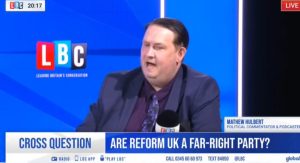 Last week I appeared on LBC’s Cross Question programme with Iain Dale, where I made the point that far too many politicians – most notably a certain Nigel Farage – have gone strangely quiet about Brexit.
I said plainly that Brexit has been a disaster for our economy, for public services, and for Britain’s standing in the world, and yet the man who campaigned hardest for it now barely ever utters the word. I challenged that hypocrisy head on and argued that we cannot fix our country until we face up to the damage Brexit has done and commit to re-building our broken relationship with Europe.
It was a lively, honest discussion – exactly as it should be.
* Mathew Hulbert is a former Councillor, is a regular commentator on TV and Radio, and is Co-Host of the Political Frenemies podcast.
 Follow @libdemvoice.org on Bluesky
 Like us on Facebook
 Subscribe to our feed
 Sign-up for our daily email digest

 A new article for Central Bylines: We shouldn't laugh at Ladybird books but celebrate them
 Reform's link to Iranian regime revealed
 Library reopening - the video
 Yes, I'm still in favour of making the House of Lords democratic
 Slamdac
 Matt (Bristol)
 Graham Jeffs
14 Comments
I agree with the article.
The triple lock should be replaced by a simple link to average earnings. I don’t fundamentally object to smoothing, but am concerned that it would become a back door to an “upwards only ratchet.”
If times are good and average earnings are rising, pensioners should share in that. The quid pro quo is that if times are bad and average earnings are falling, so should state pensions.
After all, as George Osborne used to claim, “We are all in it together.”
A change to the triple lock is acceptable, but not as proposed in this article.
Perhaps a new triple lock? – pensions to increase by the greater of the percentage increase in; inflation, or the national minimum wage, or the level of Universal Credit.
@jenny Smith – since the NMW rises with median earnings, your proposal will in almost all years be the same as the current triple lock – the higher of inflation and earnings. So pensioners would still get richer relative to workers over time.
It is sad to see how so many Lib Dems get sucked into the narrative of the rich elite that the problem for young people is the increase in state pensions (which is still low compared to almost all Western European countries) but never the tax dodges and other tricks that mean that those in the rich elite get much more while the rest get very little.
Surely we are all aware of the old cartoon where a figure (who looks very much like a Murdoch) with a bowl full of cookies says to a white person “Careful mate, that foreigner wants your cookie.” Well it’s equally true of the old person, the young person or anyone except those in the 5% who benefit from our woeful tax system and our pathetic political leaders.
Please don’t let the Lib Dems get suckered into believing it’s the others who are downtrodden who are the problem. Surely we are cleverer than that!
All this talk about the triple lock misses the point, namely that UK Pensions are almost the worst in Europe. Even after 15 years of the triple lock basic old age pensions, even for those on the Steve Webb ‘new’ pension are at best £260 a week. What is needed is a new arrangement for pensions that means people pay a lot more for them and then get a pension they can live on, rather than for many having to apply for multiple benefits and supplementary pension.
All the triple lock has done is to make sure pensions have not fallen even further behind.
There is a solution to the cost of decent pensions, pay more for them, not scrap the one measure that has slightly improved them.
@ Mick,
It may not even be a solution in the longer term but, in any case, it’s already too late to ask all those who are currently receiving pensions to pay more. Matthew does raise a valid point about the difficulties younger people face. In most cases, the only way they can afford to buy a family house is to not actually have a family or perhaps just the smallest of families.
The fall in the birth rate has already started to have both economic and social repercussions. It doesn’t really matter if everyone saves more in a private or public pension scheme, the resources to provide for an elderly population have to come from a younger generation. Savings are just a call on future resources. They aren’t a resource in their own right. If there aren’t enough younger people to provide them they can’t be provided. Period.
Of course we can have increased immigration to fill the gap. Good luck with converting everyone to your POV on that one!
Well commented, Mick Taylor!
Our state pensions are of low value compared with those of other comparable countries.
https://www.google.com/search?q=G+20+state+pensions&oq=G+20+state+pensions&gs_lcrp=EgZjaHJvbWUyBggAEEUYOTIHCAEQABjvBTIKCAIQABiiBBiJBTIKCAMQABiABBiiBDIKCAQQABiABBiiBDIHCAUQABjvBTIGCAYQRRhA0gEKMjI5NjVqMGoxNagCCLACAfEFYFzqsBZyM5c&sourceid=chrome&ie=UTF-8
Might it be that the “Triple Lock” is a “Twig Problem” in comparison with the “Root Problem” of the undermining of our economy and, indeed, our society, by “Financialisation”?
In 1956 the price of an average house was £1,884. Now it is £271,000. In the 50s, a typical mortgage was 3 times a single housholder’s income. Now it is 6.6 times.
“The mortgage that once ended in late middle age has become a lifelong constraint.”
https://www.taxresearch.org.uk/Blog/2025/11/25/is-britain-at-the-peak-of-a-great-financial-wave/
“Our state pensions are of low value compared with those of other comparable countries…” </em)
I think this oft repeated claim does need some investigation. From my own experience of paying into both Australian and UK pension schemes I have to say that the UK ones have been far better value. The Australian scheme was almost entire private. The pension company there for years had me down as a smoker even though I haven't smoked since my early 20s. They were using that as an excuse to reduce my pension, even though, if I had been a smoker, it would have likely reduced the length of time they'd need to pay out. It took a great deal of trouble to find that out. I'm still not convinced that it was properly resolved.
The State pension over there is both location and means tested and I don't get anything now I'm back in the UK even though I paid taxes there for many years
On the other hand, both the UK public and private schemes I have contributed to have been very fair with no underhand tricks at all.
Certainly agree that the triple lock should be removed. However, improving pensions to European levels should be a separate decision related to overall taxation.
The greatest inter-generational injustice is national insurance. As pensions are paid from general taxation and not a fund, there is no excuse for us pensioners not to pay the same taxation as the younger generations.
The Govt have scant regard for senior citizens as those who have worked hard and contributed to society. Their inspiration comes from a former shadow adviser who launched a vicious attack on pensioners by calling them codgers and he wanted what he called intergenerational warfare between young and old with resources transferred from older to younger people.
As a ‘better-off pensioner’ (as is my wife) I certainly agree that I could pay and should pay more tax, but we must look at why the triple-lock was introduced. For pensioners solely dependant on the state pension, necessary increases often lagged behind and governments were often tempted to just omit a necessary increase when they felt poor. So questions arise: has the triple-lock achieved the necessary catch-up? how do we compare with our European neighbours? how we do we stop governments in the future neglecting the hard-up elderly, in the vain hope that they won’t notice?
So don’t just abolish the triple-lock without thinking it through properly. Modify the scheme, but don’t expect that to solve the problems of the impencunious young.
” As pensions are paid from general taxation and not a fund….”
The Govt could make it a fund. This would mean taking money in, spending it to keep the wheels of the economy turning, and storing bonds with the BoE. Pensions could be paid out as the bonds were sold but it’s really no different from creating new bonds as required, to pay pensions and/or using taxation revenues to cancel any stored bonds. It would be directly equivalent to the system we have now.
The point is that National Insurance was originally meant to mainly cover unemployment payments. However, as pensioners don’t qualify for unemployment benefits they should at least only have to pay a reduced rate of NI. NI may well be a de facto tax but if we are going to also make it a de jure tax, the system set up by Beveridge needs to be totally scrapped.
Beveridge wouldn’t have approved. If he’d wanted pensions and unemployment benefits to be directly funded by increased taxation payments that’s what he would have argued for. It would have been far simpler!
“All the triple lock has done is to make sure pensions have not fallen even further behind.” This is not true – since the triple lock was introduced, pensions have risen faster than earnings in any year in which inflation has been higher than earnings!
Hi Tim (Leunig),
You are absolutely right, but most of the posts here have pointed to many much more fundamental problems with the proposal to abolish the triple lock which no-one promoting the idea has dealt with, including yourself. As I said myself earlier, the tax dodges and other tricks of the rich elite mean that they get much more while the rest get very little, so they try deflect things by setting the young against the old in a fight over crumbs.
What I don’t understand is why doesn’t anyone proposing abolition, including yourself, address that aspect of the problem?