


Media reports suggest the Government is to hold off on announcing its plans to reform social care until at least the autumn amid continued disputes within the Cabinet. Boris Johnson this week delayed a meeting with the Chancellor and Health Secretary to discuss the reforms and is said to have ruled out using rises in income tax, VAT and national insurance to pay for social care in England.
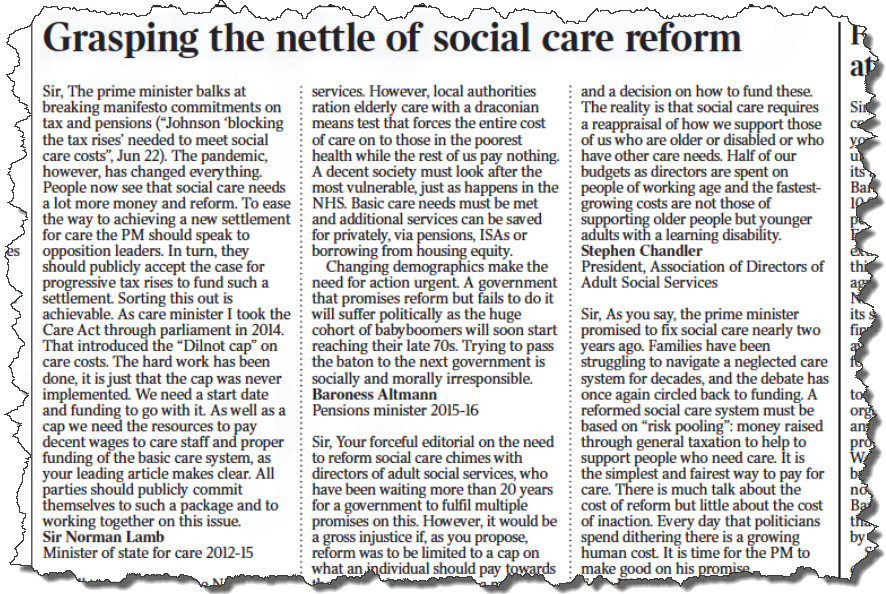
In a letter in the Times this morning, Sir Norman Lamb, minister of state for care from 2013-15, calls for the “Dilnot cap” to be implemented and for all parties to work together to resolve funding.
The pandemic… has changed everything. People now see that social care needs a lot more money and reform…
The PM should speak to opposition leaders. In turn, they should publicly accept the case for progressive tax rises to fund such a settlement.
Sorting this out is achievable. As care minister, I took the Care Act through parliament in 2014. That introduced the “Dilnot Cap” on care costs.
The hard work has been done. It is just that the cap was never implemented. We need a start date and funding to go with it…
All parties should publicly commit themselves to such a package and to working together on this issue.
* Newshound: bringing you the best Lib Dem commentary in print, on air or online.
 Follow @libdemvoice.org on Bluesky
 Like us on Facebook
 Subscribe to our feed
 Sign-up for our daily email digest

 Labour to shun pacts with Greens
 How many councillors has Reform UK lost since the May 2026 elections?
 If you want a picture of the future, imagine a man falling off a paddleboard - for ever
 Delivering in Whickham
 Sarah
Sarah Hywel
Hywel Jason Connor
 Jana
Jana
5 Comments
Dilnot does not raise enough to transform social care. As for working with other parties – years of cheap campaigning on the “dementia tax” hardly helps!
What ever change needs to happen the understanding that adequate housing is a key issue. When things are accessible it gives an added mobility to many.
For too long there has been much dialogue and very little action.
As Habinteg Housing promote a Housing List of category 3 housing for those needing Power Wheelchair accessible homes. This also includes self propel wheelchair users.
The state of social care is a national scandal. What happened in care homes a year ago is, as Amnesty pointed out, a flagrant abuse of human rights which resulted in the death of well over 10,000 real people – people with the same right to life as any others.
The core issue in the 30 year failure to address social care is not about policy details, whether the Dilnot cap or anything else. It is the obdurate refusal of the Treasury to allow the funds which will be needed to underpin any deal, complicated by the absence of machinery in Government to enable and support cross party settlement on long-term issues. Department of Health Ministers have never succeeded in persuading the Treasury to take action. Apart from a short period when Gordon Brown took an interest, Prime Ministers and Chancellors have never been willing to take a firm enough line to get a result.
The Liberal Democrats should, of course, keep the pressure. They should also seek to work with other parties to present a united front which is willing to work with Government to achieve a first-stage cross-party settlement which can be agreed and implemented and then improved in future.
This is a critical policy area that LibDems should be at the forefront of lobbying for. Norman Lamb is right that “The hard work has been done. It is just that the cap was never implemented. We need a start date and funding to go with it…”
The letter to the PM, Chancellor and Health Minister sets out the priorities https://www.adass.org.uk/media/8725/210621-adass-social-care-reform-joint-letter-to-pm-chancellor-secretary-of-state.pdf
1. Funding for short-term stabilisation
2. Urgently bringing forward investment and reform proposals needed to ensure the sustainable long-term future of social care.
3. Investment in the short term to speed the shift towards a system of social care that is both sustainable and fit for the modern age.
There has been much talk of wealth taxes to address rising inequalities driven by policies like QE. The problem is that wealth taxes have never really worked where they have been tried, as Dennis Healy found https://moneyweek.com/personal-finance/tax/602503/britain-mulls-a-wealth-tax-again-can-it-ever-work. The reason is most UK wealth is in pension funds and retirement savings or housing equity. There is a Liberal alternative suited to the issue of adult social care that focuses on community created wealth rather than individual savings. That is an annual Land Value Tax as described in this earlier article https://www.libdemvoice.org/a-residential-land-value-tax-approach-to-funding-adult-social-care-59639.html
The LVT resolves the issue of forced house sales and delivers the ‘risk pooling’ required to ensure that catastrophic care costs at the end of life are equitably shared across the community that has both created and benefited from increases in land values.
The Daily Mail reports https://www.dailymail.co.uk/news/article-9727069/Boris-Johnson-finally-cap-cost-social-care.html “Boris Johnson will finally put a cap on the cost of social care as PM orders Rishi Sunak to find cash to help the elderly and wants limit set at £50,000.”
Sir Andrew Dilnot has said his plan could cost £10billion a year, although he estimates half of this bill would be needed anyway to shore up the crumbling care system.
Mr Sunak has warned the PM that long-term funding would require a significant tax increase, potentially involving breaking the Tory ‘tax lock’ pledge to avoid increases in the headline rates of income tax, national insurance or VAT.