


 Budapest, Vienna, Munich – the newspaper and television pictures show a story of refugees fleeing from the civil war in Syria and other countries, looking for a place to stay, to keep their families safe, and most of all to survive. Images of their reception in Austria and Bavaria – most notably at Munich railway station – have been seen worldwide. Helped by thousands of volunteers and the German authorities, most of the asylum seekers have found shelter.
What does it and will it mean for Germany? And for the smaller towns and villages spread throughout the country? I live in a small town just to the East of Munich. It’s on the main railway line between Salzburg and Munich and the past week has seen both local trains and InterCity trains coming through the station packed with refugees.
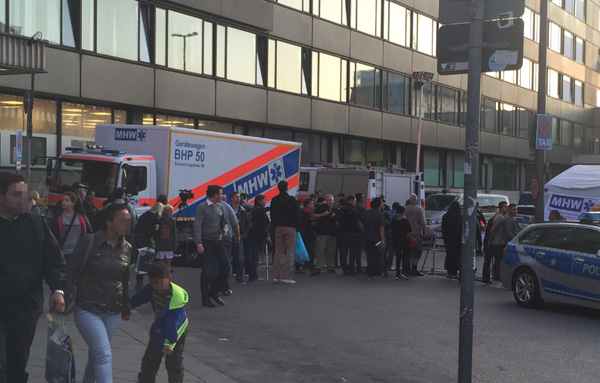
For us, this is not just a recent phenomenon. Three weeks ago – before the situation escalated in Budapest – I was at Rosenheim station as a train arrived from Italy. It was diverted to a special platform with a temporary police presence and many of the passengers were accompanied off the train and registered by the (friendly) border police before being taken by bus to a reception centre. Last year returning from holiday in Italy, the train was stopped at the border and about 5 families helped off by the police.
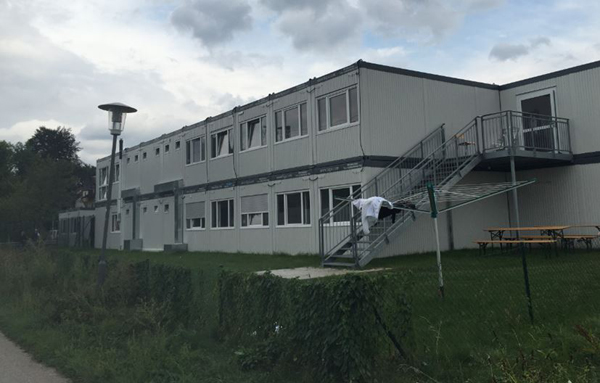
Last autumn our local town council was asked to find land on which temporary housing could be placed. The kreis administration (roughly equivalent to a county council) had been asked to pace several hundred refugees in accommodation in its area. The town responded and in spring a number of container units were set up on a vacant lot near the railway station. It was soon filled with about sixty, mostly young, men from Eritrea, Ethiopia and several other African countries.
The town – as have other towns throughout Germany – responded magnificently. The town council is not a large one. We do have a full-time mayor and a number of employees, but it was clear from the start that more needed to be done. The new inhabitants needed to be helped into their new life. Many will probably end up staying for years and they need to learn the language (German is not easy…). I’ve been part of a group of about 20 who give lessons at least once a week. Others in the town have organised reading groups and individual coaching. It’s been a challenge. Few of us are qualified teachers. We’ve had to find textbooks (and yes we have also now got one which is partly in Tigrinya, spoken in Eritrea) but fortunately most have a basic knowledge of English or French.
The local sports club has been superb. They have arranged soccer training and volleyball groups. A table tennis table was provided for use in the container village and even swimming lessons have been arranged. Needless to say both the local Catholic church and Lutheran church have reached out to the group, who are mostly Orthodox.
Adapting to life in Germany has been for some of the new residents a challenge. Another group in the town has helped with basic tasks, such as buying a train ticket (using those fantastically complicated machines that are found all over the railway system). Even shopping was for some a challenge at the beginning.
And how have the refugees responded? Superbly. Most are happy to have somewhere at last to stay. They are unlikely to be moved for some time and are beginning to put down roots. Some (about 20) have got places at the local technical college to prepare a school leaving qualification. Others have already found jobs with the help of local employers – they can work after three months in the country. At the local town fete in July many helped on a stall serving Eritrean/Ethiopian food.
It’s not all been plain sailing. There have been a few complaints about noise – as there would be with any group of 60 young men. We’ve also had a least one incident when a drunkard started yelling racist slogans. The town has also paid for full-time security personnel who help a little in ensuring that few problems occur. The police have had to be called a few times and the fire brigade at least once (yes….you have to turn off the stove it does not go out automatically…).
But is 60 places enough? The authorities are looking for new sites and another one has been identified in the local industrial estate. Can the town with its 8000 inhabitants support another 60 individuals? We’ve currently got 2-300 volunteers who support the group of 60 on a regular basis, and that is sometimes a challenge. Can we get more locals involved? Or do we drop the support for the existing group? How does the town cope with 120 young people with a lot of time on their hands and otherwise little to do….. Those will be the challenges in the next year.
The government has said that the current refugees movement will transform Germany. Even our own small town has been changed in the past year. Unlike the UK, or many other European countries, Germany has had a comparatively small BME population and until last year in my home town the only non-white face that I saw was that of the local postman. It is going to be a long-term challenge for society, as many of those now arriving have little hope of returning home for at least a few years. Towns like ours have little unemployment and have jobs to fill. There are other towns, however, with higher unemployment rates and those are the areas which have already seen attacks on temporary accommodation.
* Robert Harrison is the current Chair of LDEG. He is a true European, with British and German nationalities, and has been a candidate for the European Parliament several times in Germany.
 Follow @libdemvoice.org on Bluesky
 Like us on Facebook
 Subscribe to our feed
 Sign-up for our daily email digest

 More ministerial dissent over Labour's immigration policies
 Jane Dodds stands down as Welsh Lib Dem leader
 The straight and narrow path to Marzipan Tunnel
 Alex Macfie
 Rob Heale
 Chris Moore
 Adam
Adam Paul
Paul
16 Comments
Key steps along the line are “settlement” and “nationality”, sometimes described as “permanence” and “passports”.
Is it still the case that third-generation people of Turkish extraction are not progressing to nationality in Germany because of legal barriers? If so, is an underclass being created?
It appears Angela Merkel is shifting her ground and backing off a bit now.
Are they receiving education on Western values of equality?
Richard – the German law on nationality has now been revised several times in the past few years and anyone born in Germany is now considered to be German if at least one of the parents is a long-term resident. They can often keep the nationality of their parents as well. That has improved integration of second and third generation residents.
I agree with your thesis that integration into society also requires a perspective to obtain nationality and I know several people who have given up their original nationality to become German.
I wrote this article before last night’s sudden decision to reintroduce border controls, which has lead incidentally to massive queues today on the Autobahns in Bavaria. There were a number of factors leading to the decision. One of which was exhaustion on part of the city council in Munich with over 13000 people arriving on Saturday alone and no accommodation available. One of my colleagues told me that her husband had spent Sunday afternoon helping erect a tent in another town near us. He is a also a volunteer. It is however not a long term solution. The pressure will build up in Austria and then Hungary again.
Anne. I am not sure that I understand your point. At this stage many are still finding their feet and learning about German society. I think that there are a lot of things they need to learn. Rejection of discrimination in all of its for,s is clearly one of them but it will be a long term process.
Rob Harrison 14th Sep ’15 – 9:45pm Thank you. It was very noticeable that when the communist dictatorship of the Caesescus in Romania ended ethnic Germans were given german nationality and moved en masse to Germany.
Ethnic Hungarians were not helped in the same way by Hungary, even though the government there was post-communist and pre-Fidesz.
Richard – actually during the Caesescu regime in the 1970s and 1980s ethnic Germans were often given the opportunity to go and live in (West) Germany and were given German nationality, as were Poles and ethnic Germans from the Soviet Union. The blood line principle is still the basis of German nationality law, even if it has been loosened up so that place of birth is now a criteria.
Merkel is now panicking over the mess she has made. This has been coming for a few years yet the EU collectively have covered their eyes and stuck their fingers in ears. How will towns cope if they have 1000 + billeted on them? Will people be welcoming then? The people of Munich must be worried. Cameron has been warned that 2 in every 100 from Syria are ISIS. I worry that there is going to be a very bloody backlash because of the EU ineptitude. If large numbers of refugees/migrants arrive in towns how happy will they be when presented with a tent and not the housing etc they thought they would get? How happy will the locals be? Winter is coming and is forecast to be a harsh one.
Ethnic Hungarians in Transylvania (Romania) and also in Slovakia and parts of Serbia have been there for many generations, as they are living in places that were in Hungary pre-1918. I suspect that most of them regard the other countries as there home anyway. Hungary, pre-1918 was much bigger than now, including parts of Ukraine and Poland too.
Whether people of such minorities want to relocate should be up to the individuals themselves, even before going into the question of ‘mixed-marriages’ and their offspring.
There is former top tennis player who was Yugoslav, but kept pretty quiet for about her Hungarian ethnicity.
The German diaspora in eastern Europe, as far as Russia was somewhat different. Centuries ago, the rulers in such places had imported whole isolated communities of Germans in order to improve the order and prosperity of their lands. Slightly different in Central Europe – Poland and the Czech Republic, which straddle the traditional boundaries between German and Slav areas, and which post-1945 expelled much of their German population. There is also a long-standing Slav community – Sorbs- whose homeland is in eastern Germany.
I am inspired by the article itself and the can-do spirit it embodies.
It’s not only in Germany. I am reminded of reading in a French local newspaper, when the Yugoslav troubles died down, of a farewell party held in a small town in northern France for the group of Yugoslav refugees who had been living in that town for some years.
@Anne: I am sorry, but I don’t see how you can say that this has been coming for a few years and that the EU has covered its eyes and stuck fingers in its ears. Who could have foreseen the rise of ISIL, which has lead many of the refugees to leave their homes? I would agree with you that 1000 people billeted in a local town will cause tensions, and would simply be unaffordable as well as probably causing a backlash. We are not seeing those types of numbers, but who knows what will happen. Clearly there has to be a concerted and combined action by all member states to provide housing and shelter throughout the EU, and also to support Turkey and Greece who still house the majority of the Syrians. It’s despicable that some countries refuse to accept any share of their responsibility and others make almost futile gestures (20,000 over the next few years….)
@Ian: Germany also house a number of refugees from the Yugoslavian troubles and there were also parties held. The parallels have been drawn with current crisis and the hope is that the situation in Syrian will be calmer in the next few years.
@Anne: where do you get the 2 out 100 refugees are ISIL figure?
Rob Harrison. Lebanese minister told Cameron about 2/100. Italy and Greece have been warning for a long time about scale of migration. Italy had an agreement with Gadaffi to keep migrants from leaving Libya. Look what happened when you agreed with the Tories to decimate that country and bomb the hell out of it. Very many thousands marched in protest over the Iraq war and warned about the consequences. So yes, we have known for years. As for Daesh, mainly from Iraq and Syria, who is funding them and why did we arm rebels in Libya and Syria ? The rise of Daesh was inevitable, unfortunately, governments were more interested in backing arms dealers and supporting rebel groups that went on to form Daesh. Nobody listened to the people and common sense. Greed, greed, greed, all the time with the eye on the oil but that has not turned out as expected only misery for the people.
@Anne: thanks for giving the source. Still interested in knowing where the statistics come from, because it conflicts with other data about the number of fighters.
I agree with you that the power vacuum in Libya has contributed to the influx of refugees on Europe’s Southern border. Europe was captivated by the “Arab Spring” and failed to see the power vacuum that would result.
Not certain that the rise of Daesh/ISIL was “inevitable”, but there are a lot of open questions about who is funding them and giving logistical support. At the end of the day it is about power and influence. ISIL are probably only pawns in a power game in which Europe plays a minor role but needs to deal with the consequences.