Tag Archives: 2026 autumn conference

Mathew on Monday

Brighton was wonderful but I’m still left asking: what are the Liberal Democrats for?

There is much I love about Lib Dem Conference.

Brighton last week reminded me why. Seeing friends and colleagues from across the country, some of whom I only ever see at Conference, was wonderful. There were fascinating fringe meetings, including the one on Assisted Dying that I was honoured to chair on behalf of Dignity in Dying, passionate debates and the reassuring experience of spending a few days among people who, whatever part of the party they’re from, share a belief in liberalism, internationalism and social justice.

But I returned home with the same nagging question I took to Brighton: what, exactly, is our party trying to become? To be fair, the party knows it has a problem. The new party strategy talks about the need for a clearer national Liberal identity and a distinctive message. Conference itself was full of conversations about what-and who-we are for.

Yet I’m not convinced our gathering in Brighton provided the answer. Are we becoming a sort of One Nation Conservative Party, offering a home go moderate former Tories who are repelled by the direction of their old party?

Are we returning (as I’d certainly prefer) to our radical, centre-left traditions, talking about inequality, redistribution, public services, Europe and constitutional reform? Or are we, as I suspect, still rather vulnerable to that oldest accusations against Liberals: that we face both ways?

Ed Davey’s announcement of £17 billion of income tax cuts, funded through the growth the party believes would follow from rejoining the Single Market and a customs union, illustrated the dilemma perfectly. There was plenty there I welcomed – particularly the much stronger argument for rebuilding Britain’s broken relationship with Europe but what bigger story are we telling about the society we want to create?

And there is another question our party must answer: what are we saying to urban, Labour-facing England? Our spectacular advances against the Conservatives transformed the party’s parliamentary strength and should be celebrated.

But Liberalism cannot become something practised only or mainly in prosperous southern constituencies where the Tories are the principal opponent.

What is our offer to Leicester, Birmingham, Liverpool, Nottingham and Newcastle, to name but a few? What do we have to say to people in communities where inequality, struggling public services, poor transport connections and insecure work shape everyday life (which, of course, includes pockets in the South too)?

Our own strategy now talks explicitly about expanding in the North, Midlands and urban Britain. Good. But organisational strategy, important though it surely is, isn’t enough. We need a story to tell, too.

For me, that begins with confident Liberalism: internationalist, socially just, decentralising, environmentally ambitious, unapologetically pro European and determined to redistribute, power, wealth and opportunity.

Brighton reminded me just how much I love this party and its people.

Sadly it didn’t exactly answer my question about where we’re going next.

Christine Jardine deserved better

Posted in Op-eds | Also tagged and | 8 Comments

Conference from the other side of the barrier

Four conference ago, I walked into Liberal Democrat conference as a delegate. I arrived on my own, not knowing many people and not really knowing what to expect.

This year’s conference has now come to an end. It was my fourth conference overall and my third time stewarding, so I thought it was a good opportunity to reflect on what conference looks like from the other side of the barrier.

When you attend as a delegate, you naturally see the debates, speeches, motions and fringe events. What you don’t necessarily see is everything that happens behind the scenes to make it all work.

That’s where the stewards come in.

There are people arriving who need directions, rooms to check, questions to answer and all the little things that need to happen throughout the day. It can be busy, but that’s part of what makes it enjoyable. You’re part of a team and everyone is there to help make sure conference runs as smoothly as possible.

Being a steward also doesn’t mean giving up your own conference experience. You still get opportunities to attend debates, fringe events and other sessions you’re interested in. With a bit of planning around your stewarding duties, you can still get along to the things you really want to see.

That’s important because we’re all there for our own reasons. For me, there are debates I want to hear, fringe events I want to attend and, of course, people I want to catch up with.

And the people are probably my favourite part of conference.

I’ve been lucky to work with a fantastic stewarding team, led by our chief steward Jodie. She does a brilliant job of keeping everyone organised and making sure the team feels supported.

Over the three conferences I’ve stewarded, I’ve met some brilliant people and made friendships that have grown beyond the stewarding shifts. There are people I might not see for months, but when conference comes around again, it’s like no time has passed.

Sometimes the evening can be just as memorable as the daytime programme. You can sit down with friends for a chat about the day’s events and end up talking about politics, life and everything else until much later than you intended.

That’s the thing about conference. The politics brings people together, but the friendships are what make it special.

Posted in Op-eds | 2 Comments

Is Conference still supreme?

Aspects of the recent Party conference in Brighton raise an important question in my mind: what has happened to democratic policy-making in the Liberal Democrats?

When Nick Clegg was leader, he repeatedly distinguished us from Labour and the Conservatives by emphasising how we made policy. Conference, he reminded us, was supreme.

I remember many conferences where that principle was visible in practice. There were robust debates, speakers for and against, amendments carried and defeated, and motions sometimes lost. Conference was not there simply to endorse a predetermined position. Its purpose was to debate and decide.

The contrast with the conference just gone is striking. Every motion debated was approved and, as far as I am aware, so was every amendment.

That should make us ask whether something has changed.

It appears increasingly difficult for a motion, or even an amendment, to reach the agenda unless the Federal Conference Committee has reason to believe the relevant party spokesperson is content for it to be discussed. If that is how the system operates in practice, it creates a formidable barrier for individuals, local parties and affiliated organisations wanting to put forward new or challenging ideas.

The problem does not end with motion selection. At this conference, remarkably few speakers were called to oppose motions or amendments. Many amendments were so uncontroversial they might better have been treated as drafting changes, leaving precious conference time for genuine disagreements.

I find it difficult to believe there were not more members willing to speak against. In at least two debates, I know there were.

Posted in Op-eds | Also tagged | 16 Comments

Conference or What?

Who can actually afford to take part in Liberal Democrat democracy?

A conversation with Donna Harris about her campaigning on childcare got me thinking. Donna’s work is fundamentally about removing barriers. Barriers that prevent women from participating fully in society, work and public life.

It made me wonder whether we sometimes overlook the barriers within our own party. Because there is a slightly uncomfortable question we should be asking after Brighton 2026: Who actually gets to participate in Liberal Democrat democracy?

The Liberal Democrats proudly say that conference is where the party makes its decisions. Every member has an equal say and an equal vote. That sounds wonderfully democratic. But equality of voting rights isn’t necessarily equality of access.

The Autumn 2026 full conference pass was £225 at the late rate. A weekend pass was £140. There are concessionary rates, first-time discounts and a £10 rate for under-18 members. There is also an Access Fund.

But those are only the starting costs. Add a train ticket. Hotel. Food. Local transport. Potential childcare. Time away from work. Suddenly, conference isn’t a £225 decision. For many people, it is a £500, £700 or £1,000 decision. And that changes who can realistically be in the room.

Think about an 18-year-old member. Or a student. Someone working part time. Someone starting their first job. Someone renting in London. Someone supporting a family. Someone from a lower-income household.They may passionately believe in Liberal Democrat democracy. They may simply not have the money to participate in it.

The party offers an online solution, however it cost £25.00. Sounds reasonable, but you have to make sure you have the relevant Data and WiFi service. There is also no conference experience, that’s a given.

And that brings us to representation.

Posted in Op-eds | 13 Comments

Where next on the Triple Lock?

At conference this weekend, there was a rare – and welcome – moment of controversy in the hall.

During Ed Davey’s Q&A, journalist Carolyn Quinn asked for a show of hands.  Should the Liberal Democrats continue supporting the triple lock pension?

It was close.  The triple lock survived the straw poll, but only narrowly.

For a party which proudly introduced the triple lock, that tells us something.  There is an appetite among Liberal Democrats for a serious conversation about intergenerational fairness.

We should have it.

The triple lock was the right policy for its time. When Liberal Democrats entered government in 2010, too many pensioners had seen the value of the state pension eroded over decades.  Linking annual increases to whichever was highest – earnings, inflation or 2.5% – was rooted in a liberal instinct.  Giving people dignity and security in retirement.

It worked.

The question is whether a mechanism designed for Britain in 2010 should continue indefinitely, irrespective of how Britain changes.

Today the state spends around £154 billion a year on the state pension.  The Institute for Fiscal Studies estimates that this is now £16 billion higher annually than it would have been without the triple lock.  Looking towards 2050, it estimates the additional annual cost of maintaining the lock could plausibly be as high as £40 billion.

That is not an argument for impoverishing pensioners.  Nor should we succumb to lazy generational warfare which portrays pensioners as universally wealthy. It is an argument for asking where state support can best deliver fairness in Britain today. I believe the answer is children and families.

The triple lock has achieved something important.  It has deliberately increased the state pension faster than earnings over time.  But no equivalent promise exists to families bringing up the generation which will ultimately finance tomorrow’s pensions, NHS and social care system.  That needs to change.

Posted in Op-eds | Also tagged and | 12 Comments

I watched Ed Davey’s speech. Here’s why it matters 

Whilst those in the media world and the Westminster bubble speculate about the future of our party leader, Ed Davey, Ed focused on what matters most – a plan to end the squeeze on middle-income earners, put hundreds of pounds back in the pocket of millions of people, and take ordinary workers out of paying the higher tax rate that was designed for stockbrokers.

Ed announced that the Liberal Democrats would raise the tax-free personal allowance to £15,000 and increase the higher rate threshold from £50,270 to £56,000. He said that would mean taking two million more people out of paying tax altogether and giving most taxpayers a £680 tax cut.

£680 doesn’t sound like much to some people, but to others, it means a great deal more – carers doing early morning calls and spending a chunk of their wage keeping a car on the road. Lads on nights in the warehouses off the M62. People on the tills doing 30 hours and still checking the banking app before they go shopping. Taxi drivers who’ve watched fuel, insurance and licence costs go up while fares haven’t kept pace. For them, £680 is a couple of months of gas and electric. It’s school shoes without putting them on a card.

What gets me is that many of these people have been paying more tax for years without anyone announcing it. The allowance has been frozen, so when your wage goes up just to keep up with prices, more of it gets taxed. You don’t feel any richer, but you pay more. Under the current plans that freeze runs until 2031. Ed’s plan would lift it.

He didn’t pretend this is only about low earners, either. The higher rate change helps people on better wages, and some will say that’s where a lot of the money goes. That’s a fair point. But in towns and cities across our nation, the people creeping over £50,000 aren’t bankers. They’re senior nurses, teachers who’ve moved up to deputy head, engineers who’ve been with the same firm for twenty years. Ed said a ‘tax band designed for stockbrokers is now holding back teachers and nurses’, and I think most people would recognise that.

Posted in Op-eds | Also tagged and | 8 Comments

Citizens abroad and party strategy

There were many things to support in the party strategy motion. It includes confident liberalism, modern campaigning, and reaching new communities. However, there is one notable exclusion. In fact, around five million notable exclusions: citizens abroad.

The strategy talks about reaching out to all communities in our country. These five million people are not in the UK, but they are served by our democracy. I live in Switzerland now, having moved for a job. Yet decisions made in Westminster continue to affect my life.

The starkest of those in recent years was of course Brexit. Many of the million British citizens living and working in Europe spent years in limbo after the referendum, not knowing what residency status they would eventually be afforded in the country in which they had built a life. We continue to see Britons being removed from EU countries, most recently Charles, a British citizen deported from Sweden.

All because of a decision made in Westminster. 

It doesn’t stop there. A pensioner retiring to Australia from the UK in 2006 would now receive less than half the basic State Pension of a pensioner who stayed in the UK, despite having made exactly the same contributions.

Posted in Op-eds | Also tagged | 2 Comments

WATCH: Max Wilkinson’s speech to Conference

Creep glasses and jokes at Robert Jenrick’s expense were high on the agenda for Max Wilkinson in his speech to Conference.

I am used to being disappointed by Lib Dem Home Affairs spokesperson’s speeches. I’d rather a more positive message on immigration but this was better than we have had in recent times.

I was glad to see him prioritise tackling violence against women and girls. While I had been worried about the packaging of the campaign about smart glasses,it’s an important issue to tackle. Anna Sabine and Wera Hobhouse’s amendment at Conference called for it to be very clear when …

Posted in News | Also tagged and | 1 Comment

What do we think of Ed Davey’s tax cut announcement?

I always find it odd that, when we have had hundreds of Lib Dems discussing policy for days, we then have the leader announcing a major new policy in his speech, just as everyone’s about to go out the door.

In Spring it was a new British nuke, which we’ve mercifully not heard much about since. However the tax cut policy announced yesterday might have more longevity.

Basically we are going back to one of the really popular ideas from the coalition years, and raising the threshold at which you pay tax to £15,000. This is the idea initially brought forward by my Lib Dem Women colleague Lizzie Jewkes and which was talked about in a New Statesman podcast just last week. Lizzie was described as an “ordinary woman” and anyone who knows this very lovable force of nature will know she is as far from ordinary as you can get.

When we were in coalition, the Tories constantly claimed credit for this policy because it was so popular without mentioning that it was our idea, of course.

Anyway, the other proposal is that we would raise the threshold at which you pay the 40% tax rate to £56,000.

This would all be paid for by the benefits of rejoining the single market and customs union, proposals which we can probably all get behind.

The detail is set out n this article on the party website.

Posted in Op-eds | Also tagged , and | 50 Comments

What’s on at Conference today?

Conference kicks off with two brief policy debates on making recruitment fairer and regulating abusive use of the legal system. Then GP services in England before a keynote speech by Max Wilkinson.

After a three hour lunch break for fringes, there’s a debate on supporting people to age well in England, a keynote speech by Jane Dodds and a motion on stopping violence against women and girls in the digital age from Lib Dem Women and Marie Goldman, our Women and Equalities spokesperson.

The day ends with the parliamentary parties’ report and two emergency motions. One is from YL on wildfires and the other is from LGBT+ Lib Dems setting out a way forward after the imposition of the cruel and unworkable EHRC Code of Practice on access to services. Under this code, trans people can be banned from facilities associated with their lived gender, and, for trans men and some non binary people, also from facilities associated with their sex assigned at birth. It also suggests that access can be policed based on how people look so if you are a cis woman who is very tall, or with a deeper voice, you could find yourself being challenged when you go to the toilet.

The motion suggests a cross party committee of MPs to work out a way to fix this to ensure dignity and safety for everyone. All very sensible.

The Young Liberals have also put in a motion on action to tackle wildfires which calls for a number of things including preventative measures, assessing risk, temporary restrictions in areas of high risk.

Here’s the day in full.

Posted in News | 4 Comments

WATCH: Munira Wilson’s speech to Conference

Education spokesperson Munira Wilson gave her keynote speech to Conference yesterday. Enjoy:

Posted in News | Also tagged and | Leave a comment

WATCH: Al Pinkerton’s speech to Conference

Watch Al Pinkerton talk about our vision for closer ties to Europe:


Posted in News | Also tagged and | 1 Comment

What I would have said about homeless children at Conference

Taking part in Lib Dem Conference online (I cannot make it to Brighton, so watching and voting online) it was good to see the first policy motion was about homeless children, although tragic that we have to discuss the subject at all

You can see below more about it, but it covered the awful issues there are for children, as well of course as their parents and other adults.  Shocking to hear that There are over 176,000 children living in temporary accommodation across England, and that Since 2019, 104 children have died with temporary accommodation listed as a contributing factor to their death, 76 of whom were under the age of one, with deaths attributed to causes including lack of access to cots and Moses baskets, overcrowding, poverty and the chaos of homelessness.

Excellent and moving speeches, amendments adding important issues. The motion as amended is here.

The next step of course is for those in power to take note, and actually do something about it.

It brought back memories of the mid 1990’s when there were homeless families here in Stockton on Tees in Council accommodation.  My involvement started when I found out that play schemes for the holidays would not include these children.  I was horrified and with a lot of support, and a quickly made grant from the Church Urban Fund a play scheme was started for the summer.

As you can imagine it didn’t end there, with parents asking, what now? A project started with a lot of “challenges”.  The Labour Councillors in charge would not support it any way, and were upset when we got more funding, even though we weren’t a registered charity.  But with the backing of some good council officers (we held meetings at lunchtime so they could attend in their own time), one good labour councillor friend, other friends and churches, we went ahead.  Not just play schemes in school holidays, but activities for parents and under 5’s, and a creche so parents could attend courses.  At the playscheme we had lunch, all sat at tables with knives and forks.  For years afterwards I would meet a mum who said thanks for the opportunity given to her to do some training that had led to her career.  But the downside was that after a few years the revolving door started.  We were seeing the same families that had been housed, back again.  For all sorts of reasons, domestic violence,  family breakdown,  inability to budget as crises hit. 

Posted in Op-eds | Also tagged and | 2 Comments

Caron’s kitchen table diary

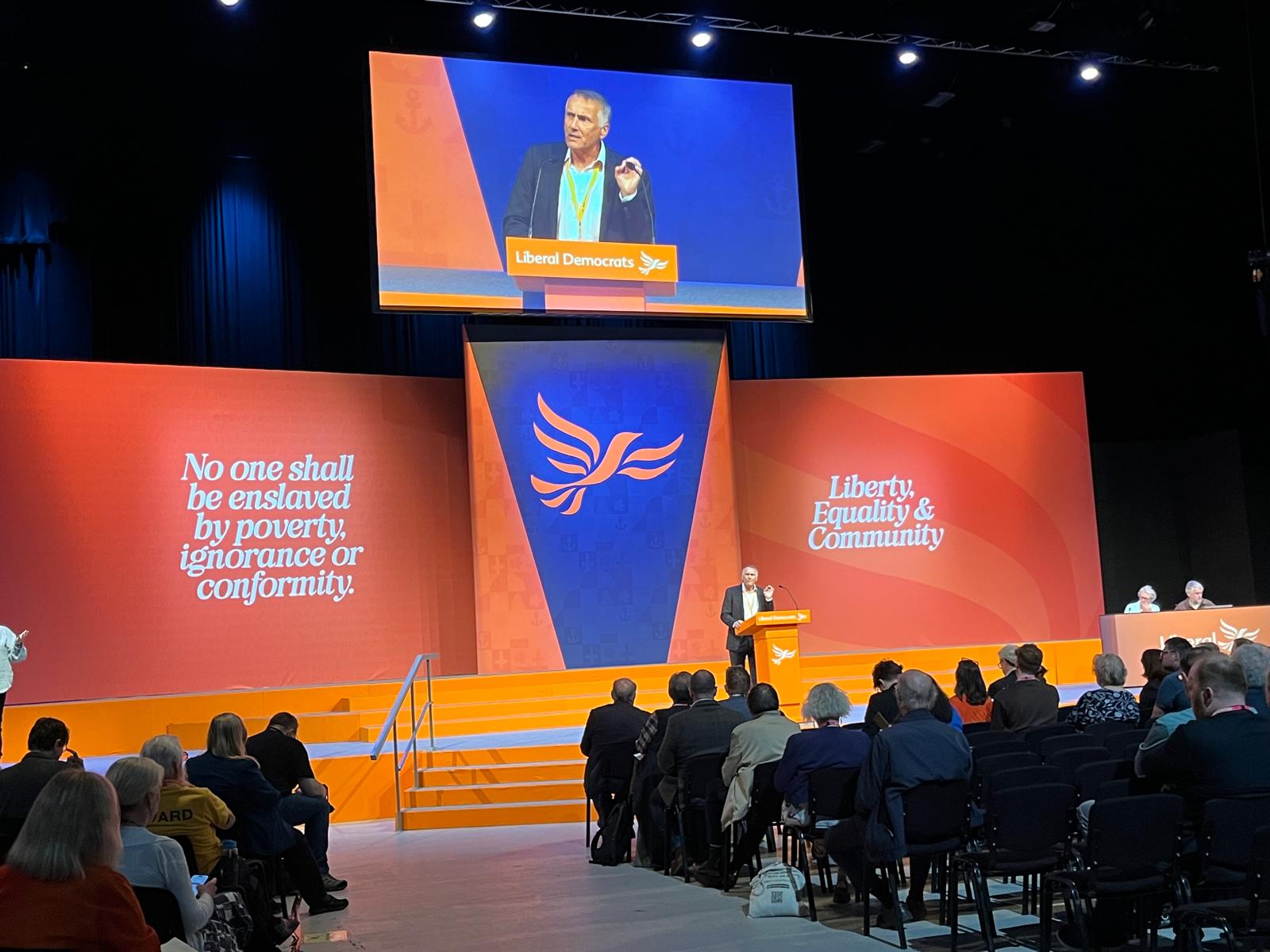
I’m settling in to day 2 of watching Conference. I’ve already spent more time “in the hall” than I have in the past 3 in person conferences. I’m uaually to be found on the Lib Dem Women or LGBT+ Lib Dem stalls, or flitting about the place from meeting to meeting.

And how gorgeous is this stage set?  When I saw the purple, I wondered at first if our Jennie Rigg had had a hand in it. But, seriously, if she had, it would have had a lot more purple and Libby would have been turned into a bat.

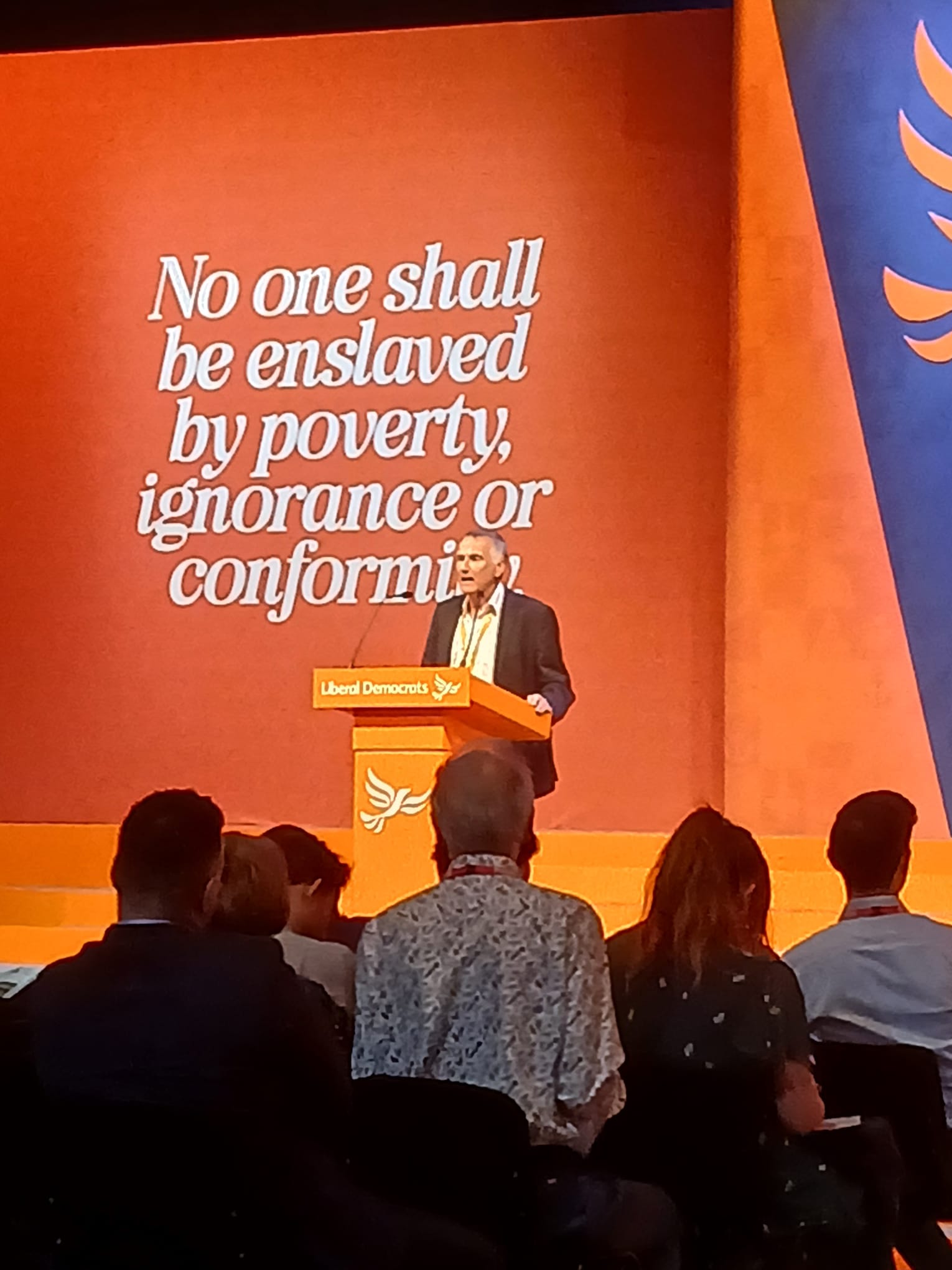
What I really like is that we are wearing our heart on our sleeve. Right there, the quote from the preamble to our constitution closest to our hearts:

No-one shall be enslaved by poverty, ignorance or conformity.

On the other side of the stage, “Liberty, Equality, Community.”

And that’s not all. I usually avoid the rally for two reasons. First of all, I can watch it on You Tube any time. I get the chance to catch up with my friends and Lib Dem family twice a year. Secondly, the rally can be a bit of a vomit inducing cringe-fest.

Last night it was an assault on the emotions as speaker after speaker spoke about what motivated them as Lib Dems. Anton Georgiou from Brent talking about his grandparents arriving from Cyprus with £20 and working hard to make their lives here and how that has inspired him to do all the work he does to support refugees.  Wendy Chamberlain talking about how her mother caring for her Grandad and her husband caring for his mum inspired her to achieve her Carer’s Leave Act.

I wonder if all this values-forward stuff has anything to do with James Holt, our excellent head of media during the coalition years who has returned as our Director of Political Strategy. I am sure that he will understand the need to make sure that our actions match up.

Posted in Op-eds | Also tagged | 7 Comments

What’s on at Conference today?

First up today is a wide-ranging motion on music covering things like AI, planning around music venues, support for music and the right to education in music. That last is so important. Playing an instrument or singing is such a good way of getting out of your own head and the links between musical tuition and attainment are clear.

Then it’s on to active travel – walking, wheeling and cycling with three amendments, one from the Lib Dem Disability Association looking at making active travel safe and accessible for disabled people from the start, one from Lib Dem Women looking …

Posted in Op-eds | Also tagged | Leave a comment

Lib Dems need a 25-year vision that sets out how we’ll change Britain

Lib Dems desperately want a message that cuts through.

Something that lifts our standing in the polls with the same gravity-defying ease as we’ve seen Reform and the Greens achieve. But I’m afraid there is no single magic phrase or policy position that will do that. (Nor, by the way, is there some charismatic new leader who could instantly rally voters to our cause. We don’t do leadership cults.)
If we want to cut through, we have to be authentic. True to ourselves. True to our values.

People are disillusioned with politicians of all stripes. They see no vision, just tinkering at the edges and broken promises. Politicians have been treating voters like consumers that want to be bribed with pleasing offers. But the focus-group approach to policy formation has failed.

Since voters don’t believe any of these bribes, they feel they may as well vote for the newcomers making the most outrageous promises. Give it another roll of the dice.
But voters aren’t stupid. One woman I called on in my local area is typical. Politics has let her down, along with others in her community that she sees struggling to get by. She wants to believe that things will get better, but knows it will take a very long time to put things right. “It’s too late for me. It’s my grandchildren I’m thinking of,” she tells me. “What kind of a future are they going to have?”

We need to fix what is wrong in Britain, but voters like this woman know it won’t happen overnight. Britain needs a generational shift in how the country is run. Today’s policies set the tone, but they should be just the starting point for a credible vision of reform stretching out over the next 25 years. Without that overarching vision, it ís as though our policies are just plucked out of the air or decided on the whim of the leader (which is ironic considering how democratically our policies are decided).

How do other parties do this? A century ago, when the Labour party replaced the Liberals as the main progressive party, it wasn’t by having a more appealing set of policies at each successive general election. On the contrary, Labour made huge missteps in the 1920s and 1930s. It finally triumphed in 1945 because it had built up a consistent vision for state socialism and welfare (with help from some key Liberal thinkers along the way) that put working people first. Irrespective of its specific policies, voters could see what it stood for.

Liberal Democrats are not going to form the next government, but if we’re going to build up our core vote, then voters need a sense of what we’d aim for in government. They need to know the bigger picture behind our commitment to carers and the NHS, our desire to fix the cost of living, our opposition to sewage in rivers, our commitment to PR and to Europe. Not just the values that we all share – a society in which no-one is held back by poverty, ill health or lack of education, where everyone is valued and empowered to choose their path – but a true sense of what that would look like.

Posted in Op-eds | Also tagged , and | 9 Comments

What’s on at Conference today?

I’m feeling quite sad this morning.

I’m not able to be at Conference this year as my husband and I get to grips with our new normal following a life-changing diagnosis a couple of months ago.

I’m missing everyone, but at least being at home means I’m not in the whirlwind so I can keep up with what’s going on and let you all know about it. Also I can watch the Strictly launch show.

So what can everyone in Brighton look forward to today?

In the main hall, I’d be wanting to speak on the heartbreaking and disgraceful situation of children in temporary accommodation. The damage that housing insecurity does to children is simply unforgivable.

The family courts motion is also interesting, particularly in its calls for regulation of therapists who give evidence. It’s frankly frightening that this does not happen already.

A motion on candidate safety looks to tackle the abuse and threats faced by candidates, particularly those from marginalised groups.

And don’t forget the opportunity to question the Federal Conference Committee and Federal Policy Committee. An important part of our internal democracy.

The chilling evidence that 2/3 of maternity units are not alway safe to give birth in is dealt with in the motion on maternity services.

Early life also comes under discussion in motion on rebuilding health visiting.

Debates on rural education, business and the scary state of our world complete the policy debates.

There are also keynote speeches from Europe spokesperson Al Pinkerton, Education spokesperson Munira Wilson and Gloucestershire Council leader Cllr Lisa Spivey.

Here’s the day in full:

Posted in News | 6 Comments

Drawing a line on Britain’s extreme wealth problem

Fifty families in Britain hold as much wealth as 34 million people.

This Autumn Conference, join us for A Just Society’s first fringe event, held jointly with Patriotic Millionaires UK. We’ll be asking what that concentration of wealth does to our politics, our media and our society, and where the line should be drawn.  

It follows Sunday’s debate on Defending Democracy. That motion names billionaires who use money and media to influence British politics as a threat to our democracy, and proposes caps on donations and spending. Our fringe picks up where the motion stops. Capping donations closes one route from wealth to political power. Wealth on this scale has others: owning media companies and platforms, funding think tanks, paying for lobbying and litigation.

Liberals have always been wary of concentrated power in the state. The question on Monday evening is whether we should be as wary of it in private hands.

Posted in News | 7 Comments

Making the most of the Government’s belated action on illegal Israeli settlements

Most of the country clearly believes that the Government’s newly announced actions to be taken to curb the illegal Israeli settlements are overdue… but very welcome nonetheless. It’s not universal, with the Board of Deputies of British Jews condemning the change, but liberal Jewish groups, such as Yachad, made the obvious but important point that “These new policies do not target Israel; they target the occupation. They draw a clear distinction between the legitimacy of the State of Israel and the settlement enterprise which is illegal under international law.”

As a Liberal Democrat, and as Vice Chair of the Liberal Democrat Friends of Palestine, I am really pleased that the Government finally appears to be taking strong action in support of international law, bringing it broadly into line with Lib Dem policy that’s been in place since 2021. I’m proud that Liberal Democrats have led the way on taking a tough, principled stand that respects the rights and aspirations of both Israelis and Palestinians, while expecting and demanding that both sides abide by their obligations under international law.

I’m saddened however that the media and the public have so little awareness of our position, despite the best efforts of our Parliamentarians in the Houses of Commons and the Lords. I regret to say that I believe our failure to take this message strongly out of parliament and to the people has contributed to us underperforming in opinion polls and elections over the last year and more.

Both for reasons of seizing the moment politically – doing what we can to advance a just peace – AND to boost our standing with the public, I think it’s crucial that we take the opportunity that our Autumn Conference provides, not only to debate Israel-Palestine but to further advance party policy.

The Lib Dem Friends of Palestine have submitted an emergency motion addressing the role of the settlements and settlers in the collapse of the two state solution and making life – obviously and deliberately – unbearable for Palestinians. The deadline for submissions was prior to the Government’s announcements, but I’m pleased nevertheless that we correctly anticipated most of what Miliband introduced. We welcome the Government’s actions but recognise that it will all come down to implementation and our motion sets out in some detail how Liberal Democrats should engage constructively in the process of designing and enforcing the rules. Our motion also goes further in a few places where it would be useful to do so, namely calling for the suspension of all military cooperation and the UK-Israel Trade and Partnership Agreement while Israel remains in defiance of international law with regards the illegal settlements. We also propose exploring a programme of progressively banning travel to the UK by Israeli settlers, beginning with the most extreme.

Posted in Op-eds | Also tagged and | 23 Comments

Winning Britain’s Cities: A Liberal Vision for Urban Britain

The Liberal Democrats have achieved something remarkable in recent years. The strategy that delivered 72 MPs in 2024 demonstrated once again the extraordinary power of community politics, strong local candidates, and disciplined targeting. The mood at the last two conferences have been of celebration, but there’s a growing disquiet amongst many following the May local elections: what comes next?

In Britain’s cities, liberal values ought to have enormous resonance. These are places shaped by diversity, mobility, economic opportunity, civil liberties, and the daily negotiation of how people with very different lives live alongside one another. Yet despite pockets of success in May, our reputation of being the party that “fixes the church roof” struggled to cut through. 

In areas where we campaigned hard, had established local candidates, and our eyes on the prize of sizable opposition groups or even control of Councils, our gains were considerably smaller than they might have been. Across London in 2026, Liberal Democrat vote share fell to 12.4%, below both 2022 and 2018, while inner London recorded its weakest Liberal Democrat vote share since 1978. This happened despite a major effort to stand candidates across the capital and despite Labour fighting in an exceptionally difficult national environment. 

The same pattern appeared at ward level. In several places, Liberal Democrat campaigns followed the local election playbook: repeated literature, extensive canvassing, and significant local activity, while Green candidates secured substantial support with limited or in some cases no visible local campaigning.

Posted in Op-eds | Also tagged and | 9 Comments

Social Liberal Forum heading to Brighton i360 for high-flying pre-Conference event

The Social Liberal Forum (SLF) has unveiled a pair of high-profile keynote speakers for its signature Pre-Conference Social ahead of the Liberal Democrat Autumn Conference in Brighton.

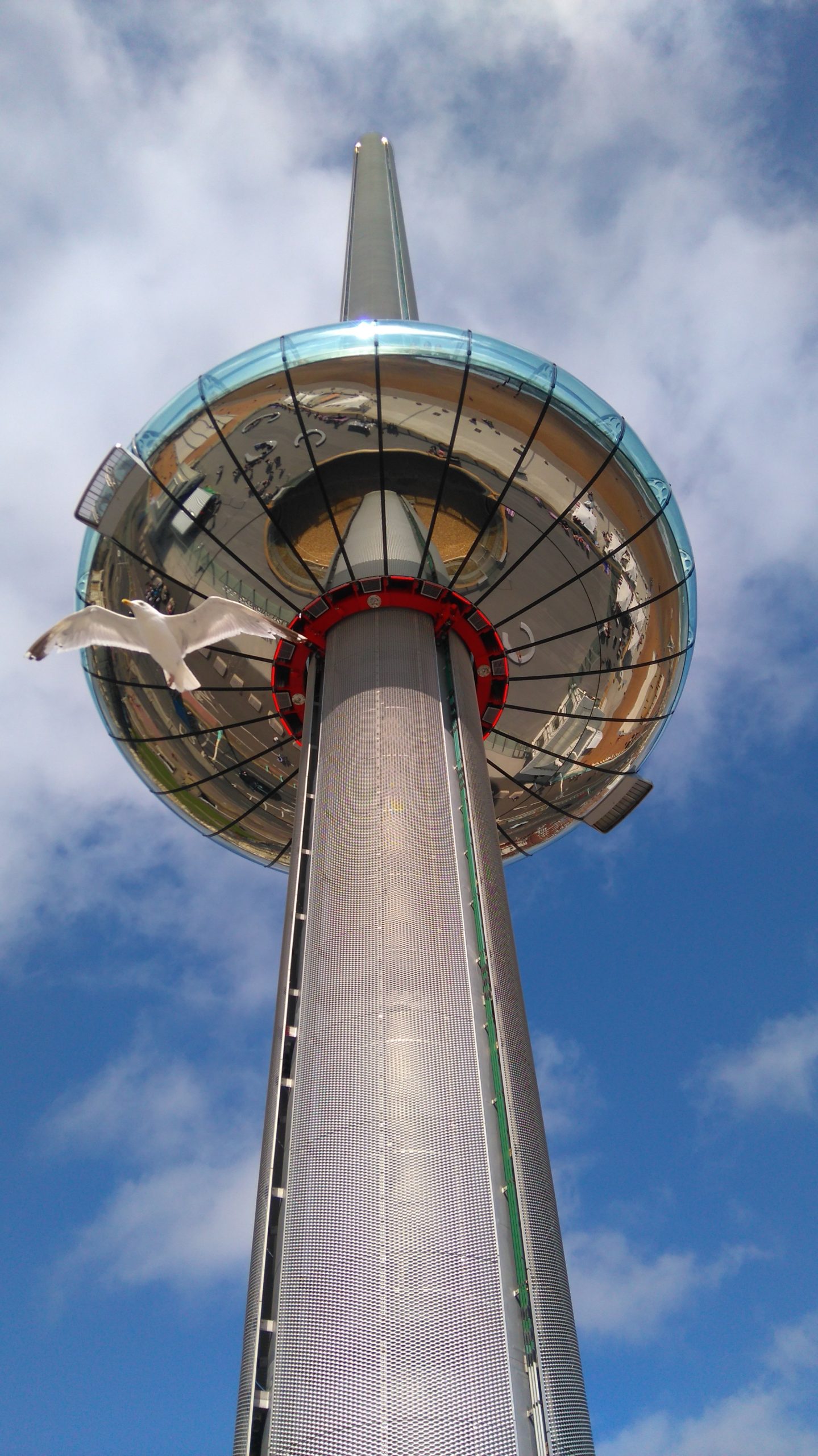
Taking place on Friday, 18th September 2026, at the iconic Brighton i360, the evening will feature guest appearances from Liberal Democrat Spokesperson for Energy Security and Net Zero Pippa Heylings MP, alongside former Cambridge MP David Howarth, who will be launching his new book, Being Liberal: The Liberal Disposition in Contemporary British Politics.

A High-Altitude Start to Conference Weekend

Set 450 feet above the Sussex coastline aboard …

Posted in News | Also tagged | 5 Comments

Getting ready for Conference – Directory now out

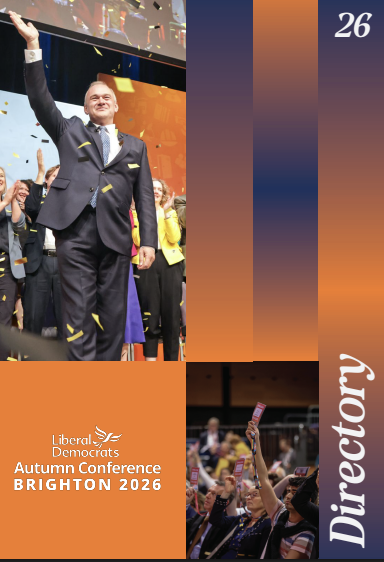
Front cover of directory Autumn 2026There are two ways you can prepare for party Conference.

Six weeks out, when the agenda and the directory come out, you could sit down with a nice cup of tea and work out a tentative plan for how you are going to spend the 4 and a bit days in Brighton.

If you are new to Conference, the agenda has all the motions up for debate – (you can read more about that here) so you can start to plan whether you might like to put in an amendment or a request for a separate vote before the deadline on Monday 7th September at 1pm.

The directory has all the details of things like the exhibition, the fringe and the marvellous array of training on offer. There will be at least five things in every time slot that you want to do and that’s before you even think about catching up with your friends.

The other way of doing it is to follow my all to often example. Leave it all to the last minute and end up filling in your schedule in the excellent Conference app on the way down while you are trying to write speeches and fill in speaker’s cards.  Ditto with packing. Rather than plan what I’m going to wear and travelling light, I usually end up throwing every piece of clothing I possess into a big suitcase half an hour before I leave the house. Or I panic that I don’t have enough to wear and buy things I really don’t need on next day delivery.

Posted in Op-eds | 1 Comment

Conference Agenda is out!

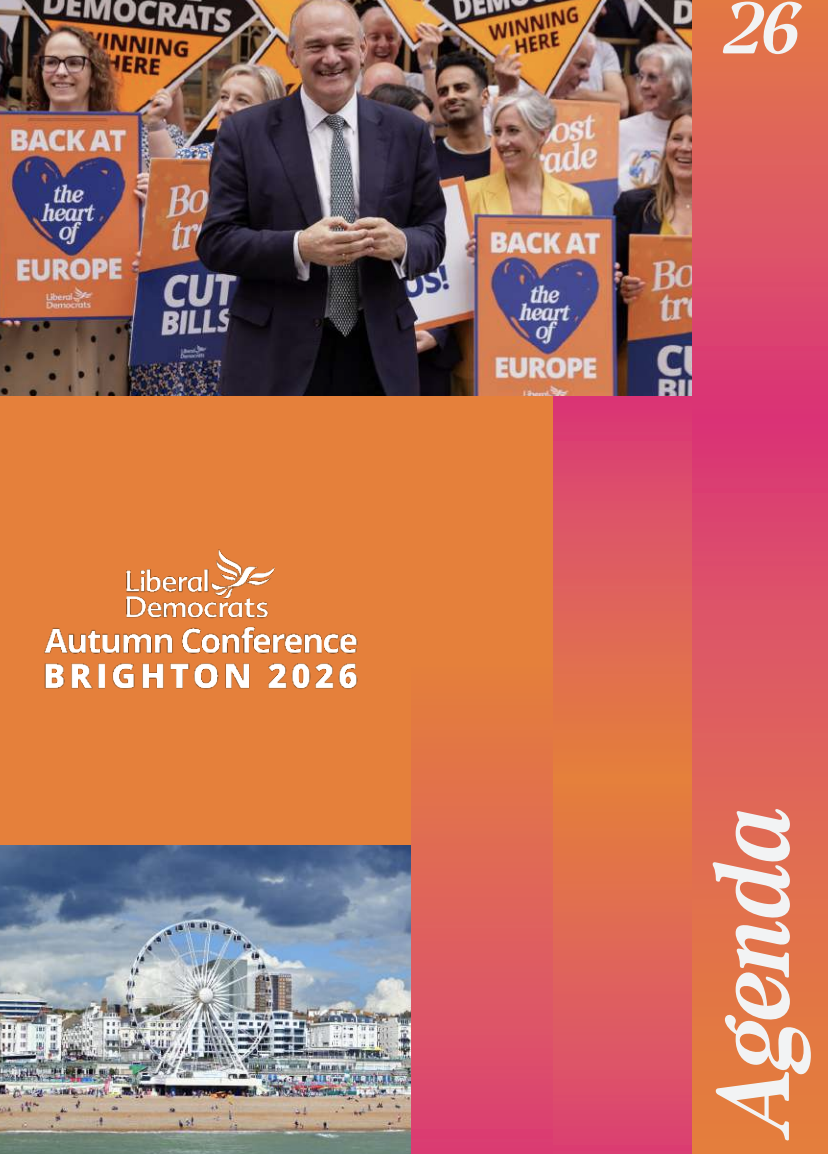
Front cover of Autumn 2026 Conference agenda with photos of Ed Davey and other MPs and Brighton seafrontIt’s just six weeks until Lib Dems gather in Brighton for our Autumn Conference. Yesterday afternoon, the Conference agenda came out.

Over the four days we will see debates on such subjects as:

  • Ending Violence against women and girls
  • Mortality of children in temporary accommodation
  • Maternity care
  • Party strategy
  • Defending Democracy
  • Food security
  • Water companies
  • AI
  • Making music matter
  • Rural and coastal education

There will be keynote speeches from:

Posted in News | 5 Comments

Autumn Conference 2026: Agenda Selection Report

The Federal Conference Committee (FCC) met on Saturday to review motion submissions and begin finalising the agenda for Autumn Conference 2026, which will take place in Brighton from 19 to 22 September 2026. We are very much looking forward to returning to Brighton for what promises to be a busy and engaging Conference.

This Conferences comes roughly midway through the Parliament but very early in the premiership of Andy Burnham. He will spend the summer setting out his agenda and trying to maintain a sense of change and momentum. There are already some (small) signs of a Labour bounce and we shall see what happens with Farage’s fight against Count Binface. 

However, as we are all aware, the task facing Burnham is daunting and his honeymoon could be very short. The political landscape continues to change, and could change drastically between now and Conference. 

We received several updates in advance of Autumn Conference and also welcomed a new member of the Federal Conference Committee, following the resignation of Sarah Teather. Cllr Sandra Gidley was the winner of the recount, and rejoins the FCC after a short hiatus of about 10 years. 

Motions Submissions and Agenda Planning

As ever, we received a strong and diverse range of submissions, reflecting the breadth of engagement across the party. In total, the FCC received:

  • 61 policy motions
  • 10 business motions
  • 1 constitutional amendment

Following very detailed discussion and several rounds of selection, the FCC agreed to include on the agenda:

  • 20 policy motions
  • Up to 3 slots for emergency motions or topical debates
  • 1 business motion.

We are extremely grateful to all members, local parties, and Associated Organisations who took the time to draft and submit motions. The quality and thoughtfulness of submissions were high, which inevitably made the selection process challenging.

Alongside policy debates, there are mandatory business items. As always, we wish we could include more debates, but we have done our best to maximise discussion within the limited time available.

Transparency and the Motions Bundle

In line with the FCC’s commitment to transparency, we are publishing:

  • A list of all motions submitted, indicating whether they were selected and providing brief reasons for non-selection. These have just been summarised, those people who submitted motions will have had fuller feedback from the relevant FCC member.  (please note that motion titles may be edited before final publication).
  • The full bundle of motions considered by the FCC, which we hope members will find useful and informative. Please note that line numbers and correct numbering will be added when we produce the final agenda. 

For motions selected for debate, there may be some minor drafting amendments made between now and publication.

Posted in News | 1 Comment

Surviving your first Conference – a neurodivergent guide

With autumn conference (taking place in Bournemouth from 20-23 September) approaching, I’ve been looking back and thinking about what I might’ve found useful to know as a first timer. The directory was full, I knew nothing and I wanted to do everything. It took a few goes before I got the hang of it. In this article, I’ve not attempted to explain the exact definition of a fringe event or the correct procedure for a reference back (there are other guides to these things). Instead, I’ve considered the “survival” aspect as it pertains to the neurodivergent community and, at the end, given some guidance on what you can afford to miss.

Look after your basics and prepare in advance

Before you get there, you will (probably) need to book accommodation. As well as cost, consider:

  • Distance from venue (especially if you’re likely to need to go back during the day)
  • Facilities (do you need to be able to make a packed lunch? Then a fridge is very useful)

Once you get to Bournemouth, consider how you will deal with various needs before they arise. Especially those that might be more complex for you. As soon as you get to the BIC, find:

  • The toilets
  • A few options for quiet corners you can hide in if you get overwhelmed
  • The exits (in case the quiet corners don’t work)
  • Stairs (this isn’t for everyone, but I find running up stairs is good for sensory regulation. Most conference centers have more than one staircase so if I need lots of stairs I can do loops)
  • A lunch option that works for you. If there isn’t one in the building, leave and find a shop BEFORE lunch time

I would recommend also doing this for the Marriott, the Conference Hotel.

Plan your meals

For me, food is the hardest need to meet at conference. Many people say you can save money by choosing lunchtime fringes that provide catering. I don’t do that, and am not recommending you do it for several reasons:

  1. The directory only tells you a session has catering. There is no distinction made between “full sandwich buffet” and “we have tea, coffee & squash”
  2. It’s common for fringes to fill up, or to close the door to new people at the start. If the catering doesn’t work for you (because it’s not actual food, or because you don’t like it) you can’t join something else in that timeslot.
  3. Some of the most interesting fringes I’ve been to were run by groups who frankly couldn’t afford catering

I recommend bringing your lunch with you. Either make a packed lunch in your accommodation or acquire a supermarket meal deal on your way in. if possible, aim for something that will still be somewhat appetising when you’re full of adrenaline. I also find I function better if I manage to meet a certain nutritional minimum. At this point, I should probably add a disclaimer. Thus, 

Posted in Op-eds | Leave a comment
Advert

Recent Comments

  • Rif Winfield
    Well said, Simon. I too remember you from 50 years ago, and discussions and campaigning we shared at that time, including not only the Party but including NLYL,...
  • Colin Brown
    Don't forget knowledge and appreciation of classical music and instrumental tuition as well!...
  • Jim Webber
    Well done Simon. I only have 5 years as an active activist and a few more years of membership, but I must have been "turned on" to the Liberal message at about ...
  • Neil Fawcett
    I agree with your objectives. But the triple lock does not help pensioners on the lowest incomes. It helps all the others. Far better to increase the s...
  • expats
    I'm surprised at the support for an article which seems to praise companies that seek to turn our children into addicts.. Does the author really believe that fl...