


A few weeks ago I took David Laws to task for proposing the UK needs to reduce public spending to 35% of GDP: it currently stands at 43%.
I stand by the three points I made then:
1) Just because public spending is higher in the C.21st than in Gladstone’s day is not in itself a sufficient argument.
2) Proposals for public spending cuts should be backed up by specific examples. (It’s a favourite trick of Conservative right-wingers in particular, for example, to preach spending restraint while also wanting to build new prisons and buy new weapons systems.)
3) There is no evidence that having a low tax-and-spend economy is itself a pre-requisite for sustained growth.
However, I do want to return to the core of David Laws’ argument by way of this graph, which shows total UK expenditure (black line) and revenues (blue line), both as a %-age of GDP, with the deficit (surplus) marked by the red columns, between 1996 and 2017:
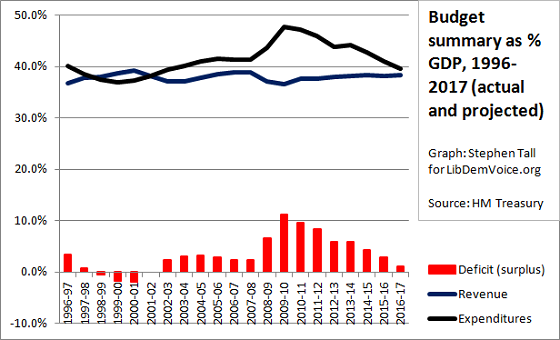
What the graph shows is that UK expenditure generally outstrips revenues, and is projected to continue doing so for the next five years.
At its simplest, then, we are continually spending more than we earn. However, for as long as the economy grows at more or less the same pace as the deficit there is no additional national debt.
David Laws’ question (though he couched it more provocatively) was a basic one: If the UK is only prepared to levy taxes at around 35% of GDP shouldn’t public spending match that figure over the long-term? There are three possible answers that I can see:
1) We cut public spending (or grow it more slowly than the economy) such that, over the long-term, it matches the level of taxes we are all prepared to pay.
OR
2) We increase taxes such that, over the long-term, it matches the level of public spending we are committed to.
OR
3) We continue to incur deficits and accept a stable level of national debt as a way of life on the basis that for as long as we can meet our repayments, and our growth cancels out our deficit, it doesn’t matter much beyond the opportunity cost of servicing our debt.
These are pretty fundamental political choices, yet the three main parties rarely discuss them.
By default we have settled on the third option, perhaps because it’s right, or perhaps because it’s easiest. Either way, I’d like to hear more from our politicians about where they think the British economy ought to be heading: what they think we should be spending and being taxed, what level of deficit they think is prudent, and what the policy implications of these choices are. Who’s first…?
* Stephen was Editor (and Co-Editor) of Liberal Democrat Voice from 2007 to 2015, and writes at The Collected Stephen Tall.
 Follow @libdemvoice.org on Bluesky
 Like us on Facebook
 Subscribe to our feed
 Sign-up for our daily email digest

 Ianto's shrine to be saved
 Walkabout
 Talbot Street and Church Street, Ellesmere
 Neil Fawcett
 Simon Robinson
 Chloe
Chloe Peter Davies
 PM
PM
21 Comments
These are interesting questions. One reason (though by no means the only one) for our current predicament is that Tony Blair’s government wanted to meet popular demands to repair the damage done to health and education, while at the same time sticking to Tory spending plans so that it wouldn’t lose the confidence of the City and become yet another one-term Labour government.
However, Stephen Tall ignores what (for Liberals) is a vital dimension of this debate. At what level should spending and taxation decisions be made? It is a major part of our critique that decision-making is too centralised and, as a result, a lot of money is wasted through inefficiencies and bureaucracy. That is why New Labour’s additional spending on health and education improved things to a degree but not to the extent the extra money should have achieved.
The reason politicians want to spend more than we earn is because they are trying to satisfy the hypocrisy of the electorate – people want better public services but don’t want to pay for them. The closer decisions are made to the people, the more likely it is that people will be able to reconcile their competing instincts.
Finally, I can recommend David Howarth’s response to David Laws’s original argument here:
http://www.liberalinsight.com/ideas/publications/spending-and-growth/
“It’s a favourite trick of Conservative right-wingers in particular, for example, to preach spending restraint while also wanting to build new prisons and buy new weapons systems”
It is not a trick:
It is an absolute cast iron principle of mine that we should not spend more than 40% of GDP on the totality of the governments activities, and that a greater priority should be placed on Defence than is currently the case because it’s current allocation does not reflect its importance as the first duty of the sovereign nation state: the provision of external security.
As to what is an appropriate level to tax and spend, I am happy to accept Laws prescription* because:
1. matches britain’s historic tolerance for taxation (want more then seek a mandate to do so)
2. is a good compromise between minimum service provision and maximum economic growth.
* Presuming he was using 35% as a target to aim for in the medium term, by which point we will hopefully have returned to the height of the economic cycle.
“David Laws’ question was a basic one: If the UK is only prepared to levy taxes at around 35% of GDP shouldn’t public spending match that figure over the long-term?”
I think that is misreading the problem, for in truth it the electorate has proved resistant to the notion of taxation a level higher than 39%.
So your option #2 is essentially labelled under the ‘courageous’ brand for you are essentially telling the electorate that the Lib-Dem’s know better than you what their money should be spent on, and that if ‘we’ get into power then more of ‘their’ money will be harvested by the exchequer.
Cast iron principle based on what?! 40% being a nice round number?!
As for Defence spending, we’re already the 4th highest spenders on it in the world. And I don’t see that we’re any less likely to be attacked than, say, Ireland. On those terms, it seems like we get pretty terrible value for money.
“I think that is misreading the problem, for in truth it the electorate has proved resistant to the notion of taxation a level higher than 39%.”
That’s funny. I really don’t remember the electorate ever being asked that question. Are you sure you’re not thinking of Rupert Murdoch or somebody?
“On those terms, it seems like we get pretty terrible value for money.”
Indeed. The MOD are great at fighting the last war, or the one before that. Always were.
Referencing the quote i would hope it is clear that my “cast iron principle” was that there is nothing illogical about decreasing government spending (which is too high) whilst demanding that Defence spending increases as a priority of total spending (because it is too low).
Yes, this means less money is available for singing kumbaya amongst many other socially worthy projects.
But seeing as you ask how i justify the 40% figure, easy:
An advanced western economy, facing relative technological and demographic decline, should not be spending more than 40% of GDP lest it do serious damage to the long-term growth rate that will preserve the standard of living we enjoy for our children too:
http://ime.bg/uploads/OptimalSizeOfGovernment.pdf
So to a degree we are going to have to get used to the idea of government doing less for us because having a public debt equivalent to 400% of GDP by 2040, and using 15% of GDP each year to service debt interest, is clearly not a happy future:
http://www.bis.org/publ/work300.pdf
Last but not least – because I want to limit the ability of government to interfere in my life, and that is best done by limiting the cheque book.
Thanks for this, Stephen. The problem with keeping the national debt ticking ever upward is that the interest payments also tick ever upward… as this note from the Commons Library states (http://www.parliament.uk/briefing-papers/SN06167.pdf) the interest alone is forecast to cost us £46 billion in 2012/13 – more than we spend on transport or defence.
“So to a degree we are going to have to get used to the idea of government doing less for us because having a public debt equivalent to 400% of GDP by 2040, and using 15% of GDP each year to service debt interest, is clearly not a happy future”
This is just fantasy, though. Even ignoring growth/inflation altogether, it would require the deficit to be about 12% of GDP every year for the next 28 years. You can see from the graphs above that it wasn’t that high even at its peak.
Stephen – this piece doesn’t recognise the economic cycle. The numbers 40% and 35% are of course arbitrary, but shouldn’t we be thinking about two figures: an optimal number during boom years (as low as possible) and a higher one during recession. The left (and many LDs too) partied when Brown was allowed to break out from Tory spending plans and we all know what happened. Had he tried to build a surplus during those years of growth we would not be lashed to the austerity raft right now.
@jedi the paper you quote there says that studies have variously estimated the optimal size of gov’t for growth is between 17 and 40%, and comes up with 25% as its own figure. Presumably you’ve taken the upper end of that (remarkably wide!) range. Fair enough I suppose, but…
However, surely the purpose of Government is not purely to create growth, as you yourself acknowledge – Defence, for example, doesn’t have any particular correlation with economic growth, but (to varying degrees) we all agree that Government should be doing it. Equally, we might think (at least in this party) that Government has some role to play in making society fairer, more equitable – surely we’d be happy to take a 0.25% hit in terms of growth if it meant that we could have universal health care, for example – and we might think that sacrifice might be worth it to redistribute some of the money at the top (from bankers etc) to those who have been less fortunate.
Of course, if you’re a hardline libertarian then you might say that government shouldn’t be doing welfare and so on – but, being on this site, I presume you’re not. In which case, 40% does look rather arbitrary, both on its own terms (there’s nowhere near agreement that it optimises for growth) and on wider terms (is growth all we hope to achieve with Government spending?)
@jedi re the deficit, I agree it needs to be reduced by the way – and I actually more or less agree with David Laws’ argument that if we’re not willing to put up taxes at some point we shouldn’t be spending beyond our means – but, given that the tax base matches it, I see no reason per se why Gov’t spending shouldn’t be, say, 41%.
Stephen, you have failed to ask the obvious question: is there any reason why total government spend should continue to be around ~40% of GDP, particularly as the population is much larger now than it was in the past. Remember, in business we expect efficiencies of scale – so why doesn’t the same apply to government expenditure?
I see no reason why, once debt repayments are taken into account, for government spending to fall. In fact this should be happening in any case. Many large PFI/PPP’s contracts contain clauses that require the contractor to reduce the price of the contract by as much as 5% pa, without reduction in service provision.
Hence we should be asking why like-for-like government spending under the coalition hasn’t been falling by circa 5% pa. This by itself would be releasing monies that could be re-used as a cushion…
@ Browne – “Equally, we might think (at least in this party) that Government has some role to play in making society fairer, more equitable – surely we’d be happy to take a 0.25% hit in terms of growth if it meant that we could have universal health care, for example”
Absolutely correct, if we were exclusively interested in growth efficiency we would no doubt be spending much less today, but we do have other interests so the exact level of spending is a political compromise.
As it should be. That i tend towards a lower figure than the compromise position and others to a higher value does not detract from the principle of compromise between efficiency and compassion.
You note the range between 17% and 40% correctly, and yes I am using the upper figure as a ceiling, but not purely based on that conclusion. Justification for choosing the higher end of the given range in a country like Britain is found here:
“Directorate-General for Economic and Financial Affairs, EC (2008)69 cites Buti, Martinez-Mongay, Sekkat and van den Noord (2003)70 who find that the maximum stabilizing size of government is lower for small open economies. Their model suggests a threshold of about 35% of GDP for small open economies and somewhat higher, or about 40% of GDP, for large open economies. According to the authors, a larger government sector helps stabilize output in case of demand shocks but would destabilize output in case of supply shocks, if the government size exceeds a certain
threshold”
On your other point:
“if we’re not willing to put up taxes at some point we shouldn’t be spending beyond our means – but, given that the tax base matches it, I see no reason per se why Gov’t spending shouldn’t be, say, 41%.”
Sure, if you can persuade people to watch the government tax 41% of the value of the economy without suffering apoplexy then feel free to spend it too. I am not doctrinaire about the figure of 40%, i have no factual basis to be that precise, but as a matter of political necessity i would like to frame the debate as “keeping it under 40%” because that is my preference.
However, as the graph above shows the British public have never been persuaded to accept nordic levels of taxation because, presumably, they have never placed the same value on nordic levels of social provision. Again, without being doctrinairre I am happy with this trend as my preference is for a bit more negative freedom and a bit less positive freedom.
Aside from Charles Beaumont’s comment about the cyclical nature of such things (something I wholeheartedly endorse Charles!), Stephen’s article is missing an ‘option 4:’ we invest in and structurally reform the economy such that greater productivity and growth are achieved (even if this means a higher deficit in the short run) – the resulting higher tax receipts would close the deficit more efficiently than cutting public spending…’
or words to that effect 🙂
It is indeed the case that a structural reform of the economy could result in higher growth and certainly a more efficient economy, but such changes take years, if not decades, to achieve. In deed, one of the ironies of the Thatcher years is that productivity in the private sector increased, not because overall productivity increased, but because the less productive firms simply went bust. Structural change involves changing attitudes and that is not simply achieved by throwing money at the problem. For instance higher spending on the NHS during the New Labour years certainly lead to improved services, but actual productivity fell.
In determining what should be or is a ‘correct’ proportion for government spend against GDP, we should remember that government has largely determined that it can get away with tax revenues at around 35~40% of GDP, and that successive governments have juggled the system so as to maintain this level of income and spent accordingly – creating new groups of winners and losers to suit the prevailing political climate, ie. they have manipulated the figures.
Hence we should disregard the historical record for %-age government revenues and expenditure against GDP as our guide as to what levels of revenue government actually needs to discharge its responsibilities and conduct a full review of government expenditure; something that was urgently needed prior to the 2010 election and was something that many were expecting the Conservatives to do (by voting for them) and then the Coalition to do (after the primacy of the national interest was committed to). As far as I can see such a review is still needed as it can then inform the debate by providing the data.
The recent report from the Royal College of Physicians illustrates well the extent to which the impact of life-prolonging medical treatment is central to the debate here. That is why it makes me so angry to see right-wing politicians going on about the proportion of GDP spent by the state in a way that completely ignores this factor, in effect stating that because there are many more very elderly people requiring social care we have become a more left-wing/socialist society than we were a few years ago.
The point is that if we accept it as standing still on the left-right scale that we provide the same standard of government paid care for those in health needs that we have done before, then expenditure on it as a share of GDP will increase.
Ultimately, the cost of this care will be paid. If there is a move so that most people are paying for it through some commercial system, with state provision only as a safety-net back-up, it will STILL be paid. From this it seems to me a lot of the argument about share of GDP spent by the state is absurd. Whether it is labelled “public” or “private” does not seem to me to be the big thing that the political right – and I include people like David Laws in that – make of it. So we should stop arguing in those terms and argue instead about what is the best way of providing it in terms of quality of service. If the argument is purely that privatising it reduces the proportion of GDP spent by the state, that misses the point.
I don’t like the idea of being treated by private medicine because:
1) I don’t like the idea of a doctor whose recommendations for treatment are biased because the more he does to me the more he earns (pay by treatment model).
2) I don’t like the idea of a doctor whose recommendations for treatment are biased because the less he does to me the more he earns (pay by insurance model).
3) Buying medical treatment is not an enjoyable thing, so I’m not going to have fun shopping for it, I just want to turn up to the nearest supplier and know I have a guarantee of service quality form that supplier.
4) I’m not a medical expert, so I don’t trust my own judgment on who is the best practitioner in any sort of market system.
5) I don’t want to be plagued by salesmen, in the way I am now for other privatised products (9 out of 10 times I am stopped and asked whether I want to think about changing my energy supplier, I ignore the salesman; the 1 out of 10 who stop me on a bad day when I have a bit of spare time are the unlucky ones) . One need only look at all the financial product sales scandals to see how a salesmen-driven market most definitely does NOT drive up quality.
the answer seems obvious Matthew; be the party that launches into the 2015 election with a manifesto advocating increased taxation for the express purpose maintaining QoS within the Health Service at a time of rising demand……..
jedibeeftrix, I would put it somewhat more subtly than that. I would prefer to start from an acceptance of what I have said, and then proceed to a fair choice between the options. So I would want any party which isn’t advocating increase in taxation to pay for maintenance of QoS in the NHS to be honest about the balance being it will decline. I should also want some general honesty about need factors, rather than the sort of lines we tend to hear, such as the suggestion that any advocacy of tax increases is the “politics of envy”.
@ Matthew – “So I would want any party which isn’t advocating increase in taxation to pay for maintenance of QoS in the NHS to be honest about the balance being it will decline.”
That is a fair point, arguably the Tories do not.
However, how much of this deficit can be made up with improved long term growth?
http://ime.bg/uploads/OptimalSizeOfGovernment.pdf
“Stefan Fölster & Magnus Henrekson (2000)40 estimate that an increase of the
government expenditure ratio by 10 percentage points is associated with a
decrease in the growth rate on the order of 0.7–0.8 percentage points.”