


In 1986, the Falkland Islands were granted our own Exclusive Economic Zone (EEZ) and set about establishing a fishing industry. Overnight we went from being sheep farmers to fisherfolk and I remember that time well. This was an exciting time for the Falkland Islands and one that had a transformational effect on our economy.
Given that fish are a national resource, we have worked hard to develop a licensing and taxation regime that allows the fishing companies to be profitable and the owners well rewarded, whilst at the same time ensuring the wider population benefits through free education from primary school to university and free healthcare etc. Our hugely successful fishing companies also make a significant contribution, not just to our economy and government revenue, but also to our community through the sponsorship of sports teams, the restoration of local landmarks and in many other ways.
Within the Falkland Islands’ EEZ we have established a robust range of systems and measures to combat illegal fishing with vessels licensed by the Falkland Islands permitted to fish in our waters and only then with strict oversight. We have a Fisheries Protection Vessel, Lillibet, and proudly work alongside a number of international partners and NGOs to ensure that we remain vigilant against illegal activities.
I am proud that the Falkland Islands have some of the strongest environmental protections in the world and that our drive to improve the human rights of those working aboard vessels in our waters have been lauded by the United Nations.
The Blue Hole however represents not only a threat to the economy and environment of the Falkland Islands and the wider region, but it is also a grave issue of concern for the global community.
The Blue Hole refers to a loosely defined area of the high seas in the Southwest Atlantic, located north of the Falkland Islands and east of Argentina and Uruguay. Unlike almost areas of the world, this portion of the ocean is not regulated by Regional Fisheries Management Organisations (RFMOs) and therefore, for lack of a better term, it is something of the ‘Wild West’ in terms of unregulated and industrial level fishing – such is the quantity and level of activity there that the sheer number of fishing trawlers present have been seen from space.
From detrimental human rights to considerable environmental concerns, the illegal activities within the Blue Hole cast a long shadow across a number of areas. The absence of an RFMO in the area means that human rights abuse cases have been frequently reported. NGOs such as Human Rights at Sea and many others have praised the Falklands’ work in ensuring that 100% of our licensed vessels meet International Fishing Standards as well as our own robust conditions, however the same cannot be said within the Blue Hole.
Similarly, there have been many instances of illegal waste dumping at sea within this area, in contravention of International Marine Pollution legislation, and the illicit and highly illegal targeting of penguins and fur seals continues unabated due to the lack of regulation and international law enforcement.
Perhaps the most critical concern over the Blue Hole is the poor reporting of both effort and catch within this area, meaning that assessment of fishing stock in this area of the ocean is particularly difficult. With the level and volume of illicit fishing in this region, issues such as overfishing will have a disastrous effect on local marine life and ecosystems with a knock-on effect for the Falklands economy, which is reliant on sustainable, environmentally friendly fishing practices.
The Falkland Islands have been world leaders in combating illegal fishing practices, protecting human rights, and ensuring environmental sustainability. However, activities within the Blue Hole represent a global threat and therefore require a global and collaborative response. The data sharing mechanism and increased scientific collaboration between the coastal states concerned are an urgent need as is the implementation of an RFMO in order ensure the Wild West of the oceans is finally brought under control for the benefit of our environment as well as future generations.
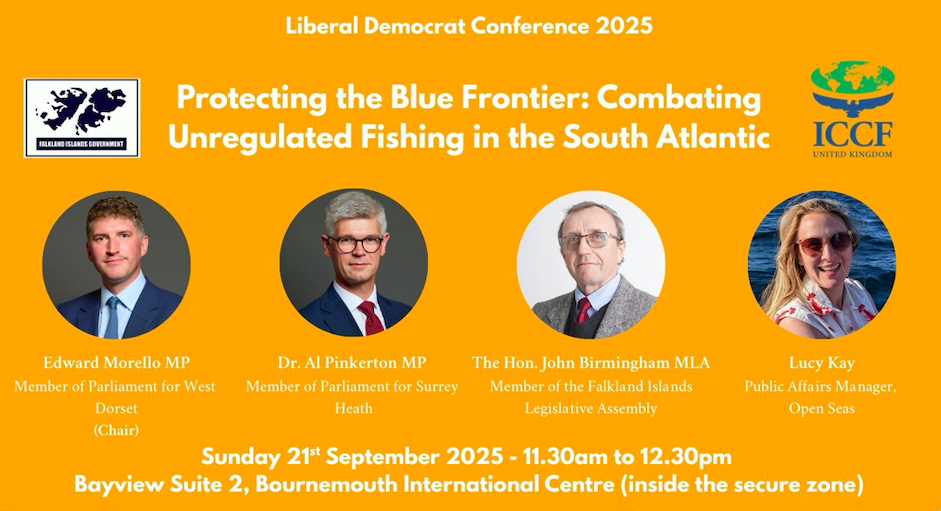
I am looking forward to discussing the Blue Hole on Sunday at the Liberal Democrat Party Conference and saying a bit more about what we do in the Falkland Islands. I am delighted that I will be joined at our fringe meeting – jointly hosted by the Falkland Islands Government and International Conservation – by Edward Morello MP, Dr Al Pinkerton MP, and Lucy Kay from Open Seas; a charity focused on protecting our marine environment and championing sustainable fishing through working with data and evidence to objectively identify issues and present opportunities for environmental and social sustainability. If you are at this year’s Conference, please come and join us at 11:30am on Sunday in Bayview Suite 2, BIC. I look forward to meeting you!
NOTES:
The Falkland Islands Government and ICCF-UK will be jointly hosting a fringe meeting at the Liberal Democrat Conference on Sunday 21st September at 11.30am to 12.30pm in Bayview Suite 2, Bournemouth International Centre (located within the secure zone).
The fringe meeting is titled, ‘Protecting the Blue Frontier: Combating Unregulated Fishing in the South Atlantic’.
The meeting will be Chaired by Edward Morello MP – panelists include Dr. Al Pinkerton MP, the Hon. John Birmginham MLA and Lucy Kay, from Open Seas.
‘The Independent View‘ is a slot on Lib Dem Voice which allows those from beyond the party to contribute to debates we believe are of interest to LDV’s readers. Please email [email protected] if you are interested in contributing.
* The Hon. John Birmingham MLA is a Member of the Falkland Islands Legislative Assembly.
 Follow @libdemvoice.org on Bluesky
 Like us on Facebook
 Subscribe to our feed
 Sign-up for our daily email digest

 The Joy of Six 1589
 The oldest pub in Swansea and the secret tunnel
 Why I'm fighting these plans
 Latest voting intention and leadership ratings opinion polls
 Katharine Pindar
 Tim L
Tim L Nigel Quinton
 Chris Rennard
2 Comments
Given what we can see everyday with the stop motion satellite imagery of weather systems and our knowledge of the oceans, and how events in one part of world has ripple on effects elsewhere, there really shouldn’t be any part of the oceans which isn’t under international regulation and monitoring.
The Blue Hole would seem to provide a good vehicle to promote this objective.
It does seem silly that not every drop of ocean is not regulated in the interests of the global community. Local ownership should have limits. No-one owns the seas.