


On Wednesday I returned to the theme of how private renters get short shrift in British politics. You can fight through a bulging email folder of press releases from politicians wanting to make mortgages easier, cheaper, safer and more numerous before you find one that talks about tackling any of the issues private renters face.
This continuing neglect of them is despite the continuing increase in their numbers, as new figures for the UK published this week show:
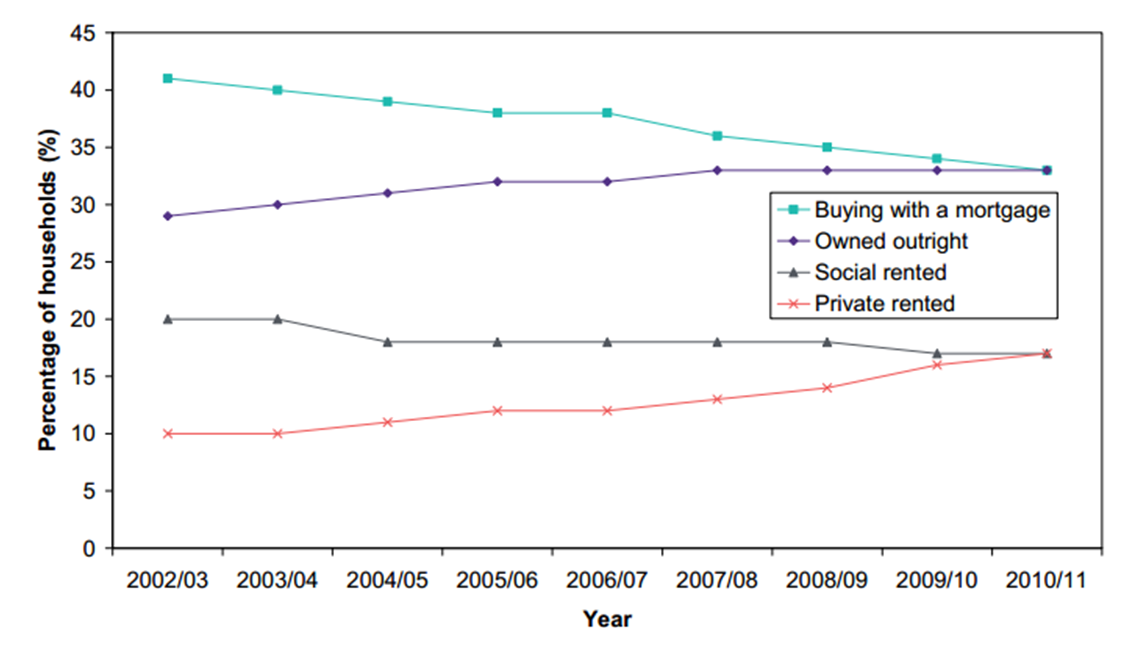
It is notable that the rising trend of private renting and declining numbers of those with a mortgage pre-date the financial crash. In fact, the crash has not caused much of a blip in the trends. That in part reflects the political policy reaction to the financial crash which, influenced by memories of the huge rise in repossessions during the major early 1990s recession, put a particular emphasis on avoiding a repeat.
The rise in private renting has been particularly sharp amongst young people:
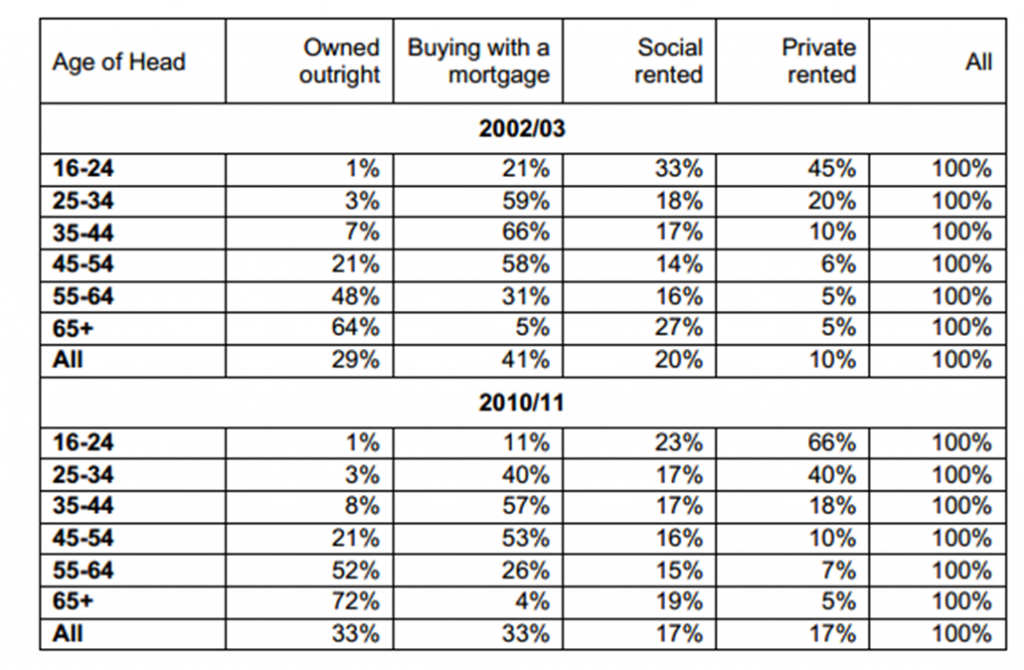
This longer-term picture means you do not have to be that young a politician to be able to envisage fighting future elections in a country where private renting is not that much less common than having a mortgage. That makes for a very different set of sensible priorities from those many current politicians instinctively have.
Data from the Family Resources Survey for 2010/11, which is the latest one out this week, and reused under the Open Government Licence.
* Mark Pack is Party President and is the editor of Liberal Democrat Newswire.
 Follow @libdemvoice.org on Bluesky
 Like us on Facebook
 Subscribe to our feed
 Sign-up for our daily email digest

 The only Tory MP to gain a seat at the last election is under threat
 How many councillors has Reform UK lost since the May 2026 elections?
 IFS warn on the budget
 Roy Gregg
 Nonconformistradical
 Richard Cripps
 Sarah
Sarah
12 Comments
The main issue private renters face is vulnerability when they lose their employment. They can rapidly lose their homes and for many there is now no social housing available.
And the polciies pursued by us in Governemnt are not helping a jot. Since 12010 we had had the two lowest years of housebuilding since 1922. We have particpated in tearing up the planning system and replacing it with one designed to create uncertainty and delay (or should that be more uncertainty and delay?).
We have allowed local authorities to reduce housing targets by agreeing to abolish RSSs. Andrew Stunell focuses on empty homes when they are mainly in areas where no one wants to live (clue: that’s why they’re empty).
We agreed to cut the housing capital budget by 60% – a self-defeating plan to get us out of recession if ever there was one. DCLG officials say they ‘can’t think why’ housing was left out of our national investment plan.
LibDems said nothing about housing in the manifesto apart from Stunell’s Empty homes obsession. Worse, nothing was said about it in the coalition agreement. The little said about social tenants in the Tory manifesto ‘we will respect the rents and tenures of existing tenants’ is now a broken promise as the Tories consult on increasing rents on hgher income tenants. The ‘Affordable Rent’ home is anything but.
In some London boroughs home ownership is down to 25% of households, and it costs fifteen times average income to buy an average price home. Although you can’t get a mortgage in any event as Project Merlin has notably failed to get banks lending again. Oh, and homelessness is soaring, as are the numbers of people in temporary accommodation, the first rise in the latter for seven years.
I know this is not a precipitate time to come into Government, but we have agreed with every dinderhead move of these short sighted Tories, and the ineffectual Andrew Stunnell sitting next to the useless, perpetually grinning Grant Shapps, fills me with same sort of despair as the experience of 50 days of continuous rain instead of a summer. In fact, there’s a metaphor there somewhere.
Grant Shapps has set up the Montagu commission to look at how to get more institutional investment into PRS, so the coalition is interested in the area.
We should, however, be careful in advocating as a good thing the rise of a tenure that is less popular with those in it than either SH or O/O, and which is almost always rejected by people who can choose one of the other two.
The sharp rise in private renting among younger adults should be seen in the context of the question of intergenerational justice (which, incidentally, will be the theme of next month’s Social Liberal Forum conference).
Much privately rented housing stock is owned by older baby boomers who cashed in on the buy-to-let craze. As a result, younger adults will increasingly sense that they are being forced to hand over their wealth to retired baby boomers in three ways: first, through high and rising rents; second, through taxation that will increasingly be spent on the needs of a growing retired population; and third, on repaying student loans, which the older generation did not have to take out.
By the 2020s, this grievance will become a major and possibly defining political issue. And rightly so since, if this problem is not addressed, we risk turning Britain into a rentier economy.
Off thread, it is also notable with the developments around Rio +20 and previous discussions, the older generation is gradually shuffling off responsibility for paying to ameliorate climate change pain to future generations.
Another serious issue is reasonable repair. A lot of tenants who have ‘reasonable’ properties (ie places they would prefer to not have to move out of) feel intimidated in trying to pursue reasonable repair issues with landlords (more often , managing agents ) because of concerns over security of tenure re: shorthold tenancies.
Rents have gone up becuase there are 3m more people living in the UK ( at least) than there were 10 years ago. The supply of housing is semi fixed becuase of controls on building.
The only way to reduce rents is to increase the supply of housing faster than population growth. Which can only be done by releaxing planning controls so that some green belt can be used for housing.
@ Simon McGrath
While there may be some merit in a very controlled and systematic release of some poor quality greenbelt land, its worth bearing in mind that London’s boroughs have given planning permission for 170,000 homes that have not been built by developers, and that there is scope to build at much higher debsities in brownfiled sites in London without compromising on quality of life (the highest density parts of London are Chelsea, Bayswater and Earls Court, suggesting that nice areas and high density can go hand in hand). So we shoudl perhaps first look at the cartel that is the development industry and see whay they are not building homes for which they have planning permission and why we do not build higher quality apartment blocks.
@LondonLiberal
“So we shoudl perhaps first look at the cartel that is the development industry and see whay they are not building homes for which they have planning permission and why we do not build higher quality apartment blocks.”
One reason why they aren’t building could be that, once you own land, it costs you nothing to keep it and do nothing with it. It could well be that the developers are just waiting for land- (and hence house-) prices to increase enough so they can sell the site on at a profit, or perhaps they are deliberately constraining the supply of land to maintain the high values of their other properties. Introducing Land Value Taxation, even at a modest rate of 1% of annual rental value per year, would penalise those who speculatively hold onto land or houses without doing anything with them, i.e. selling it on, developing it for housing or businesses or renting it out. The increase in available land for development would increase the numbers of homes, make existing homes more affordable and the revenues from the tax would pay for more public house building (which itself would become cheaper due to falling land prices). According to Lib Dem ALTER, 5% of the population currently owns 60% of UK land so LVT would also lessen social inequality as those few who own land sell their uneconomic holdings to those who currently don’t.
In a fair society which is the backbone of everything Lib-dems stand for, nobody should be without a secure habitable roof over their head that they can call home. That is why council housing was introduced a century ago. The introduction of a right to buy had virtues and would have been a good idea if the proceeds of sale had been ploughed back into replacement affordable housing but it was’nt. Now we have to rely on private landlords who range from the good to the bad to the downright greedy with the good being a minority.
Before the days of council housing slum housing was responsible for conditions that promoted tuberculosis and other life-shortening illness: will the lack of new building and the demand for affordable affordable homes take us back to the dark days of the Victorian era and the misery of which Charles Dickens wrote ? What would David Lloyd George say if he were alive today ?
As you say, the private rented sector growth is dominated by tenancies of young adults. Now we know they are unlikely to be on the electoral register, let alone vote.
Meanwhile, areas that have seen the PRS grow generally have existing homeowners that don’t like the change, who are older and much more likely to turn out.
That makes a politician’s response to the PRS one that ‘s in the interests of nearby homeowners rather than the tenants.
That’s why we see horrible policies like HMO caps, as I previously argued on this site: https://www.libdemvoice.org/opinion-we-cant-let-councils-discriminate-against-housesharers-28301.html
House prices are not just dictated by population growth. They are a major factor in private investment and profit creation. Renting has gone up because housing speculation has driven the price way pat a lot of peoples earning. This has in turn driven rent prices up, which has also driven up the housing benefit bill.. The bubble economy and general debt are heavily connected to over the property bubble economy that replaced industry and living wages.. It’s not just a matter of building more.
In truth house prices need to deflate and we maybe should look at rent control.