


There’s been a lot of coverage about the fifth anniversary of the fall of Kabul to the Taliban. I don’t think I’ll ever forget the desperate sight of people trying to get out while there was still a chance. The vast majority of them never did or could.
The Taliban originally tried to say that it was all fine and women would still be able to continue their education. The reality is that women have little legal status and fewer rights, and are essentially counted as property of the men in their lives.
Wendy Chamberlain chairs the All Party Parliamentary Group on Afghan Women and Girls which put out a statement this week.
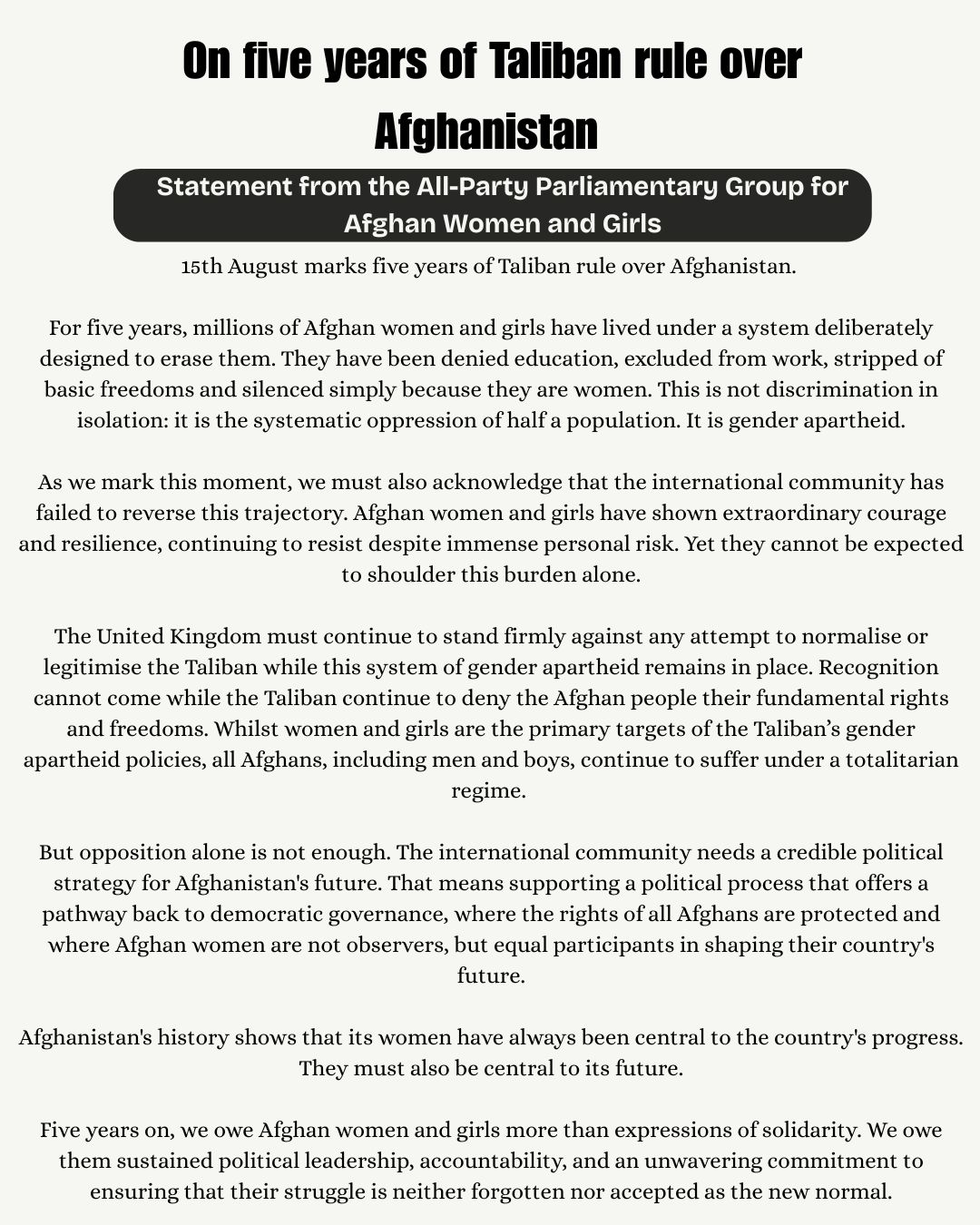
The statement describes the “gender apartheid” faced by women and girls in Afghanistan:
For five years, millions of Afghan women and girls have lived under a system deliberately designed to erase them. They have been denied education, excluded from work, stripped of basic freedoms and silenced simply because they are women. This is not discrimination of isolation. It is the systemic oppression of half a population. It is gender apartheid.
As we mark this moment, we must also acknowledge that the international community has failed to reverse this trajectory. Afghan women and girls have shown extraordinary courage and resilience, continuing to resist despite immense personal risk. Yet they cannot be expected to shoulder this burden alone.
The United Kingdom must continue to stand firmly against any attempt to normalise or legitimise the Taliban while this system of gender apartheid remains in place. Recognition cannot come while the Taliban continue to deny the Afghan people their fundamental rights and freedoms. Whilst women and girls are the primary targets of the Taliban’s gender apartheid policies, all Afghans, including men and boys, continue to suffer under a totalitarian regime.
But opposition alone is not enough. The international community needs a credible political strategy for Afghanistan’s future. That means supporting a political process that offers a pathway back to democratic governance, where the rights of all Afghans are protected and where Afghan women are not observers, but equal participants in shaping their country’s future.
Afghanistan’s history shows that its women have always been central to the country’s progress.
They must also be central to its future.
Five years on, we owe Afghan women and girls more than expressions of solidarity. We owe them sustained political leadership,
accountability, and an unwavering commitment to ensuring that their struggle is neither forgotten nor accepted as the new normal
 Follow @libdemvoice.org on Bluesky
 Like us on Facebook
 Subscribe to our feed
 Sign-up for our daily email digest

 A U-turn too far
 Ed Davey on working with Greens after Zionism conference motion
 Oh! What a Lovely War: An interview with Murray Melvin
 Gordon Lishman
 Graham Evans
 Chris Williams
 Andrew Moore
3 Comments
I am so glad to read this statement, and of Wendy Chamberlain’s involvement. A recent Guardian article bringing together statements from several of the trapped women, bravely describing their plight – training stopped, further education denied, job activity limited under male supervision, and fear for the very young girls going happily to school at the moment unaware of how their education will be stopped at puberty. There is needed international action, and pressure to be put on this regime. Surely with all the aid that is still needed and being provided there conditions can be made.
What exactly are we supposed to do about this? I’m pretty sure we’re already sanctioning them and they straight up don’t care.
There are some anti Taliban insurgent groups that are almost certainly being propped up by the US Pakistan and other international actors, should we be assisting them as well? We’d be taking a big risk that we just cause a load more bloodshed without ultimately achieving anything.
Or should we outright invade again?
I’m really struggling to think of any more options.
I am pleased to see Wendy describe what is happening in Afghanistan as ‘gender apartheid’. I just wish the Liberal Democrats were willing to speak equally clearly about how Palestinians in the West Bank are being treated.