


There are few current issues more emotive than that of immigration, so I wanted to take a dispassionate view of the future demographic and economic implications of where we are now, and what might happen in the future, particularly if Nigel Farage achieved his aim of ‘net zero’ one-in, one-out migration as he stated in June this year.
I took as a starting point the population projections published by the Office of National Statistics.
The central assumption is that the UK’s population will grow from around 69 million today to 77 million in 2047. One key point to note in this projection is the forecast that deaths will exceed births every year from the end of this decade, and so growth is primarily driven by net inward migration at an average of 340,000 per year, with the people coming to the UK at a rate approximately double that of those leaving.
Using this data we can consider alternative scenarios. In the unlikely event that we went for absolute zero immigration while still allowing British citizens to leave and taking into account below-replacement birth rates, the population would fall dramatically to around 61 million in 2047 with a collapse in the number of those of working age.
However if we look at the ‘net zero’ position advocated by Farage, then the population would fall slightly from its current 69 million to 67.5 million by 2047. At first glance this might appear an insignificant change, but in reality the effects are dramatic.
The reason for the significance is demographics. Other data from the ONS shows that 94% of immigrants coming to the UK are of working age, as are 93% of those emigrating from the UK. However, the UK’s existing population is ageing, and we currently have a ratio of working age people to non-working age (children and pensioners) of about 1.8.
In Farage’s ‘net zero’ scenario, we end up with a falling ratio of working to non-working age to around 1.5, and a working age population in 2047 roughly 2.5 million lower than it is today, most of whom will have become pensioners. This has huge implications for both taxation and spending, because getting old is expensive.
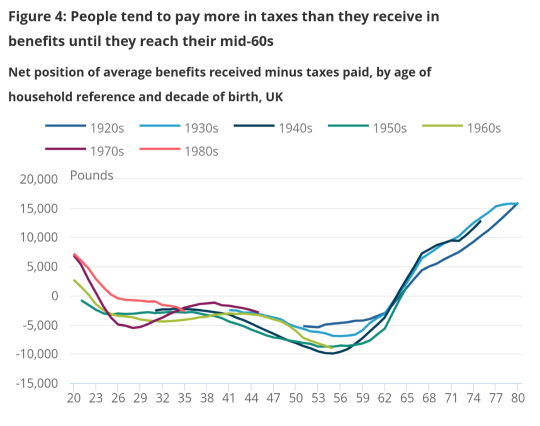
While some bemoan the rising cost of providing benefits and healthcare, the inconvenient truth is that the ageing of our population is a significant driver of this. Already slightly over half of the country’s benefits bill is spent on pensions and related benefits. Other data from the ONS shows that on average people’s net financial contribution (tax paid over benefits received) peaks in their mid-fifties, hits break-even in their mid-sixties and becomes progressively negative from there.
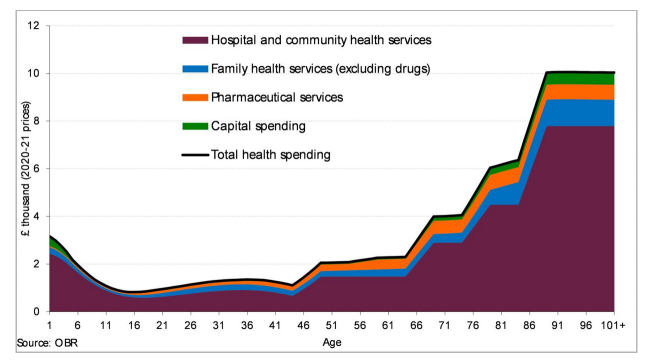
Likewise, the average cost of providing healthcare increases dramatically from your sixties, doubling by the time you reach your seventies and tripling by your eighties.
The reality is that increasing health and welfare costs are inevitable with our ageing population, and tinkering by ditching the pension ‘triple lock’ for example just slows the rise slightly. Unless a bold politician is prepared to inflict serious cuts to the provision of pensions and healthcare to a growing cohort of pensioners then we need positive net inward migration to support the economy in future years as it won’t be viable to continuously increase the income tax burden on a shrinking workforce.
So what is the correct, necessary level of net inward migration? If we start by aiming to maintain the current ratio of working to non-working population then I estimate that we need an average net immigration of 270,000 per year to achieve that outcome. This would give the UK a total population by 2047 of around 74 million, with 4 million more of working age than today to balance the rising number of pensioners. Please note that this isn’t necessarily the right answer for ever as our population age distribution has bulges, one of which is those currently approaching 60. Also, the optimum in purely economic terms may well be higher than this.
What is clear is that anyone proposing ‘net zero’ immigration, or any level significantly lower than 270k per year, needs to explain in detail their plans for taxation and funding of pensions and healthcare for the elderly. It’s fantasy economics to pretend that we can function as an ageing economy and society without positive inward migration. With Labour running scared of Reform and adopting some of their rhetoric and policies, I hope the Liberal Democrats will step up and make the positive case for the economic necessity of immigration alongside the moral imperative of our obligations under the UN Refugee Convention.
* Nick Baird is a member and activist from Cheltenham, patiently waiting to be inspired by the Party leadership.
 Follow @libdemvoice.org on Bluesky
 Like us on Facebook
 Subscribe to our feed
 Sign-up for our daily email digest

 Turning Point UK chief executive suspended by Tories over contract killing claims
 More ministerial dissent over Labour's immigration policies
 Peter Davies
 Peter Wrigley
 James Hill
19 Comments
We should thank Nick for doing the hard work of analysing the statistics to rebut the nonsense spoken and written about the ‘immigration crisis’. As he says, we need immigrants of working age, and they are willing to come to the UK.
People who get frightened when they hear someone in the UK speaking with a foreign accent, or horror of horrors, in a foreign language, are a serious problem, because they vote in elections. Attacking Farage and others like him only stiffens their defences, and we need to find a way to address whatever it is that is causes their irrational fears, and try to cure them.
I was fascinated by Starmer saying he doesn’t want to live in an island of strangers. Despite having knocked on quite a few doors during elections, nearly 100% of the 69 million British people are strangers to me too. Starmer, of course, was dog-whistling to racists, something we need to call out more loudly.
This is a useful contribution to the immigration debate. I would agree that maintaining the level of population is a sensible policy objective since a declining population would lead to significant issues. However, if the problem we face is too few births to compensate for the number of deaths, perhaps that is telling us something about the difficulties young couples face in terms of the costs of having children both increased spending but also reductions in income if one partner drops to part-time working.
Perhaps, rather than thinking about the need to being in immigrants to compensate for our otherwise declining population, we should be having a discussion about providing additional income tax allowances for children to help alleviate the costs on those who have and raise the next generation?
@Jenny Smith – birth rates, and the costs and inequalities inherent in raising children should be part of the conversation, but that won’t help in the short term as it will take 18+ years to feed into the working age population. Up until then, it actually makes the ratio of working to non-working population worse. We can only start from where we are now…..
An excellent article. The Cheltenham party is lucky to have such a thoughtful chair. Receiving and integrating 270,000 people a year (about 400 per constituency) does not sound too difficult to me. Perhaps some of the OAPs like myself who are going to be such a drain on our NHS could be “conscripted” to help new arrivals find the ropes in their new home country.
Thank you for your kind words Richard!
Also, any discussion around the ratio of working age to non working age population is only valid to the extent that the working age population is working. As we know, there is a growing problem of young people becoming ‘NEETs’ – not in Employment, Education or Training – as well of significant levels of underemployment, such as high numbers of working age people working part-time, as well as those of working age retiring early.
Rather than seeking immigration to boost the numbers of those willing to work, should we not be addressing the issues of those from our own population who are working age but not working?
Final question, if our net immigration target were to be 270,000 per year, is it assumed that this total would all be of working age people or does this total include dependents, whether children or elderly?
@Jenny – we should of course encourage maximum employment of those of working age, particularly of the young. Some older people retire early out of choice (and would you ban that?) but others leave the workforce by necessity due to disability or ill health as age catches up with them.
The 270,000 is total (including dependents), but the overwhelming majority of immigrants are of working age (94% per the ONS). Children become working age in due course, and those of working age when they arrive eventually become pensioners.
I was working in IT in one of the largest bank in the world. In a discussion with the CEO, in a informal discussion I was told one PC placed in the organisation does the work of 6 people. That was 20 years ago. Now with the AI we need a much smaller, more wealthy, healthy, better educated population. I hear say that the NHS would collapse without migrants, yet we have 11 million people unemployed. This is a failure of Government. The days of mass factory workers has past.
The obvious answer is Zero net immigration!
We need to approach this from a sustainable society viewpoint, taking into account the increasing resource wars and so the assumption we can simply depend on increasing levels of imports is invalid. Also we need to remember a UK resident consumes more of the earths resources than someone from a less developed country.
As we are seeing, the mass immigration we have seen in the last 28 years has actually had limited benefited to the country: our current problems of insufficient housing, overcrowding, etc. are direct consequences of the poor thinking around the maintenance of our society over many decades.
Given the perfect storm many have been warning of for decades, is expected to hit circa 2040~2050 (MIT model revised circa 2020) perhaps we need to first ask what is a sustainable population and then plan how to largely achieve that by 2050…
@Meby – and yet in the intervening 20 years since the arrival of that PC, 5 out of 6 of the UK workforce haven’t been made redundant. Not sure where you get your 11 million unemployed number from…
@Roland – so what is your answer to a growing population of elderly and retired people, ever increasing numbers of which need care, supported by a shrinking workforce?
This is a good analysis, and the suggestion that we’d need the population to grow to 74M in the next 20-ish years to maintain age demographics sounds plausible. Unfortunately that kind of population growth would inevitably mean massively exacerbating the housing crisis. Where would all the extra people live when we don’t have and appear unable to quickly build enough homes even for the people who already live here? And even if we could build enough, do we really want to lose so much more green space? That kind of consideration makes the trade-offs in Nick’s analysis more complicated.
Also, we shouldn’t be passively accepting that people getting old inevitably means ever more spent on health and social care: There’s ample evidence that unhealthy lifestyles, as much as age, are what have driven the growing demand for care. Trying to address that solely by importing people without tackling the question of lifestyles doesn’t seem to me like the best way forward. The optimum is surely some combination of the two?
@Roland, as Nick has already pointed out, the obvious answer isn’t the right one ! And that’s the problem we face with Farage offering net zero to an electorate that hasn’t worked out that we need a positive figure for immigration, in order to have a large enough workforce to support the ageing demographic.
This is a helpful analysis, but there is no such thing as a “right” level of immigration. Different people would choose different optimal levels of immigration for differing reasons. Politics is about deciding democratically what reasons are most important to most people, and then (hopefully) deciding policies that will achieve the selected aims.
Net zero immigration is clearly (roughly) the “best” answer if the aim is to minimise pressures on housing and resource consumption, while accepting economic decline and growing poverty due to a shrinking workforce. 270,000 per year net immigration is the “best” answer if the aims are the opposite, and we want to make sure that the workforce does not shrink as a percentage of total population, at the expense of accepting severe pressures on housing resources (and yes, greater risks of racial conflict).
These two supposedly “best” answers thus represent two opposite extreme viewpoints. Farage supports the low figure for his own specious reasons. The refugee lobby would favour the high figure. Common sense would suggest something in the middle, a reasonable compromise between too few to do the work and too many to make room for.
@Simon @David – thanks for your comments. Yes, an increasing population needs more housing, something the Government is trying to address and also something we said we would do in office.
But as I said in the article, if you advocate net zero or severely limited immigration then you need to set out your tax and spending plans when millions of people gradually move from making a net contribution to the exchequer to being a net takers to pay for pensions and care.
@Simon – getting old *does* inevitably more spend on health and social care. Promoting healthier lifestyles might limit the rise somewhat, but again that is something Governments have been trying to do for years (with some success). But as we live longer by avoiding or surviving heart attacks and strokes, more of us end up suffering from things like dementia.
@David – yes there needs to be a democratic mandate for whatever we decide to do. The problem is that only one side is being heard at the moment, and they are not being challenged on the downsides and costs of very limited immigration.
That conclusion is broadly in line with that reached by LSE Prof Alan Manning (ex head of the Migration Advisory Ctte) in his latest book
Nick,
You’re right that Farage is not being effectively challenged on the downsides of very limited immigration. One of the reasons why this is the case is that many of those who challenge Farage speak as if they could see no downsides of very high immigration. Most of the general public, reasonably, do not believe that, and therefore feel they can sensibly ignore what the pro-immigration advocates are saying.
Your analysis offers a better approach. We need immigration, but at most, we need 270,000 net immigration per year, and less than that might in some ways be preferable. So, recent levels of net immigration have indeed been undesirably high.
Say something like that, and lots of people will start really listening!
I like some of Simon’s points about healthy lifestyles changing the terms of trade here – but also I like Nick’s reply! Vascular dementia, for example, can be linked to lifestyle factors.
Perhaps if we had a voluntary national service of care, where young people were offered training and placements in the care sector for 6 months to a year, we could find a better balance between recruiting staff from the UK and welcoming carers from abroad. Also, as someone who went back to work in the care sector at 58, caring roles can provide amazing careers in later life too. Of course, we need to sort out pay and career structures – not a small matter.
@Nick – re: the “growing population of elderly and retired people”
Much depends on how you wish to look at it. Fundamentally back in the 1990’s we were only looking at a temporary blip of around 2 decades. With the approach Westminster adopted in 1997 with no vision other than a future with even more people – I am under no illusion that come 2047 with a population of 77M and a housing deficit of over 10M homes, there will be people who will still be saying we need more immigration….
My view is about the only benefit Brexit has given us is the opportunity to change the direction our society is moving in. With a smaller economy: lockdown taught us much about “froth” activity that simply erodes margin/per capita GDP, we have the capacity to temporarily handle a larger elderly population. As for the retired population – retirement doesn’t automatically mean not working/contributing.
The right level of immigration is one that the voters are willing to accept.
In a democracy if the voters say immigration is too high, then it is too high. Any political party that ignores this will eventually be severely punished.
Brexit being an example of this.