


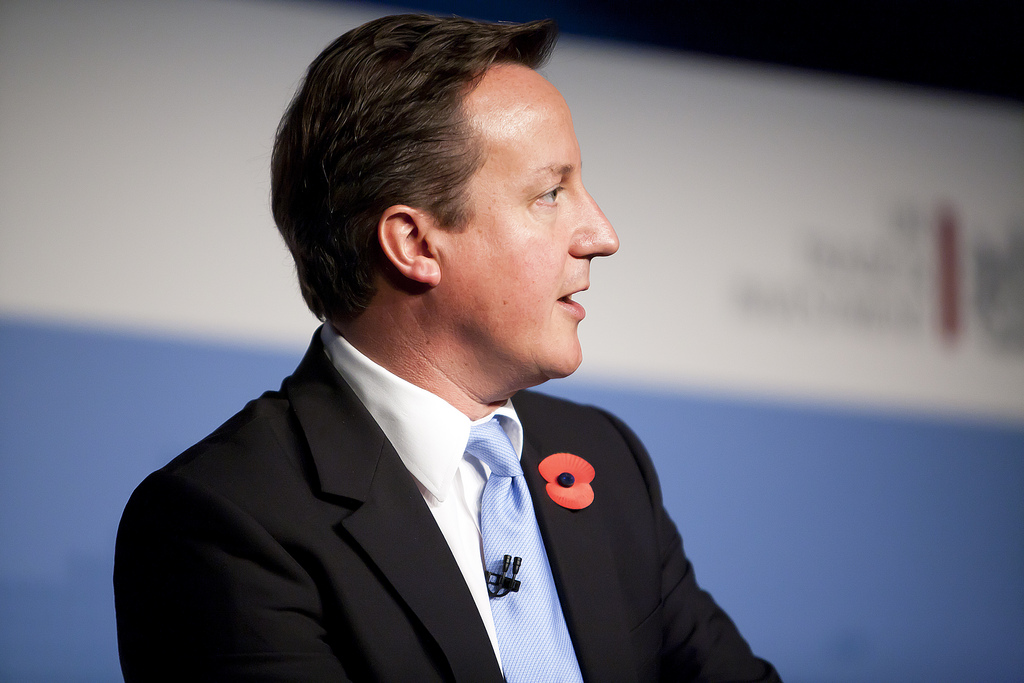
 In a display of perverse pride, David Cameron has been spinning today that he will lose a vote on the appointment of Jean-Claude Juncker as President of the European Commission. You might expect such a failure of (megaphone) diplomacy to be a source of shame, but I suppose failure is what the Brexit agenda demands, and hang the national interest.
In doing this he is, we are told standing up for the principle that the heads of government, not the European Parliament appoint the commission and that the European elections showed that the voters of Europe want reform. There are problems with both of these points. The first is that the heads of government do indeed appoint the commission – here Cameron is demanding the status quo – but that they want to appoint Mr Juncker. The second is that Juncker is the nominee of the largest (and therefore winning) group in the European Parliament, the EPP, and therefore represents the agenda the voters of Europe supported, far better than Cameron’s much smaller ECR group.
Perhaps if Cameron had kept his MEPs in the EPP rather than pulling them out in another fit of posturing some years ago, he may have persuaded that group to nominate a candidate more to his taste.
None of this bodes well for any renegotiation of Britain’s relationship with Europe. There is great potential to reform Europe so that it does what it is good at better: promoting trade, fighting crime, protecting the environment, spreading peace, democracy and human rights – and less of what it does not need to do. There are allies to be found for this all over Europe, but no progress will be made if failure is pre-announced at every opportunity.
* Joe Otten was the candidate for Sheffield Heeley in June 2017 and Doncaster North in December 2019 and is a councillor in Sheffield.
 Follow @libdemvoice.org on Bluesky
 Like us on Facebook
 Subscribe to our feed
 Sign-up for our daily email digest

 Senior Reform official casts doubt over legality of huge donations
 Turning Point UK chief executive suspended by Tories over contract killing claims
 Peter Davies
 Peter Wrigley
 James Hill
33 Comments
Joe Otten
Completely right
His vacuous comments and appearance of ‘strenngth’ is symptomatic of his approach
he is just not very good at being a PM – he is just interested in PR and has evolved from the Blair approach to Government in the4 modern age – it is all about the image and news management. The substance is forgotten
It is why, if I had the choice, I would go for someone more cerebral, intelligent and less focused on image. Even if he cannot eat a bacon sandwich
The LD in Government must be looking at Cameron with incredulity
He could so easily have blocked Juncker but messed up at every turn – you would be forgiven for thinking that he engineered this for some reason of his own. Either that or he is magnificently incompetent
Thatcher got her own way but upset the rest of the EU
Major did okay despite it being truly horrific with his small majority.
Blair got what he wanted and kept the rest of the EU happy (well up intil I**q anyway)
Brown was there too short a time but was gloriously clumsy
Cameron has managed to not get what he wanted and upset everyone at the same time……immense achievement…well done
“Perhaps if Cameron had kept his MEPs in the EPP rather than pulling them out in another fit of posturing some years ago, he may have persuaded that group to nominate a candidate more to his taste.”
This is always and everytime an utterly daft accusation to make:
The EPP is explicitly a federalist party, the Tories are unambiguously the opposite.
Thus they do not accept giving the parliament a mandate and power they do not believe it legitimate to wield.
Thus they do not accept giving the parliament a mandate and power they do not believe it legitimate to wield.
Exactly: it’s not that Cameron doesn’t like the candidate they picked, it’s that Cameron believes (rightly) that they should not have picked a candidate at all, because it should not be up to the Parliament to pick the President of the Commission.
As the Lisbon Treaty says (in article 17.7):
‘Taking into account the elections to the European Parliament and after having held the appropriate consultations, the European Council, acting by a qualified majority, shall propose to the European Parliament a candidate for President of the Commission’
So it is for the COUNCIL to propose a candidate for President, not for the Parliament to dictate to the Council who to propose in the form of an ultimatum.
The furore around Mr Juncker is frankly ridiculous and betrays either a staggering incompetence or a double agenda on the part of Cameron. The negotiating strategy has from the very beginning been incapable by design of delivering what Cameron claims to want and his approach has been such that he’s made it impossible for any other European leader to agree with or accommodate him.
Of course, the Euroseptics will claim that this shows that engagement with Europe is futile. A ridiculous claim, unless they believe that, say, a bank robber is merely opening enthusiastic negotiations over a new current account.
It is however increasingly likely that Cam won’t be Prime Minister after 2015, so the onus is on Juncker to be the bigger man and deal with the UK as if it were a sensible partner. He’ll be walking a tightrope, needing to deliver concessions that address British concerns without being seen as capitulating to the likes of Farage. Very difficult, but much of what he’s already said (unreported in the UK media, naturally) indicates that he is at least capable of doing it.
I agree Joe. I don’t buy the media narrative that Cameron is being a hero.
@jedibeeftrix
‘federalist’ is just an idea that exists in the vocabulary of people leading the tory party.
The negotiating strategy has from the very beginning been incapable by design of delivering what Cameron claims to want
Not true: had Merkel not faced domestic political attacks based on her (silly) claim that voters in the EU elections were voting for the President of the commission, then she might well have tried to find a compromise candidate (by all accounts she doesn’t find Juncker particularly easy to deal with) and if Germany and Britain were united that Juncker was not getting the job then another candidate would have had to have been found.
This whole thing was decided in the pages of Die Welt.
Dav, do you have the text of this “ultimatum” anywhere?
The only change here from the old system, is that instead of alternating between centre-left and centre-right candidates, the Council’s nomination takes into account the result of the European elections. Hence Juncker. Under the old system of alternation, it would be the EPP’s turn and so, er, Juncker.
How do you suggest the results of the European elections might have been taken into account, if not by accepting the nomination of the winning group? You quote the treaty, but this is exactly what has happened.
Dav, do you have the text of this “ultimatum” anywhere?
Of course not. These things aren’t done out in the open with written declarations.
But it was made pretty clear that the Parliament would not confirm any candidate other than the one they picked. How is that not an ultimatum? ‘We will veto everyone you present to us until you give us who we want’. Sounds pretty ultimatum-y to me. Definitely doesn’t leave much room for compromise or negotiation.
How do you suggest the results of the European elections might have been taken into account, if not by accepting the nomination of the winning group?
Well, the fact that the elections showed lack of voter engagement with Europe, and a rise in support for anti-federalist parties, could have been taken into account by proposing a candidate who could lead the reform of the European Union that those results suggest is necessary and desired by a majority of the electorate (you know, the majority who didn’t bother to vote, and the majority of those who did vote who couldn’t name any of the ‘leading candidates’ or the European party groups).
That is a way in which the results of the elections could have been taken into account.
Dav: for “by all accounts she doesn’t find Juncker particularly easy to deal with” read ‘by all tendentious accounts in the UK Angela Merkel doesn’t find Juncker particularly easy to deal with’.
Merkel has been working closely with Juncker in his role as President of the Euro group of states throughout the economic crisis. If there had been a significant problem we would have heard about it some time ago. There is no evidence of this.
Outside the UK there were widespread debates that involved the main nominees for President of the Commission. Extracts of the debates were widely aired on news channels and other media. Anyone with more than a passing interest in politics cannot have failed to notice.
Can you seriously suggest that it is possible to turn to voters across the EU and tell them that the election where we said that your vote would support one of these candidates actually is not going to be for any of them?
Actually Lib Dems screwed upo too. I cannot fathom why, but it seems for rather petty reasons that they failed to endorse the Liberal nominee Guy Verhofstadt. Labour seem to have done something similar with Martin Schultz so the Greens apart, there was a vacuous heart to the elections.
The blame is squarely on the UK parties and media. Juncker, Schultz and Verhofstadt cannot be held liable for UK lunacy. I thought I was voting for Verhofstadt and I suppose I was since the Lib Dem MEPs were being more grown up than the home Party.
@Chris: ‘federalist’ is just an idea that exists in the vocabulary of people leading the tory party
I think what it means is that the Tories have moved so far to the extreme right that even the European conservatives who used to be their allies no longer want anything to do with them.
@Martin
‘ I thought I was voting for Verhofstadt and I suppose I was since the Lib Dem MEPs were being more grown up than the home Party.’
Likewise.
It is unfortunate that the Juncker campaign has met with an inept opposition that’s driven absolutely everyone else in Europe into his camp. An ideal solution would have been that Parliament voted on Juncker, but without the grand coalition of PES and EPP forming to oppose Cameron’s all-the-toys-out-the-pram strategy, chose not to endorse him, leaving a compromise candidate like Verhofstadt, Grybauskaitė or Lagarde able to be brought forward.
Really, its that sort of situation that the Council’s role in selecting nominees is best for. If there is no single party majority, and in the absence of a grand coalition of the largest two parties (ie, almost all of the time), the Council can and should use its power to decide whether to send for approval a main parties candidate who leans towards insurgent third party views, or a third party candidate able to garner support from a main party, or even an outsider with valuable insights.
But when as now there’s an absolute majority, why should representative democracy be pushed aside so that the shadowy backroom deals of the old pre-Lisbon EU can have an encore performance?
@Dav
I really don’t think that Die Welt had all that much say, really. Merkel is as aware of the implications of the European Parliament coming to control the appointment of the EU’s most senior posts as any other more sceptical leader. The trouble is, Cameron wasn’t offering her anything she could form a consensus in Europe around, he was offering an ultimatum based on what he wanted to happen in his own little backyard. With his negotiation strategy he has managed to alienate Merkel. He has also managed to lose Britain’s closest ideological ally in Europe, Poland, as a consequence of the postures struck for the benefit of the 25% or so who’ll vote UKIP in Britain.
The result is that where he once had the initiative on making reforms for the future of the EU, like the relatively reasonable suggestion that full membership and thus free movement ought to come for future members after they’ve met certain levels of pay and development at home, he now is depending on the goodwill and enlightened self-interest of Juncker and the main national leaders to offer him something he can use.
Unless he’s just been taking the electorate for a ride and actually agrees with Farage about Europe, then it doesn’t look good for Cam whichever way you slice it.
‘Taking into account the elections to the European Parliament and after having held the appropriate consultations, the European Council, acting by a qualified majority, shall propose to the European Parliament a candidate for President of the Commission’
In retrospect, how did anyone not see that this was a fudge that could produce a contentious and difficult argument, in effect a constitutional crisis in the EU?
He’s not my favourite politician, but you can see Blair’s argument that an element of direct election may also be needed to balance the national govts and the EP.
@ Chris – hmmm, you don:’t consider attempting to harmonise taxation and spending the transfer of fundamental economic sovereignty to a central supranational body… How strange!
matt (Bristol): “Blair’s argument that an element of direct election may also be needed”
That was for President of the Council (Van Rompuy’s job). This is the position that I do feel should be arrived at as a result of a democratic process because the Council of Ministers is part of the Legislature. Although Juncker and all his predecessors have been politicians the role of the President of the Commission, head of the executive, is not to be political. The trouble is that I do not think it would work any better if the President of the Commission were a career bureaucrat, however it does need to be someone who understands the politics but is able to refrain from being overtly political.
What is good about the furore in the UK, is that it will now be more difficult for journalists, politicians and others to dismiss the EU elections as of no significance.
After today’s decision over Juncker, it is evident that modifying the UK’s relationship with the EU is a dead duck. And if Cameron doesn’t call the referendum earlier than 2017, he will look even more foolish than he already does.
The result is that where he once had the initiative on making reforms for the future of the EU, like the relatively reasonable suggestion that full membership and thus free movement ought to come for future members after they’ve met certain levels of pay and development at home
That’s not a reform for the future of the EU! Reforms for the future of the EU are about repatriation of powers and circumscribing the authority of EU institutions so that they don’t accrete more and more sovereignty over individual nations by a sort of ‘power creep’.
Reforms for the future of the EU are about reversing the trajectory of ‘ever-closer union’. They are about how to change the whole mind-set from ‘more Europe’ to ‘less Europe’.
Tinkering around the edges about how long it takes to become a member are utterly irrelevant.
It’s clear now that real reform was never on the cards. Any time Cameron, or he next UK Prime Minister, suggested any real reforms this is exactly what would have happened.
It is clear now that the option ‘in a reformed Europe’ is no longer open to the UK. It’s either ‘in’ an unreformed Europe which is barrelling headlong and unstoppably towards full federalism with complete monetary, fiscal and political union, or ‘out’ and some kind of ‘associate’ membership status.
After today’s decision over Juncker, it is evident that modifying the UK’s relationship with the EU is a dead duck.
Exactly.
And if Cameron doesn’t call the referendum earlier than 2017, he will look even more foolish than he already does.
I don’t think that it could feasibly happen before 2016, could it? The election has to be got out of the way first, and then even if it was the first order of business for the new Parliament it will take at least a year’s run-up (like the AV referendum).
What he might now want to do is bring the Referendum Bill to schedule a referendum before the end of this Parliament, thus forcing Labour to have to come off the fence (because the Lib Dems of course will vote against, so it can only be passed with Labour votes).
On the other hand that would deprive him of his ‘only I will give you a referendum’ election pitch.
Probably what he wants to do is keep it in his back pocket, so if Labour starts softening their stance on a referendum to pick up Euroscepticisc voters, he can whip it out and say, ‘Right, if you’re serious, let’s pass this now’ to regain the initiative.
Great article Joe. Cameron has repeatedly demonstrated that he is totally incapable of properly managing diplomacy in Europe and he’s failing to get either a good deal for Britain or further his goals as a result.
Pulling out of the EPP was a particularly stupid move, as his own MEPs told him.
Joe Otten
Your criticism of Cameron on this interests me.
Am I wrong that only a little while ago we were informed that Nick Clegg was “manning the phone” to ring round Europe in support of Cameron’s campaign?
the Lib Dems of course will vote against
What makes you so sure of that?
What makes you so sure of that?
True, these days one can never be sure which way the Lib Dems will vote on anything. Certainly the words that come out of their mouths are no guide.
The question for lib dems is how do we succeed in winning the European referendum debate without revisiting our own commitments to a) no refendum without change policy b) those committed to federal United States of Europe c) those option of joining the euro d) unqualified freedom of movement
Clearly all these are laudable aims but there is a debate to be had how to defend the European ideal and. Membership of eu when some of these absolutist commitments have practical problems and lack of public support
“I don’t think that it [ Referendum ], could feasibly happen before 2016, could it?”
Yes it could. What is more, I genuinely feel that this Friday may be remembered in history ,as the very day, that defines the very beginning of UK’s “The Long Goodbye” from the EU.
Did David Cameron (a) ever really want to ‘win’ this or (b) really believe he ever could?
I think the whole thing was orchestrated Billy-waving by DC to try to impress Euro-septic media and wavering semi-UKIP Tories (MPs, councillors and voters). He wants to be seen to ‘go down fighting’ for something it is not really clear he ever really believed in but is ‘big’ for a lot of his target supporters without whom he is total ‘toast’. Certainly Ken Clarke thinks it is all ‘fuss about nothing’.
Dav, you might be obsessed over national sovereignty and primarily concerned with keeping as much power as possible concentrated within the walls of the Palace of Westminster, but that obsession is not generally shared among supporters, former supporters or likely future supporters of this party.
If you wanted to argue about sovereignty within Europe, you should have said so. I would then have told you that I believe strongly that the principle of subsidiarity, as embedded in the founding treaties of the European Union, offers the best way for the people of this country to get good, accountable, legitimate and internationally relevant government.
That is the reform the European Union needs. Powers at the Union level to tackle the big issues that the nation states are too small to handle alone, regional and local powers to deliver the social utilities and services we need in daily life, and national powers to direct funds towards and around larger infrastructure and programmes of cultural significance.
Far from guaranteeing the eternal expansion of EU institutions, the principle of subsidiarity requires that decisions are made at the most local practical level.
“None of this bodes well for any renegotiation of Britain’s relationship with Europe”
Indeed not. So much for Clegg and his dismissal of the idea of a European army in the second Farage debate.
The Euro has not exactly been a success but the Lib Dems were passionate about it
Voter pointed out this “None of this bodes well for any renegotiation of Britain’s relationship with Europe” but this is just not true. It bodes poorly for *Cameron* negotiating any change in Britain’s relationship with Europe. A more competent diplomat could do just fine.
@bcrombie
“he is just interested in PR and has evolved from the Blair approach to Government in the4 modern age – it is all about the image and news management. The substance is forgotten.”
I used to think the Iranians had a monopoly on Britain’s longest surnames. I can only think it will be a matter of months before the Oxford Dictionary announces a new word:
“blaircleggcameronosborneburnhammilibandballsalexander”.
I shall leave the definition to others.
It says a lot for Nigel Farage that, despite his sliminess, he is thought by a large chunk of the UK population to ‘mean what he says’ a great deal more than the ‘bright young things’ of our ruling elite.
Voter pointed out this “None of this bodes well for any renegotiation of Britain’s relationship with Europe” but this is just not true. It bodes poorly for *Cameron* negotiating any change in Britain’s relationship with Europe. A more competent diplomat could do just fine
So do you think a more competent diplomat in Cameron’s place could have prevented Juncker being made President of the Commission?
How? What diplomatic strategy would you have used?
@Jon
Juncker was unassailable because he stood at the head of a grand coalition in the European Parliament that the Council, that is the heads of government of the member states, didn’t want to embarass themselves by coming into a deadlock with.
If Cameron was serious, he’d have gone after that grand coalition. He’d have talked with Merkel on the right and with her own coalition partners on the left, and he’d have gone around a wider range of European leaders than the usual suspects. Denmark, Sweden, Hungary? They’re the classic indicators of unease. If its just the UK grousing, its the same sort of background noise that the US experiences when Texas threatens to secede. Nothing to see, really. How many of the other three join in is an indicator of how big the crisis is – just Hungary? Its not that big.
The point is, Cameron didn’t do any consensus building that we ever heard about, he didn’t exploit the political divisions that exist within his opponents’ blocs and he comprehensively failed on every level at a task we expect our Prime Ministers to be at least somewhat competent at.
If this is the quality of British diplomacy in the 21st Century, then I really do not have confidence in UKIP’s fantasy of Britain sailing around the world negotiating better-than-present deals with every trade bloc out there. And the idea that they’d be able to get the EU to agree to a halfway house where we get the trade but none of the responsibilities and legislative cooperation? Not with the toys-out-the-pram strategy of Cameron and the UKIP fringe.
@T-J
“If this is the quality of British diplomacy in the 21st Century, then I really do not have confidence in UKIP”
Ah, so you are arguing that if Cameron failed, then UKIP and everyone else must fail as well. Should we just accept that the Titanic will hit the iceberg?
Merkel “shared Britain’s ideas about what the EU should be like” according to a BBC story
http://www.bbc.co.uk/news/uk-politics-28070771
So it does not seem to me that Cameron just stuck with the usual suspects