


xkcd sums it up:
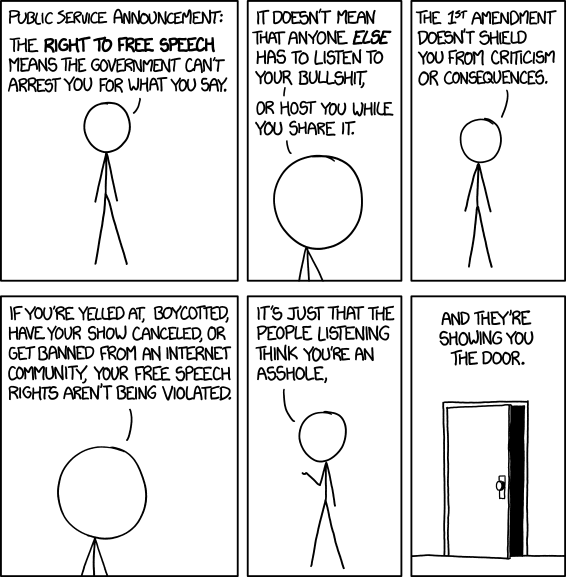
If in doubt, try being extra polite. For more details see here.
Liberal Democrat Voice is ‘our place to talk’. The team seek to ensure that a free exchange of ideas is possible, with nobody being driven away by aggressive or boorish behaviour. Commenters are advised to address themselves to the ideas that have been expressed and not to attack the individuals who have expressed them.
This high standard can be a challenge to maintain in a political context when much of what passes for political debate in our culture is little more than the imputation of base motives to one’s opponents.
Similarly, constructive debate of the highest standard requires that participants interpret each other’s arguments charitably; that is choosing the strongest and noblest of the possible meanings to discuss. Normal political discourse often involves choosing the weakest and ignoblest interpretation for an easy attack.
This tension between politics and civility places a high burden on the judgement of individual moderators. We cannot guarantee to get it right every time, or even – as a diverse group – be entirely consistent. But it is better to try.
Some comments will be held in moderation by software awaiting the intervention of a human moderator. This doesn’t necessarily mean there is anything wrong with them, simply that the software isn’t smart enough to moderate accurately. It is likely that responses to this post will be held up by software for human moderation.
 Follow @libdemvoice.org on Bluesky
 Like us on Facebook
 Subscribe to our feed
 Sign-up for our daily email digest

 The Mere puts the mere in Ellesmere
 Green leader doubles down on Zionism is racism policy
 Do shouty politicians gain long term votes?
 Chris Williams
 Andrew Moore
 Steph
Steph David Evans
 Chloe
Chloe
28 Comments
Unfortunately, it’s sometimes very hard to be polite about certain aspects of government policy or the performance of certain Liberal Democrats within the government.
So what you’re saying, essentially, is that we must all do our best to be extra polite, never to attack individuals, always to be charitable, only attributing the noblest of motives to those we disagree with.
Oh – and if you do delete our comments, it’s because you think we’re assholes …
James, but what good does it do? If your disagreement with government policy has some rational basis, you should be able to express that. And if it doesn’t then your rage us unjustified.
Anger is another routine ingredient of political discourse. Of course we are all justified in feeling angry from time to time, but it goes way beyond that. It is often a calculated attempt to bypass any debate of the pros and cons of a policy and to engage instead the primitive parts of the brain to promote hatred of people with different opinions.
Chris, yes that’s a perfect example of choosing the weakest and ignoblest intepretation. Thank you for the illustration.
The danger of the approach in this article is that it makes excuses for those who seek to wreck, derail and bully.
Could I add a couple of other suggestions ?
Refer to the original post, not someone elses comment. Comments on comments often result in a thread turning into a dialog between 2 or 3 grumpy blokes.
Try to keep it short, 7 lines max. You can always offer longer pieces to LDV as an article or link to your own blog. I always skip the longer comments myself.
”Similarly, constructive debate of the highest standard requires that participants interpret each other’s arguments charitably; that is choosing the strongest and noblest of the possible meanings to discuss”.
And who decides what that is? Stop trying to direct people’s arguments and go and read On Liberty.
Slightly off-topic, but I would like to suggest that some who write articles for LDV should look at the site before doing so, and instead post their thoughts in one of the existing discussion threads.
The recent furore over Jeremy Browne’s new book is a great example. We ended up with at least 5 parallel discussions, generally going over the same ground (if anybody missed them, people who had not read Browne’s book thought others should read it before they pointed out how terrible were Browne’s ideas). It would have been much easier to follow if some of the article writers had joined the discussion instead of starting new ones.
This is possibly not the place to make this suggestion, it being a technical one, and maybe no one will read it who can address it; but I would like to suggest that a change to the commenting code be made which wo
uld result in comments that are held up for moderation by software being threaded not in the sequence that they were submitted, but in the sequence that they were approved. The result of software-triggered moderation is usually that the comment does not get read at all, since it is inserted into the midst of a series of comments which readers have already read. Readers look for new, unread comments at the bottom of the comments list, and that is where approved software-moderated comments should go; but in fact they remain hidden unless one goes back and reads the whole comment thread from the beginning.
Since there are no indications for commenters about what triggers the software moderation, it is, moreover, impossible for a writer to be sure that his or her comment will pass it unscathed — and therefore get read. Although it would be harder to code, in principle I think it should be possible to automatically return software-moderated comments to the writer (perhaps with problematic words or phrases highlighted) so that the writer can edit the comment until it passes. This would take some of the workload off the human moderators.
“Chris, yes that’s a perfect example of choosing the weakest and ignoblest intepretation. Thank you for the illustration.”
By all means tell me what the noble and polite interpretation of “you’re an asshole” is …
The people I find most persuasive are those who take the trouble to phrase their argument in a diplomatic way. However well thought-through, if the author comes over as arrogant, I’ll distrust what they say.
A lot of the comments on these forums are, in effect, a critique of someone else’s writing. I’d love it if more people read guidance on how to critique in a way that makes a reader with a different opinion listen to their argument, rather than react in anger without understanding what was said.
A good article on this is “The Diplomatic Critiquer” from critters.org.
A nice quote from the author of the article is: “It’s not hard (or shouldn’t be, for a writer — it’s just “writing for your audience”) to make the tiny changes needed to write in a diplomatic way and convey the EXACT SAME meaning”
I agree with LDV having a moderating policy. LDV is a space of which you have ownership and you are entitled to have a say on what goes on it. And from my point of view I would hate to see it descend to the diatribe of abuse you see on the Guardian website in the comments that follow an article on the Lib Dems. Freedom of speech exists on the Internet as a whole and that is how it should be.
However I have been on the receiving end of the policy twice. Once when an article I wrote was not published because I was told it was rubbish. I was upset by that because I spent a lot of time writing it. However in hindsight I think it probably was rubbish and better not published.
The other time was when I mentioned that another Lib Dem member gave the impression of being a climate change denier. An email was sent to me saying the accusation was defamatory. It wasn’t intended to be. It was critical but I think it was fair given that person consistently makes the case against believing in the climate change science.
However that is only one gripe over a numbet of years. I much prefer you have the policy and the price for having that is that the odd decision will be disputed.
I’d love it if more people read guidance on how to critique in a way that makes a reader with a different opinion listen to their argument, rather than react in anger without understanding what was said.
But that’s a decision for the critic, isn’t it? And quite frankly, a large proportion of people here (and evidently some of the moderators) react with anger whenever they see an opinion they disagree with, however politely it’s expressed.
It would be lovely if everything people said was to everyone’s liking all the time. Personally, I’d love it if people didn’t use all these awful Americanisms, such as ‘to critique’ for ‘ to criticise’ and ‘critiquer’ (!) for ‘critic’. But to my mind, liberals just have to accept that they can’t control what other people say, and get over that fact.
I would echo what Geoffrey Payne has written. My comments have often fallen at the moderating fence. But life is too short to get too upset by such things.
Sometimes a comment that I have considered perfectly reasonable has been axed and I have never been told why or worked out why. Some moderators take the trouble to send an e-mail to explain. I take my hat off to them for taking the time and trouble to do so.
I have to say that there are some days when I expect a less sympathetic approach from particular moderators. A couple of the young men seem unable to follow their own moderating code and let their views get in the way of objectivity. I should stress that they are the exceptions. But nobody is perfect. I am still pleased that they are prepared to do a job that frankly I would not. And as one of the less polite moderators said to me , if I don’t like it I can b****r off. Actually he did not use the words “b****r off”, but he made it perfectly clear that is precisely what he meant. And he was right. If I do not like the way LDV is run I can go away.
@paul barker
> I always skip the longer comments myself.
I always skip the shorter comments myself; they indicate the author hasn’t got a lot to say on a subject. These factors are completely subjective and trying to universalise rules for communication seems to me to be a quick way to stultify it. Lib Dems need all the discussion they can get at the moment.
I’m not a big fan of comments sections in general, but LDV’s is a special kind of hell. It’s the worst kind of commenting on the headline rather than the post combined with a bunch of prickly people (both Lib Dems and others) having a family argument under the auspices of a rather boring discussion. Good comments sections have helpful, inclusive communities and/or interesting debate – LDV has neither.
I think there’s a fairly good solution which is gaining traction elsewhere. No more comments box at the bottom of the screen. An email address for a moderator goes there instead. If you’re motivated enough to want to comment sincerely on the article, you can email your comment and, if it’s good, it can be published. You can see an example of this in practice at http://jacobian.org/writing/unlimited-vacation/.
I appreciate this might create more work for the busy LDV team, but some system to make it less attractive to post backbitey comments of the type seen earlier in this thread (and, honestly, in every thread) would only be a good thing.
@Ruaraidh
At no cost to you I have just been through every post on the site you recommend since 2010. There is a total of one (1) comment featured on the site for that time period, and it is in the post to which you have linked.
The example you have provided does not support the suggestion that this approach results in a higher quality of debate. It seems to result in ‘silence, crickets chirping’. I suppose on a purist level that could be seen as a success, or possibly a no-score win; in the case of the example, I suspect the author has intentionally designed his website as a publicly shared notebook that is explicitly not intended to host protracted discussion. Most of his posts are essentially pages torn from the comp sci equivalent to a lab book, so in his case that decision makes a lot of sense.
Of course LDV could be redesigned in a similar way. It would then become a web magazine with a ‘letters to the editor’ facility. I have no particular problem with that, although speaking for myself, I wouldn’t bother to read it much (I could read Liberator, but I don’t, so I suppose I am not much interested in that format). Should that redesign take place, most below-the-line contributors would find somewhere else to hang out and engage in what for the sake of argument I will describe as passionate discussion, a few would give up and a very few, in all probability predominantly those with an existing social connection to the author of the article, would write in with remarks. Almost certainly a reduction in the demographic breadth of respondents would result. Whether that’s a bad thing is a subjective judgement.
@Ruaraidh
Mind you, I’ve just found a 2009 post from there that contains a direct link to a comment section on one of his previous posts. And following that doesn’t work either. Either the s site is mildly broken (which I sincerely doubt, being who he is!) or he has intentionally migrated without taking his comments with him, hiding all the older comments he has received, including ones that at the time were apparently so interesting that he chose to use them as a basis for future posts. He’s retired from Django BDFL, is tired of ‘[struggling with] the demons of negativity’, wants to do (continue doing) something else with his life and no longer wants to be central to that community, and looking back at his site suggests that he’s been feeling some sense of burnout for a while. Very sensibly he’s changed things. Maybe it is a good analogy for the headspace in which LDV currently lives.
@daft ha’p’orth
Thank you. I take your point, but I suspect LDV would see more comments than that site (though certainly less than at the moment, though that’s not necessarily a bad thing!) I just picked one of the tabs I had open to demonstrate, but there’s no doubt that it has a depressing effect on the number of comments made.
I think it is quite a good analogy, sadly. LDV below the line is just about as negative and dreary a place as it can be. It’s saved from degenerating into something like the Scotsman’s indyref pages only because it’s not as popular.
I suppose I take a fundamentally anti-comments line, but my own experience is that, in the absence of an extremely committed and engaged community, comments only subtract from a site. Either there needs to be a lot of work put into fostering a healthier community (I don’t know how best to go about doing that) or comments should be de-emphasised in some way.
@Ruaraidh
I think your point is self-nullifying, as you’re using the comments to engage in debate about the comments you identify yourself as being anti. If you believe what you’ve said you would of e-mailed a comment in to be published as an article, surely?
Your view seems to be that critical commentary is negative, dreary and boring; it’s not how I read these things at all, I can’t see how stopping people talking would improve the level of discourse. Some of the articles written on here are wrong (objectively/factually), it’s great that the public can interact on those article. Without that level of interaction, few would visit this site and it would serve little real purpose (there’s plenty of online resources for comment-free liberal articles, in addition to print). If you feel strongly about it I can write you a little Chrome extension that makes all of the comments disappear on the site for you – giving you the choice as to how you consume the content instead of forcing your view on to others. Let me know if that’s something you’re interested in, I’d happily donate it to the site if people really want rid of comments (maybe call it Kikazaru!).
I believe when liberals start to argue for restrictions in freedom of speech they’ve lost the debate.
@ Ruaraidh
Personally I like reading the comments of others on LDV and find few comments I think should not have been posted. Sometimes there are comments off topic and the discussion centres on that, but in the main I like reading the discussions between people on a topic that they really care about. Sometimes I feel the same thing is said again and again by a person on different threads and sometimes I feel that someone is being unreasonable in their comments (there was a recent example where someone kept asking someone to say how they would do something). For me when I am well enough I enjoy coming here to read the comments of others and to make my own. This is the only such site I visit.
The only thing I would change is that where all comments are to be moderated before being published this is clearly stated. At the moment it is only sometimes stated.
@ John Tilley “Sometimes a comment that I have considered perfectly reasonable has been axed and I have never been told why or worked out why.”
Where a comment is not allowed the person should receive a clear email stating exactly what the problem was, so they can amend their comments to meet the comments policy. I had assumed this was happening.
@ChrisB
I don’t think there’d be a great reduction in the number of people visiting the site if there were no comments, given that it’s consistently 20 or so people who actually use the feature.
If you think this would represent a restriction in freedom of speech, you need to go read the comic again. Specifically panel 2.
@Ruaraidh
“LDV below the line is just about as negative and dreary a place as it can be”
It’s a negative and dreary political universe, especially right now, especially for LDs. Certainly this would indicate that things need to change. Maybe comment policy is one of those things. Maybe it’s just a symptom. Maybe the problem lies elsewhere. Maybe everybody’s a little fed up with the status quo and it’s manifesting itself as bear-with-sore-head syndrome.
To come to terms with the changing political landscape in the UK, people need to talk and think and talk some more, but there’s no fundamental law that says that LDV needs to host any part of that process. Could be on the Grauniad. Could be down the pub. As you say, LDV is only a tiny part of that landscape anyway and those who contribute comments are only a small proportion of the readership (predictable: see the 1% rule of participation inequality, although I think you should bear in mind that whilst maybe 20 people are active at any given time it isn’t always the same 20 or so people). It’s up to LDV to decide whether it wants to speak or speak and listen, and to define its intended audience for either. Either choice has benefits, and it’s always possible for the ‘listening’ to happen on another platform.
For what it’s worth, though, the comments are very useful for me. I have other means of accessing carefully-prepared and polished political speech, much of which feels as though it isn’t aimed at me, a non-party member and bear-with-sore-head voter. Although the incidental stuff, like those Pathé videos, can be great, the ‘ordinary voices’ below the line are much more accessible to me.
A couple of months ago I did a direct count (in response to a comment similar to “only 20 people comment”) of the number of people producing replies and the number of replies per person on one thread. The number of commenters was much higher than 20 — closer to 200, I believe (and that was on just one thread, which not every reader was necessarily following). Of course, the number of replies followed a curve, with a small number of commenters producing a large number of comments — but (somewhat to my surprise), most of the comments were produced by a very large percentage of the total number of commenters.
This is a weak cartoon from xkcd. What if the publisher has a monopoly, or is the official forum for Liberal Democrat members – there is then a greater responsibility over free speech than implied by this (unusually weak for xkcd) cartoon. It is actually pretty offensive that LDV would imply that ‘thinking your an arsehole’ is a justification for silencing disagreement.
@Ruaraidh
Simply untrue, there are nearly 20 individuals commenting on this thread alone. It would clearly change the numbers of visitors to the site – I think it’s the main reason it gained traction in the first instance. If you don’t like it I’ll happily make something that will make all of the comments go away and relieve your apparent discomfort. It seems that many hold the default view on here that banning things will make it better; I don’t subscribe to that and think the party is doomed without these discussions.
As to your second point, I’d say it applies equally to yourself. You’re here, now, arguing with someone on the comments section – you don’t have to be. You could do something else. I enjoy it, like many others and don’t take the same issues with it you do. It sounds like you’re after a newspaper. I agree with Henry above, the XKCD displays a level of conceptual thinking unbecoming of a platform held together by active debate. Do LDV publish stats still?
LDV’s moderators aren’t generally too dreadful, but this article is one massive shoot-self-in-foot exercise. Calling people a*seholes within the lead article itself is breathtaking hypocrisy! Self censor please!
I made a meta-exception for this post, but I rarely bother reading below the line on LDV these days. I can pretty much predict exactly who will post what in response to any given article, including the disagreements they will then have with themselves. There is a small core who will say the same things in the same ways on every post, and it’s neither interesting nor enlightening to read, and drowns out other discussion. I’ve been tempted to set up some kind of Social Fixer-style thing that lets me automatically hide comments from certain contributors, but it’s more work than I can be bothered with these days.
This one’s a one click job : https://chrome.google.com/webstore/detail/shut-up/oklfoejikkmejobodofaimigojomlfim
Hides all LDV comments unless you click a button!
this may be of interest:
http://99u.com/articles/25151/dont-feed-the-haters-the-confessions-of-a-former-troll