


There is consistent evidence that in public elections people with names higher up the alphabet, and hence higher up the ballot paper, do slightly better than people lower down. It is not a major effect, though in a marginal seat a small difference can mean you win rather than lose, and seems to be strongest where ballot papers are more complicated, e.g. if all three seats in a council ward are up for election.
So it is no great surprise that after the Liberal Democrat federal committee and interim peers panel election results were declared on Saturday, several people made comment about how the results looked to benefit people higher up the ballot paper. The large number of candidates means these were just the sort of contest where you might expect an effect to come into play, and with the final few places on committees or panels often decided by small margins, there might be an important prompt here for reform.
But what does the evidence say?
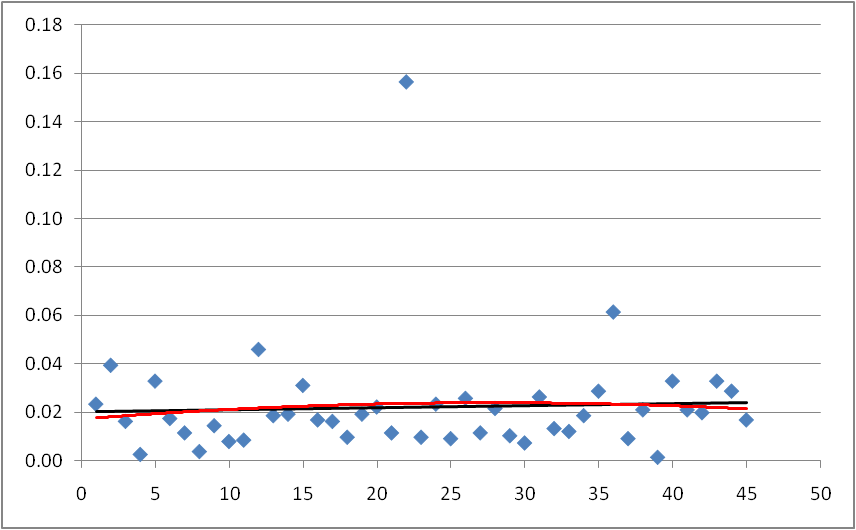
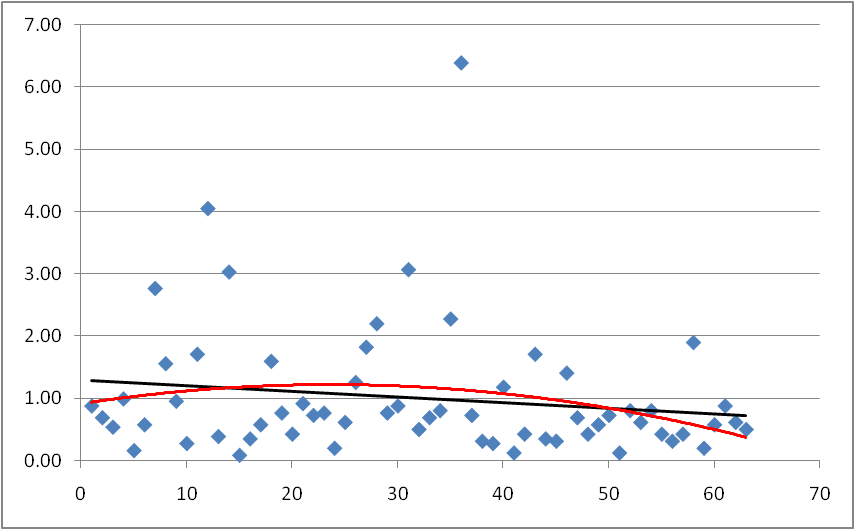
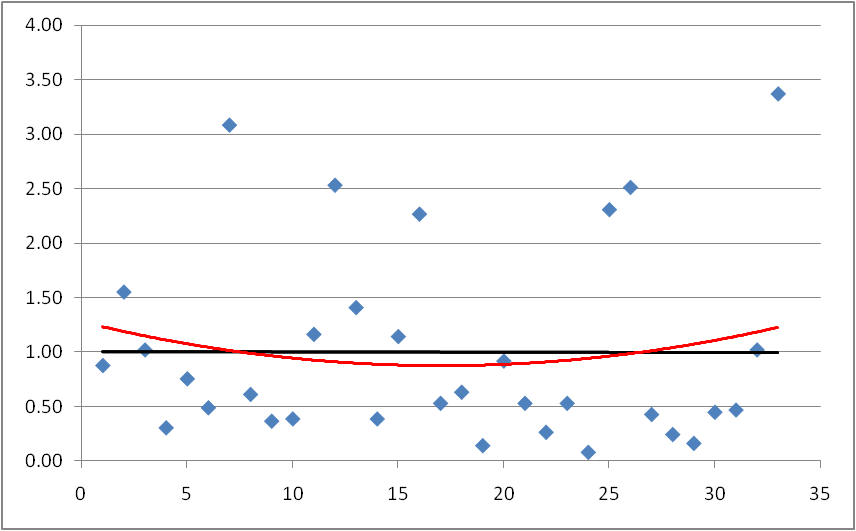
The following graphs show for each committee the first preferences gained by a candidate (calculated as a percentage of the total number of votes cast in that contest) versus the candidate’s position on the ballot paper. Also on each graph are two trend lines – a simple linear trend line and also a second-order polynomial trend line (as it is possible that, for example, candidates near the top or bottom of a ballot paper do better than those in the middle):
Federal Executive
Federal Policy Committee
Federal Conference Committee
Interim Peers Panel
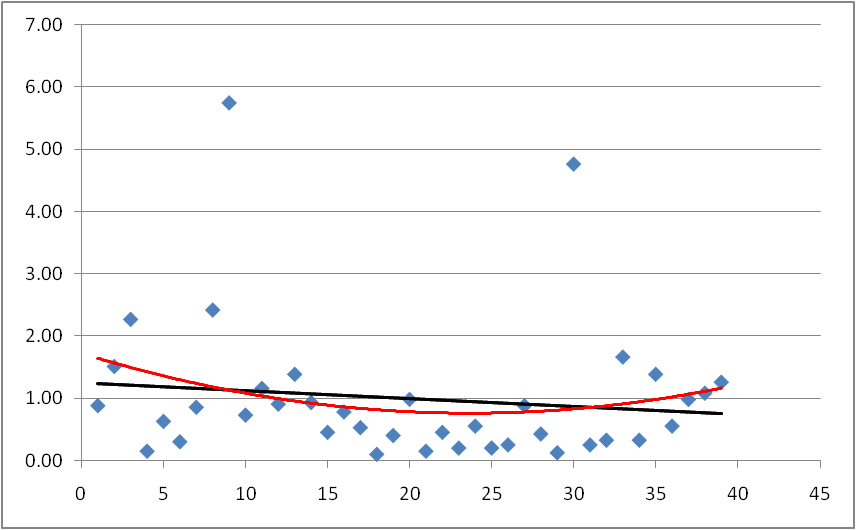
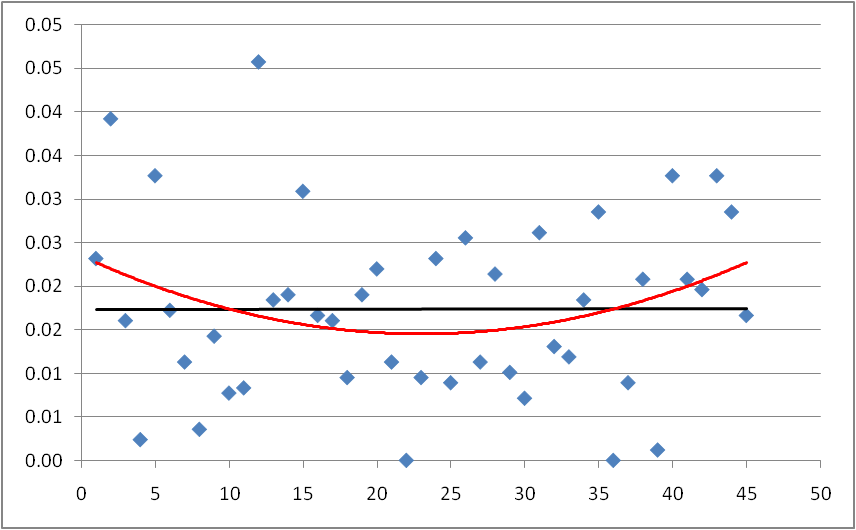
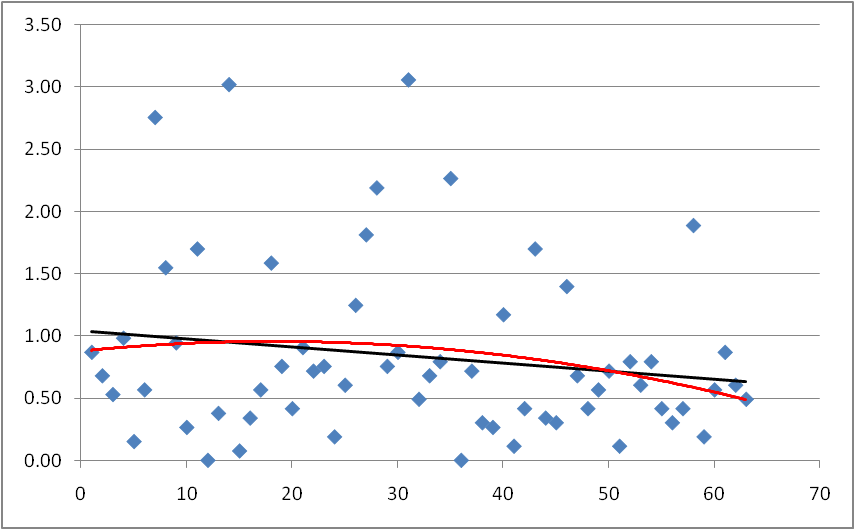
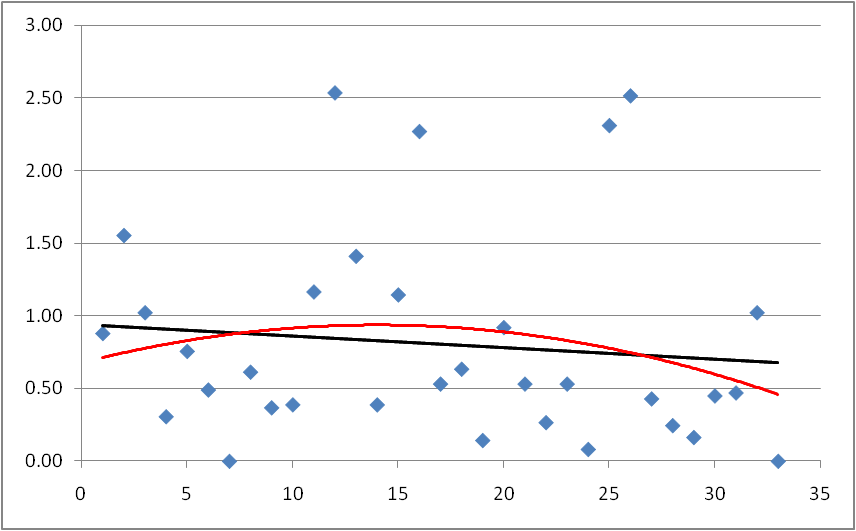
The evidence then looks pretty weak. However, in all the cases there are some major outliers which distort the results. I of course mean that in the nicest possible way as I’m one of those distorting outliers, so here is the data again, but this time with the top two candidates in each contest removed:
Federal Executive
Federal Policy Committee
Federal Conference Committee
Interim Peers Panel
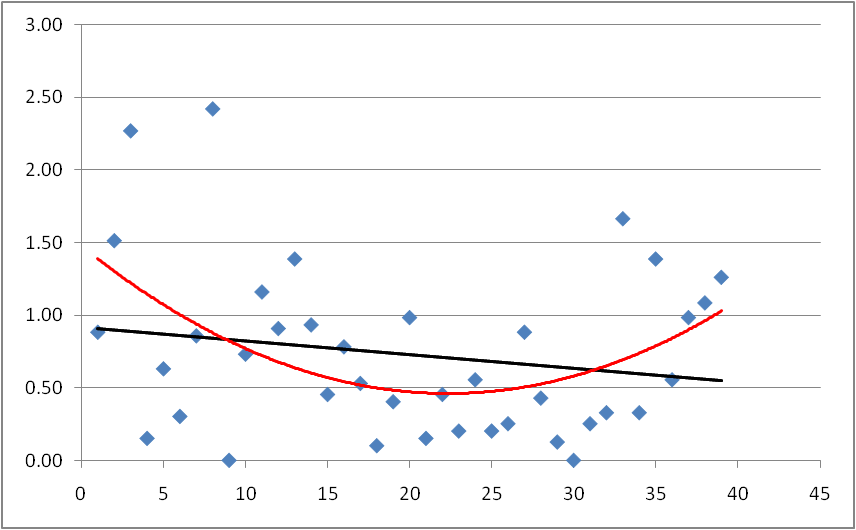
The change in the graphs thanks to the removal of just two data points from each is a healthy reminder about the vagaries of trying to read too much into data and the conclusion still is that there is no strong, consistent effect here. Just possibly there is a slight edge for those higher up the ballot paper (three of the four straight line trends are down and the fourth is flat) but the evidence is weak (look at the conflicting trends of the polynomial lines).
Which, as someone who finished second on first preferences behind a candidate many places ahead of me on the ballot paper is a bit of a shame 🙂
If you would like the data to analyse it further beyond my basic first cut, or would be willing to type up data from other years to extend the data set, let me know.
 Follow @libdemvoice.org on Bluesky
 Like us on Facebook
 Subscribe to our feed
 Sign-up for our daily email digest

 Crash! (1971): An experimental television film with J.G. Ballard and Gabrielle Drake
 What is Christian nationalism?
 Latest PollBase is out, with all the British voting intention polls since the 1930s
 David Sparrow
 Peter Davies
 Tristan Ward
 Jason Connor
16 Comments
The ABCDE’s seem to have fared quite well for PMs since 1900.
Balfour. Asquith. Baldwin,.Chamberlain. Churchill. Attlee. Eden. Douglas-Home. Callaghan. Blair. Brown. Cameron. Not forgetting Bonar-Law and Campbell-Bannerman.
have you analysed the data depending on whether the candidate’s A5 election material was on the left or right hand page? Seriously.
It is because we are just not sure about the effects of how candidates are presented to the voters that we ought to have randomised order on the ballot papers and in the accompanying booklets.
I write as one with a name near the beginning of the alphabet. And no, I didn’t get elected to FE.
So with my surname Green, should I be looking to stand only against candidates Harris to Zadok?
Based on your methodology, I am not surprised that the effect was weak. Most voters think carefully about their first preference – it’s further down the list where I’d expect to see the effect.
Many I’m sure use the approach: Vote for those I know/who impress me, then vote for all the rest EXCEPT those I don’t want. In that second stage, it’s tempting to just run down the list. And with one contest going to 53 stages, some of those low preference votes WILL have made a difference this time.
P.S. Surname starting with ‘W’ has definitely been a disadvantage to me in public elections. But it was OK, I still won after the recount 🙂
Mnay years ago I stood in a three member ward. My colleagues were Armstrong and Crow. The tory candidates included the local GP who walked it. However people liked the then Alliance team and voted the top two of our candidates to make up the three. As I am a Mac I was the one who lost out. I have always thought I should change my name to Aardvark.
Since then I have stuck to one member wards. At least you don’t know if the position of your name on the ballot paper influences your winning or losing.
It would be easy to arrange internal ballot papers with different starting letters, so one might be D, another H, a third T. Alphabetical order is retained after that, or it’s horrible trying to find individuals in a long list, and A is tacked on at the end. The Society of Indexers does some listings this way.
David Wright makes a good point – how about comparing probability of election with the position on the alphabet instead?
E.g. break the list of candidates into a few alphabetical chunks like A-D, E-H and so on. Then see what proportion of the candidates in each chunk get elected. With three major federal committees there should be enough names to get a statistically significant result.
@MrsB I (if my memory serves me correctly) was on the left hand page for FCC (69 first pref) and the right hand page for FPC (33 first pref) – does it makes the difference you would expect?
Good that you nailed that one. No need to have a boring discussion about it anymore.
Mark, thank you for your kind comments!! 🙂
I suspect David Wright is right, Mark, that there is a flaw in your methodology. I imagine a substantial number of voters will have cast their top 3,4 or 5 preferences for people they knew and then taken a different approach for later preferences.
It struck me that another common feature of a number of those getting elected was that they had fought a target seat in the general election in May.
Declaring an interest as someone who failed to get elected to FPC it is difficult to avoid the conclusion that the main lesson for those of us who lost is that the best way to increase your chances of getting elected is to run a better campaign…
so why no IRC analysis mark? – you’re just so domestic 🙂
One way of looking at this is looking at the alphabetical mid-point of names.
Amongst all MPs, it’s ‘Jones’.
Amongst all candidates, it’s Kelly.
Amongst Lib Dem MPs, it’s Huhne.
Amongst all Lib Dem candidates, it’s Jones again…
But amongst the Winchester electorate, 76,000 names, it’s Kirkaldy. And amongst our members, it’s Kyrle.
So apparent bias towards candidates earlier in the alphabet, and then further bias to people elected as MPs.
I think you can also benefit from being last on the ballot paper.
When i stood for my unions executive over an eight year period
my vote was always slightly higher when my name was last
on the paper.
As one of those who raised this on another thread I have to admit that when I did my own qualitative analysis (after I had posted!) I realised that the anomaly was not so much in the result but in the entry! It seems that the candidates are unusually confined mostly to the top end of the alphabet. – eg if you take the FCC booklet you will find that the middle page opens on G, and that there are only 7 candidates in the bottom half of the alphabet.
Nevertheless, what is wrong with randomising entries on these lists so there can be no doubt?
This makes me glad my surname starts with a ‘B’ *grin*