


Over the next few weeks, I’m taking part in a handful of training sessions about learning the lessons from May’s elections. There’s much to learn from May and from being in government, but I’ve also noticed that many of the old favourite, long-running lessons are very much still with us. So here’s my selection of the top five of those Golden Oldies.
Disliking the use of “fair”
Some Liberal Democrats love to hate the use of “fair” or “fairness”, decrying it as being meaningless, what everyone says and pointless. But it is also one of the values that the public says it most wants from political parties:
A recent YouGov poll for Policy Exchange asked people what values they most want a political party to reflect. “Economic responsibility” came out top with 59% mentioning it and “fairness” was not that far behind on 50%. No other possible value was mentioned by more than a third of people. Amongst Liberal Democrats, fairness was rated even higher…
It also did far better than some of the other values that are particular important to Liberal Democrat members (freedom/liberty – 20% overall, 22% amongst Lib Dem 2010 voters; tolerance and diversity 14% / 22% and environmentalism 11% / 17%). Those findings are a good example of why smart campaigners think not only of what matters to them but also of the evidence as to how best to present that to voters. Values such as tolerance may score low on their own, but present them as features of fairness and the ability to persuade the public is transformed.
Complaining about too many leaflets
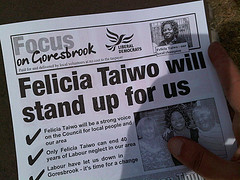 It is certainly possible to deliver too many leaflets (and of course I’m in no way thinking of a certain by-election during which three Lib Dem deliverers met each other on the same doorstep…), but almost always the complaint about ‘too many leaflets’ confuses quantity and quality.
If you are running good local campaigns, if you have interesting news to impart and if the leaflets are written and presented well, then most members of the public has a huge appetite for them. If you’ve got nothing to say the public does get bored with leaflets pretty quickly, but the answer to that isn’t to do fewer leaflets, it is to do more community campaigning so you have more to say.
In fact, you should be in the position where you’ve always go so much you could report on that the big struggle is cutting it all down to fit into the number of leaflets you can get out.
Declining offers of help
This was most starkly illustrated by my mini-survey at the start of the year:
What happens if someone tries to join the Liberal Democrats?
No reply. That’s what happens a third of the time if a member of the public contacts a Liberal Democrat local party via the internet according to a ‘mystery shopper’ exercise I carried out earlier this month… The party is being far less welcoming to would-be new members than it should be.
This example is neither new nor unique. Being efficient and welcoming in response to offers of help needs to be more widespread than it is.
Keeping social and fundraising events secret
It’s fairly rare for a local party to deliberately set out to make one of its events a secret (though these days with ministers in government and resulting security issues, there is sometimes an appropriate level of discretion). Rather, it is that obvious groups of people who would like to attend the events are not told about them; i.e. the events are kept secret from them.
Group one are those who help but who are not members. Too often the invitation list for a local party social event is the members and not the wider pool that includes people who help without having joined.
Group two are members and helpers in neighbouring local parties. Particularly in urban areas, there are often many such people within easy travel distance of the event, if only they knew it was happening.
Why keep your events secret from people who would want to come, would help fill the room to make the event feel successful and who would hand over money for raffle tickets?
Not saying thank you
Two weeks after polling day this month, around half of the local parties I helped out during the campaign had not (so far) said ‘thank you’ to me. I’ll survive… but unless parties were specially picking me out to be excluded from thank you messages, that is a pretty grim picture of how we treat each other at times. Grim, but not surprising as overall as a party we’re often rather poor at saying ‘thank you’.
There have been some good initiatives recently, such as the Party Awards, and this is one of the reasons for me doing the Local Liberal Heroes series. But as with welcoming offers of help, there is much more that could and should be done.
Finally, if after that list of five mistakes, you’d like to leaven the mix with some positive tips instead, I can offer you 160 of those.
* Mark Pack is Party President and is the editor of Liberal Democrat Newswire.
 Follow @libdemvoice.org on Bluesky
 Like us on Facebook
 Subscribe to our feed
 Sign-up for our daily email digest

 The Joy of Six 1590
 What is Christian nationalism?
 Latest PollBase is out, with all the British voting intention polls since the 1930s
 Peter Davies
 cim
cim Roland
8 Comments
I have been going around to the people who signed my nomination form over the past couple of weeks saying “Thank You” for that, but when I wrote a letter to my local newspaper thanking the people who voted for me, they rang back and said “Sorry, we are not permitted to publish electoral thank you letters. May we suggest an advert that would cost £30!”.
The point about the social events is an important one. I know of one local party which historically has always had two membership lists – the one which is the official one, and the one which is simply supporters who don’t want to join. They were frequently given the option to join, but were always sent the list of social events and sometimes were “specially invited” to these to make them feel important. These people were people who either couldn’t or wouldn’t join, who delivered Focuses or stuffed envelopes, and it was really important to make them feel need!
Mark, you missed error number 6:
“Discussing politically useful and sensitive matters about campaigning in public open forums! 🙂
All bar one seem fair and reasonable points. However if elections are about building popular support for a political project, the fact that people think politicians being “fair” is good does not mean the word means anything, is significant. If when using it the context explained what was ment by it, that would be fine. It is such a contentious word, I am pleased I am not alone and thinking it does not describe very much.
I often think it is an error that we go to desperate lengths to go negative on the other parties. And even when there is no evidence it has worked we keep on doing it.
Not planning ahead is often a cause of failure in other areas of human activity. The main task for a political candidate is probably to get onto peoples radar, and this isn’t easy to do in a short campaign. Better to start far in advance – such as now for 2015.
Oh no! I persist in wilfully making the appalling blunder of disliking the use of “fair” as part of nebulous, meaningless, ineffective slogans! 😛
Here’s a whole blogpost in which I err repeatedly about “fair”.
As Gavin says above, “fairness” being a value for which people look in a party does not automatically imply that using the word “fair” as many times as possible is the answer.
Having strong narratives about tackling unfairness, however, is a completely different matter…
As the quote goes “Insanity is doing the same thing over and over again but expecting different results.”
Disliking the use of “fair” –
Have we really defined what we mean, for we have little in place to assure that we are “fair”. We as a Party certainly “talk the talk” regarding fairness, but I would suggest that if we wish to win people over, then we need to be seen to “walk the talk” and demonstrate and evidence how that we intend to “build a fair, united society for all the people of the UK”?
Complaining about too many leaflets –
How many trees are we willing to sacrifice to get our message out? This is the 21st Century, and there are far more effective ways of getting into someones thoughts, than using poor quality printing on poor quality paper. In Newbury, where I happen to live, we are constantly delivering Focus papers (or it certainly feels that we are), then we walk the same streets to raise the postal vote levels, and then again for canvassing purposes (and I am pretty sure that I have missed another trip out). The Tories on the other hand, do NOTHING, and do not even canvass until the last minute, and still defeat us in the District elections. We are clearly doing something wrong?
Declining offers of help –
If only we were in such a luxurious position?
Keeping social and fundraising events secret –
We may be a Party with secrets, but we are not a secret Party!
Not saying thank you –
I am sadly only too aware that there exists a culture within specific areas of the Party of not “saying thank you”, and this is causing the Party to appear aloof, as well as incredibly rude. The Party membership are predominantly volunteers who pay with money, time and energy supporting the Party in many differing ways, and should be thanked far more than they are in my opinion. If we appear dismissive of our own membership, then we will certainly be appearing as dismissive of the views of the wider public.
I conclude as I started: “Insanity is doing the same thing over and over again but expecting different results.”