


I love Orkney. I’ve only visited it three times and would love to go more often but it is a bit of a trek to get there from London. But these days I get a lot of pleasure from exploring it again online and in my imagination.
The first time we went to Orkney we drove the full distance from London to Scrabster on the northern coast of mainland Scotland, near John O’Groats. We took several days to get there, stopping off for a break in Inverness. The ferry trip from Scrabster to Stromness was beautiful, as we passed the Old Man of Hoy surrounded by arctic terns. We stayed in an ancient cottage tucked away in the steep lanes of Stromness.
Returning a week later was a different story. The ferry was very late leaving and then took a long detour through the protected Scapa Flow before attempting to cross the notorious Pentland Firth in a heavy storm. That was the worst sea journey of my life. I was terrified. I now understand why the Firth is such an important sea defence.
I said I would never again try the sea crossing, so on the last two occasions we have flown from one of the Scottish airports. I don’t know how Alistair Carmichael manages his weekly commute in happier times, as it can’t be done in one hop from London. On one of our visits we popped in to his constituency office which is behind St Magnus Cathedral in Kirkwall.
So why do I love the place? It is totally different from the rest of Scotland, geographically and culturally – indeed, its heritage is more Viking than Scottish. There are no forests – in fact, no trees at all on the main island (simply known as Mainland) or on most of the outlying islands. There are no mountains, no heather, no steep sided lochs. But there are huge horizons, gentle hills, amazing birds and the wind, always the wind.
However it is the Neolithic response to that wild landscape that brings the visitors to the islands. A quite large area on Mainland is designated a UNESCO World Heritage site, and it includes four extraordinary structures: the village of Skara Brae, the Ring of Brodgar, the Stones of Stenness, and the chambered tomb of Maeshowe, all dating back over 5000 years. They alone are worth the journey, but there are an astonishing 3000 Neolithic sites to be explored on the islands.
One day we took a tiny 8 seater plane from Kirkwall to the outer island of Westray. We stayed on the plane for the two minute hop to neighbouring Papa Westray (known to everyone as Papay) – a journey that appears in the Guinness Book of Records as the shortest scheduled flight in the world. We joined a handful of other visitors for a minibus tour of the island which included lunch in the village hall served by some of the 70 people who live there.
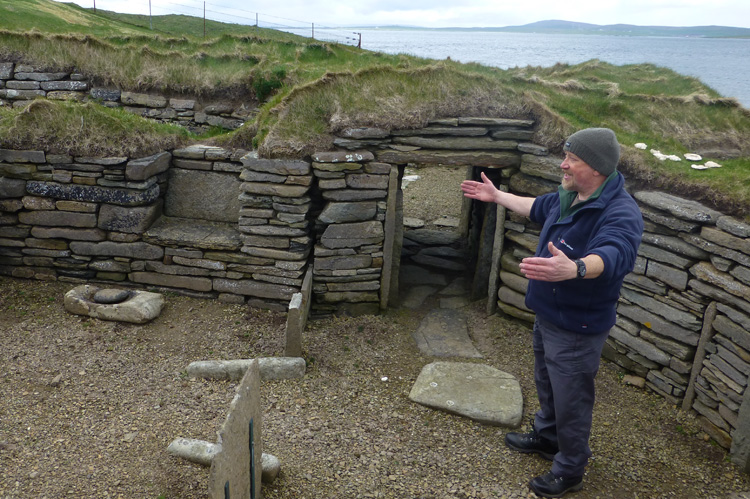
During that tour of Papay we went to see the Knap of Howar, the remains of the oldest house in Europe built nearly 6000 years ago. When we visited Skara Brae we had the full visitor ‘experience’ (at a cost) and were restricted to walkways around and over the houses. But to reach the Knap of Howar we walked across a muddy field full of cows, avoiding their deposits, opened a gate then climbed into the home and the workshop, which you can see in the photo.
Since then the excavations at the Ness of Brodgar on Mainland have unearthed some extraordinary finds which have challenged all existing understanding of Neolithic culture in the British Isles. More about that, though, another time.
Please note
We have been in full self-isolation since 16th March to protect my husband whose immune system is compromised.
If you are in self-isolation then join the Lib Dems in self-isolation Facebook group.
You can find my previous Isolation diaries here.
* Mary Reid is a contributing editor on Lib Dem Voice. She was a councillor in Kingston upon Thames, where she is still very active with the local party, and is the Hon President of Kingston Lib Dems.
 Follow @libdemvoice.org on Bluesky
 Like us on Facebook
 Subscribe to our feed
 Sign-up for our daily email digest

 Lime Garden: Moving Target
 Yes, I'm still in favour of making the House of Lords democratic
 British music only!
 Whickham North Focus delivery
 United Nations Day, 24th October
 Richard Cripps
 Steve Trevethan
 Peter Davies
 Jenny Barnes
4 Comments
There could be trees. The problem is wind. I read a biography of the Forestry Commission. They have a tree which grows horizontalis initially and proceeds vertically only when its roots are secure. It might be necessary to exclude some types of animals.
Some people might prefer views without trees, but our party was committed during the previous leadership to planting large numbers of trees. Droughts are unlikely.
I’d love to love Orkney but have not yet made it there. I’ve made three trips to Shetland — a wedding, a funeral, and a sibling trip because we all love the place — always promising to visit Orkney. I think I have enough time to get there!
Some of us travel the world to see wonderful sights forgetting the beauty in our own land, if not on our own doorsteps.
If in Shetland, visit Jarslhof right down south. History is compressed with the site encompassing remains from 2500 BC to modern times; remnants of the 17th century inn can be viewed over a cup of tea from the ugly replacement with even uglier 21st century Portakabin extensions.
Down the road is Sumburgh, the airport where many people arrive. In 1979 a turboprop plane failed to take off and crashed into the sea, causing 17 deaths. In 1993 MV Braer, an oil tanker, was caught in a storm and ran aground at Sumburgh Head. Shetland was lucky because the Braer was carrying fuel oil — light oil which is easily dispersed — and few places toss water around more than Shetland.
In a couple of square miles, every form of calamity we knew about in the 20th century has happened in a tiny space not even in the middle of nowhere. For some reason, Mother Nature has favoured the Shetland Islands.
I could post a puffin video from Sumburgh Head but there are thousands already. It’s a lovely sight but you should try the most northerly bus stop in the UK, ferries away in Unst.
I hope to visit my friend in Orkney one day. I have been to a treeless Iceland. The tundra is quite something.
Thank you Mary for the variety of your subjects since lockdown. We were hoping to go to Orkney with my in-laws when they were to have visited from Australia in June, but obviously both those plans are in the waste bin now. I find it fascinating to learn about ancient people because they can teach us much about ourselves, so I’m looking forward to the next instalment about the discoveries at the Ness of Brodgar.