


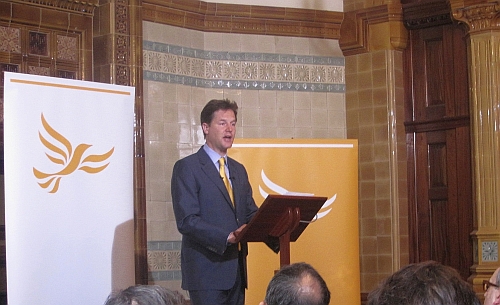
This morning, Nick Clegg gave a speech to party members to mark the first anniversary of the Coalition Government.
In the light of the past year, and of last week’s election results, Nick set out to answer what these mean for the Liberal Democrats – both as a party and in government.
Nick described the Liberal Democrat economic agenda in government as one of “short-term repair and long-term reform,” while promising “a strong liberal identity in a strong coalition government”, “muscular liberalism”, and “a louder Liberal Democrat Voice” [we at LDV like that one especially, and are limbering up already].
Nick said that having created a strong, stable government and set out credible plans to reduce the deficit, it was time to “make the Liberal Democrat imprint and influence on government more visible.”
Now read on:
I think it is obvious that this is a moment when as a party we need to take a hard look at ourselves. We were given a bloody nose by the voters last week. We lost almost 750 council seats. And of course the AV referendum delivered a clear ‘no’ vote.
So, a year into coalition government, some vital questions are being asked. In particular – what does this mean for the Liberal Democrats? And what does it mean for the Government? I am going to try and answer those questions today.
But let me be clear about a couple of points right away. Does this mean the end of the coalition? No. Does it mean the coalition is going to change? Yes.
Before looking forward, I think it’s very important to look back. To remember the situation a year ago. A fragile economy. A looming financial crisis. European neighbours seeing economic sovereignty being torn away from them by the financial markets. Huge anger at politicians after the expenses scandals. And then, of course, a hung parliament.
The decision we took to enter full coalition with the Conservatives, a decision the Liberal Democrat party collectively took, was absolutely the right one. What the country needed in May 2010 was a strong government willing to tackle the shocking deficit left behind by the Brown Government.
But we also needed a Government willing to embark on the long-term changes necessary to fix the economy for the future. Short-term repair and long-term reform: that’s the Liberal Democrat economic agenda in government.
I am proud that at a moment of national crisis, the Liberal Democrats showed ourselves to be a party of the people. A party that puts national interest ahead of partisan posturing. Given the possible alternatives, I have not doubted for a single moment that this was the right decision.
Roy Hattersley made a radio programme about coalitions last year. He suggested that there are three kinds in this country. Coalitions of convenience, which are not required by parliamentary arithmetic, but are simply easier to form for personal reasons. An example might be the Lloyd George coalition after 1918, when the Conservatives actually had a majority.
Then there are coalitions of conviction, where parties come together because of a strong ideological affinity, like the one formed in 1895 to resist Irish Home Rule. Thirdly, there are coalitions of necessity, formed in times of national emergency when no single party has the mandate to act alone.
The current government is a coalition of necessity. Of course the Liberal Democrats and Conservatives share strong convictions in many areas, such as civil liberties and the decentralisation of power away from Whitehall and Westminster. But the driving force behind the formation of the coalition was necessity: the need to act together in the national interest to sort out Labour’s toxic economic legacy. It is not a ‘national’ government, but it is a government formed in the national interest.
So, the first big call was to enter into coalition government. It was the right one.
The second big call was to set out immediately to tackle the deficit, and to commit to clearing the structural deficit by 2015. Again I am certain this was the right decision. And it was made in equal part by Liberal Democrats and Conservatives in Government.
Deciding to tackle the deficit within a parliament was, I believe, vital for the credibility of the plan.
In a perilous financial climate, it simply wouldn’t have been good enough to say that we’ll do half the job – but leave the rest to the next administration. Imagine your house is on fire. You wouldn’t expect one group of firemen to put out half of the fire, but say that the rest will have to wait for the next shift.
The two parties in the coalition are united on the central question of deficit reduction in this parliament. Labour left this mess. The Liberal Democrats and Conservatives are together cleaning it up.
I know that the cuts are extremely difficult. But remember that whoever was in government would have had to act in a similar fashion. Labour’s plans would have meant £7 of cuts this year for every £8 that the coalition is cutting.
The real difference between the coalition’s deficit reduction plans and Labour’s is not the scale – it is that people think we will deliver on our plans, whereas nobody thought for a moment that Labour’s plans were anything other than fantasy financing.
The UK has been kept out of the financial danger zone because of the decisive action we took last year. The cost of borrowing has been held down as confidence in the UK was restored.
It is too easy to forget how very different it could have been. Before the crisis, the cost of borrowing in the UK and Greece was almost the same. Now the cost of borrowing in Greece is almost five times as much as in the UK.
And it is essential to keep a sense of perspective about what we are doing. This is an economic plan to repair the public finances, not an ideological plan to shrink the size of the state.
At the end of the spending review period, public spending will account for 41% of GDP, three percentage points higher than in 1997.
And public sector employment will be half a million higher.
While the Liberal Democrats are wholly behind the deficit reduction plan, we are also determined to learn the mistakes of the past. Especially the lessons of the 1980s, when whole swathes of the north were, economically speaking, simply left for dead. And the lessons of the 1990s and since, when the economy became disastrously lopsided towards London and financial services.
I think one of the most important factors in the recent local elections was the deep, visceral memories of the 1980s in the northern cities and Scotland. These were also the places where the Liberal Democrats were the main face of the coalition government.
That fear is real, as I’ve heard very clearly on the doorsteps in cities like Hull, Newcastle and Sheffield in recent weeks. And fear is a powerful force in politics.
But the eighties won’t happen again. We are not in government to turn back the clock, but to move forward to a better, stronger and more balanced economy.
In the Thatcher years, whole communities were uprooted. Because too many areas were dependent on just one industry, economic upheaval led to social upheaval. Industries went, and communities went with them. Never again.
The Liberal Democrats were in the lead in identifying what was wrong with the economy long before the last election. The dangers of the deficit, for one: in fact I remember being criticised for warning of the depth of the cuts that would be required.
But we have also been warning for years about the way in which the economy had become dangerously lopsided; too reliant on London and the South East; pumped up on private and public debt; at the mercy of an under-regulated banking sector; and struggling with a creaking infrastructure.
It is this Liberal Democrat analysis of what is wrong with the economy that underpins the Government’s approach to putting it right.
Reform of the banking system. A Regional Growth Fund to support businesses across the nation. A Green Investment Bank to build the green infrastructure needed to cut carbon emissions.
In short, a rewiring of the economy to ensure sustainable, balanced growth.
So on the two big calls – forming the coalition, and reforming the economy – I think we got it absolutely right. But we are also ensuring that this government does not repeat the economic mistakes of the past.
Along the way, and largely unnoticed, we have demolished one of the most stubborn myths about coalitions – that they would be too divided and weak to take big decisions in the national interest. This prejudice has been killed stone dead.
Of course, there are other criticisms of coalition, which I’ll come to in a minute.
But behind all the noise and smoke of political battle, we should not lose sight of this important achievement. After decades of scaremongering from the other parties, we’ve shown that coalitions are not somehow un-natural or un-British, but simply a different and in many ways better way of delivering in government.
Of course the other main attack on coalition politics is that parties will be unable to deliver the policies in their manifestoes, because of the necessary compromises that take place. This argument – the ‘broken promises’ charge – is one I want to tackle head on. Not least since it featured so prominently in the recent referendum campaign.
Let me be clear. It will not be possible to deliver the entire Liberal Democrat manifesto in this Government. This is because we didn’t win the election. So we have had to compromise. We could not, for example, deliver our policy on tuition fees. Nor, it is important to remember, would we have been able to in coalition with Labour.
Labour was the party that introduced tuition fees, and then commissioned the Browne review which recommended no cap at all. On this issue, the other two parties agreed with each other, not with us. So we were isolated.
I know that there has been a lot of anger about this issue. But you can’t be in favour of coalition politics, but against the compromises that coalition necessarily entails. You can’t deliver 100% of your manifesto when you have 8% of the MPs.
I lead a party of 57 MPs out of 650. Much though I might often wish to, I can’t act as if I won a landslide. To deliver on all our policies, we need a Liberal Democrat majority government. That didn’t happen.
This is something the Liberal Democrats understand. It has in some ways been harder for our coalition partners, who are not, to put it politely, firm believers in plural politics.
The Conservatives promised to replace Trident in this parliament, cut inheritance tax for the most wealthy, renegotiate fundamental elements of the Lisbon Treaty on social affairs, build more prisons, and replace the Human Rights Act.
None of these things have happened. And there is no shame in this. They haven’t happened because the Conservatives are not governing as a majority party. They are in a coalition, and a coalition requires compromise.
Of course, the prospect of coalition governments in the future poses interesting questions about the status of party manifestoes, and the way our democracy works.
I don’t want to get into this in any detail today. But I think that here too, the Liberal Democrats were ahead of the curve. We put our four biggest priorities on the front of our manifesto and, more importantly, we made it clear before the election and during the days following that in any negotiations with another party these would be our principal demands.
And we’ve been as good as our word. We are now delivering on these four priorities in government.
So the coalition has shown itself to be a durable, stable government. But it is clear, not least from what we heard on the doorsteps in recent weeks, that people want the Liberal Democrats to be a louder voice in the government.
In part this means we need to do a better job of blowing our own trumpet on policies such as cutting income tax for ordinary taxpayers; ending child detention; increasing the state pension; introducing free nursery education for disadvantaged 2 year olds; adding a quarter of a million apprenticeships; increasing tax on capital gains; reining in the banks; creating a Green Investment Bank and a green deal; and getting more money into schools to help poorer pupils.
In terms of policy impact, we are punching well above our weight. A recent analysis by the BBC estimated that 75 per cent of our manifesto is being implemented through the coalition agreement, compared to 60 per cent of the Conservative manifesto.
We can also be more assertive about our different positions on certain issues, but without threatening the stability of the government. After all, nobody wants a return to the nightmarish coalition that existed between Tony Blair and Gordon Brown. Nobody wants tit-for-tat government.
In the next phase of the coalition, both partners will be able to be clearer in their identities, but equally clear about the need to support Government and government policy. We will stand together, but not so closely that we stand in each other’s shadow. You will see a strong liberal identity in a strong coalition government.
You might even call it muscular liberalism.
Recent weeks have served as a healthy reminder of the separateness of the coalition parties. The campaign has also shown that tribalism is still the dominant force in the other two main parties.
The Conservative party closed ranks in Spartan fashion against AV. Meanwhile, Labour under Ed Miliband concentrated on damaging us, the Liberal Democrats, rather than seizing the chance for a historic political reform.
Of course, there are pluralists in both the other parties too, and we will always be open to working with them. But the pluralists are not, it is clear, in the ascendancy. What the other parties want above all is to govern alone. We as Liberal Democrats must never forget that.
In terms of our own identity, I have always thought it a mistake to allow ourselves to be defined in relation to the other parties, or to use and adapt their labels.
We are not an anti-Conservative party or an anti-Labour party. Or at least only to the extent that we are different to them both. We are a liberal, democratic party – and we judge the other parties by their liberalism, rather than judging ourselves according to their ideological fixings.
Nor do I like Westminster village discussions of ‘realignment’ on either the ‘centre-left’ or the ‘centre-right’. There was a lot of ‘realignment’ talk by Labour in the run up to the 1997 election, when Tony Blair was afraid he might fall short of an overall majority. There are still those who dream of a so-called ‘progressive alliance’, forgetting that Labour had 13 years to make some moves in that direction and never quite seemed to get around to it until, in desperation, they tried to cling to power last year.
There has also been some talk of a so-called ‘centre-right realignment’ since the formation of the current coalition. This is just nonsensical and naive. As I said earlier, this is a coalition of necessity, not of conviction.
Realignment is a polite euphemism used by one party that wants to gang up on the other gang – with us as a temporary recruit.
I didn’t come into politics to simply replicate the two-party system under the guise of realignment. That’s not my definition of pluralism.
We must not define ourselves in relation to the other parties. We are defined by a century and a half of liberal politics. It is not left. It is not right. It is liberal.
If it requires a position on a spectrum, it is the radical centre. We are camped on the liberal centre-ground of British politics. And we’re not moving.
As a liberal party, we are unique in being equally committed to a dynamic economy and a fair society.
We know that only a successful economy can create the jobs and opportunities for real fairness.
But we also know that free economies do not magically produce fair societies. The Government has a moral responsibility to create the conditions for real fairness – real opportunities for ordinary people.
Labour has historically and instinctively been a party of fairness, but has all too often defined fairness in snapshot terms on a single measure.
More importantly, Labour has usually failed to win the trust of the people on the economy. For a period, under Tony Blair, the Labour Party seemed to combine economic competence with a social conscience. But it didn’t last long.
And today, in terms of the economy, Labour is not even at the races. Silent on their own plans for tackling the deficit. Unable to take any responsibility for what happened. Trapped between new Labour’s naive faith in the market and old Labour’s suspicion of enterprise.
The Conservatives, by contrast, have historically monopolised the political attribute of economic competence. That is why Black Wednesday and the sudden shattering of that faith was so traumatic. And why it has taken so long to get close to regaining that historic mantle.
But the danger for the Conservatives is that they have been seen as the ‘economics party’, concerned solely with getting the wheels of the market economy moving, and paying no more than passing attention to the structural inequalities and lack of opportunity in society.
What I am about to say may seem optimistic or even utopian in the wake of last week’s awful election results. But it was always clear that we would face some sharp questions about our identity when we entered national government after 65 years in opposition. Yet I think we have exactly the right answer.
We have an opportunity to show ourselves to be a party that combines financial hard-headedness with a passion for fairness. To occupy, as our own freehold property, the ground vacated by the Conservatives in the eighties and by Labour in the last decade.
To be open to working with other parties, open to a more grown-up, plural way of doing politics – but to do so from our own strong, liberal ground.
There is a reason neither of the two bigger parties won last May. Neither of them were really trusted to deliver both a strong, dynamic economy and a fair society. We can be trusted on both counts.
At the next election, we will say that we are demonstrably more credible on the economy than Labour, and more committed at heart to fairness than the Conservatives. I am confident that by showing we can combine economic soundness with social justice – competence with a conscience – we will be an even more formidable political force in the future.
I am convinced that there are millions of people who want a liberal politics of the centre.
So, our report card a year in. We’ve normalised the idea of a coalition government, of two separate parties working together. Maybe we’ve done too good a job of that – after all, we are now accused of being too strong rather than too weak as a government. But putting the country’s finances back on course was the priority.
Having created a strong, stable government and set out credible plans to cut the deficit, I relish the opportunity to provide a louder Liberal Democrat voice. To make the Liberal Democrat imprint and influence on government more visible.
We are showing we have the mettle to take tough economic decisions, and the determination to break down the barriers to a fairer society.
Let me be candid – we have a lot of work to do. We took a hard knock last week. But even in these difficult times, millions of people gave us their vote – and they want us to get on with the job. We will ensure that this is a more liberal nation by 2015.
And we will stand our ground in the liberal centre of British politics. Not the anti-Tory party, or the anti-Labour party, or the anti-politics party. A party of enterprise and fairness. A party that thinks we can do more together than we can alone.
A party with an unquenchable faith in the British people. The Liberal Democrat party. Our party.
Thank you.
 Follow @libdemvoice.org on Bluesky
 Like us on Facebook
 Subscribe to our feed
 Sign-up for our daily email digest

 Can Davey survive as leader?
 A Week in Politics #9
 The Joy of Six 1589
 Chloe
Chloe Anthony Acton
 Nigel Jones
 Katharine Pindar
 Tim L
Tim L
31 Comments
Hmm. Aside from the point that he still doesn’t seem to get it on tuition fees, there’s some interesting things in there. If Labour and the Tories agreed with each other, then why not just vote against?
‘But you can’t be in favour of coalition politics, but against the compromises that coalition necessarily entails.’
Well, to be brutal here, the Conservatives don’t seem to be having any problems. It is interesting to see how bad practitioners of the ‘new politics’ the Lib Dem leadership are whilst the tories (who don’t want new politics) seem to be making a great job of it. Could it possibly be that new politics was in fact hopey-changey nonsense?
One thing though.
‘Meanwhile, Labour under Ed Miliband concentrated on damaging us, the Liberal Democrats, rather than seizing the chance for a historic political reform.’
What a peevish remark. Ed M (not a leader I think too highly of) went out there and, at a political personal cost, campaigned for a yes vote. He may well have drummed up more yes votes than Nick did if some commentators are to be believed. I may not think too highly of Ed M, but I respect him taking a stand on a sinking ship.
Presumably Nick does understand the difference between ‘voting YES to AV’ and ‘voting Lib Dem?’
The decision to enter coalition was the right one for many reasons. The tactical decision to overcome the public and the market’s fear of coalition by demonstrating and communicating a very close relationship has, however, proved a strategic liability.
One of the means adopted to convince the public and the markets that this would be a strong, solid and lasting coalition was a detailed Coalition Agreement. This too has brought with it strategic liabilities in that it condensed into ‘Five Days in May’ and took from public view the negotiations that would otherwise have communicated week in and week out how two distinct parties arrived at joint policies.
For all the leader’s assertions that we shall now communicate with more muscularity, we are about to compound the problems with another comprehensive agreement (to cover 2012 to 2015) Coalition Agreement 2. As we stand, Danny Alexander and Oliver Letwin are leading a small working group behind closed doors.
It is vital that we learn the lessons of the process used in Coalition Agreement 1 by allowing the negotiations to be more open, more democratic and more accountable with greater involvement for the general public and for the Party in the shape of the Policy Committee and Conference.
It is good to see Nick rejecting any realignment and pointing out we should measure the other two main parties on how liberal they are. (We should recognise that the Conservatives in 2010 were more liberal than Labour.)
“ As a liberal party, we are unique in being equally committed to a dynamic economy and a fair society.
We know that only a successful economy can create the jobs and opportunities for real fairness.
But we also know that free economies do not magically produce fair societies. The Government has a moral responsibility to create the conditions for real fairness – real opportunities for ordinary people. ”
Can any of us really disagree with this?
There is a feeling that the deficit reduction programme is not fair and we need to address this. Also we don’t have a successful economy and the reduction in the deficit will reduce opportunities for ordinary people. Millions of people will be unable to find work. It would be fair to try to do something about this. It would be fair to ensure that those who are not working don’t get into debt.
However Nick doesn’t seem to understand the trust issue.
“ There is a reason neither of the two bigger parties won last May. Neither of them were really trusted to deliver both a strong, dynamic economy and a fair society. We can be trusted on both counts.
At the next election, we will say that we are demonstrably more credible on the economy than Labour, and more committed at heart to fairness than the Conservatives.”
Maybe there is no answer to the trust issue. Most of our MP’s broke their individual pledges on tuition fees and we as a party changed our policy on the speed of deficit reduction. We may win the argument about deficit reduction and our panic following the General Election, but the pledge issue needs to be addressed. If each individual MP apologised for pledging to do something they knew they might not do would this help? They fell into opposition politics and pledged they would unreasonably oppose any change to tuition fees even if it was fairer than the current system. Of course they were encouraged to do this by the Federal party. For some MP’s it is even worse because they didn’t really believe in our commitment to end tuition fees. Maybe the trust issue might not be so bad if all our MP’s had abstained on tuition fees as per the coalition agreement.
Nick may be confident,
“ I am confident that by showing we can combine economic soundness with social justice – competence with a conscience – we will be an even more formidable political force in the future. ”
I think most of us are not confident. If you lose the trust of the people I think they will punish you in the next general election as the Tories were in 1997.
The theme “We are in this altogether” has become a sarcastic reference to current government policies. The loss of support in the cities suggests that the electorate think that the Coalition is not in any way adequately tackling the problems of inequality and poverty. I would like to see the Liberal Democrats fight hard on this but I do not see any evidence that they are getting any leadership in doing so from this speech. It is good to read that Nick Clegg does not want a repeat of the dreadful days of Thatcherism but I am not clear what policies he supports to stop this from happening.
On the NHS reforms he is now standing up to the Tories, but does not explain why he did not do so earlier when he appeared to support the reforms. Of course I think it is good that he has taken the position he has on this recently but I do wonder where his personal convictions lay.
Bill le Breton –
As much as I take your point, the stark truth is that the people involved in the triple lock are the only people who got to vote on the Coalition Agreement, so I’m not totally sure that this line about lack of democracy really holds.
To be frank , Clegg’s biggest problem is the voters have stopped listening to him.And , as Brown and Major found out, there is only one end result when that happens.
Oh, so many things to pick holes in here, but let’s try this one:
“Of course the Liberal Democrats and Conservatives share strong convictions in many areas, such as civil liberties and the decentralisation of power away from Whitehall and Westminster.”
Of course? I don’t at all take it for granted that the Conservatives as a whole have strong convictions on these issues – in fact, I’m pretty certain that they don’t. Their opposition to ID cards and 90 days’ detention struck me as late-coming and opportunistic at the time, and they had to be pushed hard to go even halfway towards cutting back on Labour’s successfully imposed draconian emergency powers.
Let’s face it, we are not “unique in being equally committed to a dynamic economy and a fair society” – everyone would sign up to that statement, except for some cavilling about “equally”, which is a weasel word in the absence of any conceivable metric; but we probably are unique in our willingness to stand up for individual liberties and humane treatment of the other even in the face of mainstream howls for vicious clampdowns. Let’s celebrate that, not give the Tories credit where none is due.
If this is Clegg’s attempt to change the perception of us as the Tories’ Mini-me’s, it’s thoroughly unconvincing.
I recommend that all LibDems should read Matthew Norman’s article on page 5 of the “Viewspaper” section of today’s “Independent”.
Nick Clegg is a class performer. This is quite a class performance, of which Blair or Cameron would be proud. There would no particular merit in him blaming himself publicly for some of the extent of the mess he got Lib Dem councillors into in these elections. There would be considerable merit, however, in him finding ways of making clear to the Party as a whole that he both recognises these errors of his own and will be taking steps to stop them being repeated.
It really matters not how “classy” his performance is if no-one is listening and no-one finds him credible.
Whether deservedly or not, he has lost his credibility and is now a liability.
@Malcolm Todd:
I don’t believe LDs are sticking up for the “other”. Look at the thousands of disabled/sick people who marched throughout London today to defend their benefits – which keep them alive. The LDs have been a part of the anti-disabled Tory smear machine. Your LD welfare minister has been a part of this, as well. The disabled are the one group who are being hit the most by these cuts, but you’ve gone completely silent on this issue.
Nothing Clegg says will make disabled and sick people, the vulnerable you promised to protect believe him ever again.
That was an option and was considered. Clegg could have washed his hands of the whole thing, and the recommendations of the Browne report would have passed: unlimited tuition fees, typically around £20k-£30k.
That would have been like walking across a sea of corpses and proclaiming your hands are clean. Clegg instead chose to engage with the debate and argued the Tories down to £9k, while introducing more and higher financial support for those who can’t afford it. This outcome is vastly fairer than what would have happened if he’d stayed out of it, so obviously people hate him for it – no good deed goes unpunished.
@ Duncan Your point about the relative comfort of the Tory party in coalition’s is not right. If you look at what Tebbitt has said, as well as the views frequently expressed on conhome, you can see that there is plenty of discontent amongst rank and file Tories over the strength of the lib dem role in government. Tory ministers and Cameron may appear relatively comfortable in coalition – that is because they are glad that the government is not run by the dinosaur right of the party as John Major was in the 90s. The move of the political centre of gravity to the middle is Clegg’s real triumph, 1 year on.
‘Given the possible alternatives, I have not doubted for a single moment that this was the right decision.’
Hard to believe that a libdem leader would have no doubts either at the time or since about going into coalition with the tories. His belief that he is doing the right thing, despite a hammering at the polls, is almost religious.
@Andrew Suffield
‘That was an option and was considered. Clegg could have washed his hands of the whole thing, and the recommendations of the Browne report would have passed: unlimited tuition fees, typically around £20k-£30k.’
Oh come on, whether it was either labour or conservatives in government the other side would have voted against whatever bill emerged in order to embarass the other side. The Libdem did have a real choice here and could have defeated the increase in tuition fee, but choose not to as they had other priorties.
Here we are saving the country from Labour’s legacy and the ungrateful electorate just flush us away in a single day. If only they would believe us it would be so different now. That’s the first verse sorted but I’m confident that I can produce a right chart topper given time.
Sorry about the sarcasm but if Nick can’t find a way of saying things with fewer words and even less self justication, just don’t forget it.
The Government has a moral responsibility to create the conditions for real fairness – real opportunities for ordinary people.
And meanwhile over at the IOD Osbourne outlines phase two of his employer’s agenda – cutting back on redundancy notices, weakening employees rights when their organisation is taken over etc etc. Meanwhile the economy is tanking, inflation is creeping up and living standards are falling.
And that’s the problem – for all of his fine words (and I think he does believe them) Cameron and chums put forward policies that will have the exact opposite effect – I don’t think Clegg is in a bargaining position to do anything about it and once again he gets tarred with the same brush.
Why is it that the Lib Dems get hammered for their compromises despite only having 8% of MPs yet the Tories (47%) dumped their flagship policies of inheritance tax and marriage tax allowances and there’s barely a squeak.
Where’s the outrage that George Osborne hasn’t brought death to the “death tax”?
There’s only one thing that’s damaging and that’s the tuition fees mess. It wasn’t necessary from the point of view of reducing the deficit to introduce £9k/year fees for higher education (and whoever thought that Universities wouldn’t all rush lemming-like to the maximum of £9k doesn’t understand HE and therefore shouldn’t be making policy in the area) thereby detroying aspiration for all but the children of the very rich and, alas, spiting a whole generation. Until that is somehow made amends for, everything that the party says about social mobility will just make things worse.
We do have to find a way to make amends.
@Bill
I suspect that Tory voters are more understanding of the necessary compromises of coalition. There is less demand for ideological ‘purity’ in most of the Tory party, and I think the Lib Dem headbangers who won’t let certain things go should grow up, recognize the reality of the situation (a lot of Lib Dem manifesto is now legislation despite just 57 MPs) and accept. It does the party no good at all for the wider electorate to hear the constant bleatings of ‘betrayal’ by certain MPs and other activists.
Sure, but you haven’t done the maths. If the Lib Dems abstained, as stipulated in the coalition agreement, then the Tories had enough votes to carry it. If they went to the maximum extent possible and all the LD cabinet ministers abstained while all the other LD MPs voted against, then the Tories would have needed a mere 8 votes to carry it, which just meant they needed to throw a bone to one of the minor parties. The DUP (8) and/or SNP (6) would have been quite willing to change their position in exchange for concessions. Heck, they could have found 8 Labour MPs who were willing to buck the leader they didn’t want and back the policy they had been pushing for in government.
Short of repudiating the coalition agreement and abandoning the government before it had got started (which would have given an early GE with an easy Tory win), there were not enough votes to stop it.
As one of those who went up to Birmingham for the special national conference on the Coalition Agreement which was passed as I remember it by some 2000 votes to 14 or a similar awesom majority, and when I remember Vince Cable warning us then that we had no idea how unpolular we would be as the cuts started to bite in the next two or three years before the economy turns around, I am amazed at all you wingers bleating on about Nick being a toxic looser.. Nick’s speech is a classic. The best I have heard him give. He shows integrity, stategic grasp of where we and more importantly the country is, He also shows amazing resiliance while in a very hard place. It should be played as a video on the LD site. and be available for all LDs around the counrty to hear and see. Now is the time to be a tough Liberal and fight back locally. We have seen how tribal, vicious and dishonest the Tories can be, and how t lacking in any credibility Labour can be as the scuttle around and sqawk and how the Tory right are ready to pounce and if necessary ditch Cameron for his liberal inclinations. Now is the time to expose unnecessary Tory cuts locally, shout out about Liberal values, and trumpet our achievemnts in coalition which in the face of the media onslaught against us we need to bang on about.,
All these people who think that they already know the outcome of the May 2015 General Election! I don’t know what’ll be happening next week, never mind four years from now!
‘Short of repudiating the coalition agreement and abandoning the government before it had got started (which would have given an early GE with an easy Tory win), there were not enough votes to stop it.’
Firstly, it should never have been in the coalition agreement. If the libdems had demanded a free vote on tuition votes they could have got it. But as I said, they had other priorties.
Secondly, it would not have been ‘an easy tory win’, the poll lead switched about Nov of last year. Even if given the Tory money edge, Labour would most likely have been favourites, (especially as they would be using the current constistuencies), although it would have been a hard election for us.
What exactly is meant by “Economic soundness with social justice and competence with a conscience”?
Sounds like bafflegab for “Social justice and competence will not be allowed to intefere with our attemps to extricate this government from a complete fiscal quagmire, and since this was created by the previous government, our conscience will be clear”
” If the Lib Dems abstained, as stipulated in the coalition agreement, then the Tories had enough votes to carry it.”
Andrew, you have just pointed out that the ‘abstention clause’ in the Coalition agreement was a pair of glass underpants.As indeed it always has been.
It would have been an LD wipeout. The party that quit government would be expected to return roughly zero MPs – what would be the point in voting for a party that doesn’t want to govern?. Labour were in disarray at the time, and their “support” would evaporate as soon as the Tories started campaigning against them by simply pointing out that Labour doesn’t have an alternative policy yet and their existing policies are what caused the whole mess. And even worse, Labour are basically bankrupt; they’ve been running their party finances like they ran the country. They would not have been able to afford much of a campaign.
Curiously, pretty much everybody wants this government to last 5 years, although for very different reasons. The Tories want to govern, Labour needs time to regroup, and the Lib Dems need time to build up a better record.
Yes, I’m fairly sure that the LD leadership wrote that clause with the full expectation that the Browne report would be unacceptable and they would have to cut a deal to stop it.
Just to add:
Certainly it is true that by trading away enough stuff, a free vote could have been obtained. The Lib Dems could have been the party of “All Tory policies, all the time, only without any tuition fees”, at least for a few days. That would of course have been rejected by the special conference.
It is also very much true that there were other priorities. Clegg made this very clear going into the election. Everybody kept asking him what would happen in the event of a coalition, and he gave the same answer every time: there are four things which are the top priorities. These were: income tax allowance increase (done), pupil premium (done), electoral reform and localism – specifically: less MPs (partially done, not cut by as many as he said), transferring power over police and the NHS to local communities (in progress), changing the voting system (damn), and the right to sack MPs (no idea?). #4 was economic reform, specifically: massive “green” investment via an investment bank (nearly done), deficit reduction (ongoing), and banking regulation (damn).
Tuition fees were not on the list and everybody knew that going into the election.
“It would have been an LD wipeout. The party that quit government would be expected to return roughly zero MPs – what would be the point in voting for a party that doesn’t want to govern?. Labour were in disarray at the time, and their “support” would evaporate as soon as the Tories started campaigning against them…”
One or the other of these two events might have happened but not both. The Tories support has remained relatively unchanged since May 10, however the libdem support has halved and mainly gone to Labour (although in Scotland at Holyrood it went to SNP). These voters are highly unlikely to support the tories. It would be really hard to say what the result of a Dec/Jan election would have been but a hung parliament would seem like a likely bet.
“Certainly it is true that by trading away enough stuff, a free vote could have been obtained.”
If we could have got a referendum on AV, we could have just as easily got a free vote on tuition fees. We wouldn’t have had to given up much, charging higher tuition fees was hardly a tory proirity either.
“It is also very much true that there were other priorities. Clegg made this very clear going into the election.”
He made a personal pledge to vote against any rise in tuition fees. Whatever the wisdom of such a pledge, once made, it needed to be in any coalition agreement. It was both morally wrong and politically idiotic to not include it and brings into question the honesty of Nick when he made the pledge.
“These were: income tax allowance increase (done)”
Well not quite, the priority was fairer tax, which comprised of raising the income threshold to 10k (a welcome first step but still ongoing), but it was to paid for by a mansion tax rather than spending cuts and vat increase.
As to our other priorties, the pupil premium was meant to be new money, both police and NHS reform are really up in the air at the moment, and as to less MPs (which I really hate) it was in the same paragraph, on P88 in our Manifesto, as a proportional voting system. Strangely AV was never mentioned. Don’t get me wrong there have been some achievement but it has hardly been a glorious success in the areas of our ‘top priorties’.
“Tuition fees were not on the list and everybody knew that going into the election.”
Wish someone had told me. I had assumed that when every MP signs a personal pledge over and above what was in the manifesto and a party commitment for many years it was a pretty good sign they thought it was reasonably important.
The evidence that’s been slowly trickling in suggests this is an inaccurate view of events. What seems to have happened is that a lot of LD support stayed home and didn’t vote, and a lot of Labour support that previously stayed home instead came out and voted. It’s unclear whether that’s good or bad for either party.
If you read no interviews or articles from the Lib Dems and missed all three of the leaders debates then you have only yourself to blame for being uninformed. Clegg covered this repeatedly and clearly in all of the above.
“The evidence that’s been slowly trickling in suggests this is an inaccurate view of events. What seems to have happened is that a lot of LD support stayed home and didn’t vote, and a lot of Labour support that previously stayed home instead came out and voted. ”
I’ll be interested to know what this evidence is. While of course when a party is unpopular some of its supporters will stay at home, almost all the poll show a large shift of lib-dem voters (that is those who voted for the lib dems in the 2010 general election) to intending to vote for labour. Indeed that last Yougov poll had more 2010 Libdem voters intending to vote for labour than libdems, however it is a long time before that happens of course and perhaps it will change before 2015, (also others polls do not show to the same extent that kind of swing although all show substantial numbers moving to the libdems).
“If you read no interviews or articles from the Lib Dems and missed all three of the leaders debates then you have only yourself to blame for being uninformed. Clegg covered this repeatedly and clearly in all of the above.”
Really?, I am uninformed because I thought the libdems would not support a rise in tuition fees?!
“I pledge to vote against any increase in fees in the next parliament and to pressure the government to introduce a fairer alternative” Signed Nick Clegg.
Now I can certainly accept that we only won 57 seats and hence abolishing tuition fees altogether (as in our manifesto which I did read although apparently I am still uniformed) was unlikely, but there is a huge chasm from that, to actually trippling tuition fees. The leadership made a mistake in making the pledge, an even bigger mistake in not including it in the coalition agreement, and by taking an eager lead in pushing through the exact opposite of the original pledge, they have burdened the libdems with their own version of the poll tax for many a year to come.