


Norman Lamb spoke last night in Newbury at a panel discussion on drugs misuse and our current drug laws.
Norman said that he has thought through the “drugs danger” and whether it should receive a criminal response or a health response. He said he has concluded that there should be a health response. He alluded to John Stuart Mill’s ‘self-regarding acts’, where the state shouldn’t interfere and ‘other-regarding acts’ where some state intervention may be justified. He said that it is wrong to criminalise those suffering mental ill health who resort to drugs because of their condition. It is “ridiculous”, Norman asserted, that we still put people in prison for personal drugs use.
Warming to his theme, Norman declared:
The global war on drugs has been a catastrophic failure. We hand criminal networks hundreds of billions of pounds a year. What has it achieved?
To back up his points, Norman brought in references to experience in Portugal and states in the USA such as Colorado, Washington, Washington DC and Oregon.
He outlined three actions he’d like to see:
- The legalisation of cannabis for medicinal use.
- Decriminalisation of all drug use, as distinct from legalisation of drugs. Norman used Portugal as his model where he said their drugs law liberalisation is supported across the political spectrum. He said that people caught in possession of drugs in Portugal are put before a panel which considers whether they should have treatment.
- Reform of United Nations treaties which retard the liberalisation of drugs laws.
He added that such policies would not lose the Lib Dems votes – indeed young people are overwhelmingly supportive of drugs liberalisation:
If you want to identify with young people, address their concerns of seeing their friends criminalised by their drugs use.
Also on the panel, Liberal Democrat drugs policy campaigner, Georgina Hughes bemoaned the way people are forced into a criminal underworld though drugs use, where millions are spent on law enforcement. She argued that legalisation should not mean that drugs are more available than now. It should mean that they are less available than now, with more assurance of a cleaner product and dosage control.
Rev. Paul Cowan related his somewhat harrowing experience helping homeless men addicted to drugs. He said that class A drugs should not be legalised as it would make them more available. He said that neither legalisation nor decriminalisation are magic solutions and that there is no real supportive evidence yet available from states or countries which have gone down that route. He said that there should be a broad holistic approach involving a series of “carrots and sticks”.
Counselling psychologist Dr Bryony Farrant specialises in providing interventions for offenders, many of whom have been consumers or providers of drugs. She said she was in favour of reform so that drug addiction is treated as the health problem that it is. She cited the example of Texas, where two prisons have been closed down due to the success of specialist drugs courts.
Recently retired GP, Dr Meg Thomas said that her experience with drug addicts has convinced her that there needs to be legalisation of drugs with a range of regulation, which should be very tight for drugs such as heroin and crack cocaine.
All-in-all it was a very thought-provoking evening with an excellent panel. The event was organised by Newbury and West Berkshire Liberal Democrats, chaired excellently by Denise Gaines and held at St Francis de Sales church hall in Newbury.
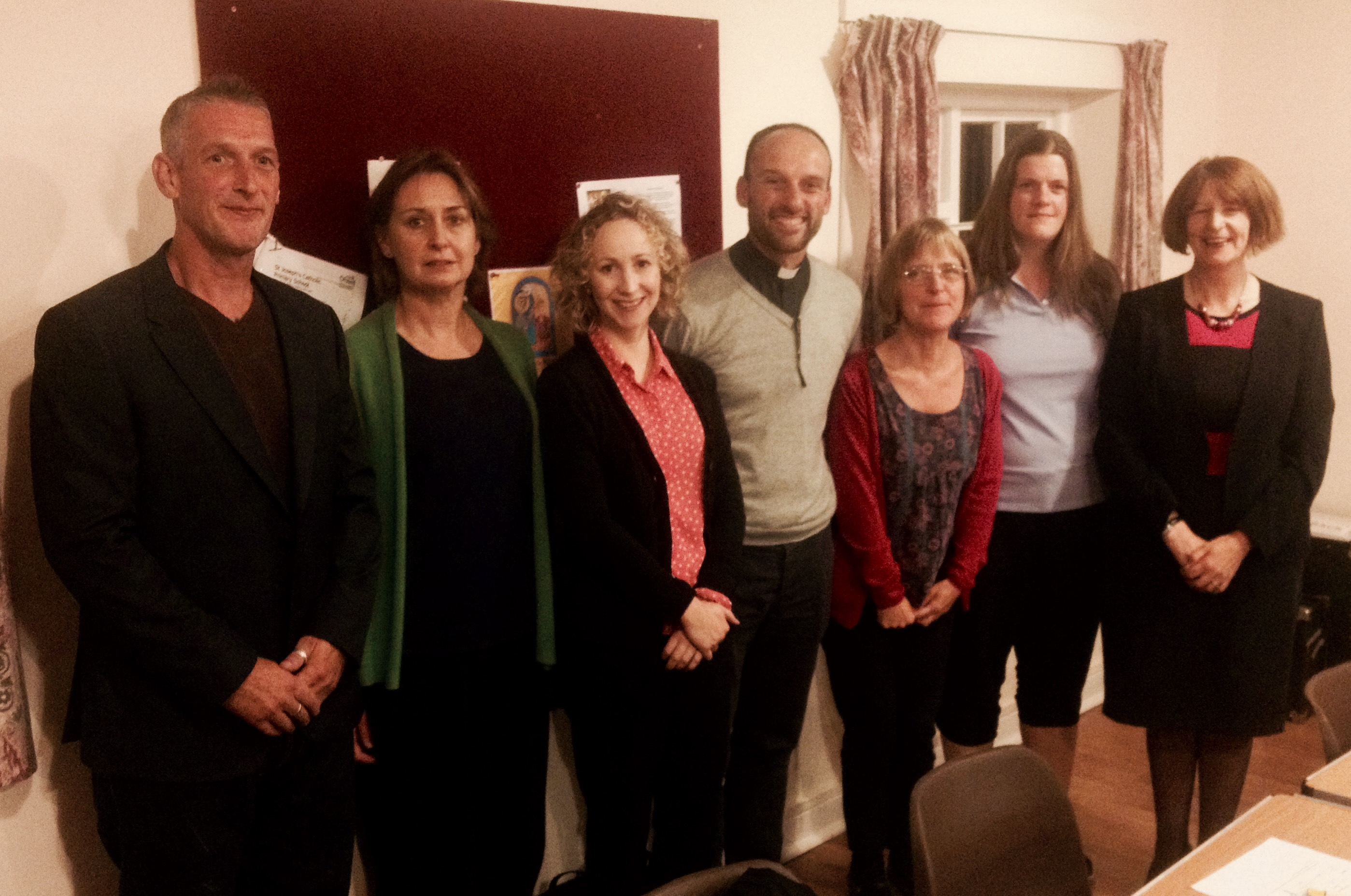
Here below is a photo of the panel after Norman dashed off to catch his train, showing (left to right): Charlie Pearce (reformed drug addict now supporting addicts), Judith Bunting, Dr Bryony Farrant, Rev. Paul Cowan, Dr Meg Thomas, Georgina Hughes and Denise Gaines.
* Paul Walter is a Liberal Democrat activist and member of the Liberal Democrat Voice team. He blogs at Liberal Burblings.
 Follow @libdemvoice.org on Bluesky
 Like us on Facebook
 Subscribe to our feed
 Sign-up for our daily email digest

 "Private affluece and public squalor" rule OK
 Jago Hazzard on the planned West London Orbital rail service
 A brilliant maiden speech from Dave McCobb
 Labour to shun pacts with Greens
 Steve Trevethan
 Kevin Hawkins
 Ellyott
 Nonconformistradical
 David Raw
15 Comments
“That the only purpose for which power can be rightfully exercised over any member of a civilized community, against his will, is to prevent harm to others. His own good, either physical or moral, is not a sufficient warrant. He cannot rightfully be compelled to do or forbear because it will be better for him to do so, because it will make him happier, because, in the opinion of others, to do so would be wise, or even right… The only part of the conduct of anyone, for which he is amenable to society, is that which concerns others. In the part which merely concerns himself, his independence is, of right, absolute. Over himself, over his own body and mind, the individual is sovereign.”
Mill, of course
Completely agree with Norman Lamb here. I understand why some people are twitchy about it, but the war on drugs has been a dismal failure and you could target the money saved by ending it at people who need the help,
Point one; the legalisation of cannabis for medical use……. why should any liberal continue that sentence beyond the word cannabis?
It certainly is….
Yet another example of jumping when the USA (in this case the late President Richard Nixon) clicks its finger. The ‘War on Drugs’ was doomed to failure from the start. What was wrong with the system of ‘registered addicts’ we had before the Act was passed in 1971 which has got us where we are today?
Let’s have a Royal Commission on the use/abuse of drugs – and I include alcohol and nicotine as well as heroin, cocaine, cannabis etc. and let’s explore all the evidence with an open mind. Decriminalising the possession of various dodgy substances for personal use, would at least remove many people from our prisons and would not lead to a massive expansion in drug use. I am one of those people who believe in the concept of an addictive personality (fortunately my ‘addiction’ is restricted to cup of strong real coffee in the morning and a glass of wine or some real ale in the evening). Unfortunately there is a significant minority of people who need a stronger prop to get through life and they are the one’s whose reliance on substances that, taken in excess invariably lead to personal danger, who need our help and certainly not a criminal record if possession is their only ‘crime’.
If the liberal party of Canada win next months federal election they have promised to legalise cannabis. The NDP just want to decrimalise cannabis but the liberals want full legalisation with taxation and proper regulation.
The Canadian liberal party got smashed at the last federal election and came 3rd but this time I’m hopefully they can win it.
The US marginal state of Ohio is having a referendum on cannabis legalisation this November. If it passes it will become the fifth US state to legalise, regulate and tax cannabis for personal use by a majority vote in a referendum. No U.S. state has ever done this via its legislature as politicians are always behind the general public.
In 2016 I expect to see at least 5 U.S. States including the largest California have referendums on cannabis legalisation. I expect every pro legalisation referendum in New England and the west coast of America to pass.
In the UK CISTA has promised to stand in the Scottish, Welsh and London elections, with good publicity and election broadcasts I believe they will get around 2% of the list votes in some regions and hopefully beat the lib dems in at least one Scottish region. The Irish Republic is also having a wholesale review of its drug laws.
I applaud Normans comments but don’t trust the lib dems not to flip flop on this. I hope to be proven wrong, the party has to stand for something, if not personal freedoms then what?
Didn’t Norman call for cannabis to be legalised during the leadership election campaign? Sounds like back peddling to me, cannabis should be fully legal for any adult who wants to use it just like tobacco is. Is it just me or has he just backed down on legalising cannabis already? The leadership election was only a couple of months ago.
In response to David Wallace, no backsliding at all. I made very clear last night I support the legalisation of cannabis. I simply said that we should get on with legalisation for medical use straight away. There is a UN Treaty which prevents States legalising generally. We have to argue the case for that to be changed! But I want the Lib Dems to campaign for legalisation!
Be careful how you use the verb ‘legalise’. I got pilloried in our local press when I mentioned drugs in the context of alcohol and nicotine, especially the former’s contribution to scenes of antisocial behaviour. What I was saying was that the effect of high consumption of both perfectly legal ‘drugs’ was equally as harmful as the use of substances the possession of which was considered a criminal offence and what I was asking for was a Royal Commission, as I still do. What the press reported was that I was in favour of legalising ALL drugs. However, I received over 50 emails of support from all over the UK, as well as further afield. I didn’t realise that so many people read The Lincolnshire Echo! I hadn’t got the heart to tell them that I was not advocating a drugs free for all, especially the old local gentleman who told me he used cannabis as the only relief he could get for his arthritis.
Colleagues seem to be concentrating on cannabis, which is, in my opinion, obscuring the real problem, especially as cannabis in its mild form is not really a health issue, except for the fact that you are usually inhaling smoke, for which your lungs weren’t designed, as a way to get it into your system. It’s the really nasty stuff we have to get a handle on and, clearly, following Tricky Dickie’s approach needs an urgent rethink.
@Norman Lamb. Thanks for taking the time to respond to my comment. It is encouraging to know that liberal democrat MPs actually read the comments of party members and those, like myself, who are not members but still take an interest in the party.
I have campaigned for cannabis legalisation for the last 15 years. Cannabis legalisation was both the reason I joined and the reason I left the liberal democrats. The party first voted for a royal commission on cannabis (which incidentally is exactly the same as CISTA’s policy) around 15 years ago and since then this position has consistently been undermined by its own MPs.
If I believed that the liberal democrats would campaign for cannabis legalisation and actually mean it I would vote for them again and even rejoin, but I simply don’t believe the party can be relied upon to do this until the argument is essentially won and it is a risk free political position (I.e after other campaigners have done the heavy lifting).
You mentioned the UN treaty with its obligations on member states, that will effectively collapse soon. Your liberal comrades in Canada have already pledged to legalise. Some U.S. States are already in breach of the treaty and the federal government in America is going to be forced to change the national law and effectively put the entire USA in breach of its obligations too.
The Americans will have to legalise at federal level as a huge industry is now growing up in places like Colorado and that industry is a cash only industry as federal law prevents the legal cannabis industry getting access to the banking system, this will not be able to continue. Also the referendum in Ohio is different, admittedly is being badly handled at the moment, but the difference is that this time it’s not being funded by activists. The 20 million dollars which got the campaign the signatures it needed for the ballot and is being used to buy the TV advertising was supplied by ten companies who seek to profit from the Ohio constitutional amendment. They have also bought the grow sites, have signed pledges with trade unions to allow the cannabis farm workers to unionise, and promise to give loans to business people who want to open cannabis shops since banks won’t be able to do it due to the federal law. A whole different force is now being unleashed and with companies funding political campaigns, tax revenues being raised and legal jobs being created it’s not going back in the bottle now.
My concern would be to adopt a laissez faire attitude to cannabis. Yes, the current policy is clearly in need of reform but the devil is in the detail when it comes to drug policy. What is the lib dem attitude towards cannabis and driving? Or even ensuring that parents with a cannabis habit don’t allow their children to take it up either. Right now the party line, though researched, is also “fragile” IMHO.
Nice to hear Norman speaking up about reforming the UN treaties, there is going to have to be some heavy leaning on this government if the UK is going to have a remotely useful voice at UNGASS (UN General Assembly Special Session on drugs) when it rolls around next year. So far I think the only thing the UK will stick its neck out for is supporting needle exchanges (which even Thatcher figured out were a good idea) and condemning the death penalty for drug sentences (despite some very morally dubious overseas anti-narcotics operations).
David I like your optimism about how quickly the UN conventions will come crashing down, but with Russia and SE Asia pulling the other way, I really don’t think it’ll happen too soon, and while they are still in place, the UK govt still has an excuse not to act. Maybe I’m wrong, and when (well, technically if) California regulates cannabis it will be the domino that starts the chain reaction through the rest of North and South America, and then the treaties will look farcical, but unfortunately that won’t happen before UNGASS, which means there will be a few more years to wait before we see significant results here. What will hopefully have more effect on UK drug policy are the sounds coming from Ireland at the moment, where decriminalisation is finally being suggested seriously. After all, if the UK is going to copy the worst of Ireland’s drug policy with its own NPS bill, hopefully it’ll copy its best too…
@Henry. We’re only about 10 years away from full legalisation now, it’s been a long and trying battle and I look forward to the day it is finally won in this country. UNGASS was supposed to be in 2018 but some how it was moved forward to just before a string of referendums in the USA.
You’re right though, UNGASS will basically be most of the northern and southern American countries and some European countries pulling one way and Russia, China and South East Asia pulling the other. With the UK and some others dithering.
But change is happening in the Americas regardless and the UK will eventually have to decide which side it is on and get off the fence. In the long run there is no chance we will side with countries that shoot people in the head for selling a few kilos of weed.
I am so angry about mainstream political parties doing nothing about this that I’m considering asking CISTA if I can stand in the up coming Scottish elections on the regional list for mid Scotland and Fife. There is no set share of the vote were a list top up seat is guaranteed but 5% of the vote will almost certainly not result in a seat while 6% of the vote almost certainly will.
I don’t believe I could get 6% of the vote but Willie Rennie won the lib dems only seat there with 5.9% of the list vote so I believe me standing could cost him his seat if I could get 1.5% of the vote with 0.5% of that coming from the lib dems. CISTA got 1.5% (ish) of the vote in the places they stood in Northern Ireland because they got an election broadcast there. I think want to cost someone from the lib dems a seat to make the point.
David I think you’re more or less right on that timescale, although I’d prefer the UK to be one of the more progressive countries in Europe when legalisation does roll around, rather than one of the last, dragging its feet. As the country with the highest usage rates of several drugs in Europe, it is crazy that more general decriminalisation policies are not being considered. The irony with UNGASS being brought forward is that it was the South American countries that urged for a review of the treaties sooner than was initially scheduled, as they are so desperate for change, yet in doing so, it places UNGASS just the wrong side of all these huge votes in California et al., which would otherwise have provided much stronger evidence of the need for treaty change.
Regarding CISTA as opposed to larger parties, I guess I don’t really see the point in taking votes away from the one party (well, two if you include the Greens) that is prepared to make a stand for drug policy reform in parliament, and consequently weakening their voice. Lib Dem action may not have been as strong as you might have liked on the issue, but I guess that’s the compromise that is made for the fact that for most people, drug policy reform is way down on their list of priorities. Despite this, though, there have been repeated calls from Lib Dems throughout the years for reform, with Norman being the most outspoken MP on this issue for years (although Caroline Lucas has done a pretty good job too).
Great to see Norman fighting for freedoms that other MPs are scared to discuss. Agree with everything he said, just hope others will take note.