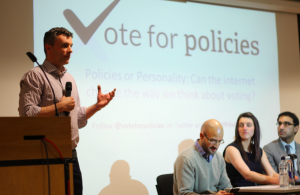
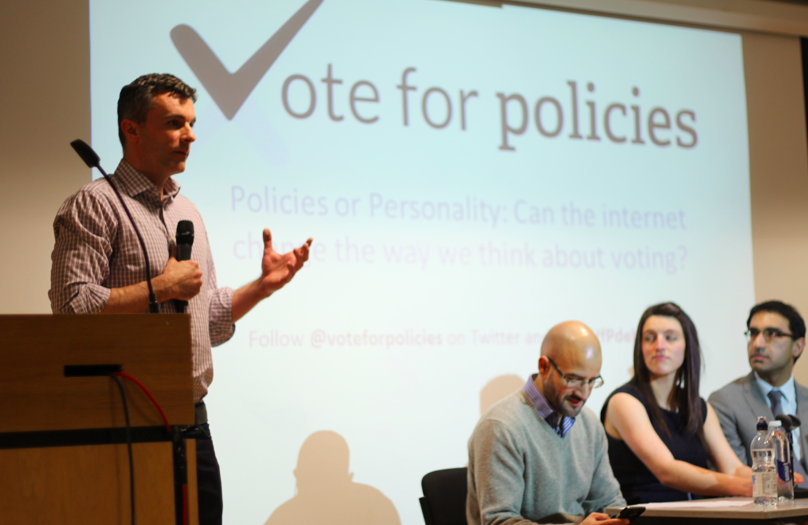
 Last night, I found myself in the strange position of introducing a panel of speakers at Birkbeck, including John Curtice and Dr Rosie Campbell, to discuss whether the internet can have an impact on our voting habits. I say strange because just 5 years ago, I had no real interest in politics. I suppose I was like most people, engaged a little around election time but otherwise never really bothered by what went on in Westminster.
But yesterday, the organisation I set up during the 2010 election, Vote for Policies, organised this debate in partnership with The Birkbeck Institute for Social Research, as we released some really interesting data from our users: 50% of people polled on the Vote for Policies website say they are likely to vote for a different party as a result of using the site. A further 63% say they are surprised to discover which party’s policies they support. You can read a full report of the debate here.
Vote for Policies allows users to compare policies on topics like education or the economy, without knowing which party they belong to. 166,000 surveys have been completed since its soft launch on February 19th 2015. 1,111 users completed the poll on which our findings are based.
I set it up because before the last election I came to the frightening realisation that I simply didn’t understand the differences between the parties’ policies, which led me to read all of the manifestos in detail. For the first time, I felt informed and ready to vote – but most people don’t have time to trawl through manifestos, so I wanted to make this process easier for everyone else. You can take the survey here.


 Follow @libdemvoice.org on Bluesky
 Like us on Facebook
 Subscribe to our feed
 Sign-up for our daily email digest

 The Joy of Six 1593
 Do shouty politicians gain long term votes?
 Farage let off Reform staffer accused of racist slur
 Rose Runswick
  Tristan Ward
  Katharine Pindar
  tom arms
  Andy Daer