


So, a new era dawns! Not only with an unusual election result, but with a Queen’s speech unusually peppered with political slogans and dumping blame on predecessors. Since this is the only transport we have into the immediate future, we must hope that it is not too uncomfortable a ride.
And yes! It is a new era, isn’t it? All party leaders have promised us an end to the hypocrisy, dishonesty, and dishonourable practices which sullied the reputations of our Members of Parliament latterly. One of the three main planks driving the coalition programme is fairness. Well, we shall see. It is very early days yet to test this aspiration, but perhaps there is some little straw in the wind of the aforementioned speech.
Ah now, what about this one? It is proposed to make the electoral system fairer. Constituencies are to be rearranged, and the suspicion might be, as hinted at in the press, to remove the bias in favour of Labour. In any fair system the number of votes needed per seat will be as near equal as possible,** [Well, for the first two parties anyway].
What is the nature of this bias? In 2005 the Labour party required, 26,800.8 votes per seat gained, whereas the Conservatives required 44,400.3 votes for each seat gained. Ergo, the system is biased in favour of Labour. Obvious, isn’t it?
Well no; by the same logic, my cat has four legs, therefore those four-legged mammals mooing and grazing in the field outside my window are cats.
In 1983 the Conservatives needed 32,300.3 votes per seat, Labour 46,400.4, therefore is the system at the same time also biased against Labour in favour of the Conservatives? Or did the bias suddenly shift the day that Blair won the election? I saw no mass migration of voters to different constituencies reported in the press, but perhaps I missed it.
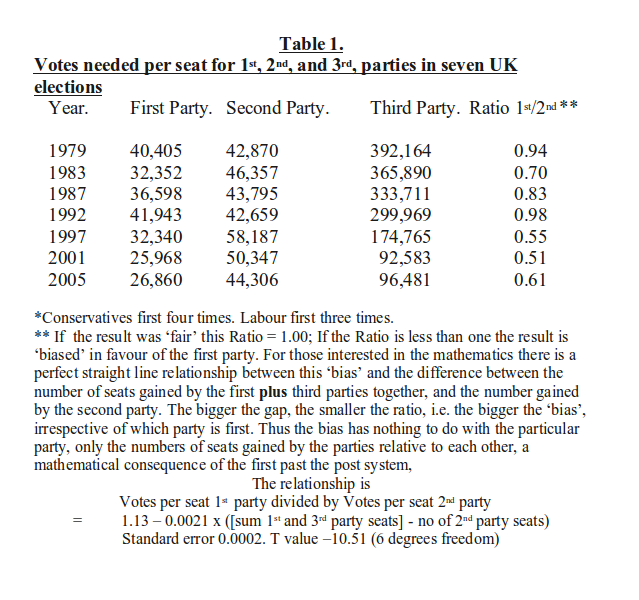
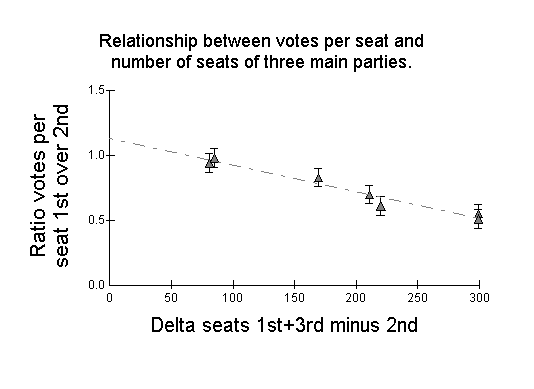
Should you care to examine the table below, which gives the votes needed per seat for first, second, and third, parties in the seven previous elections, and the derived graph, you will observe that the bias has nothing to do with party, it has all to do with the mathematics of who is first or second in a first-past-the-post system.*
As for coming third, no wonder the Lib Dems feel discriminated against!
In fact, there was another remarkable, but un-remarked upon, result in the recent election, namely, THERE WAS NO SIGNIFICANT APPARENT BIAS FOR OR AGAINST either of the first two parties. The Labour party required 33,300.3, the Conservatives 34,900.9, votes per seat, which is about as near to equality as our system has ever produced, only 1992 being closer.
Had just 245 voters changed their allegiance in the appropriate marginal seats the figures would have been identical. Thus the figures are identical within a shift of about one vote per 106,000, an average of under half a vote per constituency. So, what the politicians might be saying is ‘Oh dear, we need to create a bias so more of our friends can share the spoils of power’.
As for press reports that the aim is to make seat size and structure more identical ‘to produce a fairer system’, the very opposite is true with the first-past-the-post system. The only reason the present system produces anything approaching a fair division of seats is that it is VERY heterogeneous between seats, which vary a great deal in size, social composition, rural or industrial nature, and so on.
Were every seat a microcosm of the nation in size and social composition, i.e. voting patterns were repeated similarly in each seat, then the party with marginally the most votes would obtain nearly all the seats. At its extreme, if voting patterns were exactly identical in every seat, one party with 650 more votes than the next would gain all the seats.
If the intention in the proposed changes were to transfer votes randomly between constituencies this would only marginally reduce between-seat heterogeneity; if however, as hinted at in press reports, the aim is to make a conscious attempt to ‘balance’ seats by e.g. attaching rural areas to predominantly industrial seats, then seats will become more similar and bias will be increased.
Likewise, having fewer seats, by increasing the number of votes per sample [= seat] and reducing the number of samples, will produce greater bias. This is a direct mathematical consequence of the system. Fortunately, making all seats similar is impossible to achieve without mass population transfers. However, any changes of the type proposed will be detrimental to the Lib Dems.
So, Liberals beware! Unless you win the referendum, by cooperating in the equalising of seats, you are cooperating in greatly increasing the likelihood of your electoral elimination. Rather like a condemned man oiling the gallows mechanism. Or turkeys voting for Christmas.
Dr Lee is an academic researcher
 Follow @libdemvoice.org on Bluesky
 Like us on Facebook
 Subscribe to our feed
 Sign-up for our daily email digest

 The Joy of Six 1590
 What is Christian nationalism?
 Latest PollBase is out, with all the British voting intention polls since the 1930s
 Peter Wrigley
 Cassie
 Katharine Pindar
 Alex B
 Jason Connor
44 Comments
Excellent article!!! LibDems – get your heads out of the sand, wake up and smell the coffee. You’ve argued for a fairer voting system for donkeys years yet now with the best chance in a generation your letting the crypto-tories who seized the party leadership to slash your own wrists!
Interesting, but it’s funny how it’s often made out to be just the Conservatives who want the number of MPs reduced and constituencies redrawn.
Not sure if I’m missing something here. Aren’t the redrawn boundaries to ensure that each constituency is a similar size and therefore making votes count the same from a person in one constituency to another? How many votes it takes to elect a single party MP into power is just a property of the electoral system.
I’m sorry, but you’ve totally missed the point.
The argument is not that different parties needed different numbers of votes to win a seat but that seats are different sizes and hence for no good reason some people’s votes are worth more than others. This is gerrymandering (albeit unintentional) of the worst sort. The reason that the Conservatives tend to be the one’s complaining is that the smaller seats are generally in Urban, scottish and welsh areas and the larger seats tend to be in rural, english areas. I.e. Labour seats are generally smaller than Tory seats. Whose complaining has nothing to do with the fact that it is fundamentally wrong and undemocratic though.
As impressive as all your charts are they are, hence, totally useless as they totally fail to address the point in hand.
Liked this post!
The worry for Labour is not only that it’s being done, but the way in which it’s being done- there’s nothing to stop Labour voters in scrapped seats being shifted into safe seats where they’ll vote noislessly and have no effect, while the Tory and Lib Dem areas get attached as well as possible to marginal seats where they’ll make all the difference.
The message *should* be music to Lib Dem ears- FPTP is unfixable, it’s not the constituencies it’s the system.
Surely the unseemly haste in which all this is being rushed through is the problem.
We have a census next year – what would be wrong in waiting for the census data, and then asking the Boundaries Commissions to draw up constituencies based on the data from the census? And to get equal seats based on population (and not registered voters) – after all, MPs represent children and those not registered on the electoral roll, as well as those who are registered to vote.
This analysis somewhat disingenuously implies that constituency boundaries remained unchanged since 1983 as it erroneously attempts to extrapolate boundary effects to draw its conclusions across this entire time period.
I also question whether the cause and effect of the winner requiring fewer votes per MP under FPTP has not been inverted; rather the fewer votes required to get an MP, the easier it is to have more of them and emerge victorious.
@Paul B
It is voters who select who represents them and on whose decisions our democratic system is based; how many individuals a politician covers in largely irrelevant, in a democracy what is important is who they represent and are democratically answerable to.
If you want it based on population I assume you support extending the vote to children, prisoners and non-British citizens?
The mantra from the pro-reform crowd is that they wish to abolish safe seats. It seems to me that if you wish to abolish safe seats, you necessarily wish to make every seat marginal. The logical conclusion of that process is quite rightly, as you describe, bigger majorities on smaller swings.
Unless you either remove the geographic basis of some or all seats, or have more than one representative per seat. Both of which are possible, and both of which are controversial, but neither of which are at issue in the present debate relating to the AV referendum.
Brilliant post.
Remember that “miserable little reform” the Great Leader’s deputy used to complain about? The one that LDV now gets all excited about and the Orange-Bookers defend rigorously every time it’s brought up? Most serious electoral commentators now agree, it will bias the Tories and reduce Labour + Lib Dem chances of success. Why? The gerrymandering attached to the bill. Funny how the orange book brigade refuse to countenance breaking the bill up.
The sad fact is that Cleggy has staked the future of the party on a reform that will more than likely destroy it. Why?
I have already put a monkey on Cleggy leaving the Liberal party and joining the Tories by 2015.
This article rather leaves out a vital piece of information.
2010: 1st party 34980, 2nd party 33370, 3rd party 119944
For the first time in the period under examination, the first party required more votes for each seat than the second party, a result which supporters of FPTP would find incorrect. Of course, the problem lies for the most part with the absurd electoral system itself, but given the absurdity of the system, the unequal constituency sizes do contribute a small part to this result. Sadly achieving a proportional electoral system is beyond the gift of the Liberal Democrats in government or more widely in parliament. The step to AV must be taken this time, if further progress is to come later.
@Paul McKeown.
“The step to AV must be taken this time, if further progress is to come later.”
Based on what logic or evidence, seeing as Cleggy has stated publicly that this will be the one and only referendum on changing the voting system?
And do you include in that the Tory gerrymandering? Or is AV such an important principle for you that you would take any amount of Tory intereference to get it on the statute book?
If it’s the latter, then the party has indeed lost its mind.
Good article. It’s true that the difference in constituency sizes mean that some votes carry greater weight than others. This injustice, however, is massvely dwarfed the fact that under FPTP in single member seats, votes cast for losing candidates don’t count at all. To restore – sorry, make that introduce – democracy in the UK, that is the issue that must be addressed.
Historically, the boundary commission have always been allowed a fair amount of leeway in constituency electoral roll sizes, in order to create geographical entities that make some kind of local sense. As noticed elsewhere, this legislation is going to mean some pretty extraordinary new constituencies (Isle of Wight east and Portsmouth South, anyone?). Apart from that, it will do very little to address the ridiculous disparity that has existed at most recent UK elections between votes cast and seats won.
The fac that some of my fellow Lib Dems have not only been defending this equalisation, but accusing Labour of all manner of things for questioning its wisdom, is a source of great distress to me. Accepting this in return for a referendum on AV was not a compromise, but a craven capitulation.
Paul mcKeown makes the point i wanted to make. It has got harder for the third party to win a seat. That doesn’t relate to equalisation of voters per seat, but is a damning case for electoral reform.
@Cuse
There is no gerrymandering, except that of the Red and Blue Tories in resisting all change to a fairer system with might and main. They will not give up their little cartel until no choice remains to them. It is hardly a secret. There are a few honest parliamentarians and activists within the Red and Blue Tory parties, but they are a minority. Change will come only via arm twisting in hung parliaments, just like this one, and then as little as possible, as slowly as possible, again like now. For all your chuntering, I hear no call for a fair electoral system, just the crowing of a football crowd. Of course, in politics, as in life, he who laughs last, will laugh longest. And time is on the side of fairness.
Your cries of “gerrymander” are merely those of the thief finally brought to trial. For all his pleas of, “it’s not fair,” no one is listening. The Red Tory party has a built in advantage at the moment of between 50 and 80 seats over the Blue Tory party. Whilst we are stuck with the electoral system favoured by the majoritarian cartel, we might as well have constituencies that favour the Red Tories rather less than they currently do.
I think we have heard enough humbug from you and your Red Tory chums.
@Paul Ankers
It has got harder for the third party to win a seat. That doesn’t relate to equalisation of voters per seat, but is a damning case for electoral reform.
Is it a damning case for AV with attached gerrymandering?
@Hove
Your post lacks much logic. All that is proven is that Labour has a large built in advantage beyond the Conservatives. The table given is dishonest, in that it leaves out the figures for the 2010 General Election. Whilst we are stuck with FPTP, the balance between the two largest parties should be maintained. As it is, Labour wins huge majorities on small favourable electoral balances, whilst the Conservatives can’t win a majority at all on similar electoral balances in their favour.
You have been fooled by Labour’s propaganda.
Of course, the electoral system disadvantages third and fourth parties. For that reason we should change it.
However, whilst a majoritarian system remains in place, balanced must be maintained between the two cartel parties.
Can I ask why you didn’t expand your figures to 2010?
First Party Second Party Third Party
34940 33370 119944
What you are saying is simply wrong, it does matter which party is which as well as the tendency for FPTP to accentuate results. Go to a online result predictor and swap the Conservative and Labour votes from the last election, it will do a uniform swing prediction and give a substantial Labour majority.
Alternatively think of it this way: in 2005 a 2 point lead gave Labour an overall majority, in 2010 (for better or worse) a 7 point lead for the Conservatives gave a hung parliament.
This post may seem a bit similar to mine of a few weeks ago, in which I argued that the new “national grid” boundaries will create ever-changing constituencies, destroy the effective lipong-term link between an MP and his/her constituents, and seriously hurt the Lib Dems because of the loss of the incumbency benefit:
https://www.libdemvoice.org/opinion-unnatural-constituency-boundaries-the-hidden-menace-20731.html
However, it isn’t really very similar, and I largely don’t buy the arguments now being put forward.
Our system is of course grossly unfair to the third party. It is of course galling to see the Tories tackle a small pro-Labour bias while not doing much to remove the anti-third party bias. To that extent I agree with the poster. However, whilst this (rather obvious) part of his argument does make sense, I don’t think very much else does.
Yes, the winner tends to win by a bigger margin in seats than would have been allocated under pure PR, but how important is that, really? The winner has still won. It is (normally) still the same winner. All that is being quibbled about is the detailed size of the governing majority. The effect is quite a natural one. The winner has won a lot of marginals with narrow majorities, so he has got “good value” in terms of the number of seats he has won, but in general terms, he has beaten the second party fair and square.
The Tories are not wrong to feel that a systematic bias in favour of Labour as compared to themselves is a rather more important thing. I don’t like what they propose to do about it, I think it will go pear-shaped for largely technical reasons, but, I don’t dispute that it is reasonable for them to want to eliminate a source of bias.
“The Labour party required 33,300.3, the Conservatives 34,900.9, votes per seat” says Dr Lee. Love the spurious accuracy of the last decimal place! But there is something of a juggling act going on here with these figures. What they conceal is that this time for once, the second party (Labour) actually got the better deal. And, that what looks like a tiny margin in votes is in fact about five per cent, which roughly means that Labour will have won five percent more seats that they would have done on equal votes per seat. That’s about 15 seats. This wasn’t a big enough bias to overturn the overall result, but it sure ain’t as trivial a thing as Dr Lee is trying to make it sound. After all, if the Tories had picked up those extra 15 setas that the system denied them, they wouldn’t have needed a coalition.
Dr Lee doesn’t tell us which party he votes for, but I think we can guess. Labour should not be trying to cling on to a system that contains an inbuilt bias towards them. Sadly, we’re giving them a chance to do so, by trying to change the system in a way that won’t work properly.
If I’m wearing my anorack the right way round AV would have delivered all of about 20 more seats to the Lib Dems
based on 2010 results. AV virually kills off forever any prospect of smaller parties like the Greens and thus reduces the pluralityy of poltical opinion in Parliament. Far from being a small step in the right direction AV is the only step likely to happen for the foreseeable future in the wrong direction,Desribing it as a miserable little reform was the truest thing the DPM has said since he got the job. Good article from Lee.
I agree with @David Allen and @John C, and they put their points well, so no need to repeat them.
One thing that’s often forgotten is that, even after the proposed changes, first past the post will still give Labour a substantial advantage.
The main reason why it tends to take fewer votes to elect a Labour MP than a Tory one, is because Labour voting areas tend to have lower turnouts. So, even if an inner city Labour-voting constituency has a similar number of voters to an affluent seat in the suburbs, if the turnout is lower, it will take fewer voters to elect the Labour MP.
@Ray Cobbett
The flaw in your argument is in the words “based on 2010 results”.
AV will remove the need for tactical voting. No one knows how people will vote if AV is introduced, but it’s likely that more people will vote for the Greens and other minor parties, because they’ll no longer need to worry about wasted votes.
This post is in error. The winner under FPTP tends to get an advantage, but Labour also gets and advantage. Thus when Labour is ahead they get a double advantage, while when the Tories are ahead they only get a single advantage.
To summarise this piece: “Because I can prove that FPTP is flawed, there is no constituency advantage for Labour.” I don’t think J Lee should be making smart arse comments about logical errors involving four legged mammals given the flaws in this article.
A cursory glance at the data reveals that Labour wins with a ratio in the 0.5 to 0.6 range, while the Conservatives’ range 0.70 to 0.98 (1.04 if you include 2010). These ranges have no overlap – they are clear, distinct groupings. In other words, there is strong evidence of additional factors above and beyond the demonstrable bias of FPTP.
And yet Dr Lee manages to come the opposite conclusion – what did the good doctor study, surrealist art? That would at least explain decimal points on statistics rounded off to the hundreds.
There is an attempt to draw a statistical correlation from only seven data points. This is bad maths. But if you insist, “for those interested in the mathematics”, you can derive almost exactly the same straight line relationship by ignoring the third party altogether, making it a function of the straightforward majority (1st party seats minus 2nd party seats):
“Fairness ratio” = 1.11 – 0.0023 x majority
(see this graph )
Why include the 3rd party? Just to build up to the hysterical conclusion?
In fact, probably the most embarrassing thing about this piece is that the Lib Dem Voice agreed to post it. Some quality standards wouldn’t go amiss. Surely before accepting a piece there should at least be a real name to go with it, and if we are to include professional qualifications then some indication of what the alleged “academic research” consists of? Because I truly hope the peer review process doesn’t accept this kind of nonsense.
Looks like there was a typo in there – that’s supposed to be a short link to a graph with the alternative correlation. Is there any way to edit comments?
@ Nick – “Not sure if I’m missing something here. Aren’t the redrawn boundaries to ensure that each constituency is a similar size and therefore making votes count the same from a person in one constituency to another? How many votes it takes to elect a single party MP into power is just a property of the electoral system.”
Agreed.
The point, I think, is that you can’t fix FPTP by changing boundaries and the bias in favour of the leading party is generally greater than that for Labour. The Tories won’t countenance changing the electoral system in order to get rid of the greater bias, Labour is more likely to. If you don’t needlessly antagonise them.
And Paul McKeown, Red Tory is already an established thing, it’s stupid to try and apply it to Labour because it already means something quite different.
It’s staggering that Clegg allowed the boundary changes to be linked to A.V.
We all know how tokenistic and ineffectual A.V. is, but did Nick really know what he was doing when he signed up to boundary changes which do not have to pass any referendum like A.V. does ?
I’m afraid it was one part of the coalition agreement in which the Tories sold Nick a pup, and it was the one part which really matters. Pretending electoral reform is some minor matter fools no-one.
Even if the A.V. referendum is won the Liberal Democrats lose and if A.V. doesn’t go through then the loss is incalculable since there will be no referendum on A.V. or P.R. for a decade or more as well as the boundary change skewing things against the Liberal Democrats electorally.
The Coalition is all pain and no gain and the pain is going to intensify sharply with no prospect of any gain whatsoever.
Ministerial salaries and makework jobs in the Government are no substitute for ditching everything the Liberal Democrats ever believed in. Something has to change at the top of the Party to stop all the appalling strategic blunders, and it must change soon.
Jon: I’ve corrected your broken link.
Editorial note: a quick reminder about keeping comments on topic in line with our moderation policy at https://www.libdemvoice.org/the-liberal-democrat-voice-team, which also explains how if someone repeatedly breaches our moderation policy we’ll put them on auto-moderation so their comments need to be manually approved before appearing on the site.
George Kendall states
“The main reason why it tends to take fewer votes to elect a Labour MP than a Tory one, is because Labour voting areas tend to have lower turnouts. So, even if an inner city Labour-voting constituency has a similar number of voters to an affluent seat in the suburbs, if the turnout is lower, it will take fewer voters to elect the Labour MP.”
He is absolutely right. The turnout in safe Tory seats at the last election was approx 10 percentage points higher than in safe Labour seats. That makes a big difference but it’s hardly ever mentioned in discussions about this.
The article sensibly point out that the distorting effect of winner-takes all single-member constituencies is hugely more than any other distorting effect. The Tory argument about constitueny boundaries is pathetic compared to that – AND WE SHOULD BE SAYING SO! Just because we are in coalition with them doesn’t stop that being so.
It’s all part of being honest and sticking to our principles while accepting the coalition as what the voters forced us into. We don’t have to pretend that AV is suddenly a hugely wonderful reform, we can admit it’s as much as we could get out of the Tories, ok as an improvement but not the big imrpovemnt true STV would be.
The article tries to sensibly analyse how FPTP distorts and that is good. Much of the argument against electoral refrom is illogical and innumerate – I find it hard to see how supposedly intelligent people could embarrass themselves with it, but they get away with it, in part because we are a country which thinks being innumerate is something to boast about. We’re not quite like the USA where it seems to be a distinct electoral advantage to be extremely thick, but we’re getting there.
People who defend FPTP on the grounds it gives single party majorities should be prepared to consider in a little more detail how and why it does that. J.Lee is right to note the reductio ad absurdum case where if the country were completely homogenous, every seat would elect an MP of the same party. As it happens, distortions caused by FPTP in Africa where we left them with that system often HAVE resulted in Parliaments being almost single party, this then led to a slide into dictatorship. Funny how the FPTPers are happy to talk about Italy, but not about Ghana, Zimbabwe etc.
If you want to talk about dumb commentary on electoral reform suggesting FPTP is to blame for Zimbabwe’s slide into dictatorship is about as dumb as its possible to get.
I humbly suggest to you that this may have more to do with massive fraud, intimidation, violence against and murder of political opponents, and not actually due to a lack of the Single transferable vote.
I can just see the poster now. Vote yes on AV or we’ll become a dictatorship, murder of political opponents will begin, the economy will be ruined by idiots taking over all economic enterprises, hyperinflation will ensue and the standard of living will totally collapse.
Well, if people aren’t convinced by that I don’t know what they will be.
@Paul McKeown
I find your willingness to shore up the FPTP system baffling.
Labour winning a majority on 36 percent was wrong. It would also have been wrong for the Tories to have won outright on 37 percent. You seem to want to hand that to them on a plate. Why?
I am quite aware that much of Labour’s opposition to equalisation is based on self-interest. But everyone’s prone to a bit of that, let’s be honest. It is a fact that this legislation will mark a fundamental change in the way our parliamentary boundaries are drawn, and it is not surprising – as HM Opposition – that they would want to seize on that.
@Hove
Who said I wanted to shore up FPTP? You said it not me?
Look, the plain fact is, neither Labour nor Conservatives are going to shift from a majoritarian system unless forced. The Liberal Democrats and fourth parties do not have sufficient seats in parliament to make that happen.
The best majoritarian system we can hope for is AV. We have a referendum on that, sadly it looks difficult to win.
In the absence of change to a genuinely fair electoral system, the current one should at least reflect the balance between the two major parties more accurately than it does, otherwise we might as well just award Labour permanent control of central government. They wouldn’t object.
I would agree with those who have commented that this article is bunkum. It is worse than that, though, it is baseless propaganda, doublespeak.
@Paul M “The best majoritarian system we can hope for is AV. We have a referendum on that, sadly it looks difficult to win”
I dont buy into the believe that the referundum wll be difficult to win. That would mean the great British Public is happy to be governed by huge majorities (Labour or Tory) in the House of Commons based on a minority vote (usually between 30 and 40 percent
This is not what I am picking up on the street.
The public now by and large accept that we need a fairer system by which we elect our MPs. They are less concerned about the size of constituencies so long as they have an MP who works for their constituency
So long as Liberal Democrats mount a good campaign and persuade the public that under AV their vote will count more than under FPTP the majority will vote Yes
Paul McKeown wrote:
“In the absence of change to a genuinely fair electoral system, the current one should at least reflect the balance between the two major parties more accurately than it does, otherwise we might as well just award Labour permanent control of central government. They wouldn’t object.”
Erm, Labour just lost the election, despite the bias. You clearly have a visceral dislike of Labour. I think you are letting it cloud your judgement. A significant number of Labour members and MPs are willing to support electoral reform, even though the system currently suits them. Give some credit where it’s due.
Shoring up FPTP is precisely what you are doing, just read your last post again. You say Labour and the Tories won’t change ‘unless forced’. Ok then, let’s force them. How? For a start, by not entering five year dance-of-death coalitions with either one of them unless some real reform is guaranteed.
Stephen W: No-one thinks that FPTP was the only thing responsible for Zimbabwe’s slide into dictatorship, or that the same would happen in the UK. The point is that FPTP in Zimbabwe allowed the dominant party to gain practically all the seats in parliament, thus creating a situation where ZANU-PF could do exactly what it liked in government with virtually no opposition. When a credible opposition did emerge, the single-party system had already given ZANU-PF a sense of entitlement to govern in perpetuity, and the ability to change the rules so that it could do so without any opposition.
South Africa is an example of how the use of proportional representation has almost certainly prevented the establisment of a single-party system. The ANC polled 65.9% of the vote in last year’s parliamentary election, and would most likely have won practically all the seats if the election had been held under FPTP. But the use of PR has allowed a genuine opposition force to emerge very early in post-apartheid South Africa, holding the ANC in check. I have no doubt that some in the ruling party would like to create a one-party state (look at the recent press censorhip law), but the size of the opposition means that they can’t just railroad through changes in the constitution. In other words, thanks to proportional representation, South Africa has a dominant-party system rather than a single-party system.
Stephen W
If you want to talk about dumb commentary on electoral reform suggesting FPTP is to blame for Zimbabwe’s slide into dictatorship is about as dumb as its possible to get
Well, there may be plenty of other factors in Italy, but that doesn’t stop the FPTPers blaming that country’s problems on the PR system it used after experiencing the strong government it had between the wars.
I have actually looked into this and feel the distorting effect of FPTP has been damaging in cutting off Africa’s experiments in democracy. Try looking for example at Ghana’s first election – what ought to have been a stable two-ish party system CPP v UGCC turned into CPP winning almost everything, that idiot Nkrumah given the impression all his country adored him so the confidence to go to formal one-party state, and Danquah, who would have been a far better leader dying in prison.
Idiots and fools. That’s what Clegg thinks of us, and the deal on electoral reform, when the AV vote is lost, will highlight how we have been made to look so ridiculous.
labour lost the election – so did the others. I did not vote for the co-ilition. I think that the swinging spending cuts – which will decimate the north of england in particular, will make the av vote a protest vote and therefore a no vote. The gerrymandering link will then fall. The liberals, unfortunately, look and sound like rabid tories. How did the party squander the opportunity they had, and for what? The people who are going to pay for this are the vulnerable – As someone has said, Clegg et al are tories and will split the party.
It looks likely that AV will be defeated in the referendum. If they play their cards right it seems probable that Labour will get a majority at the next (and I hope early) General Election. Who needs electoral reform? The truth is that a Coaliton with the Tories was never likely to deliver electoral reform. Lib Dems will have to live with the failure of Coalition with the Tories. It was all rather predictable.
The article is utter tripe from begining to end.
All the figures about “votes needed per seat” are bogus. They are the average vote cast per seat won – nothing to do with the votes NEEDED per seat. Obviously, none of the votes were needed in seats that were lost and none of the votes above a majority of 1 were needed in seats that were won.
Neither is the bias against a “Third party” as the Lib Dems in Scotland regualrly get less votes but win more seats than both the SNP and the Conservative party. It is about the concentration of votes.
The reality is that in many places MPs are elecetd with between 10,000 – 15,000 votes while millions of votes are cast for other parties and elect few or no MPs.
At every election seats change hands NOT because of anyone changing their vote but due to boundry changes switching voters between constituencies.
It is an absurd system and should have been scrapped years ago.
There is a a simple principle, no taxation without representation.
Sooner or later a change is gonna come