


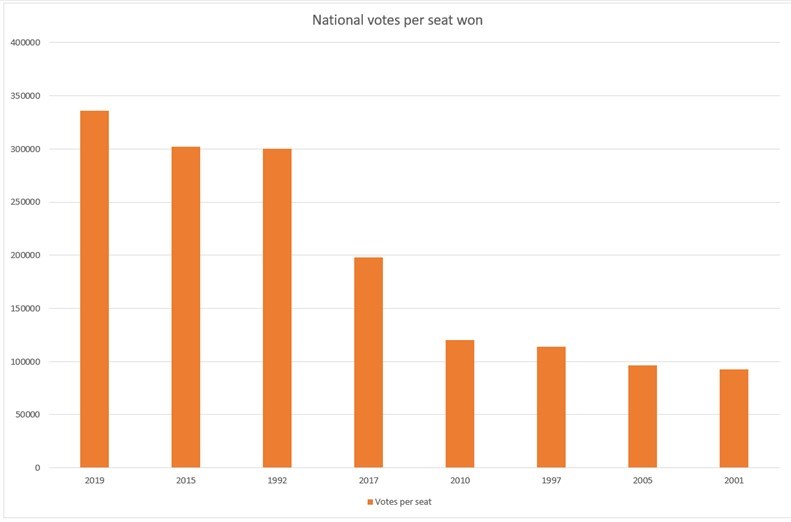
If the objective of a general election is to win the most Commons’ seats we can (which I assume it is), then 2019 was the least efficient general election in the party’s history.
That is, if you define efficiency as garnering votes in such a geographical way so that we maximise the number of seats we win. The figures are as follows:

Ranking the votes per seat with the highest number on the right and moving downwards towards the left hand side, my graph looks like this:
Following on from this, I have a number of questions about the process of national party decision-making and its relationship with evidence, before and during the campaign. I believe these questions should be answered in full for party members and are crucial to understanding our defeat and learning its lessons:
- On what evidence did we make the decision to vote in the Commons for an election, in alliance with the SNP? On what evidence did we decide this would be a good idea which would increase our number of seats?
- How many seats did we target? Was it 100 as rumoured?
- On what evidence did we base the targetting of seats?
- On what evidence did we make last minute polling day calls for urgent activist assistance in target seats?
- How much money did we spend on the campaign compared to previous GE campaigns?
- How much money did we spend on the nationally distributed newspapers that arrived at people’s homes with pizza menus and estate agents’ fliers?
- What evidence did we have that such a method as described in point 6, was more effective than spending money in 10-20 high target seats?
As you will possibly conclude from my questions, I happen to believe (admittedly after the event) that the party collectively “drank the Kool-Aid” as the Americans term it. We were basically overcome (albeit corporately as a whole, rather than uniformly amongst members) by a sort of Groupthink, rather like a religious sect, where we thought, based on little evidence but plenty of hope, that we were going to win 100 seats by spending £5 million on the campaign, spaffing money around the country generally and talking ourselves up as party of government.
What I guess we were lacking were people to say “Hang on a minute, in the past we have only moved forward when we concentrate our resources on 10-20 target seats”.
* Paul Walter is a Liberal Democrat activist and member of the Liberal Democrat Voice team. He blogs at Liberal Burblings.
 Follow @libdemvoice.org on Bluesky
 Like us on Facebook
 Subscribe to our feed
 Sign-up for our daily email digest

 Dog owner fined after man bitten on penis
 More ministerial dissent over Labour's immigration policies
 Jane Dodds stands down as Welsh Lib Dem leader
 Peter Davies
 Alex Macfie
 Rob Heale
 Chris Moore
 Adam
Adam
33 Comments
We spaffed the money up the wall. We will not get out of this until those who made the campaign decisions are removed from campaign decision making in the future.
Very good article. The whole thing was a travesty from the moment Vince stood down through the election of a leader from a marginal Scottish seat, to agreeing to call the election, to going for revoke, to promoting our leader as p.m and the conduct of the national vote. If I hear one person in authority say again that we increased our vote I will resign !
As a member since the foundation of this party and its predecessor since 75, a former councillor and parliamentary Candidate, I have seen it all before but I feel very sorry for the 20 activists I encouraged to deliver 5 leaflets in our far flung corner of a rural seat. There must be no excuses, heads must roll and the party must reconsider its raison d’etre. En Marche !
Much of this is unfair. I said on a thread in support of Jo posing “what was the alternative?”
Prolonging the life of a broken parliament so that politicians’ could “stitch up” a “remain” in defiance of the voters? Please note that those politicians have been summarily removed from office, virtually to a man/woman/etc.
The day of reckoning, at the ballot box, would have eventually come and the party may well not have made 11 seats.
The fault line was that the remain side had managed to convince itself that the public mood had shifted, dramatically, to support their view.
As I said, there may have been 500,000 on a Peoples’ Vote march. But that just leaves 66.5 million who weren’t. The truth, demonstrated to anyone’s test was that a) the public were still strongly leave or b) still remain minded but fed up and not prepared to have this national open wound kept open much longer.
My admiration for Swinson was high anyway and her conduct has “saved” the nation from this endless conflict. Her critics are angry because she did not keep the last frail sparks of remain alive for a few weeks longer. No juggling with numbers or graphs can reverse the truth of last Friday morning.
@ Innocent Bystander
We were heading for Brexit as some Labour members were coming round to support the deal. The difference is that it was a Brexit with safeguards, all now removed.
I do not blame Jo, but those who advised, or failed to advise, her. At least half of her campaign should have been run from her constituency, she might then still be a MP.
At several times earlier in the year we could have achieved the softest possible Brexit-the Boles option for instance. The divisions in the country would have been mended, Mrs May would still be leader and the next election fought on climate change and public services.
What about the pledge to provide free childcare? We made great fanfair over how this was our most expensive policy but it feels like it fell pretty flat. Our vote share was more male than female.
There is a fundamental dilemma in any election campaign that arises from the raison d’aitre of any political party. Is the objective of the Liberal Democrats party to borrow Jermy Corbyns words “to win the argument” even if you lose, or is it as Tony Blair advocates for Labour to win power and then set about winning the arguments?
The Libdem vote was always going to get squeezed by Labour, just as the Brexit party was squeezed out by the Conservatives. This is going to happen whoever is the Libdem leader and regardless of the policy platform when the two larger parties appear to be in close contention.
I am not sure the revoke policy ultimately made that much of a difference one way or another to the overall outcome. It did, however, guarantee the loss of leave voting seats and make it much more difficult to muster support within the large bloc of voters wanting a 2nd referendum in the face of the Labour squeeze. This article from Giles Fraser explains why a committed socialist voted conservative https://unherd.com/2019/12/how-i-became-tory-scum/
Going forward we have a Conservative party committed to a Laissez Faire ideology and a Labour party that has been returned to its socialist planning roots. This is how it should be. The Liberal Democrats offer has to be distinctively Liberal rooted in the tradition of advancing fundamental civic and human rights. No amount of tactical maneuvering can overcome a public perception of an extreme or indecisive position before the argument has actually been won.
John Major won against the odds in 1992 with a disappointing 20 Libdem MPs being elected at that time. The Conservative party was in turmoil within months of the election following the Maastricht treaty. At the 1993 Christchurch by-election a Conservative majority of 23,000 was turned into a Liberal Democrat majority of 16,000. The Blair landslide of 1997 was the reaction to those years. Better targetting returned 46 Libdem MPs in 1997 on a decreased share of the vote from 1992.
It was not, however, until 2010 that the Libdem bloc of MPs provided for participation in the coalition government.
This brings us back to the fundamental dilemma. Is the party’s purpose to improve targeting to win a few more seats and have a stronger voice among the opposition benches; or is it to gain power as part of a coalition government with either a socialist Labour party or a Thatcherite Conservative party.
Jo Bourke asks what the ‘purpose’ of the Lib Dems is. According to the late Lord Dennis Healey, the purpose of ‘the Liberals’ was to provide the ideas, which the Conservative and Labour Parties could take on board and call their own. A bit like political advisors, I reckon.
There will be much soul searching in the next few months. As a critical friend of the party, I would rather allow the dust to settle before rushing to judgement. In the meantime, I really hope that we can take that Brexit record off the turn table and start playing a few different ones. After all, when it comes to ideas, the party never disappoints.
Interesting and despite the 6 seats that were lost by less than 1,000 votes in Scotland the LD votes per seat was ~66,000. The fundamental issue is that our support is so evenly distributed unlike the SNP who only needed on average 26,000 to win a seat.
But even if the target list was quickly reduced to say, 50 what does “target” mean? just a few more flyers? or a few more volunteers? even if both it doesn’t matter. What was needed was a better theme and imagery to bring all the policies together instead of the slightly scattergun approach.
Overall there is a real need for a lot of transparency about what market research was commissioned and how it was used. e.g. Were these target seats little more than a wish list or did robust, quantitative evidence show that in say, October when we were at ~22% in polls that there were ~100 target seats that LD could feasibly win?
I suspect the former but lets see what the new President has to say as he is very open about using evidence in how the election was lost.
Additionally, even if there was some evidence of “100 target seats”; the campaign got off to a bad start and the polling share dropped quickly. That needs to be looked at as well.
As John Marriott says ,we come forth with the ideas which are then taken by the big boys and sold as theirs. They have the media to circulate them as theirs. As far as I am concerned we should NOT have bar charts but SELL our policies/ideas and NOT allow the big boys to take the credit. One was Land Value Tax that got advertised in the media by Labour ,we were not mentioned,Tories Lifelong learning. If we do not ‘blow our own trumpet ‘ we have only ourselves to blame.
By marketing our product we can get feed back to see if they are worth it or not Monitoring responses can then guide us. Remember the media is not our friend but we should endeavour to get it on our side.
Seven excellent questions that our newly elected Federal Board and President should ask and keep asking and not stop until they get proper answers and proper change.
Paul gives a few excellent questions and there are of course lots more to ask. I hope our Federal Board and President are ready to consider all questions and all points made. I wait to see how much they are willing to listen. I am disappointed that they are thinking of surveys, because surely some of the most crucial messages are when people put forth their views, not simply answer questions put by those who expect people to conform to their questions.
It’s interesting that Paul Walter mentions “drinking the Koolaid”. I was present at the meeting in the Wokingham Hilton where Phillip Lee was introduced as the new candidate for Wokingham constituency, and Ed Davey mentioned the possibility of up to 200 Lib Dem MPs. I was sorely tempted to ask where the Koolaid dispenser was.
Good article Paul and some great questions (even if some are not neutral). I would add to them:
8. Why were members not told to go to our target seats in week one?
9. Was 24th November when members were first sent a link to our website for them to find their nearest target seat?
10a. Did the party reduce the number of target seats during the campaign?
10b. If so, when and to what number?
10c. If so, when using the party tool to find one’s nearest target seat did those removed from the target list no longer come up?
11a. How many constituencies received nationally distributed leaflets (including newspapers)?
11b. Did each constituency agent after seeing the artwork have a veto on whether these should be delivered?
Perhaps you should ask a member of the Federal Board to answer them or ask James Gurling who I assume from his emails was the General Election Campaign Chair to answer them in an article for LDV (as he has wrote an article for LDV at the start of the general election).
Innocent Bystander,
Neither Parliament nor the House of Commons was broken. I would like to see no party ever having a majority of MPs in the House of Commons. Perhaps then, compromise and not adhering to party discipline would become the norm and it would matter if you had an independently minded MP or just party folder.
Joe Bourke,
I don’t recall our vote being squeezed before 2015. In 1992 when called our opinion poll rating was about 16.5%, result 18.3%; 1997 opinion poll rating when called about 10.5%, result 16.8%; 2001 about 13.5% and 18.3%; 2005 about 20% and 22.7%; and 2010 about 20% and 23.6%.
The party’s purpose is to get as many MPs elected as possible (in this context) so as many of our policies can be enacted to create a society where no one is disadvantaged by poverty, ignorance or conformity; where people have the basics of life including a secure job and a home and where they have liberty and where they are all treated equally.
The questions are well asked.
In defence of Jo Swinson’s decision to trigger an election jointly with the SNP, if we had not done so I believe Mr Johnson would have got his withdrawal agreement through Parliament, without a second referendum getting attached to it.
Brexit was the most important issue, and the election was our last chance to stop it. We rolled the dice and lost, but that does not make rolling the dice a bad decision. Just a decision that did not work out.
The conduct of the campaign is a separate issue, where I concur with the implied criticism.
As the Guardian article notes https://www.theguardian.com/politics/2019/dec/19/we-are-the-lib-dems-rebuilding-after-disasters-is-what-we-do
“Serious, even potentially existential challenges loom as the process of choosing a new leader begins, not least deciding the raison d’etre for a party that went into the election so closely defined by one, now largely defunct idea – remaining in the EU. Other key challenges include how to avoid the Lib Dem vote being squeezed yet again under a first past the post electoral system, escaping the legacy of the 2010-15 coalition, and improving party organisation.”
The focus needs to move swiftly to Housing, crime and air pollution as we prepare for the Local elections next May including for the London Mayor and assembly.
@Roger Billins has a point: “At several times earlier in the year we could have achieved the softest possible Brexit – the Boles option for instance.” etc. This has got me thinking about our great party more generally.
While the idealism of our members is what makes our party great, it needs to be combined with realism about how to gain power. I don’t think being Dennis Healey style political advisors (thank you @John Marriott for the reference) is what we want. We want power as well. The frustration expressed here and elsewhere is from our disappointment at being powerless.
However, getting power means representing as large a part of the country as we can. That in turn means listening to as many voices as we can. It might be helpful to have more of those voices contributing here, preferably as well written opinion pieces.
To put this into context this is our fourth disappointing election result in a row.
In 2010 we gained votes and lost seats.
In 2015 we were apparently caught by surprise by the effectiveness of the Tory campaign, thus Paddy offering to eat his hat if the exit poll was correct. It was. He did.
In 2017 we were caught unawares and put on the back foot by Tim Farron’s equivocation on gay rights, etc.
In 2019 we announced a revoke policy and a ‘Presidential’ Jo Swinson for PM campaign which were either fundamentally undemocratic (a PR party hoping to exploit the vagaries of FPTP to get a majority of seats with a minority of votes in order to impose our ideas. Really?) or frankly laughable, i.e. no-one, including most of us, thought Jo was going to be PM. In addition, having a leader who was a coalition minister was always going to provide a soft target to the likes of Momentum.
This suggests several issues which have existed over time:
1. our market research is very poor in terms of identifying issues which move voters (away as well as towards);
2. our tracking of an election campaign in the seats that matter is lamentable;
3. we fail to ‘war game’ our policies/politicians to destruction in order to determine their strengths and weaknesses;
4. our policy making process is weak as it allows the often hyperactive and definitely highly motivated people who have the time and money to attend conference to bounce or be bounced into key decisions without the time and thought needed to determine what each policy means and how it might be effectively presented and, importantly, effectively attacked; and
5. if some suggestions of the numbers of seats identified as ‘targets’ is true (100!) then, to be blunt, this is not ‘targeting’. It is, at best, naïve and, at worst, hubris and I suspect was an issue in both 2015 and 2017.
excellent questions and absolutely essential that they are fully answered.
As someone running data in one of our target seats (2nd highest swing but just missed out) I know he data I was looking at, and I am also aware of corresponding data elsewhere. Which leads me to the conclusion that those making the decisions about the campaign were not looking at the same data I was. Or chose to ignore it.
Are there two Labour Parties and will it therefore split, e.g. Radical Labour and Continuity Labour? That would make our job much easier.
Correct that this was an awful election in terms of the vote:seat ratio (though not as bad as the Evening Very Low Standard online would have us believe, saying we’re left with “just seven seats”).
Some mistakes of targeting were made – for example, I in NE Essex was being loudly urged by the where-to-go tool well hidden on the Party website and directly to go to St Albans (I did, once, for three hours delivering and six hours sitting in the car) and no mention was made of South Cambridgeshire, which I could have helped with at least two hours less travel time. We won St Albans by over 6,000 and failed in South Cambridgeshire by about half that. But on the whole it seems likely we made fewer gross mistakes of targeting than in 2017.
The plus side of the result is that in addition to a good number of solid majorities (nearly all our seats outside Scotland), we pushed our vote up a lot from low levels in many constituencies. In Clacton, for example, it nearly trebled ans in Harwich/NE Essex it doubled. This delivers no seats (though good second places can deliver next time), but it puts us in better health in more than just a few redoubts.
Another reason why Labour lost was the Shadow Chancellor, always on the TV, never convincing compared with, say, Gordon Brown. The credibility of a costed manifesto was in doubt, but adding an un-costed major expense at a late stage torpedoed any financial credibility Labour still had. Having said that Labour will need to include WASPI women next time in their costings, whoever is their leader or whoever is their shadow chancellor.
https://en.wikipedia.org/wiki/Women_Against_State_Pension_Inequality
Some of the WASPI women will have died, emigrated, etc, but we will need a policy and should be thinking about it now.
@Bill MacCormick
4. our policy making process is weak as it allows the often hyperactive and definitely highly motivated people who have the time and money to attend conference to bounce or be bounced into key decisions….
Using existing technologies, we should find ways to include all members in the policy making process (i.e. direct voting on-line), not just leave it to the members with time and money who can attend conference.
It is a good idea in principle, but I would like to see how it could be implemented in practice. For reasons of security, I wouldn’t like to see us using something like Facebook, while this discussion forum is open to non- party members. Also, involving all members doesn’t necessarily improve decision-making; if the additional members do not hear all the arguments, as those at conference do, then the decisions made could actually be worse.
I myself have argued elsewhere (on the FB Lib Dem internal elections group) that we need to start by making FCC more transparent, so that all members are aware of motions that have come from elesewhere in the Party and can express their support for them before FCC make the final decision on the Conference Agenda. There are too many that only have the support of between 10 and 20 members (< 0.02% of our membership).
We vote via the party’s website for committees and some candidates inc. the leader. Why cannot that be extended to policy resolutions? Debates can be live-streamed and videoed and placed on the party web site. Transcripts of the debate and contributions and questions from those not able to attend conference can also be made available. Voting would be time-limited and you’d have to be a fully paid member to vote but supporters could contribute to the debate. You never know, but had the Revoke Article 50 policy been subject to longer debate and consideration the democratic and political implications might have become apparent in time to amend/stop it.
You never know, but had the Revoke Article 50 policy been subject to longer debate and consideration the democratic and political implications might have become apparent in time to amend/stop it.
But that debate has to take place before conference, because what was needed was an amendment to limit the Revoke Article 50 policy to the situation where otherwise there would have been a no deal Brexit. Unless you also allow amendments after the debate has started, which the Party does not at present you are simply forced to choose between accepting and rejecting Revoke Article 50 in all circumstances.
This is why I made the point about practicalities. We need to think through all the consequences before we make changes; we changed from having conference representatives elected by local parties with the number of reprentatives dependent on the number of local party members, to one-member-one-vote at conference which, as we have now found, gives disproportionate power to those who can afford to attend conference. Under the old system our local party used to discuss the conference motions just before conference so the representatives knew the members’ views although, as representatives not delegates, they were free to change their minds when they heard the debate at conference.
They say generals always plan how fight the previous war.
Our stop Brexit message worked well in the Euro elections, leading us to a result where we were well ahead of both Labour and Conservative in many areas.
It failed in the General Election, where many voters were concerned about other issues (on which we did indeed have good policies, but those messages were swamped by large numbers of STOP BREXIT leaflets in target seats). Jo’s “I could be Prime Minister” may have been based on the EU result, or may have been intended to cut through the “Will it be Boris or Corbin” message. Either way, it was an act of hubris and seen as false pride by many voters.
We were persuaded to vote for “Lib Dems will cancel Article 50 if we have an overall majority” at Conference, as one part of a long, detailed and well argued motion. But as a sound bite out of context, it turned off many voters and allowed our opponents to claim we were undemocratic. In retrospect, promoting the People’s Vote part of that motion would have appealed as well or better to Remain voters, and not scared off Leave voters who liked our other policies.
@ Laurence Cox. The debate on the Article 50 Revoke policy was skewed, IMO, because there was not a separate part of the debate for it to be discussed . It was the only contentious part of the motion, but it was not discussed separately. Had it been, there would have been a chance for a longer discussion of that particular question, so that more members could have had a say. There was in the end a separate vote on that part of the motion, but there had not been a separate debate preceding it.
The pity was, that already, earlier in the motion, Revoke was cited as a last resort . So the main Revoke policy which was so contentious seemed possibly unnecessary, yet almost to be given preference by the way the debate was handled – which also at times gave rise to some confusion as to which clause was being referred to by members who spoke. It seemed to me that this was a strategy by the Conference organisers, which I deplored and have protested about. I suppose it was because Jo wanted it and Conference organisers thought she, as our new leader, should have her policy adopted. But it seemed as if Conference was rather pushed into our decision, and that wasn’t surely as it should have been. (I said as much during his election campaign to Andrew George, who spoke against the Revoke proposal, as I would have liked to do myself.)
When the finger-pointing starts, the teamwork ends.
A great time to improve working relationships is when mistakes have been made
We must work together to do much of anything. Mistakes were made, and my bet is that the ppl concerned know this very well and will not deny it – we are not Labour.
Absolutely Paul. This must have been the most ineffecient, uneconomic and ineffective campaign I can recall since the war! Have any heads rolled yet, all I have received over the last week is an mail asking for our thoughts, another going on about Brexit and what to do about it! No apologies, no apparent changes in personel. just the same familiar faces at a political and organisational level who have got us into this situation. Above all the w aste of money, if I was a large doner I would want my money back. In response to such large scale waste other organisations would have seen resignations and seen sackings. Have we?.
One of our problems is this view that we are a “family”. We are not, we are a political organisation and if necessary have to be ruthless when faced with such a large scale disaster.
From refusing to get out of the coalition to this election we have been our own worst enemies and must stop highlighting little things like more second places, many of which are really out of contention and face what really matters. Once Labour get their act together, which they will, where then?
A new vision, new structures with new people to lead MUST BE the number 1 priority, .
I challenge the Chairs of the Federal Board and all the Federal Committees of 2019 to stand on the stadium at the next Conference and answer these questions! Proper democratic accountability. Absolutely excellent set of questions, most pertinent.
Paul Fisher. Submit the questions within the deadline to the conference office to be asked of each of these individuals when moving their committee reports, and I expect they will be. You can get the Reports to Conference from the website even if you aren’t going to conference.
I can understand why the party’s strategists would have believed that standing as the Remain party in this election would bring widespread voter support without the need for narrow targeting since that is the strategy it has followed for over three years.
However, I think they should have spent more time here at LibDemVoice!
If those in charge spent a little time reading threads on this site (especially if they looked beyond the frequent anti-Brexit echo chamber and a modicum of proactive moderating) then they would have seen plenty to challenge the “groupthink” that (from the outside, at least) seems to have been predominant since 2016. The “religious sect” might even be older than that as the party faithful seem to have circled the wagons around a defence of the Coalition (and some orange book) since 2011/2. Consequently, and especially in combination with a narrow-minded focus on stopping Brexit, the party has looked far less consistent and outward looking than it did before 2010.