


 On Saturday, 10th March, at Spring Conference in Gateshead, we launched a new organisation – Liberal Democrats for Electoral Reform. At the moment, LDER has over 70 members and is aiming to gain the status of an Accredited Organisation (AO) at the earliest possible opportunity.
Electoral reform is not exactly a new cause, you might think, and the voters have told us exactly what they think about it. As I went around the conference centre asking Liberal Democrats to sign up for LDER, I was asked repeatedly: ‘Why electoral reform?’ ‘Why now?’ – ‘Haven’t we done that and failed?’ – ‘don’t we have better things to do?
But we must not give up just because of the AV referendum: Liberals and Liberal Democrats have been advocating electoral reform for well over a century; it’s in our party’s DNA, and surely, one setback cannot change that! Lord Rennard spoke at the meeting and outlined priorities and strategy: reforming the system we use to elect our MPs should remain an important goal, but there is so much else to do; in fact, we must not forget that in government our party is advancing aspects of electoral reform: Lords reform, party funding and recall are all on the agenda.
At a moment when Liberal Democrats are actually closer to achieving some improvements than we have been in decades, the party should remain at the cutting edge of advancing this agenda. For example, we need to pursue more proportional systems in local and European elections: STV is already in use for local elections in Scotland and in Northern Ireland councillors, assembly members and MEPs are elected by STV; so why not in England and Wales?
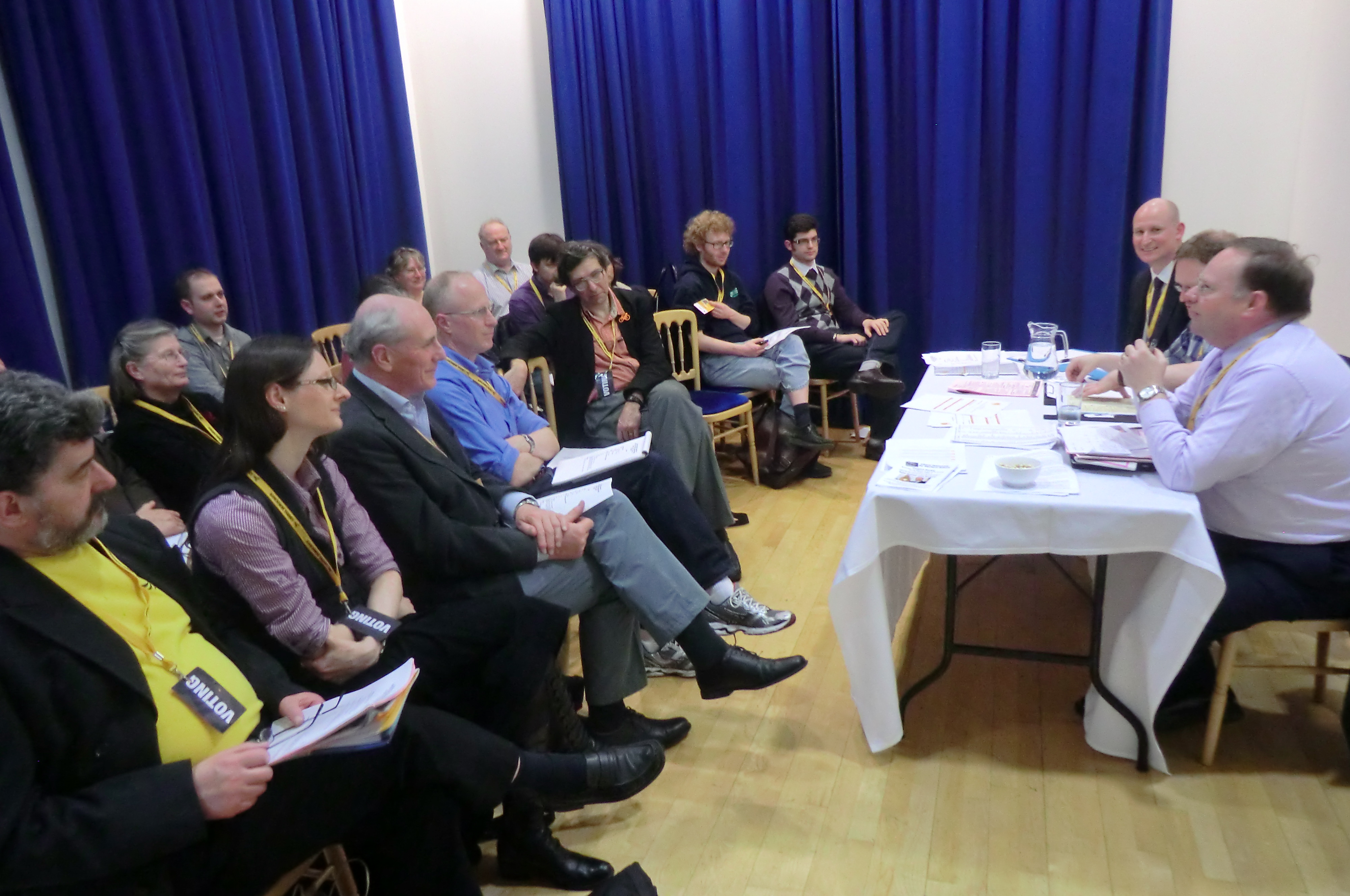
The LDER launch meeting at the Spring Conference in Gateshead. Panel: Lord Rennard, Crispin Allard (chair), Julian Tisi (vice chair).
Watch out for LDER at future conferences or sign up now to receive updates and help shape our agenda. Membership costs £10 (reduced rate: £5). Please visit our facebook page or contact [email protected] for further information.
* Maria Pretzler is a Lecturer in Greek History at Swansea University. She blogs at Working Memories , where ancient Greekery and Libdemmery can happily coexist.
 Follow @libdemvoice.org on Bluesky
 Like us on Facebook
 Subscribe to our feed
 Sign-up for our daily email digest

 "A little heaven here on earth": Launde Abbey in Leicestershire
 MI5 chief confirms Russian interference in Brexit referendum
 How many councillors has Reform UK lost since the May 2026 elections?
 David Le Grice
 Jamie Dobson
 Ying Perrett
 Graham Evans
 Tim Rogers
11 Comments
I felt this was a successful meeting and nice to see a picture of me on the net!
I am pleased that we are not giving up on electoral reform or letting it fall to the side.
However, might I suggest adopting a different logo for LDER? The purple and rounded square aren’t really associated with success.
Jason, yes, that may be a good idea, since this logo does date to 2009 or 2010, as far as I can make out.
We really are at the beginning of the whole process, and I am sure that the logo can be discussed at some stage. Personally – though it’s not for me to decide – I am rather partial to purple in this context. After all, it is part of a long tradition, and the setback in 2011 shouldn’t spoil that, especially because it represents a connection with the suffragette movement!
I absolutely agree we should never give on Electoral reform but never ever again allow the thirst for power to overshadow what should be our basic belief, DEMOCRACY
Strictly speaking Lords reform is constitutional reform rather than electoral reform, and its currently being used by Nick Clegg to distract people while he waters down the recall mechanism in order to save his own seat.
Great stuff. Will be signing up.
As a part of electoral reform can I put forward the idea of direct elections for prime minister?
Electoral reform is the ‘Dem’ bit of Lib Dem. The AV debate revealed the other main parties to be deficient in ‘Dem’, unsurprising they now appear all set to stymie attempts to bring democracy to the Lords. At the next election, Lib Dems should specify that movement on electoral reform continues to be a requirement for cooperation with any other party, except this time AV as an alternative to PR should be dismissed as a non-starter.
Martin – couldn’t agree more. This is something people should simply take granted about us.
Charles –
“Strictly speaking Lords reform is constitutional reform rather than electoral reform”
Well, yes and no. As far as it concerns making it a wholly or partially elected chamber, it certainly concerns electoral reformers, too. We are concerned with the choice of an appropriate electoral system for this purpose, and there are interesting discussions to be had about this, not just concerning how you translate crosses or numbers on the ballot papers into seats, but also how you select candidates and so forth.
Charles also said:
” and its currently being used by Nick Clegg to distract people while he waters down the recall mechanism in order to save his own seat.”
Unlikely. Recall was always going to be triggered by serious misdemeanour or a criminal offence. There has been lot of talk about which suggested that voters could just trigger recall on a whim, and might then do this in Sheffield Hallam (and that therefore Nick Clegg doesn’t want it after all). This is simply not correct.
Whoever is suggesting this should be careful what they wish for. At the moment there are plenty of MPs with less than 40% of the vote in their constituency. If we’d really go for recall just on the basis of a certain number of signatures on a petition, there are quite a few constituencies where a well organised second party might be able to organise recall on a whim, which would be a serious disruption to the political process, and well beyond the affected constituencies. Any high profile politican on a slim majority would be a potential target: in those terms, Ed Balls, for example, might be a more obvious candidate than Nick Clegg, even now, I’d have thought (and no, I wouldn’t want that, either).
Therefore, the threshold for overturning an election result has to be pretty high, and has to be separate from purely political reasons. Sensible people have of course thought about this, and therefore nothing is being ‘watered down’: a procedure which may have allowed Labour in Sheffield to stage a recall in Hallam was never on the cards, since it simply isn’t feasible, and wouldn’t be in the interest of Labour, either. But if we had recall at our disposal already (and I wish we did) along the lines actually proposed, Eric Joyce would be an obvious target, and I have no doubt that the SNP would organise it as soon as it could. But you wouldn’t want to see more than a handful of recall attempts in any given parliament, I’d have thought. It ought to be something that remains rare and very serious.
The curious thing about the AV referendum was that it was swung by all those people who were effectively saying “I hate the way we have a government where the Tories are so strong and the LibDems so weak, so I’m voting for a system whose main stated advantage given by its supporters is that it strengthens the biggest party and weakens the smaller parties”. It was odd to find so many people moaning about “the irrelevance of this referendum” and simultaneously moaning about the government, as if the electoral system that put it in had no connection with it being in. The LibDems did not play the trump card “Even if we had had AV, the balances would be changed enough so that we wouldn’t be forced into this coalition on these terms” because that conflicted with the “we’re equal partners with the Tories” message the leadership had been trying to put out since the coalition was forme .
The strongest case for electoral reform is that it would mean we never again have such an extremist unrepresentative government like we have now. But saying this would mean the Liberal Democrats dropping their tactic (which I believe is damaging) of over-playing rather than under-playing the party’s role in the coalition.
As I said when I signed up for the LDER, I’m more interested in reform of the electoral system for council elections than for Europe.
But I would say that, I live in a city with a gerrymandered ward structure that gives Labour 80% if the seats with 40% of the vote.
I am very glad that the Liberal Democrats haven’t given-up on the cause of electoral reform. I live in the Tory stronghold of Brentwood and Ongar and if you don’t vote Tory or Lib Dem here you may as well not bother going to vote. It is high time Britain became a modern democracy just like everywhere else in Europe. I personally think the German system of Mixed Member Proportional where you get both a local constituency MP and fair representation for different parties at the national level would suit this country well.
AV was never going to pass as people didn’t see how it would improve on First Past The Post. We all know the REAL issue is whether our system is proportional or not and AV wouldn’t have improved that aspect (indeed in some circumstances it would have been worse). Even though I wouldn’t call myself a Liberal Democrat, you are totally correct that FPTP has to go. That vote against AV in 2011 was a vote AGAINST AV NOT a vote against electoral reform.
I shall continue to vote Lib Dem until this disgracefully undemocratic electoral system is consigned to the dustbin of history where it belongs.