


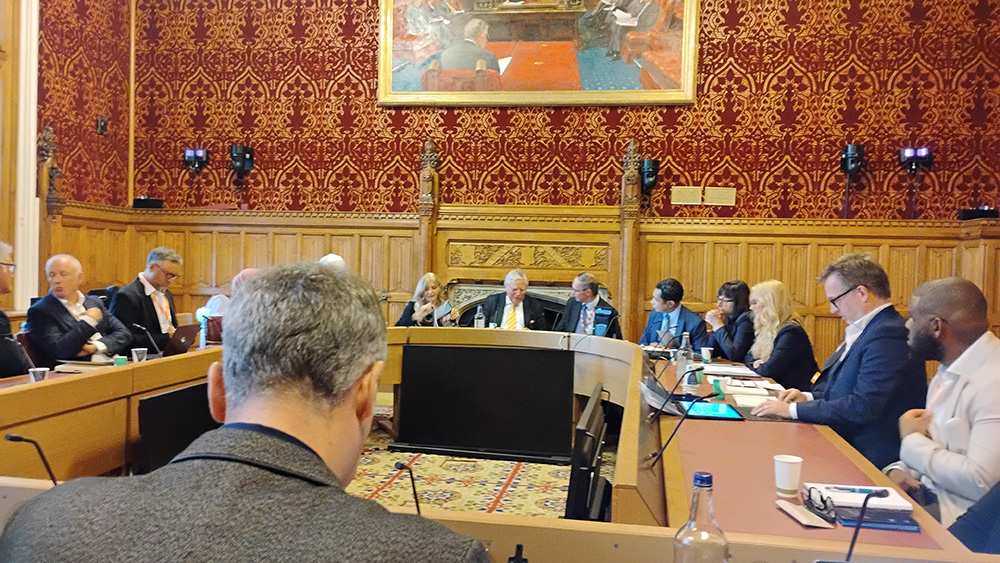
On Monday evening, during our APPG AI meeting in the House of Lords, we discussed whether Britain could develop its own sovereign artificial-intelligence language models for military use. One speaker with expertise in military AI suggested that this would not be feasible, at least initially, given the cost involved.
The Chief of the Defence Staff, Air Chief Marshal Sir Richard Knighton, said that Project ASGARD is helping British soldiers make faster decisions and save time in combat operations through AI agents and targeted large language models (LLMs), with the capability being developed and tested by soldiers in Estonia.
The Army is also developing AI-enabled training. In July 2026, the Ministry of Defence announced a £2 billion, 15-year contract for an AI-enabled training capability intended to support the training of approximately 60,000 soldiers each year through AI and analytics.
The most ambitious element is the new Digital Targeting Web, designed to digitally connect sensors, intelligence systems, commanders and weapons to enable faster decision-making and targeting. The Defence Investment Plan commits nearly £2 billion in new funding to the capability, with the wider programme and supporting digital infrastructure receiving additional investment. Its aim is to reduce the time between detecting a threat and deciding how to respond.
In June 2026, the Ministry also established the ‘Rapid AI Delivery Taskforce’, or TF RAID. Its priorities include machine-assisted intelligence fusion, operations when communications are disrupted, automated military planning and AI-enabled swarms of uncrewed systems. It has been allocated ‘£100 million’.
These are significant programmes. However, they do not yet amount to a clearly identifiable, sovereign British equivalent of France’s military-AI ecosystem.
France has made technological sovereignty a central defence priority. It has created the ‘Agence ministérielle pour l’intelligence artificielle de défense’, or AMIAD, and is developing systems such as ‘Arcadia’, an AI-enabled battlefield command platform, and ‘Berthier’, a military language model intended to assist staff officers with information retrieval, summarisation and operational planning.
France has also invested in secure military computing infrastructure. Its ASGARD is a classified supercomputer for training and operating defence-AI models—entirely different from Britain’s Project ASGARD, which is an Army targeting and reconnaissance programme.
Most importantly, France has helped create and adopted a national industrial alternative in Mistral AI. Founded in Paris in 2023, Mistral developed its models from the ground up rather than simply adapting an American commercial chatbot. Its first model, Mistral 7B, was released under the permissive Apache 2.0 licence, allowing it to be used, modified and deployed on privately controlled infrastructure.
Mistral is now one of the foundations of France’s sovereign AI strategy with an LLM seemingly created in house. In January 2026, the French Ministry of the Armed Forces awarded it a framework agreement giving the Armed Forces and associated public bodies access to its models, software and services. The agreement is being managed by AMIAD and is intended to reinforce French technological sovereignty.
This is the crucial point. France did not wait for a foreign supplier to offer a military version of an existing model. It supported an indigenous company that built frontier AI capability from the bottom up, and it is now integrating that capability into defence systems.
The UK’s close relationship with the United States brings major benefits, including access to research, intelligence and advanced technology. But cooperation should not become dependence. Britain should retain control over its sensitive military data, secure computing, software architecture and ability to replace a supplier.
Britain already has the necessary advantages:
– a substantial defence budget;
– leading universities and technology companies;
– an advanced defence-industrial base;
– expertise in intelligence and cyber operations;
– close relationships with the United States and European partners – France in particular.
France demonstrates that sovereignty is not simply a technical possibility; it is a political choice. Its development of Mistral shows that a European country can build a major language-model company from the ground up and place it at the centre of a national defence-AI strategy.
The United States is Britain’s ally – and historically France’s equally – and that relationship can remain central to national security. Yet an alliance is strongest when both partners retain meaningful capabilities of their own. Britain should continue to cooperate closely with Washington while ensuring that its Army’s most sensitive AI systems can operate independently when sovereignty, security or operational resilience requires it.
* Christian de Vartavan is an eminent scholar and now CEO of a London blockchain consulting company and Associate, APPG AI, House of Lords.
 Follow @libdemvoice.org on Bluesky
 Like us on Facebook
 Subscribe to our feed
 Sign-up for our daily email digest

 Woman 'posed as substitute teacher to insult students because she hates kids'
 Tories to reward the better off
 Spread it around
 Big Tall Tim
 David Allen
 cim
cim Ben Rich
2 Comments
Mistral deserves further investigation
ASML the Dutch leader in advanced chip machine has just bought into it to create a European force in AI. We could buy from Mistral and host solely in our own capabilities ensuring we are sovereign and safe amongst both friends and foes.
Robin Ashby
Lib Dems Friends of the Armed Forces
Robin Ashby – Thank you for this comment. I was not aware that ASML – indeed one of the world’s lead manufacturers of chips – is using Mistral. Apparently, ASML is both an equity investor in Mistral AI and a named enterprise customer.