


Fairer taxes, crack down on tax avoidance, an emphasis on the mansion tax and a low-key, getting on with the work in hand delivery: that’s Danny Alexander’s conference speech in a nutshell.
"You can move your money offshore. You can't move your mansion" – @DannyAlexander calls for mansion tax #ldconf
— Mark Pack 🔶 (@markpack) September 25, 2012
Although not quite up there with his GMB speech (still well worth a read), it was an effective one as the delivery style matched the message.
Having often heard Danny Alexander talk in the past about action needing to be taken on tax avoidance and tax evasion, I noticed a change in emphasis this time, with more talk about what has been done. That’s a good sign of progress, such as:
Back in 2009, Labour made an agreement with Liechtenstein that set a time limited window that closes in 2016 for people to bring their UK tax affairs up to date.
They thought it would raise a billion pounds. Under this Government many more people are fessing up. So, we are doubling the size of the team focussed on Liechtenstein. With that extra effort we can recover much more from those who thought they could hide their money offshore. Up to three times more – £3bn.
and also:
In the summer, I shut down the scandalous situation where thousands of public sector workers were being paid in a way that potentially allowed them to pay too little tax.
.@DannyAlexander setting out Lib Dem action for fairer taxes at #ldconf. Sign up to back the campaign: http://t.co/Ln26kzmW
— Mark Pack 🔶 (@markpack) September 25, 2012
Here’s the official text of his speech:
 I’d like to talk to you about our conference slogan: “Fairer taxes in tough times.”
Thanks to the Liberal Democrats, taxes are getting fairer. Our tough budget negotiations mean that next year 24 million people will benefit from the largest ever increase in the tax free amount.
From April, working people will have seen their income tax bill fall by £550 and 2 million of the lowest earners will have ceased to pay any income tax. This is happening thanks to the Liberal Democrats in the Coalition Government.
It would not be happening without you.
Not everything about the Budget this year was perfect. But the Income Tax cut was by far the most important measure in the Budget – and the working people of this country will have over £3 billion more of their own money to spend next year as a result.
A cleaner working full time on the minimum wage will see their tax bill halved, thanks to Liberal Democrats. Very soon no one will pay Income Tax until they are earning more than £10,000, thanks to the Liberal Democrats.
We promised it in our manifesto, we campaigned for it, and we had the courage to go into coalition to deliver it. At the next election, we will promise to raise that figure yet further, to £12,500. So that you don’t pay any Income Tax until you are earning more than a full-time salary on the minimum wage.
And in 2015 people will know that promise is credible, because we have delivered in Government. Thanks to the Liberal Democrats, truly a record of action – a promise of more.
Fairer taxes matter, because times are tough. The spending power of most people’s pay packets has fallen over the last 5 years.
For too many, the spectre of unemployment has become a painful reality. For the country as a whole, the adjustment to a level of government spending and taxation that we can afford is painful and difficult.
When we came into office, we knew things were bad. But the truth is, we didn’t know how bad. The damage that the crisis has done to our economy is even deeper than we first thought. The headwinds from high inflation and the eurozone are stronger than anyone imagined. The mess Labour left, worse than they would ever admit – let alone apologise for.
Now, having heard all of that, you might think I am pessimistic. You couldn’t be more wrong. We have a government determined to do the right thing for the long term. Over the last two years we have laid strong foundations for a stronger economy.
I am fundamentally optimistic for the future. Because there are brilliant businesses, talented and hard-working people in every corner of this country who make this one of the best places to do business in the world.
Like the members of the Bristol Junior Chamber of Commerce I met with our brilliant Mayoral candidate Jon Rogers on Thursday, enthusing about the opportunities for young people to start their own businesses.
Like the small manufacturing company I visited in Cardiff South with Bablin Molik, our inspiring by-election candidate. A business that that has grown and is providing much needed jobs in the local area.
Like the massive chemicals plant I visited in Redcar with Ian Swales, growing with the help of a regional growth fund grant. These people are the growth makers, the job creators – our job is to help them.
Last year I announced the creation of the Growing Places Fund. £730m to help local areas fund local infrastructure to unlock new jobs. I can tell you today that the fund that Andrew Stunell and I established has already helped fund around 170 projects, supporting an estimated 178,000 jobs.
Conference, the economy has rightly been the central focus of this party conference.
Yesterday, we had an excellent debate on some of the further measures we would like to see to support growth. And Vince Cable gave a brilliant speech, setting out the work his department is doing to help clear up the mess that Labour left.
I daresay the congratulatory text message from Ed Miliband has been unavoidably delayed. Mr Miliband has come out with a new economic theory this month: ‘Predistribution’
Apparently it means spending money you don’t have, without knowing where that money is going to come from in the future. Conference, it’s not a big new idea.
It’s a bad old one. Labour spent 13 years trying it – and let the British people down spectacularly.
Labour don’t like us talking about their record in office. But the country can never be allowed to forget their disastrous mistakes in banking, in regulation, in the public finances – falsely promising the British people that they could end boom and bust.
So I make no apology for reminding people that when it comes to the economy, Ed Balls and Ed Miliband have about as much credibility as Andrew Mitchell’s etiquette coach.
The country won’t let them forget their role in the economic crisis but it is also true that growth is much slower than we want. It will take us longer to deal with the deficit than we expected.
Here’s why. The eurozone crisis. Higher than expected inflation. The weight of our broken banking system suffocating businesses with growth potential. All of these things have been tougher for Britain than was forecast when we started down this road.
In the short term, we are borrowing more as taxes and benefits respond automatically to help stabilise the economy. Critics should welcome that, not criticise it, because it shows that our plan is able to adjust as new pressures emerge. We have always been clear that flexibility is built in to our plan.
But every time an alternative is put forward, I ask myself a simple question. Will it strengthen the foundations of the better future economy that we are building?
Despite all of the difficulties and the challenges that lie ahead, in the last two years we have re-secured for this country a very precious commodity: credibility.
No one now doubts that Britain is a nation that can pay its way. As a result, the people from whom we borrowed £125 billion last year (more than the entire cost of the NHS by the way) were willing to lend us their money at some of the lowest interest rates we have ever paid.
Those low interest rates help keep wasteful spending on debt interest down. We have spent two years earning the confidence that secures those low rates. And we will not sacrifice it now.
Especially as we are able to use that credibility to create jobs, to help build homes, to get more money to business. Guaranteeing mortgages for first time buyers. Funding for lending to get more money to small firms. Guaranteeing funding to bring forward the major infrastructure projects our country needs and for housing associations to build more affordable homes.
Let me give you an example. One major project we are funding is London’s Crossrail.
It is the biggest infrastructure project in Europe right now. But we need to ensure the rolling stock is delivered on time.
Right now, difficulties raising the necessary private funding in the market could delay their delivery. So I can announce to you today that the train contract for Crossrail will be the first project to qualify for a new government guarantee.
And it will be the first of many across Britain, I am sure. We have rebuilt the confidence in this nation’s ability to pay its way in the world, we can now put that credibility to work for the British people.
There could not be a worse time to argue that we should abandon our plan. As we overwhelmingly agreed in our debate yesterday – we won’t do it. It is the foundation for everything else. It is the foundation for jobs and prosperity in the future.
Last autumn, we were faced with a worsening forecast from the independent Office of Budget Responsibility. Rather than add more cuts now, we decided to take another two years to do the job.
That was the right, pragmatic response to things getting worse. Fellow Liberal Democrats, that decision has consequences too. It means we are now committed to further deficit reduction into the next Parliament.
Let me be absolutely clear: I will not sacrifice this party’s independence by binding us to detailed spending plans deep into the next Parliament.
But there is one thing we must do. We have to set a detailed budget for government for the year 2015-16 because we will be in government for the first 5 weeks of it, at least.
That means setting out specific plans for the £16 billion of savings that are needed in that year. And it means setting out how we, as Liberal Democrats, would make the further tough choices needed beyond that.
Nick and I will negotiate hard to get this right, to make choices that are shaped by our Liberal values and driven by our Liberal Democrat priorities. We simply will not allow the books to be balanced in a way that hits the poorest hardest. At £220bn, welfare is one third of all public spending – and despite our painful reforms it is still rising.
We will have to look at it. But that cannot, must not, and will not be the only place we look. We insist that the difficult choices must be fairly shared: that those who can afford more must contribute more.
Which brings me back to where I started: fairer taxes, in tough times. We have done a great job cutting income taxes for working people. We have helped millions of people by stopping Labour’s fuel duty increases. Helping struggling families and businesses deal with the burden of very high fuel costs.
And we have made a good start in raising taxes on the wealthiest. High earners get less tax relief on their pension contributions. You can’t dodge stamp duty by putting your home in an offshore company.
Banks pay a special new tax – paying £10 billion over this Parliament. Capital Gains Tax is up – ending the scandal that a hedge fund manager could pay less tax than their cleaner.
At our conference 2 years ago, I announced an extra £900m to get tough on tax dodgers and told you that by the end of the Parliament it would deliver an additional £7bn a year in revenue.
Last year, I reported back that we were on track for an additional £2bn. And this year, I can announce we are on track to raise an additional £4bn. Fairer taxes in tough times, means everyone playing by the same rule book, and everyone paying their fair share.
To their credit, even most Conservatives now agree with that too. Last year we set up a new affluent unit within HMRC. I can report that it is already a success: it has raised £44m in less than a year.
And so I can announce that we will build on that success and expand its remit to the wealthiest 500,000 people in the country, those with net wealth over a million pounds.
The vast majority of taxpayers in this wealth bracket pay their fair share. We have this message to the small minority of wealthy people who don’t play by the rules: we are coming to get you and you will pay your fair share.
But conference, tax dodging is not limited to our own shores.
So when I say we are coming to get you and you will pay your fair share, I mean those hiding their assets offshore too. Back in 2009, Labour made an agreement with Liechtenstein that set a time limited window that closes in 2016 for people to bring their UK tax affairs up to date.
They thought it would raise a billion pounds. Under this Government many more people are fessing up. So, we are doubling the size of the team focussed on Liechtenstein. With that extra effort we can recover much more from those who thought they could hide their money offshore. Up to three times more – £3bn.
That is good progress. We should all be proud of it. Getting tough on those who don’t play by the rules. And as times get tougher, as belts get tighter, as austerity goes on for longer, it is morally necessary to do more.
In the summer, I shut down the scandalous situation where thousands of public sector workers were being paid in a way that potentially allowed them to pay too little tax.
Rules are now in place to stop that happening – based on the simple principle that if you’re being paid public money, you should pay your taxes. But it cannot be right that similar rules don’t apply to companies doing business with the government too.
There are thousands of large firms that receive taxpayers’ money to deliver a service – they do a good job helping to deliver public services. But I have discovered that there is nothing that prevents the very small minority of firms that don’t play by the rules from winning government contracts.
That is not right. That is not fair. And I am determined that it comes to an end.
If you want to work for us, you should play by our rules. Taxpayers’ money should not be funding tax dodgers. So I have tasked HMRC and the Cabinet Office to come up with a workable solution to this problem and we will set out more details later this year.
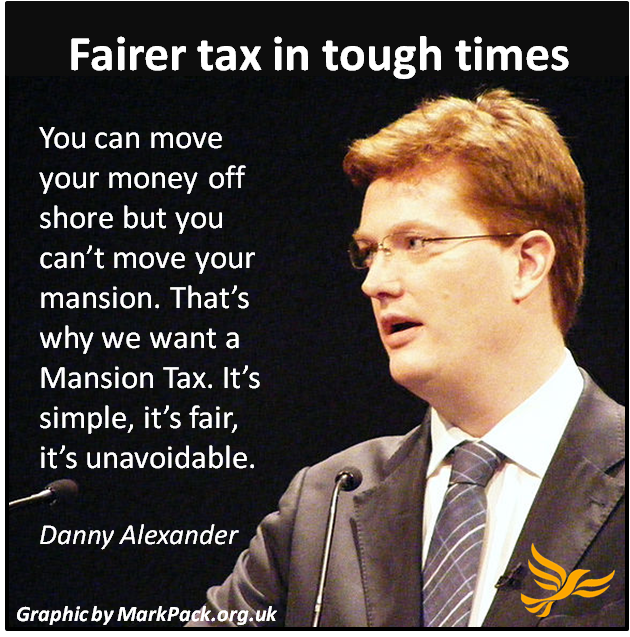
And we need to get wealthy individuals to pay a fairer share too. In this country, we tax work, effort and income too highly, and unearned wealth far too little. Now you can move your money off shore but you can’t move your mansion. That’s why we want a Mansion Tax. It’s simple, it’s fair, it’s unavoidable.
An extra levy on high value property would get more money from those who can afford it. It would ensure that the burden of the next round of deficit reduction is shared more fairly. We will continue to argue for it within government.
Now, some experiences in government have been quite strange. Nick may have hit the heady heights of 143 in the official charts. But strangest of all, some people seem to think it is impossible to be Chief Secretary to the Treasury and a Liberal Democrat at the same time.
Yes, I do have to work closely with George Osborne and Oliver Letwin. I do my best to make the Coalition work. And, actually, they do too. It is not impossible to be a Liberal Democrat in the Treasury. It is essential.
My liberal values are not left at the door on Whitehall. They are strengthened by being applied in practice, toughened by the experience of government.
And through my department we are delivering Liberal Democrat ideas:
- More investment in transport than ever before
- £2.5bn set aside for the pupil premium
- £1.3bn to invest in Post Offices
- A crackdown on tax avoidance and evasion
- Big tax cuts for ordinary working families
All of that in the toughest economic circumstances any modern government has faced. Do you really think Conservatives governing on their own would have done those things? That’s the difference Liberal Democrats make in the Treasury.
We inherited an economy as damaged as any in modern peacetime history. We have taken the tough decisions that lay the foundations for a modern, strong, balanced economy with strong businesses and more jobs. Reforming welfare, taxing the wealthy, practical help for working families.
Thanks to you, we are on the road to recovery. Thanks to you, we are doing the job we set out to do. It is not easy, but we are doing the right thing and we are making a difference. That is worth the effort.
* Mark Pack is Party President and is the editor of Liberal Democrat Newswire.
 Follow @libdemvoice.org on Bluesky
 Like us on Facebook
 Subscribe to our feed
 Sign-up for our daily email digest

 Councillor Samantha Williamson joins Lib Dems in Bolton
 Senedd bans poem by Wales National Poet
 "A little heaven here on earth": Launde Abbey in Leicestershire
 Pete Roberts
 Peter Davies
 theakes
 Chris Moore
 John Hall
13 Comments
What stops your ‘mansion’ tax from being a tax on mansions, and transforming into a generally applied wealth tax on all?
Will you link it to the minimum wage, as has been proposed for the tax-free income threshold?
Or, will it be linked to inflation?
The state has no business trying to tax me on my three-bed semi, and if I even suspect that this mansion tax is a thin-end-of-the-wedge move then my grudging acceptance of a swap for ditching IHT in favour of a mansion tax will become outright rejection and hostility.
This is the voice of the aspiring class speaking – toy with their dreams at your peril!
Jedi – why would anyone link a mansion tax to the minimum wage?
I would rather see genuine efforts to simplify and clarify the UK tax system, so it delivers efficiently what it should, before generating more and more complex taxes. If you were dong your job properly, Mr Alexander, then we will not need a Mansion Tax. To my mind (not living in a mansion, BTW) the Mansion Tax proposal is a clear sign of failure.
Moving a mansion is easy.
One way is to sell it and use the proceeds to buy one somewhere else.
Another way is to convert it to flats, rent out the flats, use the rent to pay any taxes, and use it and their re-sale value as collateral to borrow enogh to buy a mansion somewhere else.
Or you could sell the flats.
Just want to repeat a simple question not yet answered in another thread.
Why is it a good thing to raise the tax threshold in order to take the lowest paid out of the income tax system?
Why is it fairer for those paid less than the minimum wage to pay zero income tax?
As a middle-earner, I see the top rate being reduced for the highest earners, the lowest earners being taken out of the system, so the burden falls on people like me, the proverbial “squeezed middle”. If I am to take such a hit, I would at least like a good explanation as to why this is the right thing to do.
Hmmm. Something doesn’t quite add up here. Danny quotes various examples of where tax dodging is being tackled but the Guardian yesterday reported that tax evasion cases have dropped by 25%.
http://www.guardian.co.uk/business/2012/sep/24/tax-evasion-cases-drops?INTCMP=SRCH
Campaigners claim that HMRC simply doesn’t have enough staff for complex cases. Are they perhaps doing the easy thing and targetting the (relatively) small fry with a million or so in assets? I hope not. Even the Liechtenstein success touted by Danny has another side. HMRC originally thought they could raise £1 billion but now find it’s actually £3 billion which implies that they are massively underestimating the scale of the evasion that’s going on. Again, this is exactly what campaigners argue. A small problem can be dismissed as of marginal importance; were it’s likely true scale to be exposed there would be a public scandal.
Perhaps this shouldn’t be a surprise. Some Conservatives are deeply wedded to the idea that wealth should not be taxed and delivering opportunities to legally avoid this is surely what many of their big money backers are buying. Politically, it doesn’t pay to own up to this so saying one thing but doing another is what we should expect of them.
Jedibeeftrix – What stops your ‘mansion’ tax from being a tax on mansions, and transforming into a generally applied wealth tax on all?
A ‘tax on all’ is, by definition, not a ‘wealth tax’. To be meaningful it has to relate to a few – say 1% – who have a disproportionate share. Of course a cunning politician might disguise his/her true intentions by crafting a tax which appears to be on wealth but is actually fairly regressive. You might call it – ooh, say, Council Tax.
The thrust of neoliberal policies for over 30 years has been to reduce any taxes levied on any form of wealth – e.g. IHT, capital gains, property etc. while winking at loopholes that enable money to be salted away in tax havens.
Conservatives argue that wealth will ‘trickle down’ and/or be invested. Actually, hoarded wealth (as opposed to invested wealth which requires special skill and experience to manage) typically finds its way into property boosting prices to crazy levels. Had this not happened most of us would have a lot more disposable income left over after paying our mortgage and a better lifestyle. Overall, demand across the economy would be higher so creating more jobs. Lots of current problems track back in part to neoliberal tax policies.
“Jedi – why would anyone link a mansion tax to the minimum wage?”
It is a truism of taxation that ‘temporary’ taxes become permanent and ‘rich’ taxes are eroded by inflation/band-shifting and thus become general taxes.
Fine – propose a mansion tax on properties over £1m, but my parents bought their first house for £5,000 and sold their last for more than £300,000, so what surety do we have that a mansion tax for the rich won’t become a wealth tax on the middle-class?
One of the discussion items on the fairer-tax document was linking the tax-free threshold to minimum wage at full time employment, surely a similar mechanism could be used here – say 100x the tax free threshold.
Or, just link it to inflation.
But the important point here is: convince me or i will tell our mansion tax advocates precisely where it can be shoved.
@ Liberal Eye – “The thrust of neoliberal policies for over 30 years has been to reduce any taxes levied on any form of wealth”
I think the middle-class rather suspect that you wish to reverse this principle.
‘Courageous’ if true.
If not, then make a VERY convincing case that £1m mansion tax threshold will rise with inflation.
@ Jedibeeftrix – many (most?) neoliberal policies – including reducing wealth taxes – have turned out to be highly pernicious. Just to take a simple example; the start of the Great Depression in 1929 was marked by a peak in wealth inequality not seen again until the start of the global financial crisis in 2007. Correlation or causation? I think causation as plausible mechanisms exist for translating inequality into economic collapse.
Reducing wealth taxes is, par excellence, a policy for the vested interest of a tiny minority rather than the majority despite attempts to dress it up as economically respectable. So, yes I would like to see this reversed.
A key question is what is defined as ‘wealth’. I DON’T think it should include a family home, even a rather large one in a good area, not even when values rise with inflation so I would certainly favour indexing the threshold. Of course, a future govt could still break the link but then they would have to take a positive action and likely blow-back. And, over and above a home , it should include enough assets to provide a generous pension even if not in a formal scheme
Oh dear oh dear….how not to make up taxation policy
Clegg – were thinking of taking away age related payments from pensionsers
Laws – Er perhaps not a good idea… We definitely wont add up their jewels anyway
Tories : Not in the life of this parliament you wont.
What the hell is this policy making on the hoof… it looks as foolish as Cameron announcing he will revive the economy with conservatory extensions and is about as full of holes…
“Of course, a future govt could still break the link but then they would have to take a positive action and likely blow-back.”
This is of course what worries ‘us’.
On the one hand we appear to have an ideological need to tax wealth, on the other they say that this particular wealth tax will only be targeted at the rich.
Which will win out; the desire to remain scrupulous to the original principle or the conviction that you have a better notion of what to do with my ‘excess’ cash then me.
I would say the onus is on the lib-dem’s to convince the property owning class [exactly] what is meant by fairness……….
Not least because a party of the lefty-refugees/students/moderate-environmentalists/public-sector/middle-class that is losing lefty-refugees/students/moderate-environmentalists/public-sector voters desperately doesn’t want to chase the middle-class away too!
Again, we hear much talk of the importance of showing how ready we are to make tough decisions on behalf of the country.
A couple of things worry me about this. One is tactical: as part of this message is a ‘confession’ that we have not been realistic in opposition and that we enjoy oppositional politics.
Countless councillors have relished power and done quite amazingly innovative, Liberal and controversial policies. Also, all our manifestos, at least since Paddy, have been fully costed and signed off my some firm of big accountants.
By going down this line we are saying to those who have voted for us that we were actually cheating them. We weren’t and how is this an inducement for them to stay with us or to return to us? Again we are pursuing this folly of a strategy restated by Richard Reeve – the pursuit of a new core vote.
The second point is strategic. Being tough by insisting on continuing the wrong policy is bad for the country and selfish for those who made the mistakes in 2010 which they should be apologising for.
Accelerating the rate at which we wanted to consolidate the deficit at the same time as keeping monetary policy tight against imaginary inflation (that has not realised) was a huge mistake, which is about to be reinforced by the Leader later today. The economy fell off a cliff in the summer and autumn of 2010 – repeating the mistakes of 2008.
The Governor of the Bank of England, no less, in his way accepted this on Channel 4 last week. He has told us that we can reduce the pace of the deficit reduction. So why keep bashing on about deficit reduction when the best way to cut the deficit is growth and receiving the taxes growth brings?
It is far tougher and far more responsible to campaign against Tory economics than to support it and even to lead it.