


Since the general election I’ve been to speak at fifteen local party events and two trends have struck me. First, the increase in the party’s headline membership figures comes over on the ground, with new faces turning up at events and new people interested in helping. Second, and less promising, is the heavy reliance on only two questions when someone new pops up: “can you deliver leaflets?” or, if they look really keen, “do you want to be on the local party executive?”
Those are both good questions – and the enthusiasm for getting people directly involved with leafleting is a welcome difference from other organisations where offers of help get smothered in reams of intermediate steps. However, they leave much potential untapped. Delivering does not always suit everyone and serving on a committee does not always appeal – and can appear a huge, and so off-putting, leap.
So here are my seven tips for how to get members, and interested supporters, more involved:
1. “Members newsletters” are not just for members: send them to helpers, donors and other interested people too. The more people you keep informed and get involved, the bigger the team you can build.
2. Make good use of neighbouring local parties: if many parts of the country, events put on by neighbouring local parties are nearly as easy for people to get to as those put on by your own. Yet we often treat the boundary between local parties as a firewall across which information must not move. Get on the mailing lists for your neighbouring parties and pass on information about their events. Advertise your own events on Facebook and Flock Together. That way people get the chance to enjoy more events – without you having to organise them!
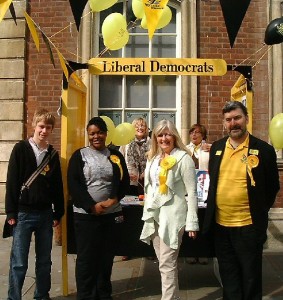 3. Offer a range of activities: leafleting is the bedrock of good councillor communications and effective election campaigning, but it is not the only activity by any means. Whether it is running street stalls, going out as a team to do some surveys door-to-door or asking people to gather information about their street (such as for a pothole survey to put pressure on the council) all sorts of opportunities come to mind if you organise with the question, “how can we arrange this in a way that makes it as easy as possible for people to help?”
4. Get training: when was the last time your local party ran a training event, whether in canvassing, how to be a local council candidate, how to get the council to fix things in the community or learning EARS? Whatever the topic, there’s plenty of scope to share skills and get people more involved.
5. Open up your committee meetings: some local parties have had great success by encouraging interested potential activists to come to local executive meetings or interested potential councillors to come to group meetings, without any commitment beyond that. It’s a good way for people to find out more – and has the bonus of making use of meetings you would have had to have anyway.
6. Go to conference: whether it is regional, state or federal conference, encourage people to attend. Again, you can make good use of the work other people put into organising events if you spread the knowledge about them more widely – and look out for opportunities, such as organising some car sharing.
7. Keep good records: good records of offers of help and their contact details are crucial to keeping people involved and informed.
Individually each of these steps is easy; collectively they can help make your local party one that welcomes new people and ends up getting the most out of them.
A slightly different version of this article first appeared in Liberal Democrat News, the party’s weekly newspaper. You can get a subscription to Liberal Democrat News here.
 Follow @libdemvoice.org on Bluesky
 Like us on Facebook
 Subscribe to our feed
 Sign-up for our daily email digest

 Jane Dodds stands down as Welsh Lib Dem leader
 The straight and narrow path to Marzipan Tunnel
 A U-turn too far
 Rob Heale
 Chris Moore
 Adam
Adam Paul
Paul
7 Comments
I agree Mark. This approach is vital for membership retention. I think we don’t look at the social aspects of belonging enough. My local branch is full of nice people but I think it will be difficult to retain younger members because the active members in the branch are all retired and so the activities/talks are pitched more at the older age group.
The training aspect is a very good idea. I’m on a committee of a national charity for young people and we are putting a lot of focus on advocacy by young people. We give young people important skills, give them media exposure and in return we’re able to reach new audiences and we find fantastic people to represent us. I think with the yes to AV campaign we have a great opportunity to do this. I think the new 18 year olds who have joined us – and probably find us incredibly dull – could be fired up by this.
Is there any research on the effectiveness of political party leaflets delivered door-to-door?
I am still shocked about how bad we can be at this. At one annual dinner I went to this month, the new members who’d bothered to come were shoved on a half empty table at the back of the room where you couldn’t hear the speaker. With one noticeable exception there was no attempt to make these new member particularly welcome, never mind get them to get involved in the party or campaigning. What a waste of good will, enthusiasm and young legs for delivery.
I think all organisations suffer a bit from this.
I have been at lots of meetings over the years
where unfamiliar faces turn up and the old regulars
don’t speak to them.
At my union AGM it happened and i was the only
one to talk to a guy who noone new but had made
the effort to come to a meeting on a Sunday morning!
Hear! Hear! to all the above. It all strikes a chord, and we do do some of the the things advocated some of the time.
My slightly premature New Year’s resolution is try harder to put the lessons into practice.
I went to my first meeting and was promptly voted in as conference rep at the Welsh conference in Cardiff! My local party were so warm and full of welcome and full of very fun people.
I’m looking forward to becomeing even more involved in the new year 🙂
Glad to hear you’re getting all these new recruits – wonder if they might be students infiltrators.
Still it will help fill the increasing gaps in the ranks 🙂
And there must be a helluva lot if a member at their first meeting gets voted in as a conference rep.