


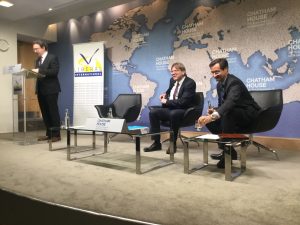
 A packed lecture theatre in St James’s Square, London, was the setting for this year’s Isaiah Berlin Lecture, hosted by Chatham House and introduced by Liberal International President, Dr Juli Minoves. Tickets had been swallowed up within three hours of becoming available in anticipation of a typically robust contribution from the recently appointed negotiator for the European Parliament, and Guy Verhofstadt didn’t disappoint.
Against a backdrop of unprecedented threats to the stability of the European Union, he set out his vision for the future of the political order in Europe.
He believes that Europe is under a triple threat of radicalised political Islam through terrorism, from Vladimir Putin’s Russia through cyber attacks and the financing of extremist parties, and from Donald Trump’s America, given his expressed desire for a fragmentation of the European Union. The European Union has fewer friends than at any time in recent history.
And how do we avoid the disintegration of the European Union? He acknowledges that it has problems, multiple crises of migration, terrorism, geopolitical weakness, the economies of Southern Europe. It acts too little, too late.
He gave the example of the response to the 2008 financial crisis. The Americans cleaned up their banking sector and took all the necessary steps to secure the economy in just nine months. Europe is still talking about it. The American taxpayer has already been recompensed for the cost of the rescue.
Europe has a half-complete banking union and inadequate political institutions. Perhaps, he mused, the European Union doesn’t really exist, but is simply a loose confederation of twenty-eight European states. As he explained, if you have weak institutions, you will not have good policies and resulting poor economic performance (a point that is true both in politics and in political parties). And, with the unanimity rule at European Council level, you cannot have effective decision making.
In cantering through a brief history of the European institutions, he pointed out that the Treaty of Rome had simply created a customs union, due to French diffidence about the project. As a result, the institutions have been playing catch-up with the politics ever since.
Europe does things the wrong way round, passing Schengen and then thinking about a Coastguard and Border Agency, creating a common currency without a treasury. The institutions matter.
I was particularly intrigued to hear that Europe spends the equivalent 42% of the American defence budget but has only 12% of the capacity because each country duplicates the efforts of its neighbours. Co-operation is localised, not Europe-wide, and he was clear that we need to address this, through a European Defence Union which would complement, not compete with, NATO.
He did have a potentially positive sense that people believe that Europe should do all sorts of things, but not the way that they are done now. More than 70% of European citizens believe, in twelve of thirteen fields polled, that Europe should do more. We need to find a way of delivering these things by having a better Europe, a Europe that can defend itself and its values.
In a final rallying call, he said that we cannot retreat to nationalism and national identity. Nationalism was a European invention, but proved to be a disaster when it became a conduit for the politics of ethnicity. Too many people died for nationalism for it to be the answer. It was, he concluded, the most stupid thing you can do, and you play with fire if you return to it.
All in all, it was a lecture that would be unfamiliar to those whose only image of Guy Verhofstadt is that of the fanatical federalist so alarming to our somewhat rabid press corps. He believes that, for Europe to work, it needs to change and change radically. He isn’t alone…
* Mark Valladares is a member of the Party’s International Relations Committee.
 Follow @libdemvoice.org on Bluesky
 Like us on Facebook
 Subscribe to our feed
 Sign-up for our daily email digest

 Ed Davey on working with Greens after Zionism conference motion
 Oh! What a Lovely War: An interview with Murray Melvin
 Green leader doubles down on Zionism is racism policy
 Chris Williams
 Andrew Moore
 Steph
Steph David Evans
 Chloe
Chloe
5 Comments
All in all, it was a lecture that would be unfamiliar to those whose only image of Guy Verhofstadt is that of the fanatical federalist so alarming to our somewhat rabid press corps
Um… it sounds like is solution to everything is more Europe, more power to the European institutions, and that his general view is that the members of the EU as separate countries have too much autonomy (which causes slow, confused responses) and they could do with becoming more like regions of a single state, with a central government which runs their border policy, foreign policy, central banking and treasury, etc etc.
How are these not exactly all the things a fanatical federalist believes? He seems to have pretty much confirmed that a fanatical federalist, who believes in a United States of Europe, is exactly what he is!
@Dav – The solutions to many of the issues identified by Guy, is greater forethought (eg. single currency, Schengen) and cooperation and coordination between the European nations (eg. reducing duplication in defence spending). The real questions are: how can these be achieved and can the existing arrangements be adapted.
I think both your thinking and Guy’s are limited in the same way, namely your first thought is the ‘solution’ is more EU and not potentially something different…
The first challenge facing a post-Brexit UK is re-engaging with Europe and the EU and reaching agreements where the UK will rely on creating new collaborations and cooperations that will both help the UK retain it’s sovereignty and prevent a massive increase in the size of the state as we duplicate capabilities with little real value add to our economy… So I would listen to what Guy has to say, as Britain’s future is still tied to Europe’s and the EU…
I admire and rate Guy, and his thinker brother, Dirk, but increasingly I realise his version of a reformed EU is not only not that which every British pro European could want, let alone, the anti Europeans it is not what I would want , or do want !
He talks of economies of scale, and means more federalism, he talks of quicker decisions and means no vetoes, nor opt outs, he talks unity and it means eventually unanimity or worse , majority voting and then literally the perception we are ruled by Brussels!
It is time for a pooling of resources on a few areas , friendship, and free and flexible trade, social safety nets and security, other than that , a loose , confederation.
Not a federal EU or full steam ahead Euro !
The solutions to many of the issues identified by Guy, is greater forethought (eg. single currency, Schengen)
Isn’t the solution to the problems of the single currency to realise that it was a stupid idea from the start, and to disband it and go back to the countries of Europe having their own currencies, which can then float so that they are at appropriate levels to each other, thus going at least some of the way towards dealing with the massive structural imbalances which will continue to cause crisis after crisis until they are resolved?
I think another area where the EU acted without much thought about implementation was free movement of people which I’ve heard Guy saying is not up for discussion. Perhaps he could be persuaded to acknowledge that some areas in some countries need help to implement this without causing resentment.