


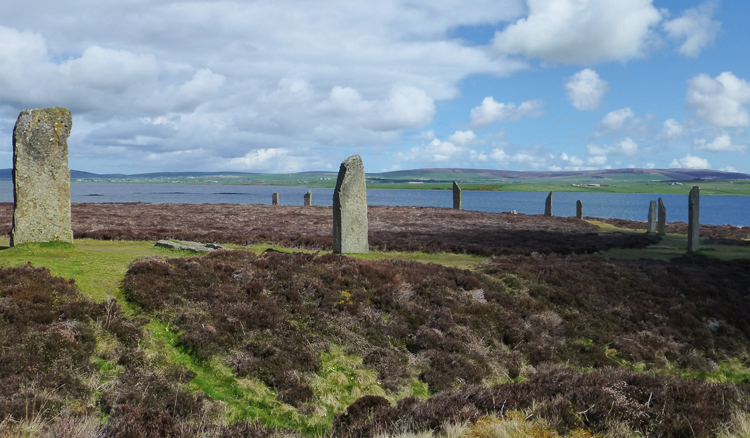
The ring of Brodgar is a huge stone circle set in a most dramatic setting on Mainland Orkney. It lies on a narrow strip of land between two lakes – on one side is the saltwater Loch of Stenness that opens to the sea and on the other side is the freshwater Loch of Harray. They all sit in a vast bowl surrounded by green hills. No trees to be seen.
Nearby is one of the most astonishing archeological sites in the British Isles, known as the Ness of Brodgar. It was discovered very close to a farmhouse in 2002.
The first structure to be uncovered was the remains of a large rectangular building, similar to ones nearby at the Barnhouse Neolithic Village. As more buildings and artifacts were found it became clear that this was not a domestic site but a vast ceremonial centre that was first built around 3200BC, 200 years before Stonehenge. Many of the buildings had been given complex decorations and paving. In fact, over 800 pieces of stone incised with patterns and other markings have been found. Some stones had been painted with a reddish pigment, probably derived from local iron ores.
One of the structures is 25 by 20 metres and its external wall is 5 metres thick. It is thought to be a burial place. The site has also revealed a surrounding 4 metre thick stone wall – an extraordinary structure.
When we first visited the Neolithic village of Skara Brae, only a few miles from the Ness of Brodgar, we learnt that the buildings probably had roofs constructed from whalebone or driftwood, then covered with animal skins and turf. Nothing had survived of the roofing materials. But at the Ness, which was built around the same time, they discovered rectangular roof tiles.
Every summer the site is opened up for a dig for 6 weeks. In between it is covered with black plastic sheeting held down by car tyres. I have never been there during the dig, unfortunately, but it is something I would very much like to do at some point. Visitors are allowed to look at the site from a raised structure and to meet the archeologists.
There is a lot of information about the excavations on the Ness of Brodgar website, and you can subscribe to a newsletter. You can explore a 3D model of the main trench from 2016.
In 2017 the BBC filmed a three part series Britain’s Ancient Capital: Secrets of Orkney, narrated by Neil Oliver. It is absolutely fascinating and certainly worth a visit during lockdown. The series explores the theory that Orkney was the cultural centre of life in Neolithic Britain, and includes close-ups of the excavations at the Ness.
Here is a clip from the series in which Neil Oliver unearths a bone on the site.
Orkney is one of my happy places, along with my favourite beach in Fuerteventura. Although their climates are very different they do offer wide open spaces with long views over sea and land. I have been visiting both a lot in my imagination while my actual view has been restricted to a suburban street in the front and small gardens to the back.
Please note
We have been in full self-isolation since 16th March to protect my husband whose immune system is compromised.
If you are in self-isolation then join the Lib Dems in self-isolation Facebook group.
You can find my previous Isolation diaries here.
* Mary Reid is a contributing editor on Lib Dem Voice. She was a councillor in Kingston upon Thames, where she is still very active with the local party, and is the Hon President of Kingston Lib Dems.
 Follow @libdemvoice.org on Bluesky
 Like us on Facebook
 Subscribe to our feed
 Sign-up for our daily email digest

 IFS warn on the budget
 Crash! (1971): An experimental television film with J.G. Ballard and Gabrielle Drake
 Peter Wrigley
 Meg Thomas
 David Le Grice
 David Raw
 Nick Baird