


With a new American Presidential cycle producing, as ever, near obsessional coverage (and ignoring other more important electoral news), now is a good time to update a post from the last cycle about learning lessons from the US:
This year is already seeing all sorts of prognostications about the lessons UK political parties and campaigners can and should be drawing.
However, many of the differences between American and British election campaigns are not the result of American campaigners having good ideas the British should copy, but rather are the result of four key legal differences between the two countries.
First – and the only one of the four that gets more than the rarest of rare mentions – is the existence of donation caps in the US. These caps exist at relatively low levels. Americans can give a maximum of just $2,500 to a Presidential candidate, for example. There are ways partially around these caps – such as by donating to not just a Presidential campaign but also the national party of that campaign along with state and local parties or via the creation of Super PACs. But the rules do stop Michael Ashcroft or Lord Sainsbury style direct financial support. This provides an incentive to find small donors which does not exist in the UK, although it does raise an intriguing question about whether introducing such caps would therefore produce a similar US-style small donor revolution.
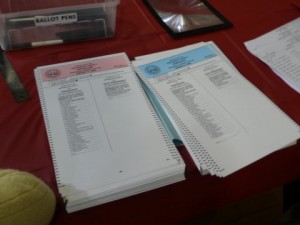 Second – in 29 US states, the electoral register indicates whether someone is a Democrat, Republican or some variation of independent (exact rules on this last category vary from state to state). This means that campaigns in those states start with a complete set of voter ID information. Whilst in the UK campaigns put huge efforts into canvassing people to find out which party they tend to support, in the US campaigns have that information from day one in most states.
As a result, canvassing in the US is much more about persuading people. Certainly some of the techniques involved – including matching canvassers up with people with similar outlooks and views, such as getting farmers to canvass other farmers – are eye-catching in their sophistication. But the apparent backwardness of British campaigns with their emphasis on much more straight forward ‘ask everyone how they are going to vote’ activities isn’t a reflection of a failure to learn. It’s also reflection of a different electoral system.
Third – it’s illegal for campaigns to place leaflets in people’s letterboxes in the US (18 U.S.C. 1725, known as ‘the mailbox restriction’). That doesn’t make delivering leaflets impossible but it does have an impact. It is a major reason for the popularity of door-hangers (leaflets that go over a door handle) in the US. But it – combined with the geography of the US – is also a reason why the sort of campaign dominated by the volunteer-delivered leaflet is frequent in the UK but so rare in the US. Again, it is the legal details that play a key role in explaining the differences.
Fourth – there is a very different legal and cultural attitude towards data protection in the US and the UK. All the main political parties in the UK have data they make available to their campaigners, but they are all rather more circumspect than most US campaigns. This certainly does not mean there is nothing to learn from the US about involving a wide base of helpers in a campaign, but again the legal details are important. British political campaigns aren’t slothful, they are less slapdash with other people’s personal data – and rightly so.
None of these differences, on their own or combined, are a reason to think that lessons can’t be learned from the US elections. But without bearing them in mind, the chances are the lessons drawn will be wrong.
* Mark Pack is Party President and is the editor of Liberal Democrat Newswire.
 Follow @libdemvoice.org on Bluesky
 Like us on Facebook
 Subscribe to our feed
 Sign-up for our daily email digest

 Turning Point UK chief executive suspended by Tories over contract killing claims
 More ministerial dissent over Labour's immigration policies
 Jane Dodds stands down as Welsh Lib Dem leader
 Peter Wrigley
 James Hill
3 Comments
“But the rules do stop Michael Ashcroft or Lord Sainsbury style direct financial support.”
Really?
The problem is that with Super PACs, donors can pour in unlimited money in order to support or attack candidates, and thus influence election outcomes. The groups, who are technically unaffiliated with candidates even though they are often run by their former staffers, were made possible by the 2010 Supreme Court decision on Citizens United v FEC http://caselaw.lp.findlaw.com/scripts/getcase.pl?court=us&vol=000&invol=08-205) that effectively classified money as speech.
For example, The New York Times reports that casino magnate Sheldon Adelson’s $5 million donation to Winning Our Future, a group supporting Newt Gingrich for the Republican presidential nomination, “underscores how the 2010 landmark Supreme Court ruling on campaign finance has made it possible for a wealthy individual to influence an election.”
Simon: Yup, hence my use of “direct” in the phrase “direct support”. Third party campaigns can be funded, but what those SuperPACs can’t do is the equivalent of Michael Ashcroft being Tory treasurer, directing the spending of money within the party and appointing key staff – they have to be much more independent than that.
I would be fascinated to see the difference in voter engagement levels between the states you do and don’t have to declare themselves for a party/ independent when registering and those where you don’t.