


 On board Eurostar, homeward bound after a Parisian Easter break, I am, as always, full of praise and affection for La France.
In the area where we were staying, activity on behalf of the Socialist candidate, for the forthcoming Presidential election, was omni-present. I collected a sheaf of leaflets and lettters politely profferred in markets on his behalf. I have little knowledge of French politics, but I can safely say that the 12th arrondissement of Paris is securely in the bag for François Hollande.
Yesterday’s Figaro described the extraordinary global nature of the French elections, with voting taking place in embassies, consulates and far-flung territories (such as Réunion, French Guiana, Guadeloupe and Martinique) all across the world. The ex-pat electorate numbers 2.5 million, which is just short of the entire populaton of Jamaica. For the first time this year, those ex-pats will elect 11 representatives in the national parliament.
A purist would question why the French have two voting rounds (the first is on April 22nd, then there is a run-off, if necessary, on May 6th). Why not just have one STV vote? However, there is something curiously French and admirable about the two round system. It accomodates, no doubt, an intensifying national debate, some of it, one likes to imagine (I hope not patronisingly), indulged over long wine-fuelled lunches amidst much vigorous arm-waving. The two round system also allows for that great French prerogative, changing one’s mind.
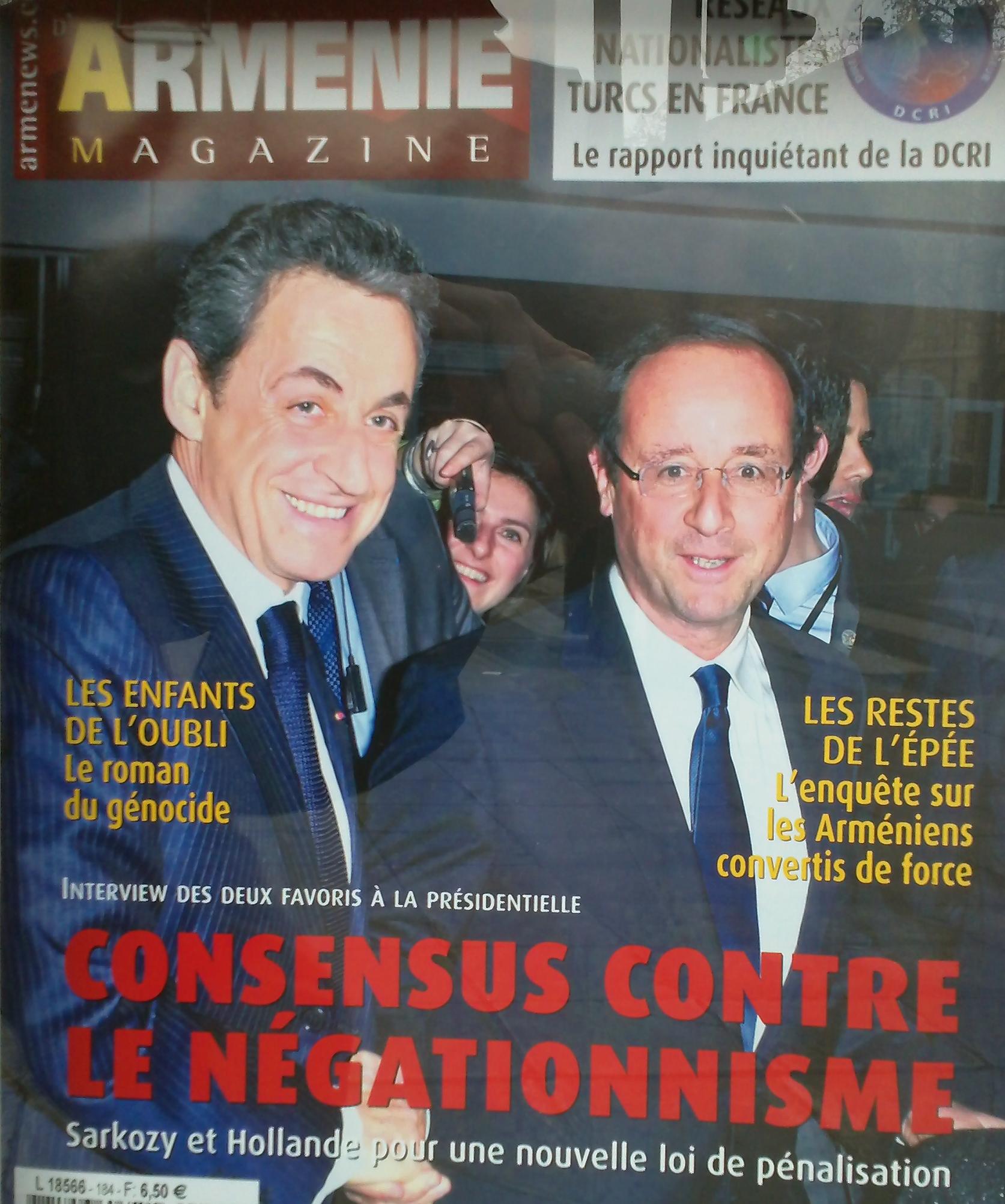 It’s to be welcomed that, apart from the two main candidates, Sarkozy and Hollande (pictured right on a Parisian magazine stand), there are significant other players, most notably Marine Le Pen of the far right, Jean-Luc Mélenchon of the Far left and Francois Bayrou of MoDem, who are the French sister party of the Liberal Democrats.
In the UK, we sometimes tire of “sameness” in our politics, with little to differentiate the main parties. It seems that the French do not share that problem at this election. Yesterday’s Figaro carries a poll which shows Sarkozy dramatically ahead on the “regal” powers of the President, such as on security, immigration and taking difficult decisions. In sharp contrast, Hollande clearly leads on social and economic issues such as improving the education system, improving living standards and increasing spending power.
There is certainly a very clear choice in front of the French people, and it will be fascinating to see how it all ends.
* Paul Walter is a Liberal Democrat activist and member of the Liberal Democrat Voice team. He blogs at Liberal Burblings.
 Follow @libdemvoice.org on Bluesky
 Like us on Facebook
 Subscribe to our feed
 Sign-up for our daily email digest

 What is Christian nationalism?
 Ellesmere Yard: A living relic of the canal age
 Latest PollBase is out, with all the British voting intention polls since the 1930s
 Tim Rogers
 Jason Connor
 Julian Brookes
2 Comments
>It seems that the French do not share that problem at this election.
Hard to compare a presidential election with here, when we don’t have a president!
But it is interesting.
And the double round system would be great here, I’ve always thought. Might shake up a few safe seats.
France used to have four main parties in parliament: l’UDF and the RPR (Gaullists) on the right, allied against the PS (Socialists) and PC (Communists) on the left.
They are therefore used to coalitions!
Communists lost a lot of support for obvious reasons post-1990 or so, and the right realigned itself, sweeping up smaller parties into a more-solid single one, l’UMP.
These days, it’s mostly l’UMP versus the Socialists.Quick check says 313 and 186 seats respectively in the Assembly (out of 577). WIth the third party in terms of seats having 23 and a real rag-tag assortment of others.
Not sure that’s so great.
I don’t agree that the two-round system for the French President is ideal, as it suffers from the same potential drawback as the two preference system for London Mayor. Only the first two from the first round enter the second round. This first-and-second-past-the-post applies even if the initial votes for the first two (first round in France or first preferences in London) are quite small. A fully transferable vote or a second (and further rounds) between candidates that share a given percentage of the first vote would stop this.
The worst example of this was in 2002 when the Socialist PM Lionel Jospin was the main challenger to President Chirac. Many on the centre and left thought they were safe in voting for other candidates in the first round, confident that they coulf transfer to Jospin in the second round. But it didn’t work out like this, as Jospin (16.18%) came a narrow third in the first round to Chirac(19.88%) and le Pen (16.86%) and was elminated. The second round was said at the time to be between the Crook and the Fascist and was won by Chirac who got nearly all the transferred votes. (Chirac was convicted in December 2011 for offences committed pre-1995 when Mayor of Paris. He could not be prosecuted during his period as Presindent of the Republic.)