


Over at Prospect Magazine there is a thoughtful review from Miranda Green of Politics: Between the Extremes by Nick Clegg, alongside The Death of Liberal Democracy? by David Boyle and Joe Zammit-Lucia.
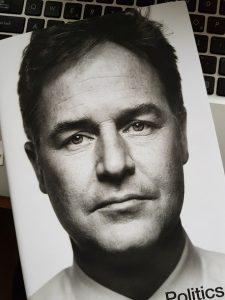
The result, in this book [Politics:…], is a mix of avowed optimism—that a liberal worldview can and must survive—with a hugely gloomy analysis of British political culture. Politics: Between the Extremes is part memoir of the Coalition years, part meditation on the rebellious spirit of the post-crash period (to call it an age seems premature). Its balance can be uneasy, but Clegg’s book is a necessary contribution to a pressing current debate: how much and for what reason are liberal values, in the broad sense, at bay? And can any moderate politician find a way to turn the tide of resentment against the political system and its practitioners?
Green contrasts Clegg’s plea for reason over rage with the other book’s
… demand a renewed activist fervour that bases its broad policy in the needs of communities, and asserts human values against the “soulless, bureaucratic, centralised state.” This, their argument goes, would be a “reborn” liberalism, “clearer and fiercer,” a liberalism that can take on populism because it has something to say to that perennial target of the populist, namely “the little guy.”
It is not clear – and Green admits this – that the two ideas are really in conflict. Liberal Democrats stand squarely for giving power back to people through constitutional reform, transparency and localism. But there does appear to be a conflict in tone.
The contrasting prescriptions for the future of Liberal politics in Politics and The Death of Liberal Democracy?—moderate versus radical—bring out the dilemma facing the party. Does the public want or need the Lib Dems to be, for want of a better word, the sensible party, electorally useful enough in their former strongholds to help disenfranchised Labour moderates reclaim centre ground votes from Theresa May and challenge permanent Tory rule? Perhaps, counter-intuitively, this could be a failure of nerve. Instead, revived liberal radicalism, with its emphasis on local solutions and communities taking control, could be the real challenge to the UK’s populist moment—becoming, as Boyle and Zammit-Lucia suggest, “an electoral asset and a source of moral authority.”
In other words should we embrace angry populism (again), or campaign responsibly for the policies which will empower the disempowered and fearful, without scapegoating some other section of society who might be seen to be at blame?
I am reminded of the frightful populist power of the Donald Trump campaign as understood in this article, as a howl of rage by the rural left-behind against the, er, liberal metropolitan elite like me. Every one of Trump’s outrages makes that howl of rage louder and more compelling to his supporters.
Never mind that Trump and Brexit have nothing to offer economically left-behind areas, they speak to the pain with false promises. Is there a way to speak to that pain with honesty?
But to travel back to relevance, to be in a fit state to make such a contribution somewhere down the line, the Liberal Democrats need to face up to some big strategic questions. Clegg’s book elucidates these, and insists on the values of compromise and moderation. The party may be tempted instead to embark on a chippier course, and redefine Liberal politics for the post-crash era as a crusade against the powerful on behalf of “the little guy.”
Maybe, just maybe, if it can find a way to marry the two, then a future period of power-sharing might give rise to a memoir of liberal triumph, rather than a chronicle of defeat.
The full review is here.
* Joe Otten was the candidate for Sheffield Heeley in June 2017 and Doncaster North in December 2019 and is a councillor in Sheffield.
 Follow @libdemvoice.org on Bluesky
 Like us on Facebook
 Subscribe to our feed
 Sign-up for our daily email digest

 Turning Point UK chief executive suspended by Tories over contract killing claims
 More ministerial dissent over Labour's immigration policies
 Peter Davies
 Peter Wrigley
 James Hill
9 Comments
Lets have a bit more self cofidence, The Goverment has just delayed The decision on Heathrow by another 15 Months because there are scared that we will take Richmond Park in a Byelection. Whatever happens on Thursday we have already taken big strides towards recovery. We can be popular without being populist.
I’ve noticed these ad-hoc attempts being made, to equate ‘populist’ with tyranny. It’s not just a bad move,.. it’s a deeply foolish move. It’s a snobbish and dismissive,.. ‘let them eat cake’ attitude, that history proves never ends well.
You need to drop this vilification of populists,.. Read history, and you’ll find that you really,.. really,.. don’t want to see populists when they’re angry, and feeling dismissed.?
“can any moderate politician find a way to turn the tide of resentment against the political system and its practitioners?
A competent one could do so.
Some people criticise Clegg and Laws for being moderate and centrist. I would say that within the context of the Coalition I wish that he actually was. Although I find Polly Toynbee’s critique of the Lib Dems in Coalition hypocritical given her support for a Blairite Labour party which had a majority to do what it likes, I think she has a point. The welfare cuts where not moderate, they ruined people’s lives. In government we could have stopped them and we didn’t. Even so, things have moved on. Lib Dem conference rejected the benefit cuts recently and Tim Farron didn’t support them in the first place.
Nick Clegg has nonetheless revived his reputation and deservedly so after Tim Farron gave him the brief on Brexit. On this issue at least I am starting to warm to him again.
However the question today needs to be asked; apart from opposing Brexit, what does he stand for these days?
This is not a recent problem. In 2010 we went into government intending to implement a raft of policies many of which were driven by Nick Clegg. By 2014 there wan’t much left. in 2015 there was talk about the Lib Dems going into Coalition with the Tories again. Apart from stopping them do stupid things like Brexit, I was wondering what for? In a second term, what would we want to make them do that we want and they don’t? It seemed as though the “Orange Book” had run out of steam. It was right for Nick Clegg to resign and give someone else a go.
Yet the biggest indicator that there is still much to do came from the Brexit vote. Cornwall was one of the heartlands of the Brexit vote, and historically a Liberal stronghold. It is one of the most deprived areas in the EU, and one would hope that the Lib Dems in government could improve life and bring hope to the region.
Well the voters gave their verdict and the concern is that that part of the world is becoming less liberal as a result. I do not see that anyone is really grappling with what should be done to rectify this, it should be one of our top priorities.
And can any moderate politician find a way to turn the tide of resentment against the political system and its practitioners?
This is no time for moderation. The west is in a quickly unravelling debt crisis and the public knows that drastic action is needed but no politician will risk saying so.
We could make a start by presenting more accurate and less biased information on significant matters such as finance, economics and reign policy. From this we could develop discussions which include a range of verifications and views and only after that move on to policies which are demonstrably information founded. We, and our fellow citizens, are in for a lot more governmental incompetence and malcompetence and resentment from those who most feel the pain of it, unless we analyse, objectively assess and look beyond what the information cartel aka the Main Stream Media puts into our eyes and ears. We need to become the party of informational accuracy and word to action reliability.
Was Clegg between extremes ? Not really. Was he an apostle of reason ? hardly. Is he still peddling the line that its all everyone else fault for not realising he put country before party – yes, you bet he is. Did Clegg himself contribute to rage and anger and lack of trust by his absurd decision on tuition fees ? Yes.
The juxtaposition of these two works is interesting. I look forward to reading Miranda’s review.
The Party post Kennedy seems unrecognizable from the one I joined in 1978 and including the successor Party campaigned for actively until about 2002, when I needed to concentrate on other things.
During that time community politics, helping people take and use power, was the driving force. There wasn’t a hint of centrism – or of moderation – we made gains because we hard radical alternatives to the left right spectrum, including the fiction of a centre.
It was very popular because it put people first. I never heard anyone sneer when we persuaded majorities in wards and across authorities of our radically different policies and ways of exercising power. We probably had majorities on 40 councils and held the balance of power in 100 more – exploiting that opportunity to get lots of policies through.
All that started to dissipate when people who thought they were grown ups and wanted to practice grown up politics of power took over. The paradox? They lost power. And when they were fortunate to find themselves in the balance in 2010 they got it so disastrously wrong that not only did they find themselves out of ‘office’ at the first opportunity, they destroyed the local parties that had been exercising power on and off (but mostly on) for 30 years.
It is ironic that the recent Sheffield academic study of the Referendum found that the key battleground that lost it for Remain were the very wards that six or seven years ago had Liberal Democrat councillors but by 2016 had no Lib Dem representation.
You cannot have successful radical Liberalism and be moderates. The former help people take and use power. The latter squander the inheritance. History tells us this.
Moderates just can’t figure out why they aren’t popular, why they are seen as elitist, why people won’t do as they say.
I have sympathy with J Dunn’s comment on populism. The American Populism of the late 19th century, for example, was in many ways a progressive force and it actually briefly, here and there, united Sothern Black and “Rednecks”.
However, if someone is preaching hate, yes, God help me, I’ll meet them when they’re angry.
As for the reason versus rage question, I really can’t see the argument. To speak from the heart, to excite people, to fight for our values, we need passion and occasionally rage at injustice. To get a clear idea of what we want to achieve, to work out the right ways of achieving it and to persuade thoughtful people, we need reason.