


Eurovision is an acquired taste. Many people regard it as a pleasure. War is an enforced taste. Very few people regard it as a pleasure.
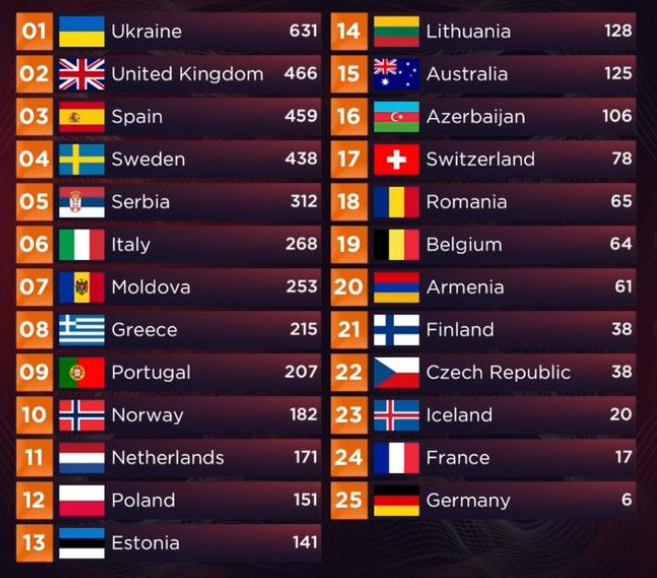
The win last night at the world’s most popular, and often cheesiest, song contest is a mood boost for Ukraine. The jury had put the UK entry, Space Man by Sam Ryder at the head of the pack. In an ordinary year, Sam Ryder would have given the UK the winner that has eluded it since Katrina and the Waves.
This is not an ordinary year. Last night’s event opened with a Rockin’ 1000 rendition of the anthem “Give Peace a Chance”.
The public vote, especially in Europe and Australia, was in favour of Stefania, performed by Ukraine’s Kalush Orchestra. Without the war, this performance might have won in its own right. However, this was a night where politics blended with music. As the crowd roared its approval, Oleh Psiuk pleaded: “Please help Ukraine, help Mariupol, help Azovstal right now.” Ukraine duly won Eurovision for a second time.
President Zelensky said on hearing the result: “Our courage impresses the world. Our music conquers Europe! Next year Ukraine will host Eurovision!”
That’s ambitious but the world needs to do everything it can to ensure that ambition is fulfilled. That means winning a war first.
Votes at the Eurovision Song Contest have long had a political element. But a study by the University of Groningen suggests that political voting is rarely decisive for the outcome of the contest. The study also concluded that the highest valued Eurovision song is “Save Your Kisses for Me” by the Brotherhood of Man. Oh dear.
Writing a few days ago in The Conversation, Catherine Baker from the University of Hull said: “In my opinion if Kalush Orchestra do win Eurovision 2022, it will be down to the strength of their song’s concept and performance, not primarily voting alliances or sympathy.”Last night’s result might challenge those views. And as Rare Bird once sang, “sympathy is what we need my friend.” Last night Ukraine got that sympathy.
Sympathy won’t win a brutal war. But like Vera Lynn decades ago, it will give cheer to Ukrainian forces and civilians fighting for the survival of themselves and their country.
The Eurovision is silly, jolly good fun… and tonight, I really think this is an important statement of unity from the peoples of Europe in support of a proud, free country fighting for its right to exist. Slava Ukraini 🇺🇦 (and well done Sam 🇬🇧)
— Tim Farron (@timfarron) May 14, 2022
It’s a good thing we sent the nicest man in Britain to represent us at this extraordinary #Eurovision Well done @SamRyderMusic and congratulations #Ukraine
— Sarah Olney (@sarahjolney1) May 14, 2022
Well done #Ukraine and 🙏🏼 #UK what a #Eurovision
— Christine Jardine 🔶 (@cajardineMP) May 14, 2022
Congrats to Sam Ryder!! An amazing turnaround of fortunes for the UK 🇬🇧 #Eurovision2022
— Layla Moran 🔶🕊️ (@LaylaMoran) May 14, 2022
How many 2nds is that for the #UK in #Eurovision ? Nice to be back on the left hand side of the board. Congrats #Ukraine 🥳🥳🥳
— Wendy Chamberlain MP (@wendychambLD) May 14, 2022
* Andy Boddington is a Lib Dem councillor in Shropshire. He blogs at andybodders.co.uk.
 Follow @libdemvoice.org on Bluesky
 Like us on Facebook
 Subscribe to our feed
 Sign-up for our daily email digest

 Farage let off Reform staffer accused of racist slur
 Stalling an Ambush and protecting more than the countryside
 Latest voting intention and leadership ratings opinion polls
 Tim Rogers
 Adam
Adam Nigel Jones
 Jana
Jana David Warren
15 Comments
I suspect that they idea that Eurovision is non-political will be impossible to enforce in future years after what has been not only permitted, but promoted, this year. It will be impossible for Eurovision to ban songs or performances they deem political, as they have done in the past, and the ‘would bring the competition into disrepute’ argument used to ban Russia this year may lead to pressure to ban other countries in future years for political reasons. In my opinion, it would have been better to let Russia compete and achieve zero points.
@ Andy Boddington. “Now we have to win a war”.
Are you suggesting, or implying by “We”, that the United Kingdom should take part militarily in this conflict ?
In a word, no. The we is generic and refers to all of those supporting Ukraine.
I love Save Your Kisses For Me by BoM. Simple but effective. I wasn’t that keen on this year’s UK entry but well done to Sam Ryder anyway. I did like the Ukraine entry though. My favourite Eurovision was when Sonia came 2nd with Better the Devil You Know, beaten by Ireland’s entry Niamh Kavanagh’s In Your Eyes. Both worthy winners in their own right.
I don’t support either side in this conflict – I support peace. By that I mean that I do not want this war to continue until ‘my’ side wins a military victory, whether than takes 10 months or 10 years and costs 10s of thousand or 10s of hundreds of thousands of lives. A diplomatic resolution of the issues is required and not a military one. While I think Russia was wrong to escalate to an invasion, I also think Ukraine was wrong not to implement the Minsk Agreement. Unfortunately I don’t think NATO/ the West will allow Ukraine to make any concession to end the war and Russia will not end the war until it gets something in return for all its losses – so I expect a long war at a huge cost in death, destruction and human misery.
War is never the answer. Peace does not come about because one side wins, it comes about through negotiation round the peace table. It always makes sense to skip the war and get round the negotiating table. Quite apart from the huge reaction in death and damage and the economy, negotiation will always be the way to settle disputes.
Sadly far too many political leaders get invested in war. Putin is just one of many autarchs who go to war out of stubborn pride or to distract from their domestic failures. There have been many wars and genocides in my lifetime and all of them have, or will be resolved, only when the protagonists get round the table and make peace.
Liz Truss only succeeds in making matters worse with her belicose statements. The UK needs a foreign secretary who is interested in peace, not a mouthpiece for a corrupt and venal Prime Minister interested only in diverting attention from his criminal behaviour.
@Brad Barrows
It was the separatists and by extension Russia that refused to implement the Minsk agreement by continuing to fight and even taking over a whole town after signing the agreement. They were supposed to ceasefire and withdraw heavy weapons before becoming autonomous regions of Ukraine. Russia subsequently claimed they weren’t party to the agreement even though they signed it. It’s obvious now that this was just a stalling tactic for Russia.
If you’re not spreading russian propaganda on purpose then you need to be more careful. Most of what they’ve said in their defence is gaslighting and strait up lies.
@David Le Grice
All sides engage in propaganda in a war which means that anyone who stands up to point out an inconsistency or failing in one side’s argument is pushing propaganda for the other side. So let me point out two arguments being pushed by NATO/the West and you explain which of the points I make are untrue…
NATO is purely a defensive organisation….yet NATO used force against Serbia when Serbia had not attacked any NATO country.
It is never acceptable to change borders by military force – yet NATO used military force to force Serbia to yield control of part of its internationally recognised territory, and then recognised the yielded territory as an independent country.
None of the above justifies Russia’s actions, but I make the point just to illustrate that we should not merely accept everything either side says without question.
Mick Taylor
Doctor Who nails it: “How many hearts will be broken. How many lives shattered! How much blood will spill… before everybody does what they were ALWAYS going to have to do from the very beginning! SIT. DOWN. AND. TALK.”
It seems to have been forgotten that Putin set his sights on annexing much of Ukraine back in 2014 as part of his “Greater Novorossiya” mission. He would have taken eastern and southern Ukraine back then if Ukrainian forces (including the newly formed Azov battalion) had not been able to quickly reorganise to push Russian backed separatists out of Mariupol and elsewhere “Greater Novorossiya”
Negotiations can only work when both parties are willing to engage in good faith. It is a mistake to assume that Russian statesmen think as European democracies do. They see compromise and negotiation as weakness and Liberal democracy as incapable of the kind of strongman rule they advocate.
Every sovereign nation has a right to self-defense against aggression. Just as Palestinians have a right of self-defense against occupation of Internationally recognised Palestinian territory by Israel; so too does Ukraine have a right of self-defense against occupation by Russia.
@Brad Barrows
(1/2)
Desmond Tutu’s adage that “If you are neutral in situations of injustice, you have chosen the side of the oppressor” is especially true in this situation. For Ukraine, a military victory is the continuation of Ukraine if not the restoration of the land stolen by Putin’s Russia since 2014. For Putin a military victory means some annexation at best or (if the first few days of the war got off without a hitch) finding a ‘solution of the Ukrainian question’ so that the state can be ‘reorganized, re-established and returned to its natural state of part of the Russian world’ (see link below). Essentially re-colonisation of Ukraine and a continuation of the same Russification that the Tsarists and Soviets practiced in order to eradicate Ukrainian national identity.
What diplomatic solution can there be when the aggressor declares in its state media that ‘Denazification will inevitably also be a de-Ukrainization – a rejection of the large-scale artificial inflation of the ethnic component of self-identification of the population of the territories of historical Little Russia and New Russia’, effectively openly advocating genocide. Whatever was agreed in the Minsk agreement is irrelevant in light of this and its manifestation in Bucha.
@Brad Burrows
(2/2)
Lasting and just peace can only be achieved on terms that favor the sovereignty and liberty of Ukrainians and a rejection of Putin’s efforts to unleash the same imperialism practiced by the Romanovs and CCCP. That means either Putin ( or his inner circle or some counter elite) coming to their senses or a complete military victory for Ukraine, or some combination of both.
https://web.archive.org/web/20220226051154/https://ria.ru/20220226/rossiya-1775162336.html
https://web.archive.org/web/20220404091828/https://ria.ru/20220403/ukraina-1781469605.html
@William Francis
I understand your points but I do think the situation is more complex than you describe. So, for example, should the people of Crimea be forced to return to Ukrainian rule when it is clear that the majority of the population wish to be part of Russia? Some may argue that Crimea has no right to determine its own future and the opinions of its people are irrelevant, but Western countries took a different view when part of Serbia wanted to break away (Kosovo) and they took military action to force Serbia to yield that territory.
On Crimea, 100 United Nations member states, affirmed the General Assembly’s commitment to the territorial integrity of Ukraine within its internationally recognized borders and underscored the invalidity of the 2014 Crimean referendum.
Kosovo is not Internationally recognised and the United Nations has maintained a position of strict neutrality on the question of Kosovo’s status. That is unlikely to change with Russia able to exercise a veto in the security council.
The intervention in Kosovo was conducted on the premise of a ‘just cause’ – the prevention of mass slaughter and ethnic-cleansing against Kosovo’s ethnic Albanians. Nato countries were unable to secure a UN resolution against Russia’s opposition. The main argument against intervention was that without a UN resolution the intervention lacked authority. The Srebrenica massacre occurred in 1995. Prior to the massacre, the UNhad declared the besieged enclave of Srebrenica, in eastern Bosnia, a “safe area” under UN protection. However, the UN failed both to demilitarize the Army of the Republic of Bosnia and Herzegovina (ARBiH) within Srebrenica and to force withdrawal of the VRS surrounding Srebrenica. The Dutch UN peacekeepers were unable to prevent the town’s capture and the subsequent massacre. It is argued that Britain was the country most responsible for preventing intervention by the UN or Nato to rescue the Bosnians Muslims Srebrenica: the silence over Britain’s guilt must be ended. When, after Srebrenica, Nato was finally authorised to conduct air strikes, the war was ended in 20 days.
“In March 1999 the Blair government took a quite different view of Balkan affairs, pressing Nato to commit troops to Kosovo to counter the threat of genocide against Albanian Muslims.”
Ukraine, as with all conflicts, has its nuances and share of blame to go around OLIVER STONE’S RECOMMENDED READ ON UKRAINE
@Brad Burrow’s
I don’t think Putin’s Anschluss of Crimea should be seen as evidence of Crimean independence.